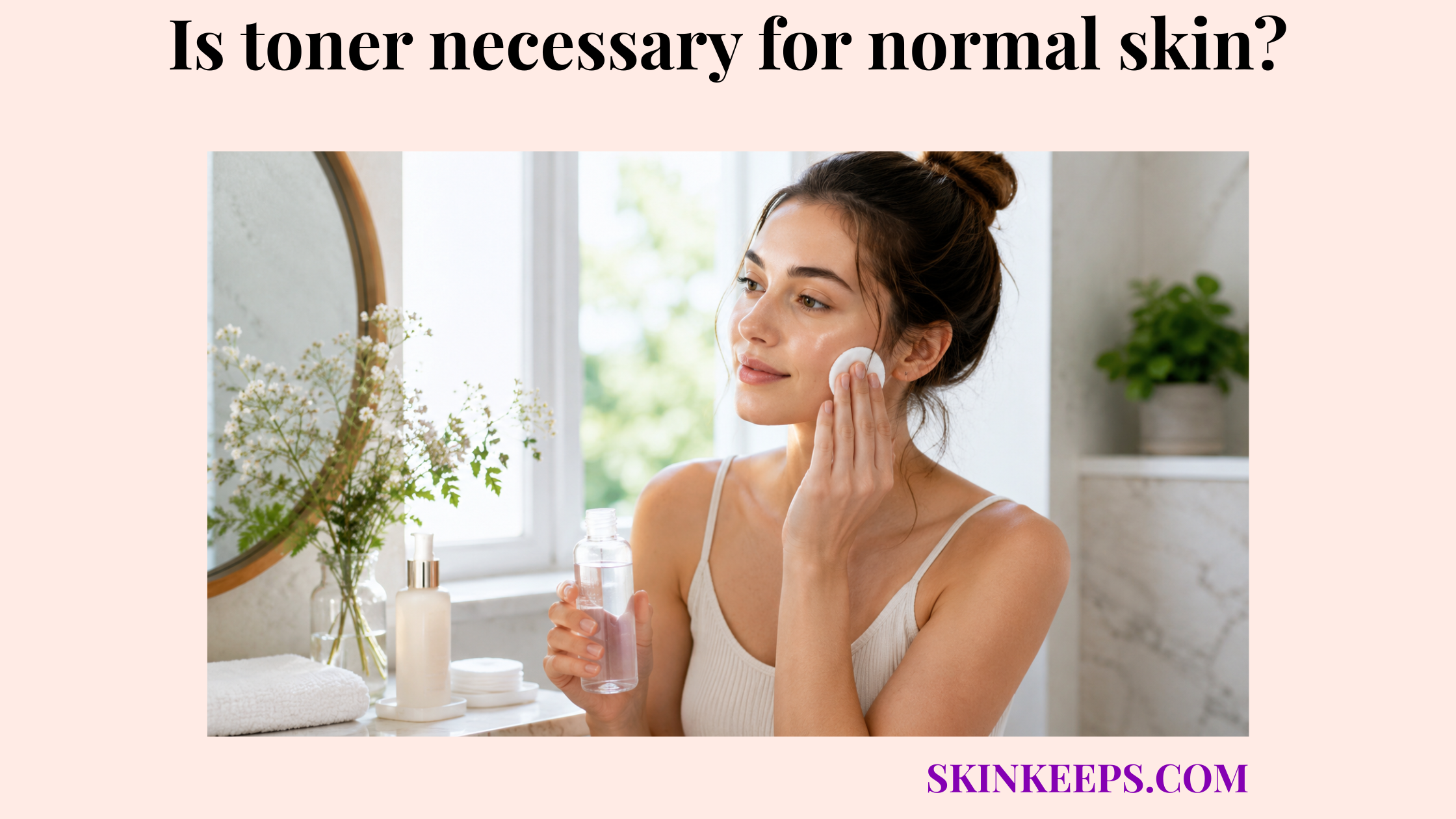

Yes, normal skin usually needs less specialized skincare because it is not strongly dominated by oiliness, dryness, frequent breakouts, or repeated sensitivity.
A simple routine often supports normal skin well when it includes gentle cleansing, moisturizer when needed, and daily sun protection. Less specialized does not mean no care, because normal skin can still become dry, oily, dull, irritated, sun-damaged, or breakout-prone when affected by weather, stress, hormones, harsh products, sun exposure, medications, illness, or aging.
Why does normal skin usually need less specialized skincare?
Normal skin usually needs less specialized skincare because its baseline is often more balanced, more comfortable, and less dominated by repeated oiliness, dryness, breakouts, or reactivity.
That balanced baseline may reduce the need for many corrective products. It does not mean normal skin is flawless, problem-free, or safe from irritation.
Compared with many different skin types, normal skin often needs fewer corrective products because fewer dominant problem patterns are present at baseline.
Normal skin usually has a more balanced baseline
Normal skin usually has a more balanced baseline because oil, moisture, comfort, sensitivity, and breakout frequency are often steadier.
This balance may reduce the need for many corrective products. It does not remove the need for basic care.
Normal skin still needs maintenance care
Normal skin still needs maintenance care because balanced skin can collect sweat, sunscreen, makeup, debris, and UV exposure like any other skin type.
Cleansing, moisture support when needed, and sun protection can reduce avoidable dryness, residue buildup, irritation, and UV damage. The goal is simple care, not no care.
| Care type | What it means for normal skin | When it matters |
|---|---|---|
| Gentle cleanser | Removes sweat, oil, sunscreen, and debris | Daily or after sweating |
| Moisturizer | Supports comfort when skin feels dry or tight | As needed |
| Sunscreen | Protects against UV damage | Daily daylight exposure |
| Exfoliant | Helps texture only when needed | Occasional, not automatic |
| Acne treatment | Targets breakouts | Only if acne appears |
| Rich barrier cream | Supports dryness | In dry weather or irritation |
| Calming products | Supports reactivity | If redness or stinging occurs |
| Pigment-targeting products | Addresses marks or uneven tone | If a real tone concern exists |
Normal skin needs a strong basic routine before it needs specialized extras.
How does normal skin skincare differ from oily skin skincare?
Normal skin skincare differs from oily skin skincare because normal skin usually does not need strong oil-control steps unless shine, greasiness, or clogged pores repeat.
Excess shine, greasiness, and repeated clogged pores are not dominant normal-skin patterns. Oily skin may need more attention to lightweight textures, noncomedogenic formulas, and congestion control.
| Care need | Normal skin | Oily skin |
|---|---|---|
| Oil control | Usually minimal | More important |
| Cleanser strength | Gentle is enough | Gentle but oil-aware |
| Moisturizer texture | Chosen by comfort | Often lightweight |
| Shine management | Occasional | More frequent |
| Clogged pores | Occasional | More repeated |
| Acne support | Only if needed | Often more relevant |
| Risk of over-cleansing | Still possible | Common mistake |
Normal skin should not use oily-skin control products unless oiliness is a repeated pattern.
How does normal skin skincare differ from dry skin skincare?
Normal skin skincare differs from dry skin skincare because normal skin usually needs less intensive moisture support than skin with persistent tightness, flaking, roughness, or cracking.
Normal skin may need moisturizer, but it does not always need heavy dry-skin products. Dry skin may need richer moisturizers and stronger barrier support more consistently.
Moisturizer decisions should follow comfort cues such as tightness, roughness, and hydration level and normal skin balance.
| Care need | Normal skin | Dry skin |
|---|---|---|
| Moisturizer need | As needed or daily if comfortable | Usually consistent |
| Rich creams | Not always necessary | Often helpful |
| Flaking support | Occasional | More frequent |
| Tightness after cleansing | Less common | More common |
| Weather adjustment | Moderate | More important |
| Barrier repair focus | Trigger-based | Often central |
| Risk of heavy products | Can feel greasy | Often better tolerated |
Normal skin may need moisturizer, but it does not always need heavy dry-skin products.
How does normal skin skincare differ from reactive skin skincare?
Normal skin skincare differs from reactive skin skincare because normal skin often needs fewer trigger restrictions, while reactive skin may need stricter irritation control.
Reactive skin may need stricter fragrance avoidance, simpler formulas, and more patch testing. Normal skin usually has more flexibility, but strong products still need caution.
This difference connects to the practical advantages normal skin can have compared with reactive skin types.
Normal skin usually needs fewer trigger restrictions
Normal skin usually needs fewer trigger restrictions because basic products often feel comfortable and ordinary exposure changes are less likely to cause repeated reactions.
Reactive skin may need stricter avoidance of known irritants. The comparison should stay practical and respectful.
Normal skin still needs caution with strong products
Normal skin still needs caution with strong products because acids, retinoids, harsh scrubs, fragrance-heavy formulas, and over-layering can irritate balanced skin.
Tolerance has limits. Normal skin should not be treated as safe for every product or every active.
| Care issue | Normal skin | Reactive skin |
|---|---|---|
| Product stinging | Less frequent | More frequent |
| Fragrance tolerance | May tolerate some formulas | Often more risky |
| Patch testing | Useful for strong products | More important |
| Routine simplicity | Often flexible | Often essential |
| Strong actives | Introduce slowly | Extra caution needed |
| Redness risk | Trigger-based | More easily triggered |
| Recovery | Often faster | May take longer |
Normal skin needs less restriction than reactive skin, but it still has irritation limits.
When does normal skin need specialized skincare?
Normal skin needs specialized skincare when a specific concern becomes real, repeated, and strong enough that basic care is no longer enough.
Targeted care should be based on the concern, not the normal-skin label alone. Specialized care should match the problem and avoid full-face overuse when the concern is localized.
| Situation | Specialized support may help | Caution |
|---|---|---|
| Occasional acne | Spot or acne-specific support | Avoid full-face overuse |
| Repeated breakouts | Acne-focused care | Seek help if painful or scarring |
| Dry season tightness | More moisture support | Avoid heavy clogging if not needed |
| Dullness or roughness | Gentle exfoliation may help | Do not over-exfoliate |
| Uneven tone or marks | Tone-support products may help | Sunscreen still matters |
| Redness or stinging | Calming/fragrance-free approach | Stop products that burn |
| Aging texture changes | Targeted actives may help | Introduce slowly |
| Medication-related changes | Medical guidance may be needed | Do not self-stop medication |
Normal skin needs specialized skincare only when a specific concern becomes real and repeated.
Can normal skin use active ingredients without specialized needs?
Normal skin can use active ingredients, but it does not need them just because they are popular or trending.
Exfoliating acids, retinoids, vitamin C, acne treatments, and pigment products should match a real goal and be introduced slowly to avoid dryness, stinging, redness, peeling, burning, or new irritation.
- What concern is this product solving?
- Is the skin already comfortable without it?
- Could this active cause dryness or stinging?
- Am I adding more than one active at once?
- Do I use sunscreen consistently?
- Is the product needed daily or only occasionally?
- Did irritation begin after starting it?
- Would a simpler routine work better?
Normal skin should use actives with purpose, not pressure.
What mistakes happen when normal skin uses too much specialized skincare?
Normal skin can become irritated when too much specialized skincare creates dryness, stinging, peeling, redness, clogged pores, or trigger confusion.
Over-treatment can make balanced skin harder to read. The issue is often product overload, not a need for even more corrective products.
Normal skin often needs fewer acne or heavy moisture products because normal skin is usually less prone to acne and dryness at baseline.
| Mistake | How it can harm normal skin | Better move |
|---|---|---|
| Using acne products without acne | Dryness and irritation | Use only when needed |
| Daily strong exfoliation | Stinging, peeling, barrier stress | Reduce frequency |
| Layering many actives | Redness and confusion | Add one at a time |
| Heavy creams without dryness | Greasy feel or clogged pores | Match texture to need |
| Chasing glass skin | Over-treatment risk | Aim for comfort |
| Switching products often | Triggers become hard to identify | Keep routine stable |
| Ignoring sunscreen | UV damage continues | Protect daily |
| Treating normal skin as invincible | Irritation can build | Respect limits |
Normal skin often gets worse from unnecessary specialization, not from simplicity.
How should normal skin keep skincare simple but complete?
Normal skin should keep skincare simple but complete by using steps that each have a clear job: cleansing, comfort support, sun protection, and targeted care only when needed.
Simple care is not careless when each step has a real purpose. Daily protection also matters because normal skin still needs protection from sun damage.
- Gentle cleansing.
- Moisturizer when skin feels dry, tight, or rough.
- Daily sun protection.
- Careful removal of sunscreen and makeup.
- Slow introduction of strong actives.
- Seasonal adjustment when needed.
- Fewer products when skin is calm.
- Targeted care only for repeated concerns.
- Professional help for persistent or severe changes.
Simple does not mean careless; it means each step has a real job.
When should normal skin avoid specialized skincare?
Normal skin should avoid specialized skincare when the skin feels balanced and the product is being added without a clear repeated concern.
Less is often better when the skin is comfortable, the concern is not repeated, or irritation has already started. Normal skin should not add correction before it has a clear problem.
- Skin feels comfortable and balanced.
- There is no repeated acne, dryness, redness, or dullness concern.
- The product is being added only because it is trending.
- Several actives are already in use.
- Skin is stinging, peeling, or burning.
- A new product recently caused irritation.
- The routine is too complicated to track.
- Sunscreen and gentle basics are not yet consistent.
Normal skin should not add correction before it has a clear problem.
When should normal skin concerns need professional attention instead of more specialized skincare?
Normal skin concerns need professional attention instead of more specialized skincare when symptoms are painful, persistent, spreading, bleeding, swollen, rash-like, changing, or repeatedly worsened by over-the-counter products.
Specialized skincare is not a substitute for diagnosis when symptoms persist or worsen. More products can delay care when the pattern is severe, sudden, or changing.
- Breakouts become painful, deep, frequent, cystic, or scarring.
- Dry patches crack, bleed, burn, or spread.
- Redness becomes persistent, warm, swollen, or rash-like.
- Products repeatedly sting, burn, or trigger reactions.
- Skin reacts to many gentle products.
- Pigmentation appears suddenly, spreads, darkens, or changes.
- A mole, spot, or lesion changes color, shape, size, or behavior.
- Skin changes appear after medication changes, illness, or broader symptoms.
- Over-the-counter products keep worsening the concern.
Specialized skincare is not a substitute for diagnosis when symptoms are persistent, painful, spreading, bleeding, or changing.
What should you remember about normal skin and specialized skincare?
The key point is that normal skin usually needs less specialized skincare, but it still needs simple, consistent, protective care.
Normal skin often needs fewer corrective products than oily, dry, acne-prone, or reactive skin patterns. Specialized products should match a real concern, not a trend.
Frequently Asked Questions About Normal Skin and Specialized Skincare
Does normal skin need a special skincare routine?
Usually, no. Normal skin often does well with a simple routine built around gentle cleansing, moisturizer when needed, and daily sunscreen.
Can normal skin skip moisturizer?
Sometimes normal skin may not need a heavy moisturizer every time, but it can still benefit from moisturizer when skin feels dry, tight, rough, or exposed to dry weather.
Does normal skin need acne products?
Only if acne is actually present. Using acne products without a breakout pattern can dry or irritate normal skin.
Does normal skin need exfoliation?
Not always. Normal skin may use gentle exfoliation when texture or dullness is a real concern, but daily aggressive exfoliation can damage comfort.
Can normal skin use anti-aging products?
Yes, but they should be introduced carefully and used for a real goal. Sunscreen remains the most important long-term protection step.
Sources & Evidence About Normal Skin and Specialized Skincare
Cleveland Clinic skin-type guidance was used to ground normal, dry, oily, combination, and sensitive skin distinctions.
American Academy of Dermatology basic skin-care guidance was used for general everyday skincare boundaries and simple-care framing.
American Academy of Dermatology face-washing guidance was used for gentle cleansing, lukewarm water, avoiding scrubbing, and moisturizer support.
American Academy of Dermatology sunscreen guidance was used for broad-spectrum sunscreen, water resistance, SPF 30 or higher, shade, protective clothing, and UV-protection boundaries.
American Academy of Dermatology dry-skin signs guidance was used for dryness, cracking, bleeding, itching, and moisturizer-support boundaries.
American Academy of Dermatology acne treatment guidance was used for painful, persistent, cystic, frequent, or scarring acne referral boundaries.
American Academy of Dermatology exfoliation guidance was used for irritation, redness, peeling, acne breakouts, and over-exfoliation risk.
American Academy of Dermatology contact-dermatitis symptom guidance was used for burning, stinging, itching, swelling, and repeated product-reaction boundaries.
American Academy of Dermatology melanoma signs guidance was used for changing mole, changing spot, lesion behavior, and referral boundaries.
Educational Disclaimer: This article is for general skin education only and does not diagnose, treat, or replace professional medical advice. If skin concerns include painful acne, scarring, cracked or bleeding patches, persistent burning, swelling, spreading redness, rash-like irritation, severe itching, repeated product reactions, sudden unexplained changes, broader health symptoms, or changing moles or lesions, consult a qualified dermatologist or healthcare professional.