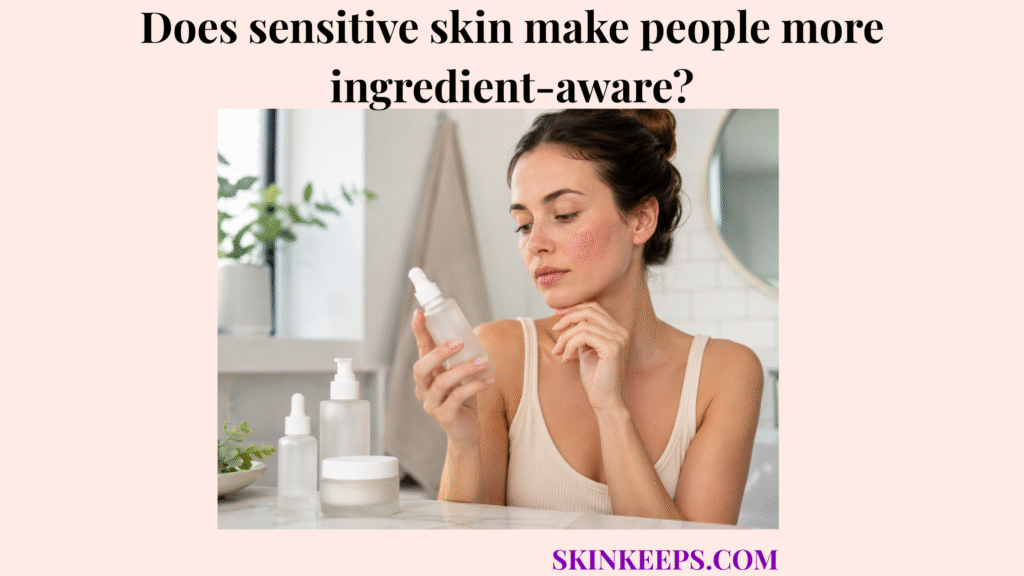
Yes, sensitive skin can make people more ingredient-aware because repeated stinging, burning, itching, tightness, redness, bumps, peeling, or rash-like reactions often encourage closer attention to labels and formulas. This awareness may make readers notice added fragrance, essential oils, drying formulas, strong actives, exfoliants, retinoids, benzoyl peroxide, vitamin C formulas, preservatives, dyes, and repeated ingredient patterns.
This article explains why reactions increase label awareness, how to read labels better, how repeated patterns are identified, why formula context matters, how to avoid fear-based blacklists, how to test products carefully, how to track reactions, and when professional care is needed.
Why Does Sensitive Skin Often Increase Ingredient Awareness?
Sensitive skin often increases ingredient awareness because reactions make product tolerance easier to notice and harder to ignore. When stinging, burning, itching, tightness, or rash-like changes follow product use, the formula becomes more relevant than the front-label promise.
Ingredient awareness is one of the practical advantages of sensitive skin when reactions encourage more careful product choices instead of fear-based avoidance.
How Do Skin Reactions Encourage Closer Label Reading?
Skin reactions encourage closer label reading because the reader wants to understand which formula features may have preceded the reaction. Labels provide clues, but labels alone do not prove the trigger.
Why Does Sensitive Skin Make Product Tolerance More Noticeable?
Sensitive skin makes product tolerance more noticeable because tolerated and poorly tolerated formulas often produce clearer differences in comfort. Weather, flares, application area, and routine changes can still confuse the pattern.
| Behavior sensitive skin may encourage | Why it helps |
|---|---|
| Reading ingredient lists | Helps identify possible repeated triggers. |
| Comparing reacting products | Helps find shared formula patterns. |
| Checking for fragrance | Helps reduce unnecessary scent exposure when fragrance is a trigger. |
| Noticing strong actives | Helps prevent accidental active overuse. |
| Saving product labels | Makes later investigation easier. |
| Introducing products slowly | Shows whether one formula is tolerated. |
| Tracking reactions | Separates real patterns from one-time irritation. |
| Questioning marketing claims | Prevents blind trust in gentle or natural labels. |
How Reactions Become Ingredient-Awareness Clues
This visual shows the useful path from reaction timing to label review, formula comparison, and pattern-based decisions. The goal is evidence-based awareness, not fear of every ingredient.
Figure 1. Ingredient awareness works best when repeated evidence guides decisions instead of one uncertain reaction creating a broad blacklist.
How Can Sensitive Skin Improve Label-Reading Habits?
Sensitive skin can improve label-reading habits by encouraging readers to look past front-label claims and check the full ingredient list. Label reading can help readers notice potentially irritating skincare ingredients without turning every unfamiliar ingredient name into a warning sign.
Label-Reading Behavior Checklist
- Check whether fragrance or parfum is listed.
- Notice essential oils or aromatic plant extracts.
- Identify strong active ingredients.
- Distinguish volatile drying alcohols from fatty alcohols.
- Check whether the product is rinse-off or leave-on.
- Compare ingredients across products that caused reactions.
- Avoid judging only by words like clean, natural, hypoallergenic, or dermatologist tested.
- Save ingredient lists from products that caused strong reactions.
Does Ingredient Awareness Help Identify Repeated Triggers?
Yes, ingredient awareness helps identify repeated triggers when similar reactions occur across products with shared ingredients or shared formula categories. Repeat patterns are stronger evidence than one isolated reaction with several possible causes.
| Pattern | What it may suggest |
|---|---|
| Several scented products cause itching. | Fragrance may be a trigger. |
| Acid products repeatedly cause burning. | Exfoliant tolerance may be low. |
| Retinoid products cause peeling each time. | Use pattern may be too strong. |
| Several products with similar preservatives cause rash-like reactions. | A shared preservative may need assessment. |
| Only one product causes symptoms. | The full formula, not one ingredient alone, may be the issue. |
| A product stings only during a flare. | Barrier condition may be the real reason. |
How Is Ingredient Awareness Different From Ingredient Fear?
Ingredient awareness is evidence-based pattern recognition, while ingredient fear is broad avoidance without a repeatable reason. Useful awareness makes skincare more precise; fear-based avoidance can create restriction, confusion, and unnecessary product switching.
| Helpful ingredient awareness | Fear-based ingredient avoidance |
|---|---|
| Looks for repeatable reaction patterns. | Avoids ingredients after one uncertain reaction. |
| Compares full formulas. | Blames the longest ingredient name. |
| Understands concentration and product type matter. | Treats every ingredient as equally risky. |
| Recognizes personal triggers. | Copies someone else’s avoid-list. |
| Keeps useful tolerated products. | Removes products without evidence. |
| Seeks help for severe reactions. | Self-diagnoses every reaction as allergy. |
Simple Rule
Ingredient awareness should make skincare more precise, not more fearful.
Why Does Formula Context Matter for Sensitive Skin?
Formula context matters because the same ingredient may feel different depending on concentration, product type, pH, contact time, frequency, skin condition, and the rest of the routine. Blaming one ingredient name without considering the complete product can mislead the investigation.
| Formula factor | Why it matters |
|---|---|
| Concentration | Higher exposure may be harder to tolerate. |
| Rinse-off vs leave-on | Leave-on products create longer contact. |
| Product pH | pH can affect stinging and active strength. |
| Frequency of use | Repeated exposure can increase irritation. |
| Supporting ingredients | Moisturizing ingredients may improve comfort. |
| Other routine products | Active stacking may cause the reaction. |
| Barrier condition | Irritated skin may react to normally tolerated products. |
| Application area | Eyelids, neck, and mouth area may be more reactive. |
Can Sensitive Skin Make People More Aware of Fragrance and Dyes?
Yes, sensitive skin can make people more aware of fragrance and dyes when scented, unscented, tinted, or colored products repeatedly precede symptoms. Sensitive skin can make readers more aware of fragrance and dyes when reactions repeatedly follow scented, unscented, tinted, or colored products.
Fragrance and Dye Awareness Clues
- Reading whether a product is fragrance-free or merely unscented.
- Noticing when different scented products cause similar symptoms.
- Comparing tinted products that irritate the same area.
- Watching eye-area reactions from scented or colored products.
- Tracking whether fragrance-free products are better tolerated.
- Avoiding broad conclusions from one uncertain reaction.
Can Sensitive Skin Improve Awareness of Strong Active Ingredients?
Yes, sensitive skin can improve awareness of strong active ingredients by encouraging slower introduction, lower frequency, and closer attention to warning symptoms. Exfoliating acids, retinoids, benzoyl peroxide, vitamin C formulas, and other active products are not automatically bad, but use pattern matters.
| Awareness behavior | Why it helps sensitive skin |
|---|---|
| Identifying active ingredients before use | Prevents accidental active stacking. |
| Introducing one active at a time | Makes reactions easier to trace. |
| Using lower frequency at first | Gives skin more recovery opportunity. |
| Avoiding actives during flares | Reduces irritation risk. |
| Pausing when burning appears | Prevents stronger reactions. |
| Not combining several exfoliants | Lowers cumulative irritation load. |
How Can Ingredient Awareness Prevent Routine Confusion?
Ingredient awareness can prevent routine confusion by helping the reader decide whether a reaction is linked to one product, one ingredient category, active overlap, or the whole routine load. Ingredient awareness can reduce confusion when using too many products makes it difficult to identify whether one formula, one ingredient category, or the whole routine caused the reaction.
| Confusing situation | How ingredient awareness helps |
|---|---|
| Several products sting. | Look for shared ingredients or active overlap. |
| Reaction appears after the full routine. | Review total exposure and layering. |
| Moisturizer suddenly burns. | Consider barrier condition, not only moisturizer ingredients. |
| Sunscreen irritates after actives. | Check whether previous steps made skin reactive. |
| New bumps appear. | Compare formula texture, actives, and application area. |
| Reaction returns with one product type. | Track product category and shared formula features. |
One Product, One Category, or the Whole Routine?
This visual separates three common explanations: one formula, a shared ingredient category, or routine load. Ingredient awareness is useful when it narrows the question rather than blaming every product at once.
Figure 2. Ingredient awareness improves trigger clarity when it compares formulas and routine context before broad removal.
Can Ingredient Awareness Help People Avoid Unnecessary Products?
Yes, ingredient awareness can help people avoid unnecessary products by making each formula’s purpose and exposure easier to question. This is not minimalism for its own sake; it is a way to keep useful, tolerated products and remove steps that add exposure without clear value.
Product-Purpose Questions
- What does this product do?
- Is another product already doing the same job?
- Does this formula contain an active I am already using?
- Does this product add fragrance without a clear skincare benefit?
- Is this step necessary daily or only occasionally?
- Did my skin improve when I removed this product?
- Is this product useful, or is it only adding more exposure?
What Marketing Claims Should Ingredient-Aware Sensitive Skin Question?
Ingredient-aware sensitive skin should question marketing claims because terms like natural, clean, hypoallergenic, gentle, and dermatologist tested do not guarantee tolerance. These claims may provide context, but they do not replace formula review and personal tolerance evidence.
| Marketing claim | What sensitive skin should still check |
|---|---|
| Natural | The formula can still contain irritating botanicals or essential oils. |
| Clean | The label does not guarantee tolerance. |
| Hypoallergenic | The claim suggests reduced allergy intent, not zero-risk proof. |
| Dermatologist tested | The phrase does not mean every sensitive skin type will tolerate it. |
| Unscented | The formula may still include masking fragrance. |
| Gentle | The full formula and skin condition still matter. |
| Non-comedogenic | The claim does not guarantee non-irritating use. |
| For sensitive skin | The product still needs individual tolerance testing. |
How Should Someone Build an Ingredient-Awareness Habit Without Overdoing It?
Someone can build ingredient awareness without overdoing it by tracking repeatable patterns, comparing full formulas, and keeping products that are clearly tolerated. The goal is calm product decision-making, not fear-based avoidance.
Balanced Ingredient-Awareness Checklist
- Read labels, but avoid panic-reading.
- Track repeated reactions, not guesses.
- Compare full formulas, not one word alone.
- Keep products that are clearly tolerated.
- Avoid copying another person’s blacklist.
- Introduce new products one at a time.
- Save ingredient lists from strong reactions.
- Be cautious with fragrance and strong actives if they repeatedly trigger symptoms.
- Remember that skin condition affects tolerance.
- Seek professional guidance for severe or recurring reactions.
What Mistakes Make Ingredient Awareness Less Useful?
Ingredient awareness becomes less useful when the reader blames one ingredient without a pattern, fears chemical-sounding names, or tests many replacements together. These mistakes weaken trigger identification and can make the routine more confusing.
| Mistake | Why it backfires |
|---|---|
| Blaming one ingredient without a pattern | May misidentify the real trigger. |
| Avoiding all chemical-sounding ingredients | Creates unnecessary fear. |
| Assuming natural ingredients are always safer | Can miss botanical irritation. |
| Ignoring concentration and frequency | Overlooks use-pattern irritation. |
| Testing many replacements together | Makes reactions harder to trace. |
| Throwing away ingredient lists | Removes useful evidence. |
| Treating every reaction as allergy | Confuses irritation with allergy-like reactions. |
| Keeping a product because it is marketed for sensitive skin | Ignores actual skin response. |
How Should Someone Track Ingredient-Related Awareness?
Someone should track ingredient-related awareness by recording the product, full ingredient list, formula type, use pattern, symptoms, and repeated ingredient patterns. The worksheet supports pattern recognition, not diagnosis.
Ingredient Awareness Tracking Worksheet
- Product name and category.
- Full ingredient list.
- Fragrance-free, unscented, scented, tinted, or active formula status.
- Rinse-off or leave-on format.
- Application area.
- How often the product was used.
- Other products used in the same routine.
- Main symptoms: stinging, burning, itching, tightness, rash, bumps, peeling, or swelling.
- Time between product use and symptoms.
- Whether the reaction returned after reuse.
- Shared ingredients across other reacting products.
- Whether a simpler formula was better tolerated.
- Photos of visible reactions if needed.
When Should Ingredient-Related Reactions Be Professionally Evaluated?
Ingredient-related reactions should be professionally evaluated when they are severe, persistent, spreading, swollen, blistering, painful, recurring, or difficult to connect to one product. Severe, spreading, swollen, blistering, painful, or recurring reactions are reasons to see a dermatologist.
Clinical patch testing may help identify delayed contact allergens when a clinician thinks allergic contact dermatitis is possible. Home tracking cannot confirm allergy, eczema, rosacea, infection, or another diagnosis.
Professional Evaluation Checklist
- Skin swells, blisters, oozes, crusts, or bleeds.
- Rash spreads beyond the application area.
- Burning, pain, or itching is severe.
- Eye or eyelid reactions occur.
- Reactions happen with many unrelated products.
- Skin reacts to water or a minimal routine.
- Symptoms persist after stopping the suspected product.
- Reactions interfere with sleep or daily activity.
- A specific ingredient allergy is suspected.
- Eczema, dermatitis, rosacea, infection, or another condition may be involved.
Urgent Safety Note
Breathing difficulty, throat tightness, faintness, or rapid facial, lip, or tongue swelling requires emergency medical care.
What Should You Remember About Sensitive Skin and Ingredient Awareness?
Sensitive skin can improve ingredient awareness when reactions lead to careful observation instead of fear-based avoidance.
What Should You Remember?
- Sensitive skin can make people more ingredient-aware.
- Ingredient awareness can improve label reading, product testing, and trigger tracking.
- Awareness is useful when it is based on repeatable patterns.
- One uncertain reaction does not prove one ingredient is the cause.
- Full formula context matters more than one ingredient name alone.
- Fragrance, dyes, actives, preservatives, and formula type should be evaluated through tolerance history.
- Marketing claims do not guarantee sensitive-skin compatibility.
- Chemical-sounding names are not automatically dangerous.
- Natural ingredients are not automatically safer.
- Products that are clearly tolerated do not need to be removed without evidence.
- New products should be introduced one at a time.
- Severe reactions should not be deliberately reproduced.
- Persistent, spreading, swollen, blistering, painful, or recurring reactions need professional evaluation.
Frequently Asked Questions
Does Sensitive Skin Make People Better at Reading Labels?
Sensitive skin can make people more attentive to labels because reactions often encourage closer review of fragrance, actives, exfoliants, preservatives, dyes, and formula type. Good label reading looks for repeatable patterns, not random fear.
Should Sensitive Skin Avoid Every Ingredient That Sounds Chemical?
No. Chemical-sounding names do not prove danger. Sensitive skin should focus on real reaction patterns, complete formulas, concentration, product type, and tolerance rather than avoiding every unfamiliar ingredient name.
Can Ingredient Awareness Help Find Triggers?
Yes. Ingredient awareness can help when similar reactions occur across products that share fragrance, an active ingredient, a preservative, dye, or another formula feature. A single uncertain reaction is weaker evidence.
Is Natural Skincare Better for Ingredient-Aware Sensitive Skin?
Not automatically. Natural formulas can still contain essential oils, aromatic extracts, active botanicals, and other components that may irritate some sensitive skin. Actual tolerance matters more than natural marketing language.
Can Ingredient Awareness Become Too Much?
Yes. Ingredient awareness becomes unhelpful when it creates fear, unnecessary blacklists, or constant product switching. The goal is precise, evidence-based decision-making, not avoiding every ingredient.
When Should Ingredient Reactions Be Checked by a Dermatologist?
Ingredient reactions should be checked when they are severe, spreading, swollen, blistering, painful, recurring, affect the eyes, or continue after the suspected product is stopped.
Conclusion
Sensitive skin can make people more ingredient-aware by encouraging closer label reading, better trigger tracking, slower product testing, and more thoughtful formula choices. Repeated reactions can reveal patterns across fragrance, dyes, actives, preservatives, formula type, and product context.
Awareness should not become fear. Tolerated products can stay, unfamiliar names are not automatically dangerous, and severe or recurring reactions need professional assessment. The best ingredient awareness is precise, calm, and evidence-based: it protects sensitive skin without turning every formula into a threat.
Sources & Evidence
DermNet — Sensitive Skin
Supports sensitive-skin symptoms, product intolerance, and the importance of recognizing repeated triggers.
[DermNet]DermNet — Irritant Contact Dermatitis
Supports irritation from cosmetics, soaps, friction, retinoids, benzoyl peroxide, and repeated exposures.
[DermNet]DermNet — Allergic Contact Dermatitis
Supports the distinction between direct irritation and delayed immune-mediated reactions.
[DermNet]American Academy of Dermatology — How to Test Skin-Care Products
Supports cautious product testing and seeking care for severe or recurring reactions.
[AAD]FDA — Fragrances in Cosmetics
Supports label awareness around fragrance, masking fragrance, and product ingredient review.
[FDA]FDA — Hypoallergenic Cosmetics
Supports the limitation that hypoallergenic labeling does not guarantee zero reaction risk.
[FDA]Alani et al., 2013 — Allergy to Cosmetics: Literature Review
Supports cosmetic allergy patterns and clinical patch testing for delayed contact allergens.
[PubMed]Draelos, 2018 — The Science Behind Skin Care: Cleansers
Supports formulation context and why complete product behavior matters more than a single name.
[PubMed]Disclaimer: This article provides general educational information and does not diagnose or treat irritant contact dermatitis, allergic contact dermatitis, fragrance allergy, preservative allergy, eczema, rosacea, infection, or another skin condition. Stop using a suspected product and seek professional advice for severe, persistent, recurrent, spreading, blistering, swollen, oozing, bleeding, painful, or eye-area reactions. Breathing difficulty, throat tightness, faintness, or rapid facial, lip, or tongue swelling requires urgent medical care.