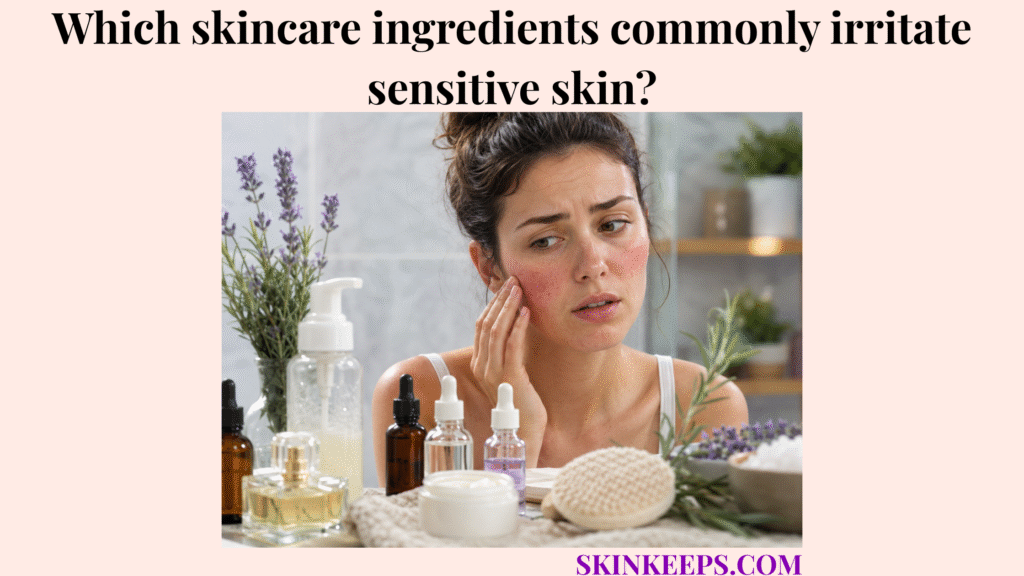
Skincare ingredients that commonly irritate sensitive skin include added fragrance, fragrant essential oils, high levels of volatile alcohol, strong cleansing systems, concentrated exfoliating acids, retinoids, benzoyl peroxide, and other potent active ingredients when formulation or use exceeds skin tolerance. No ingredient irritates everyone. Concentration, product pH, leave-on versus rinse-off exposure, frequency, active overlap, and current skin condition all shape whether stinging, burning, itching, tightness, dryness, peeling, rash, or swelling develops.
This article explains the major ingredient groups, why complete formulation matters, how volatile and fatty alcohols differ, why active products can irritate, why preservatives remain necessary, how irritation differs from a possible allergy, and how to investigate a suspected ingredient without building a universal blacklist.
Why Do Certain Skincare Ingredients Irritate Sensitive Skin?
Certain skincare ingredients irritate sensitive skin when their strength, pH, contact duration, frequency, or combined use exceeds the skin’s current tolerance. Ingredient exposure is one part of the broader group of skincare habits that irritate sensitive skin, but formula strength and use pattern remain central on this page.
How Do Strong Ingredients Increase Barrier Stress?
Strong ingredients increase barrier stress when they remove surface lipids, loosen corneocyte connections, accelerate exfoliation, or activate sensory pathways beyond current tolerance. Useful ingredients can still sting or burn when the stratum corneum is already irritated, but this does not prove permanent damage.
Why Do Concentration and Frequency Change Tolerability?
Concentration and frequency change tolerability because stronger or repeated exposure increases the amount of active contact the skin must process and recover from. Several low-level exposures may accumulate even when one application appears mild.
| Ingredient-related factor | How the factor may affect sensitive skin |
|---|---|
| High concentration | Delivers a stronger exposure than current tolerance may support. |
| Frequent application | Reduces recovery time between exposures. |
| Very acidic or alkaline formula | May increase stinging or discomfort in susceptible skin. |
| Multiple active ingredients | Creates overlapping irritation pathways. |
| Fragrance components | May produce irritation or an allergy-like reaction in susceptible users. |
| Strong cleansing system | May increase tightness, dryness, or a stripped after-feel. |
| Already-irritated skin | Often tolerates products less comfortably. |
| Long contact time | Extends exposure to the complete formula. |
How Ingredient Exposure Becomes Irritation
An ingredient name does not determine tolerance by itself. Strength, pH, contact time, frequency, active overlap, and current skin condition combine to shape the response.
Figure 1. Formula variables and use pattern determine the actual exposure. The diagram does not establish an allergy or universal threshold.
Why Is Added Fragrance a Common Sensitive-Skin Trigger?
Added fragrance is a common sensitive-skin trigger because fragrance mixtures contain multiple aromatic compounds that can irritate or sensitize susceptible skin. Readers with repeated reactions to fragranced formulas may need to examine fragrances and dyes as distinct contact exposures.
Fragrance-Reaction Clues
- Symptoms begin after a fragranced product is applied.
- Similar reactions occur with different fragranced formulas.
- Itching or burning is stronger than with fragrance-free products.
- Eyelids, neck, or face repeatedly react.
- Leave-on fragrance creates more discomfort than rinse-off exposure.
- Symptoms improve after added fragrance is removed.
Can Essential Oils Irritate Sensitive Skin?
Yes, essential oils can irritate sensitive skin because they contain concentrated aromatic compounds capable of causing stinging, burning, dryness, irritation, or contact allergy in susceptible users. Natural origin does not guarantee tolerance.
| Essential-oil characteristic | Possible sensitive-skin issue |
|---|---|
| Strong fragrance profile | May increase itching or irritation in susceptible skin. |
| Cooling or warming sensation | May feel like stinging or burning. |
| Concentrated aromatic compounds | May reduce tolerance in reactive skin. |
| Leave-on formula | Creates longer contact than rinse-off exposure. |
| Combined with acids or retinoids | May increase cumulative irritation. |
| Certain citrus-derived components | May require additional sun-exposure consideration. |
Key Rule
Natural, clean, plant-based, or botanical does not automatically mean suitable for sensitive skin.
Which Alcohols Are More Likely to Irritate Sensitive Skin?
Volatile alcohols such as alcohol denat., ethanol, and SD alcohol are more likely to sting or dry sensitive skin at high exposure, while fatty alcohols usually serve different emollient or stabilizing functions.
| Alcohol category | Common role | Sensitive-skin consideration |
|---|---|---|
| Alcohol denat. | Solvent and quick-drying vehicle | High exposure may sting or dry reactive skin. |
| Ethanol | Solvent and lightweight-feel ingredient | Higher formula exposure may increase discomfort. |
| SD alcohol | Fast-evaporating solvent | Some sensitive skin develops tightness or burning. |
| Cetyl alcohol | Emollient and thickener | Chemically different from volatile alcohol and often tolerated. |
| Cetearyl alcohol | Stabilizer and softening agent | Should not be grouped automatically with drying alcohols. |
| Stearyl alcohol | Texture and emollience support | Commonly tolerated in moisturizers. |
How Can Harsh Cleansing Agents Irritate Sensitive Skin?
Harsh cleansing agents irritate sensitive skin when the complete surfactant system removes more surface oil and interacts with skin proteins more strongly than the cleansing task requires. One surfactant name does not define the full cleanser.
| Formula pattern | Possible reaction |
|---|---|
| High-pH traditional soap | May produce tightness and barrier discomfort. |
| Very strong foaming system | May create dryness or a squeaky-clean sensation. |
| Several strong surfactants | May increase cleansing intensity. |
| Active cleanser used too frequently | May create cumulative irritation. |
| Fragranced cleanser | Adds fragrance exposure to cleansing exposure. |
| Long contact time | May increase dryness or stinging. |
Which Exfoliating Acids Commonly Irritate Sensitive Skin?
Glycolic, lactic, salicylic, mandelic, polyhydroxy, and blended acids can irritate sensitive skin when strength, frequency, pH, overlap, or barrier condition exceeds tolerance. Concentrated acids, overlapping exfoliants, and excessive frequency can turn otherwise useful formulas into harsh exfoliants.
| Active category | Possible sensitive-skin reaction |
|---|---|
| Glycolic acid | May produce stinging, burning, peeling, or tightness. |
| Lactic acid | May feel gentler in some formulas but can still irritate. |
| Salicylic acid | May produce dryness, stinging, or peeling when overused. |
| Mandelic acid | May be better tolerated by some users but is not irritation-proof. |
| Polyhydroxy acids | May provide milder exfoliation, although tolerance still varies. |
| Exfoliating blends | Increase cumulative exposure and trigger confusion. |
High-Risk Exfoliating Patterns
- Daily use without established tolerance.
- Several acid products in one routine.
- Application to raw or peeling skin.
- Acid and retinoid overlap.
- Increasing strength despite stinging.
- Acid cleanser plus leave-on exfoliant.
Can Retinoids Trigger Sensitivity?
Yes, retinoids can trigger dryness, peeling, tightness, stinging, and burning, especially when introduced too quickly or combined with other irritating actives. Predictable irritation should not be normalized as proof that treatment is working.
Retinoid-Irritation Clues
- Peeling develops after frequency increases.
- Moisturizer begins to sting.
- Skin feels tight or raw.
- Burning follows cleansing.
- Other active products become difficult to tolerate.
- Symptoms improve after label-consistent or professional reduction.
- Irritation worsens when acids and retinoids overlap.
Can Benzoyl Peroxide and Acne Treatments Irritate Sensitive Skin?
Yes, benzoyl peroxide and other acne treatments can irritate sensitive skin by increasing dryness, peeling, burning, and cumulative active exposure.
| Treatment pattern | Possible result |
|---|---|
| High-strength benzoyl peroxide | May increase dryness, peeling, or burning. |
| Benzoyl peroxide plus a retinoid | May increase cumulative irritation. |
| Active cleanser plus leave-on treatment | Creates repeated active exposure. |
| Spot treatment spread over large areas | Increases the treated surface. |
| Daily use during active peeling | May prolong discomfort. |
| Scrubbing acne-prone sensitive skin | Adds mechanical irritation. |
Can Vitamin C Formulas Irritate Sensitive Skin?
Some vitamin C formulas can irritate sensitive skin, particularly low-pH or highly concentrated formulas, although tolerance varies substantially across derivatives and complete formulations.
Possible Vitamin C Irritation Clues
- Sharp stinging begins immediately.
- Burning persists after application.
- Tightness or redness develops with repeated use.
- Discomfort increases when combined with acids.
- Lower-frequency use feels more tolerable.
- Different vitamin C formulas produce different reactions.
Can Botanical Extracts Irritate Sensitive Skin?
Yes, botanical extracts can irritate sensitive skin because plant-derived formulas may contain numerous fragrant or biologically active constituents with variable tolerance.
Botanical-Formula Caution Signs
- The product contains many plant extracts.
- Itching occurs despite a calming label.
- Fragrant botanical ingredients are present.
- Similar plant-heavy formulas cause recurring symptoms.
- Several botanical serums are layered together.
- Skin improves when the formula is simplified.
Can Preservatives Irritate Sensitive Skin?
Yes, a specific preservative can irritate or sensitize susceptible skin, but preservatives are necessary in many water-based formulas to prevent microbial contamination.
| Pattern | Possible interpretation |
|---|---|
| Reactions recur with formulas sharing one preservative. | A specific intolerance may need investigation. |
| Strong itching or rash develops after repeated use. | An allergy-like pattern may be possible. |
| Several unrelated products create similar symptoms. | A shared ingredient should be assessed. |
| Symptoms improve after the product is stopped. | A product-related pattern becomes more plausible. |
| Every preserved product is blamed. | The conclusion is probably too broad. |
| Unpreserved homemade formulas replace commercial products. | Microbial contamination risk may increase. |
Why Does Formulation Matter More Than an Ingredient Name Alone?
Formulation matters more than an ingredient name alone because concentration, pH, delivery system, contact time, supporting ingredients, and frequency determine the skin’s actual exposure. Formula context becomes harder to interpret when using too many products introduces several active and inactive ingredients at once.
| Formulation factor | Why the factor matters |
|---|---|
| Concentration | Changes the intensity of ingredient exposure. |
| Product pH | Can affect sting and active behavior. |
| Leave-on versus rinse-off | Changes contact duration. |
| Supporting moisturizers | May improve comfort without eliminating all irritation. |
| Added fragrance | Introduces another possible trigger. |
| Application frequency | Changes cumulative exposure. |
| Combined products | May increase the irritation burden. |
| Current skin condition | Changes tolerance. |
How Is Ingredient Irritation Different From an Allergy-Like Reaction?
Ingredient irritation usually depends on strength, frequency, pH, or barrier condition, while an allergy-like reaction reflects immune sensitivity to a specific substance.
| Feature | Irritation pattern | Allergy-like pattern |
|---|---|---|
| Main driver | Strength, frequency, pH, contact time, or barrier stress | Immune sensitivity to a specific ingredient |
| Timing | Often begins during or soon after use | May be delayed or recur after repeated exposure |
| Sensation | Stinging, burning, tightness, or dryness | Strong itching, rash, swelling, or blisters |
| Location | Usually strongest where applied | May extend beyond the original application area |
| Dose relationship | Often worsens with greater or more frequent exposure | Small exposure may reproduce the reaction |
| Next step | Stop or reduce exposure and reassess | Seek evaluation when strong, spreading, or recurrent |
Irritation Pattern Versus Allergy-Like Pattern
Timing, sensation, dose relationship, and distribution provide clues. Predictable irritation often follows stronger exposure, while an allergy-like pattern may recur after small contact in a sensitized person.
Figure 2. Symptom pattern may guide next steps, but only professional assessment can diagnose allergic contact dermatitis or another skin condition.
What Signs Suggest One Ingredient Is Causing the Reaction?
One ingredient becomes more suspicious when several reacting products share it and produce a repeatable reaction with similar timing and distribution.
Ingredient-Trigger Checklist
- Different reacting products share the same ingredient.
- Symptoms return with similar exposure.
- The reaction follows the same application area.
- Timing is similar after each exposure.
- Products without the suspected ingredient are better tolerated.
- The reaction continues despite reducing routine complexity.
- The pattern is more specific than general product overload.
- Professional patch testing identifies the trigger.
How Should Sensitive Skin Investigate a Suspected Ingredient Trigger?
A suspected ingredient trigger should be investigated by stopping the newest or most suspicious product, stabilizing the remaining routine, and comparing complete ingredient lists across similar reactions. Readers may patch test new products where appropriate, but home testing cannot rule out every delayed or facial reaction.
Ingredient Investigation Protocol
- Stop the newest or most suspicious product.
- Keep the remaining routine stable and minimal.
- Save the complete ingredient list.
- Compare ingredient lists across products that caused similar reactions.
- Look for repeated ingredient categories rather than blaming the first unfamiliar name.
- Avoid introducing several replacement products.
- Do not deliberately retest a product that caused a severe reaction.
- Seek professional assessment when reactions are strong, recurrent, or unclear.
How Can Someone Read Ingredient Lists Without Creating an Unnecessary Blacklist?
Ingredient lists should be used to compare repeated exposures and formula roles, not to label every unfamiliar chemical name as harmful.
Ingredient-List Review Guide
- Check whether added fragrance is present.
- Identify strong active ingredients.
- Note whether several exfoliants appear in one formula.
- Distinguish volatile alcohols from fatty alcohols.
- Compare complete formulas rather than one name.
- Note repeated ingredients across reacting products.
- Identify rinse-off versus leave-on format.
- Record frequency and application area.
- Avoid assuming every long name is harmful.
- Prioritize repeatable reaction patterns.
Which Ingredient-Related Mistakes Worsen Sensitive Skin?
Ingredient-related sensitivity worsens when unfamiliar names are automatically avoided, natural ingredients are assumed safe, strong actives are combined, or severe reactions are deliberately retested.
| Mistake | Why it backfires |
|---|---|
| Avoiding every chemical-sounding ingredient | Creates an inaccurate blacklist. |
| Assuming natural ingredients cannot irritate | Overlooks essential-oil and botanical reactions. |
| Combining several strong actives | Raises cumulative irritation. |
| Increasing frequency despite stinging | Reduces recovery time. |
| Testing several replacements together | Hides the true trigger. |
| Reusing a product after a severe reaction | May provoke another strong response. |
| Treating every reaction as allergy | Misclassifies predictable irritation. |
| Choosing preservative-free automatically | May ignore contamination risk. |
How Can Ingredient-Triggered Sensitivity Be Reduced?
Ingredient-triggered sensitivity can be reduced by removing repeatable triggers, limiting active overlap, lowering unnecessary exposure, and keeping the remaining routine stable.
Ingredient-Tolerance Checklist
- Use fragrance-free formulas when added fragrance is a confirmed or repeatable trigger.
- Avoid unnecessary fragrant essential oils during active reactivity.
- Introduce strong actives cautiously.
- Limit overlapping active treatments.
- Avoid applying strong actives to burning or peeling skin.
- Reduce frequency when repeated stinging or tightness appears.
- Keep the rest of the routine stable during investigation.
- Stop products that repeatedly produce the same reaction.
- Choose formulas according to tolerance rather than marketing terms.
- Seek professional evaluation for allergy-like reactions.
How Should Someone Track Ingredient-Related Sensitive-Skin Reactions?
Ingredient-related reactions should be tracked by recording the complete formula, product format, concentration where stated, frequency, symptom timing, and shared ingredients across reacting products.
Ingredient Reaction Tracking Worksheet
- Product name and category.
- Complete ingredient list.
- Stated active concentration.
- Rinse-off or leave-on format.
- Application frequency and area.
- Other active products used.
- Time from application to symptoms.
- Stinging, burning, itching, tightness, rash, swelling, peeling, or bumps.
- Whether the reaction returned.
- Shared ingredients across other reacting products.
- Weather, medication, or health changes.
- Photographs where appropriate.
When Should Ingredient-Related Sensitivity Be Professionally Evaluated?
Ingredient-related sensitivity should be professionally evaluated when reactions are severe, recurrent, spreading, blistering, swollen, painful, or difficult to connect to one formula. Strong, recurring, spreading, blistering, swollen, or diagnostically unclear reactions are reasons to see a dermatologist.
Professional Evaluation Checklist
- Skin swells, blisters, oozes, crusts, or bleeds.
- Rash spreads beyond the application area.
- Burning, pain, or itching is severe.
- Eye or eyelid reactions occur.
- Several unrelated products produce strong reactions.
- Symptoms persist after the suspected product is stopped.
- Skin reacts to water or a minimal routine.
- Reactions interfere with sleep or daily activities.
- Contact dermatitis, eczema, rosacea, or infection is suspected.
Urgent Safety Note
Breathing difficulty, throat tightness, faintness, or rapidly progressing facial, lip, or tongue swelling requires emergency medical attention.
What Should You Remember About Irritating Skincare Ingredients and Sensitive Skin?
Ingredient tolerance depends on the complete formula, exposure pattern, and individual skin response rather than the ingredient name alone.
What Should You Remember?
- Added fragrance commonly creates irritation or sensitization in susceptible skin.
- Fragrant essential oils are concentrated aromatic exposures and are not automatically gentle.
- Volatile alcohols differ chemically and functionally from fatty alcohols.
- Strong cleansing systems should be judged by the complete formula.
- Exfoliating acids can irritate when strength, frequency, overlap, or barrier condition exceeds tolerance.
- Retinoids and acne actives can create predictable dryness, peeling, or burning.
- Vitamin C tolerance varies by form, pH, concentration, and formulation.
- Botanical extracts can soothe some users and irritate others.
- Preservatives protect formula safety, although a specific preservative may trigger a reaction.
- Product concentration, pH, contact time, and frequency matter as much as ingredient presence.
- Predictable irritation and allergic contact dermatitis are different pathways.
- Shared ingredients across several reacting products provide stronger evidence than one isolated reaction.
- Severe reactions should not be deliberately reproduced.
- Persistent, spreading, swollen, blistering, oozing, painful, or recurrent reactions require professional evaluation.
Frequently Asked Questions
Is Fragrance Always Bad for Sensitive Skin?
No. Fragrance does not irritate everyone, but added fragrance is a common source of irritation and allergic contact reactions in susceptible users. A fragrance-free formula may be easier to assess when fragranced products repeatedly produce symptoms.
Are Essential Oils Safe for Sensitive Skin?
Essential oils are not automatically safe because they are natural. Concentrated aromatic compounds can cause stinging, burning, irritation, or contact allergy, particularly in leave-on formulas or when combined with other strong active products.
Are All Alcohols in Skincare Drying?
No. Volatile alcohols such as alcohol denat. and ethanol differ from fatty alcohols such as cetyl, cetearyl, and stearyl alcohol. Fatty alcohols commonly function as emollients, thickeners, or stabilizers.
Can Sensitive Skin Use Exfoliating Acids?
Some sensitive skin can tolerate carefully formulated acids at an appropriate frequency. Irritation becomes more likely when concentration, frequency, product overlap, or current barrier condition exceeds individual tolerance.
Does Stinging Mean an Ingredient Allergy?
Not necessarily. Stinging commonly reflects predictable irritation, formula acidity, active strength, or an already stressed surface. Strong itching, delayed rash, swelling, blistering, or repeat reactions to small exposure may justify allergy assessment.
Are Preservative-Free Products Safer?
Not automatically. Preservatives reduce microbial contamination in many water-based formulas. A person may react to one preservative, but unpreserved or poorly preserved products introduce a different safety risk.
Conclusion
Several skincare ingredient groups commonly irritate sensitive skin, but formulation, concentration, frequency, contact time, and individual tolerance determine the actual reaction. Fragrance, essential oils, volatile alcohol, strong cleansing systems, acids, retinoids, acne actives, vitamin C, botanicals, and preservatives can all create tolerance problems in the wrong context.
Ingredient names do not function as universal safety labels. Repeatable reaction patterns are more useful than broad avoidance, and strong or unclear reactions require professional evaluation. The safest ingredient decisions come from repeated evidence, complete-formula context, and individual tolerance—not fear of unfamiliar names.
Sources & Evidence
American Academy of Dermatology — How to Test Skin-Care Products
Supports cautious product testing, fragrance-free selection when fragrance is a trigger, and the limits of “unscented” or botanical labels.
[AAD]American Academy of Dermatology — Contact Dermatitis Causes
Supports fragrance and personal-care products as recognized contact-dermatitis exposures.
[AAD]DermNet — Fragrance Allergy
Supports fragrance allergy as delayed allergic contact dermatitis after sensitization.
[DermNet]DermNet — Allergic Contact Dermatitis to Essential Oils
Supports delayed contact allergy to essential-oil constituents in sensitized individuals.
[DermNet]DermNet — Emollients and Moisturisers
Supports preservative necessity in water-based products and the possibility of preservative allergy in sensitized users.
[DermNet]Corazza et al., 2010 — Surfactants, Skin Cleansing Protagonists
Supports surfactant interaction with proteins and lipids and the need to assess complete cleansing systems.
[PubMed]Blaak and Staib, 2018 — The Relation of pH and Skin Cleansing
Supports the role of cleanser pH in skin-surface function and cleansing tolerance.
[PubMed]Narsa et al., 2024 — Strategies to Reduce Topical Retinoid Irritation
Supports retinoid-related tolerability problems and the importance of formulation and use strategy.
[PubMed]Foti et al., 2015 — Contact Dermatitis to Topical Acne Drugs
Supports irritant and less common allergic reactions associated with retinoids and benzoyl peroxide.
[PubMed]Al-Niaimi and Chiang, 2017 — Topical Vitamin C and the Skin
Supports differences among vitamin C formulations and the importance of formulation stability and delivery.
[PMC]DermNet — Allergic Contact Dermatitis
Supports the distinction between direct irritation and delayed immune-mediated contact allergy.
[DermNet]Disclaimer: This article provides general educational information and does not diagnose or treat irritant contact dermatitis, allergic contact dermatitis, fragrance allergy, preservative allergy, eczema, rosacea, infection, or another skin condition. Stop using a suspected product and seek professional advice for severe, persistent, recurrent, spreading, blistering, swollen, oozing, bleeding, painful, or eye-area reactions. Breathing difficulty, throat tightness, faintness, or rapid facial, lip, or tongue swelling requires urgent medical care.