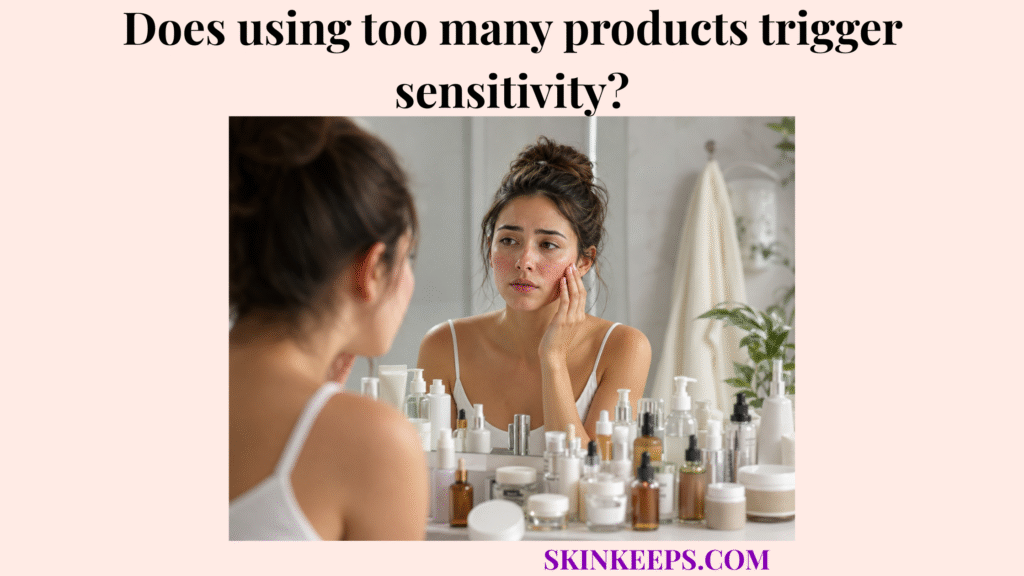
Yes, using too many skincare products can trigger or worsen sensitivity when cumulative formula exposure, active overlap, repeated layering, application friction, and routine complexity exceed the skin’s tolerance. Several formulas may expose the skin to repeated preservatives, fragrance components, active ingredients, cleansers, exfoliants, heavy textures, rubbing, and occlusive films. Stinging, burning, itching, tightness, peeling, flushing, bumps, heat, or sudden intolerance may follow.
Product count alone does not determine risk. This article explains why quantity and overlap matter, how gentle products can create cumulative exposure, why the trigger becomes difficult to identify, how one-product intolerance differs from overload, and how to reduce, rebuild, and track a routine without inventing a universal limit.
Why Can Using Many Skincare Products Make Sensitive Skin More Reactive?
Using many skincare products can make sensitive skin more reactive by increasing total ingredient exposure, active overlap, application friction, film thickness, and the number of daily exposures. Product overload occurs when quantity, duplication, treatment intensity, layering, or rubbing exceeds current tolerance.
A multi-product routine can address distinct needs and remain comfortable. The problem begins when formulas duplicate functions, require repeated rubbing, create heat or heaviness, or produce warning symptoms before the skin stabilizes.
Product overload is one of several skincare habits that irritate sensitive skin, but this page focuses on quantity, overlap, and routine complexity.
How Does Repeated Ingredient Exposure Increase Irritation Load?
Repeated ingredient exposure increases irritation load when several formulas expose the skin to overlapping preservatives, fragrances, surfactants, botanical extracts, and active ingredients. Exposure does not make every ingredient harmful; the complete formula and individual tolerance matter.
Repeated contact with several formulas increases exposure to preservatives, fragrance components, active substances, and other potentially irritating skincare ingredients. Related components may appear in more than one product without proving allergy.
Why May Sensitive Skin Not Recover Between Multiple Routine Steps?
Sensitive skin may not recover between multiple routine steps when cleansing, actives, layering, rubbing, and reapplication occur repeatedly within the same day. Morning and evening routines may repeat similar exposures while sunscreen or makeup reapplication adds further contact.
No universal recovery duration applies. The practical question is whether the next routine begins while burning, itching, tightness, or peeling remains active.
| Product-overload factor | Possible sensitive-skin effect |
|---|---|
| Multiple formulas increase total ingredient exposure. | More preservatives, fragrances, vehicles, extracts, and active substances contact the skin. |
| Several active products overlap. | Burning, peeling, dryness, or reduced tolerance may become more likely. |
| Repeated rubbing adds mechanical irritation. | Pilling and difficult spreading can increase friction and tenderness. |
| Morning, evening, and reapplication cycles repeat exposure. | The next routine may begin before prior discomfort settles. |
| Several fragrances or preservatives add possible triggers. | Trigger identification becomes harder, although exposure does not prove allergy. |
| Heavy films increase occlusion. | Warmth, sweat retention, itching, heaviness, or bumps may occur in susceptible skin. |
| Constant product changes remove the baseline. | Tolerance and reaction timing become difficult to interpret. |
How Product Load Becomes a Routine-Level Trigger
Product count becomes clinically relevant when duplicated functions, overlapping actives, repeated rubbing, heavy films, and frequent routine cycles combine. No individual formula must appear severe.
Figure 1.How cumulative product load develops: Formula exposure, active overlap, functional duplication, application friction, and heavy product films can combine into one routine-level irritation burden. The pathways show a possible mechanism, not a fixed threshold or guaranteed reaction.
Is the Number of Products Itself Always the Problem?
No, the number of products itself is not always the problem; function, overlap, strength, application friction, frequency, and individual tolerance determine the real irritation burden. No universal safe maximum applies to every person or formula combination.
Several simple products with distinct purposes may create less load than a shorter routine containing multiple strong actives. Actual skin response outranks bottle count.
| Routine pattern | Relative sensitivity risk |
|---|---|
| A few well-tolerated products with distinct purposes. | Usually a lower cumulative load when warning symptoms are absent. |
| Several gentle products with distinct roles. | May remain well tolerated when formulas layer comfortably. |
| Several products containing active ingredients. | Creates a higher cumulative treatment load. |
| Multiple exfoliating or acne treatments. | Creates a higher irritation burden through functional overlap. |
| Frequent new-product additions. | Creates a high trigger-confusion risk. |
| A long routine during active irritation. | Often becomes poorly tolerated because recovery and interpretation are limited. |
These are relative troubleshooting patterns, not medical risk categories.
How Does Active-Product Overlap Trigger Sensitivity?
Active-product overlap triggers sensitivity when several products affect exfoliation, epidermal turnover, acne treatment, pigmentation, or oil control at the same time. Overlap is defined by function, not product format.
Active overlap becomes especially relevant when several products create the equivalent of repeated or harsh exfoliation. An active cleanser, acid toner, retinoid, benzoyl peroxide product, or multi-active serum may converge on burning, peeling, and reduced tolerance.
Clinicians may intentionally combine treatments. The concern is uncontrolled duplication or escalation without regard to strength, frequency, current irritation, or professional instructions.
| Product combination pattern | Possible reaction |
|---|---|
| Exfoliating cleanser plus acid toner. | Tightness, stinging, or peeling may increase. |
| Several exfoliating serums. | Burning, raw texture, or reduced tolerance may develop. |
| Retinoid plus exfoliating treatment. | Flaking and irritation may intensify. |
| Several acne treatments. | Dryness, tenderness, burning, or inflamed patches may appear. |
| Multiple brightening actives. | Patchy sensitivity or burning may occur. |
| Active treatments repeated morning and evening. | Some users may receive insufficient recovery between cycles. |
Can Products Interact Even When Each One Seems Gentle?
Yes, individually gentle products can create an irritating routine when total formula exposure, layering, occlusion, fragrance contact, and application friction accumulate. “Interaction” does not necessarily mean a dangerous chemical reaction occurred on the face.
Additive exposure means several mild variables contribute to the same discomfort. Heavy films reduce evaporation, pilling prompts rubbing, and multiple formulas increase contact with vehicles, extracts, and preservatives.
Routine-Interaction Clues
- The complete routine causes discomfort although individual products seem comfortable alone.
- Skin feels hot or itchy after the final layer.
- Products pill and require repeated rubbing.
- Sunscreen stings only over several products.
- Makeup feels uncomfortable over a heavily layered routine.
- Skin feels calmer when optional steps are removed.
Why Does Product Overload Make the Real Trigger Difficult to Identify?
Product overload makes the real trigger difficult to identify because several formulas, active combinations, and application behaviors change at the same time. Each addition becomes an uncontrolled variable while repeated ingredients may appear in several products.
New “repair” products can add formulas before the earlier reaction is understood. Removing one bottle may fail when duplication, heavy layering, or friction remains.
Trigger-Identification Problems
- Several products are introduced on the same day.
- The same or related ingredient appears in multiple formulas.
- Symptoms begin only after the complete routine.
- Products change before the reaction settles.
- New products are added to treat irritation caused by earlier products.
- The application stage causing discomfort is unclear.
- Removing one product fails because the remaining routine stays overloaded.
Why a Stable Baseline Matters
A stable baseline is a small, unchanged group of tolerated products used for comparison. Without it, timing, recurrence, improvement after removal, and response to reintroduction become difficult to interpret.
How Is Cumulative Product Overload Different From One-Product Intolerance?
One-product intolerance repeatedly follows one formula, while cumulative product overload develops through the combined quantity, overlap, friction, and complexity of several routine steps. Both patterns can coexist.
Improvement after removal supports a hypothesis but does not prove causality or diagnose allergy. Severe reactions should never be deliberately recreated.
| Feature | Single-product intolerance | Cumulative product overload |
|---|---|---|
| Main clue | One specific product repeatedly precedes symptoms. | Symptoms develop after several routine steps. |
| Timing | Symptoms often follow that product’s application. | Symptoms may appear only after the full routine. |
| Reproducibility | The same formula produces a similar reaction. | The reaction returns when complexity increases. |
| Location | Symptoms often match the application area. | Most routinely treated areas may react. |
| Improvement | Removing one product improves symptoms. | Simplifying several steps improves symptoms. |
| Investigation | Assess the individual formula. | Assess duplication, active overlap, friction, and layering. |
One Formula or the Complete Routine?
Timing, recurrence, application area, and response to simplification help separate a formula-specific pattern from routine-wide overload.
Figure 2.How to separate one-product intolerance from routine overload: Reactions that repeatedly follow one formula suggest a product-specific pattern, while symptoms that appear after several layers suggest cumulative overload. The comparison supports investigation but cannot diagnose allergy, dermatitis, acne, or folliculitis.
What Symptoms Suggest That a Routine Contains Too Many Products?
A routine may contain too many products when discomfort increases as layers accumulate and improves when optional steps are removed. Progressive timing links symptoms to increasing product load rather than one isolated event.
Product-Overload Warning Signs
- Skin feels increasingly tight as layers are applied.
- Burning begins near the end of the routine.
- Moisturizer or sunscreen suddenly stings.
- Peeling develops despite no single obviously strong product.
- Small bumps appear after routine expansion.
- Skin feels heavy, hot, itchy, or congested.
- Previously tolerated products become uncomfortable.
- Sensitivity improves on reduced-routine days.
- Skin does not calm between morning and evening routines.
- Reactions began after several products were added close together.
Can Too Many Soothing Products Also Irritate Sensitive Skin?
Yes, too many soothing products can irritate sensitive skin because calming labels do not eliminate botanical extracts, fragrances, preservatives, formula overlap, or individual intolerance. A tolerated soothing product may reduce discomfort, but several new “barrier” products can add variables faster than they improve clarity.
“Soothing,” “calming,” and “barrier-supporting” are not guarantees of universal tolerance. Actual response outranks marketing language.
Soothing-Product Overload Rule
During active sensitivity, fewer tolerated products are easier to assess than several products marketed as calming or barrier-supportive.
Can Excessive Layering Cause Bumps or Congestion in Sensitive Skin?
Yes, excessive layering can contribute to bumps or congestion-like discomfort when thick product films trap heat and sweat, increase friction, or create poor tolerance in covered areas. Occlusion means reduced airflow and evaporation beneath a covering film.
Bumps have multiple possible causes and should not automatically be labeled acne, folliculitis, or clogged pores. More exfoliation may worsen irritation-related bumps.
Layering-Related Bump Clues
- Bumps appear after several hydrating layers are added.
- Skin feels heavy or warm beneath the routine.
- Symptoms increase in humid conditions.
- Bumps appear where thick products overlap.
- Skin improves when layering is reduced.
- Scrubbing or aggressive acne treatment worsens the reaction.
What Product-Overload Mistakes Commonly Worsen Sensitivity?
Product overload worsens when several products are added together, formulas duplicate the same function, or more products are applied to treat irritation caused by the existing routine.
| Mistake | Why it backfires |
|---|---|
| Adding several new products together. | Prevents reliable trigger identification. |
| Using multiple products for the same goal. | Increases exposure without adding a distinct function. |
| Applying every owned product daily. | Treats product availability as a skin requirement. |
| Adding more products when irritation begins. | Increases complexity while the trigger remains unclear. |
| Layering several active formulas. | Raises cumulative treatment intensity. |
| Rubbing each layer aggressively. | Adds mechanical stress. |
| Copying another person’s long routine. | Ignores individual tolerance. |
| Assuming gentle products cannot overload skin. | Underestimates cumulative exposure and occlusion. |
How Should an Overloaded Sensitive-Skin Routine Be Reduced?
An overloaded sensitive-skin routine should be reduced by stopping recently added and non-essential products, pausing strong actives during irritation, and keeping only the minimum tolerated core steps. This is a troubleshooting reset, not a universal minimalist ideology.
A temporary minimal sensitive-skin routine reduces uncontrolled variables while the reader assesses tolerance. Prescribed treatments should not change without professional advice.
Product-Load Reduction Protocol
- Stop recently added and non-essential products.
- Pause strong non-prescribed actives while skin is burning, itching, peeling, or raw.
- Keep only minimum tolerated cleansing, moisturizing, and daytime-protection steps.
- Avoid brushes, pads, scrubs, and repeated rubbing.
- Do not replace removed products immediately.
- Keep the remaining routine stable enough to interpret the response.
- Record which symptoms improve after product load is reduced.
- Seek professional advice before changing prescribed treatment.
How Should Products Be Reintroduced After Sensitivity Improves?
Products should be reintroduced one at a time after active burning, itching, peeling, and persistent tightness have settled enough for the response to be interpreted. Controlled reintroduction keeps the baseline stable.
Readers should patch test new products where appropriate before rebuilding a more complex facial routine. A home patch test cannot rule out every delayed reaction, facial intolerance, or allergy.
Products with a clear, non-duplicated purpose should return first. Products associated with swelling, blistering, or severe pain should not be deliberately retested.
Controlled Reintroduction Guide
- Wait until active symptoms have settled enough for interpretation.
- Reintroduce one product at a time.
- Start with products serving a clear and necessary purpose.
- Use a cautious frequency for active products.
- Keep the rest of the routine unchanged.
- Observe immediate and delayed reactions.
- Do not add another product before tolerance is reasonably clear.
- Stop the newest addition if symptoms return.
- Do not deliberately retest severe reactions.
- Avoid rebuilding unnecessary duplicated steps.
How Can Someone Decide Which Products Are Actually Necessary?
A product is more likely to be necessary when it serves a clear function, remains well tolerated, and is not duplicated by another step. This is a functional audit, not a judgment about ownership or routine length.
| Question | Why the question matters |
|---|---|
| What specific job does this product perform? | Reveals whether the step has a clear purpose. |
| Is another product already doing the same job? | Identifies functional duplication. |
| Does skin improve when this step is removed? | Tests practical value. |
| Does this product repeatedly cause discomfort? | Identifies poor tolerance. |
| Is the product used because skin needs it or because it is available? | Separates need from habit. |
| Can the same goal be met with fewer products? | Supports lower cumulative exposure. |
What Signs Show That Routine Simplification Is Helping?
Routine simplification is helping when stinging, burning, tightness, peeling, heat, bumps, and unpredictable reactions become less frequent or less intense. Relative change is more useful than an invented percentage.
Improvement supports the overload hypothesis but does not prove overload was the only cause. No improvement warrants reassessment.
Routine-Simplification Improvement Signals
- Stinging during application decreases.
- Burning after the routine becomes less frequent.
- Moisturizer and sunscreen feel comfortable again.
- Tightness occurs less often.
- Peeling or roughness decreases.
- Small irritation bumps begin to settle.
- Skin feels less hot or heavy.
- Fewer unpredictable reactions occur.
- Tolerated products become easier to identify.
- New reactions become easier to trace.
How Should Someone Track Product-Load Sensitivity?
Product-load sensitivity should be tracked by recording product count, application order, functional overlap, active ingredients, symptom timing, reduced-routine days, and reintroduction results. The worksheet supports pattern recognition but does not diagnose allergy.
Product-Load Tracking Worksheet
- Total morning product count.
- Total evening product count.
- Application order.
- Products serving the same function.
- Active ingredients used together.
- New products and start dates.
- Product consistency or film thickness.
- Amount of rubbing required.
- Symptoms after each application step.
- Time from routine completion to symptoms.
- Whether symptoms improve on reduced-routine days.
- Product reintroduction dates.
- Whether the same reaction returns.
- Weather, humidity, medication, or health changes.
- Photographs when useful.
Interpret Categories, Not Scores
The log may suggest an unclear trigger, possible one-product intolerance, likely cumulative overload, a heavy-layer or friction pattern, or the need for professional evaluation.
When Should Product-Overload Sensitivity Be Professionally Evaluated?
Product-overload sensitivity should be professionally evaluated when symptoms remain severe, persistent, recurrent, spreading, blistering, swollen, painful, or unresponsive to routine simplification. Persistent or unclear reactions are reasons to see a dermatologist.
Several similar reactions may justify assessment for irritant or allergic contact dermatitis, eczema, rosacea, infection, or another condition. A clinician determines whether allergy testing is appropriate.
Professional Evaluation Checklist
- Skin reacts to water or a minimal basic routine.
- Burning, itching, or pain remains severe.
- A rash spreads or repeatedly returns.
- Skin swells, blisters, oozes, crusts, or bleeds.
- Eye or eyelid reactions occur.
- Sensitivity persists after simplification.
- Skin becomes deeply cracked or infected-looking.
- Reactions interfere with sleep or daily activities.
- Several products cause similar strong reactions.
- An underlying condition or allergy is suspected.
Urgent Medical Care
Breathing difficulty, rapid facial swelling, throat tightness, faintness, or another severe immediate reaction requires urgent medical attention.
What Should You Remember About Using Too Many Products and Sensitivity?
Product overload depends on cumulative formula exposure, functional overlap, friction, layering, and individual tolerance—not product count alone.
What Should You Remember?
- Using too many products can trigger or worsen sensitive-skin reactions.
- Product count alone does not determine whether a routine is irritating.
- Functional duplication increases exposure without adding a distinct purpose.
- Several active products can create overlapping irritation pathways.
- Individually mild products can still create a high cumulative load.
- Heavy layering can add friction, heat, sweat retention, pilling, and discomfort.
- Several soothing products can introduce more extracts, fragrances, preservatives, and variables.
- Product overload makes the true trigger difficult to identify.
- A one-product reaction usually follows one reproducible formula.
- A routine-overload reaction often appears after several steps.
- Non-essential and duplicated steps should be removed before new products are added.
- Products should be reintroduced one at a time.
- Severe reactions should not be deliberately reproduced.
- Persistent or severe reactions require professional evaluation.
Frequently Asked Questions
How Many Skincare Products Are Too Many?
No universal product number is too many for everyone. A routine becomes excessive when products duplicate functions, overlap in active ingredients, require repeated rubbing, create persistent discomfort, or make the true trigger impossible to identify.
Can Several Gentle Products Irritate Sensitive Skin?
Yes. Several gentle products can create a high cumulative load through repeated preservatives, fragrance components, botanical extracts, active ingredients, product films, and application friction. Actual tolerance matters more than the marketing description of each product.
Can Too Many Serums Damage Sensitive Skin?
Several serums may increase active overlap, formula exposure, pilling, and application friction. Risk depends on each serum’s function, frequency, strength, and the skin’s response rather than the serum category alone.
Can Too Many Moisturizers Cause Bumps?
Several creams, balms, oils, or occlusive layers may trap heat and sweat or feel heavy on some skin. New bumps may have several causes, so persistent or inflamed bumps should not automatically be treated with stronger acne products.
Should Every Product Be Stopped During a Sensitive-Skin Flare?
Not necessarily. Recently added, non-essential, or clearly irritating products are the first candidates for removal. Prescribed treatments should not be stopped without professional guidance. The goal is a stable, tolerated baseline rather than uncontrolled removal and replacement.
How Should Skincare Products Be Added Back?
Products should be added back one at a time while the rest of the routine remains stable. Each product should serve a clear purpose, begin at an appropriate frequency, and be stopped if the same warning symptoms return.
Conclusion
Using too many products can trigger sensitive-skin reactions when product quantity, active overlap, functional duplication, friction, and heavy layering combine into a routine the skin cannot tolerate. Product count is not the only variable; cumulative exposure and routine structure often matter more.
Simplification improves trigger clarity, products should return one at a time, and actual tolerance should determine routine size. Persistent or severe symptoms require professional evaluation. The right routine is not the longest or shortest routine; it is the smallest set of clearly useful products the skin can consistently tolerate.
Sources & Evidence
DermNet — Sensitive Skin
Supports cumulative mild irritants and the roles of friction, pressure, heat, sweat, and occlusion.
[DermNet]DermNet — Irritant Contact Dermatitis
Supports repetitive exposure, heat, sweat, friction, retinoids, and benzoyl peroxide as possible irritant factors.
[DermNet]DermNet — Contact Reactions to Cosmetics
Supports fragrance, preservative, and cosmetic-formula contact reactions.
[DermNet]DermNet — Emollients and Moisturisers
Supports the limits of occlusive layering and individual reactions to fragrances, preservatives, vehicles, and heavy films.
[DermNet]American Academy of Dermatology — How to Test Skin-Care Products
Supports cautious product testing before wider routine use.
[AAD]American Academy of Dermatology — Products That Sting or Burn
Supports stopping non-prescribed products that repeatedly sting or burn.
[AAD]Narsa et al., 2024 — Strategies to Reduce Topical Retinoid Irritation
Supports retinoid irritation as a recognized tolerability problem.
[PubMed]Foti et al., 2015 — Contact Dermatitis to Topical Acne Drugs
Supports burning, dryness, scaling, itching, and irritant reactions linked with topical acne treatments.
[PubMed]Zeichner, 2012 — Optimizing Topical Combination Therapy
Supports the challenge of managing irritation when multiple topical products with overlapping adverse effects are used together.
[PubMed]Disclaimer: This article provides general educational information and does not diagnose or treat irritant contact dermatitis, allergic contact dermatitis, eczema, rosacea, acne, folliculitis, infection, or another skin condition. Stop using a product and seek professional advice for severe, persistent, recurrent, spreading, blistering, swollen, oozing, bleeding, painful, or eye-area reactions. Breathing difficulty, rapid facial swelling, throat tightness, or faintness requires urgent medical care.