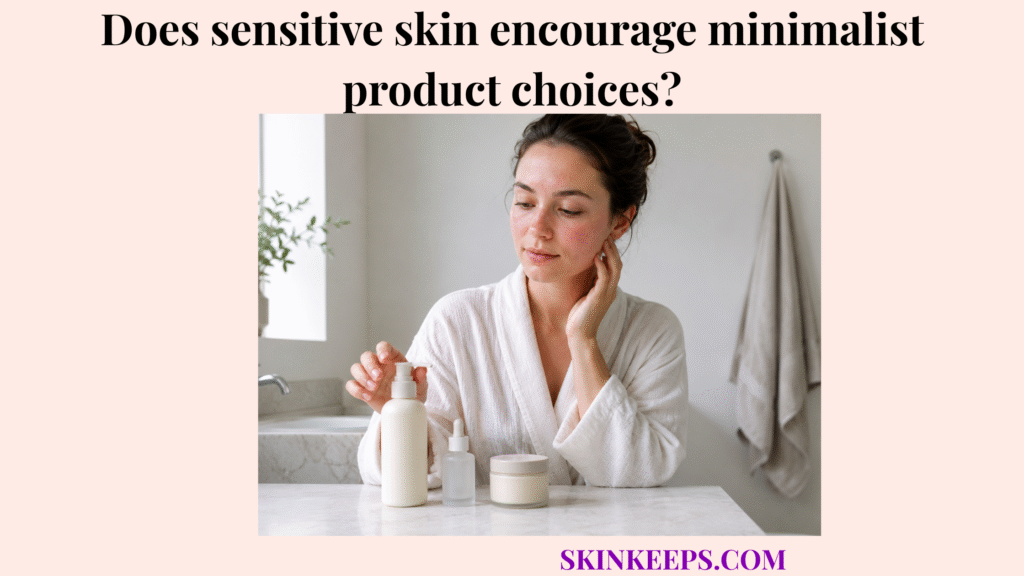
Yes, sensitive skin can encourage minimalist product choices because reactive skin often responds better when products have a clear purpose, fewer unnecessary extras, and a lower chance of trigger confusion. Minimalist choices may reduce random product use, duplicate formulas, unnecessary fragrance, trend-driven purchases, formula overlap, trigger confusion, and impulsive product switching. Minimalist does not mean every product must be natural, active-free, or ultra-short.
This article explains what minimalist product choice means, how it differs from a simple routine, whether active ingredients can still fit, why fewer formula variables can help, why natural products are not automatically safer, why short ingredient lists are not always better, how to track product choices, and when professional evaluation is needed.
Why Can Sensitive Skin Encourage Minimalist Product Choices?
Sensitive skin can encourage minimalist product choices because repeated reactions make unnecessary, duplicative, or poorly tolerated products easier to question. Minimalist product selection is one of the practical advantages of sensitive skin when skin feedback encourages more purposeful product choices.
How Does Sensitive Skin Make Unnecessary Products Easier to Question?
Sensitive skin makes unnecessary products easier to question because products that add no clear benefit but create stinging, burning, itching, tightness, or confusion become harder to justify.
Why Can Fewer Formula Variables Make Reactions Easier to Understand?
Fewer formula variables can make reactions easier to understand because there are fewer ingredients, actives, textures, and product changes to compare after irritation appears.
| Minimalist product behavior | Why it may help sensitive skin |
|---|---|
| Choosing products with clear purpose | Reduces random product use. |
| Avoiding unnecessary fragrance | Removes a common optional trigger. |
| Limiting duplicate products | Reduces formula overlap. |
| Preferring tolerated basics | Supports routine stability. |
| Avoiding trend-driven purchases | Reduces unnecessary exposure. |
| Choosing simpler formulas when reactive | Makes reactions easier to interpret. |
| Testing one product at a time | Improves trigger clarity. |
| Keeping products that work | Prevents constant disruption. |
How Minimalist Product Selection Improves Trigger Clarity
This visual shows how product purpose, formula clarity, tolerance evidence, and fewer duplicate products can lower confusion when sensitive skin reacts.
Figure 1. Minimalist product selection is strongest when purpose and tolerance evidence guide product choice.
How Are Minimalist Product Choices Different From a Minimal Routine?
Minimalist product choices focus on which formulas deserve to be selected, while a minimal routine focuses on how many steps are used. Minimalist product selection is related to simpler routines, but this page focuses on which products deserve to be chosen rather than how many steps the routine uses.
| Topic | Main focus | Example |
|---|---|---|
| Minimalist product choices | Selecting fewer, clearer, more purposeful formulas. | Choosing one tolerated moisturizer instead of three similar creams. |
| Minimal routine | Reducing the number of routine steps. | Cleanse, moisturize, protect, then reassess. |
| Product selection | Deciding what kind of formula deserves a place. | Purposeful and tolerated. |
| Routine structure | Deciding how many steps are used. | Shorter morning or evening routine. |
| Main benefit | Less product confusion. | Less step complexity. |
Simple Rule
A minimalist routine is about how many steps you use. Minimalist product choice is about which products deserve to be chosen at all.
What Makes a Product Choice “Minimalist” for Sensitive Skin?
A product choice is minimalist for sensitive skin when the product has a clear purpose, fits the person’s tolerance history, and avoids unnecessary formula confusion.
| Question | Why it matters |
|---|---|
| What problem does this product solve? | Prevents random buying. |
| Is another product already doing this job? | Avoids duplication. |
| Does this product add fragrance without need? | Reduces optional trigger exposure. |
| Does my skin tolerate this type of formula? | Keeps response evidence central. |
| Is this product needed daily or occasionally? | Reduces unnecessary contact. |
| Am I buying this for a real need or a trend? | Prevents impulse irritation risk. |
| Can I test this without changing everything else? | Supports clearer trigger tracking. |
Does Minimalist Product Choice Mean Avoiding All Active Ingredients?
No, minimalist product choice does not mean avoiding all active ingredients. Active products can fit when they serve one clear goal, are introduced carefully, do not duplicate another product, are tolerated by the skin, and are not added during a flare without reason.
Active-Ingredient Product Discipline
- Choose one active for one clear goal.
- Avoid several products that do the same job.
- Start with lower frequency when appropriate.
- Do not add active products during a flare.
- Avoid copying strong routines made for other skin types.
- Stop or reduce use if burning, peeling, or persistent tightness appears.
Why Can Minimalist Product Choices Reduce Trigger Confusion?
Minimalist product choices can reduce trigger confusion because fewer formulas make it easier to identify what the skin tolerated and what may have caused a reaction. Minimalist product choices can reduce the confusion created by using too many products, especially when several formulas change at once.
| Product-choice pattern | Trigger clarity |
|---|---|
| One new product at a time | Reactions are easier to identify. |
| Several new products together | The trigger becomes unclear. |
| Purposeful product selection | Each product has a reason to be tested. |
| Trend-driven buying | More unnecessary variables are introduced. |
| Keeping tolerated products | A stable baseline is created. |
| Frequent replacement | Tolerance becomes harder to judge. |
How Can Minimalist Product Choices Improve Label Awareness?
Minimalist product choices can improve label awareness because fewer products make each formula easier to review, compare, and track. Minimalist product selection can strengthen ingredient awareness by making each formula easier to compare against the skin’s real tolerance history.
Minimalist Label-Awareness Checklist
- Does the product contain added fragrance?
- Does it contain strong active ingredients?
- Does it duplicate another product?
- Is it rinse-off or leave-on?
- Does it have a clear purpose?
- Has my skin tolerated similar formulas before?
- Does it contain many botanical or scent-related extras?
- Can I introduce it without changing the rest of the routine?
- Would removing it make the routine clearer?
Can Sensitive Skin Make People Less Likely to Buy Trendy Products?
Yes, sensitive skin can make people less likely to buy trendy products because reactive skin often makes tolerance more important than popularity.
Trend-Resistance Product Habits
- Buying for function, not hype.
- Avoiding duplicate serums.
- Questioning viral actives.
- Keeping tolerated basics.
- Avoiding just-in-case products.
- Looking past packaging claims.
- Choosing products based on skin response.
- Waiting before adding new launches.
Does Minimalist Product Choice Mean Choosing Only “Natural” Products?
No, minimalist product choice does not mean choosing only natural products. Natural formulas can still contain essential oils, botanical extracts, aromatic compounds, and active plant-derived ingredients that irritate some people.
Better Principle
Choose products by tolerance, purpose, and formula clarity, not by natural marketing alone.
Does a Shorter Ingredient List Always Mean Better for Sensitive Skin?
No, a shorter ingredient list does not always mean a product is better for sensitive skin. A shorter formula may reduce variables, but it can still contain a poorly tolerated ingredient, while a longer formula may include stabilizers, moisturizers, or ingredients that improve comfort.
| Myth | Better explanation |
|---|---|
| Short ingredient lists are always safer. | The specific formula matters. |
| Long ingredient lists are always bad. | Some ingredients support stability and comfort. |
| Natural formulas are automatically gentle. | Natural extracts can irritate. |
| Fragrance-free means perfect. | It only removes one common trigger. |
| Minimalist means no treatment products. | Treatments can be used if purposeful and tolerated. |
| Fewer ingredients means no allergy risk. | Reactions still depend on the person. |
Which Product Types Often Deserve Closer Questioning?
Product types that duplicate existing steps, add fragrance, contain strong actives, or create extra variables deserve closer questioning before purchase. This is not a blacklist; it is a product-purpose audit.
| Product type | Why question it |
|---|---|
| Duplicate serums | They may repeat the same function. |
| Fragranced extras | They add scent without a skin need. |
| Strong active treatments | They can overwhelm sensitive skin if unnecessary. |
| Trend masks | They often add variables without daily need. |
| Multiple toners or essences | They may duplicate hydration claims. |
| Scrubs and peel products | They have higher irritation potential. |
| Heavy oils or balms | They may trap heat or feel uncomfortable for some people. |
| Calming products with many botanicals | They may still contain irritating extras. |
How Can Someone Choose Minimalist Products Without Under-Caring for Sensitive Skin?
Someone can choose minimalist products without under-caring by removing unnecessary exposure while keeping useful cleansing, moisture, sun protection, and condition-specific care when needed.
| Needed support | Minimalist choice approach |
|---|---|
| Cleansing | Choose a gentle cleanser only when cleansing is needed. |
| Moisture support | Use one tolerated moisturizer rather than several overlapping creams. |
| Sun exposure | Choose sunscreen the skin can tolerate. |
| Treatment goals | Use one targeted product at a time. |
| Flares | Simplify instead of adding many rescue products. |
| Known triggers | Avoid only the triggers supported by pattern evidence. |
What Signs Show Minimalist Product Choices Are Helping Sensitive Skin?
Minimalist product choices may be helping sensitive skin when reactions become less frequent, products become easier to tolerate, and triggers become easier to identify.
Minimalist Product Improvement Signs
- Fewer unpredictable reactions.
- Less stinging or burning after application.
- Easier product tolerance tracking.
- Less confusion about what caused a flare.
- Fewer duplicate products in the routine.
- Skin feels calmer after removing unnecessary extras.
- Products have clearer purposes.
- Less impulse switching.
- Better confidence in tolerated basics.
- Faster response when a product does not suit the skin.
What Mistakes Make Minimalist Product Choices Less Helpful?
Minimalist product choices become less helpful when useful products are removed out of fear, marketing labels replace tolerance evidence, or several simple products are added at once.
| Mistake | Why it backfires |
|---|---|
| Removing useful products out of fear | Dryness or sun sensitivity may worsen. |
| Choosing products only because the label says minimal | Marketing does not guarantee tolerance. |
| Avoiding every unfamiliar ingredient | Unnecessary fear increases. |
| Buying many simple products at once | Product overload can still happen. |
| Assuming natural means safer | Botanical irritation may be missed. |
| Keeping a product just because it has few ingredients | The formula may still irritate. |
| Refusing treatment when a condition needs care | Symptoms may persist. |
| Ignoring repeated reactions to a minimal formula | Actual skin response matters more than label style. |
How Should Someone Build a Minimalist Product-Selection Habit?
Someone can build a minimalist product-selection habit by starting with the skin concern, choosing products with clear jobs, and testing one formula at a time. Readers may patch test new products where appropriate before adding a new formula to an otherwise stable routine.
Minimalist Product-Selection Habit Checklist
- Start with the skin concern, not the product trend.
- Choose products with a clear job.
- Avoid duplicate products.
- Avoid unnecessary fragrance if sensitivity is frequent.
- Introduce one new product at a time.
- Keep ingredient lists from reactions.
- Judge products by skin response.
- Keep tolerated basics stable.
- Remove products that add no benefit.
- Avoid buying several new formulas during a flare.
- Seek help if even simple products trigger strong reactions.
Minimalist Product-Selection Decision Loop
This visual shows how a product is selected by purpose, compared against duplicates, tested as one new formula, and kept only if tolerance evidence is strong.
Figure 2. A minimalist product choice is a selection decision based on purpose, non-duplication, controlled testing, and tolerance evidence.
How Should Minimalist Product Choices Be Tracked?
Minimalist product choices should be tracked by recording why the product was chosen, what role it serves, how often it is used, and how the skin responds.
Minimalist Product Tracking Worksheet
- Product name and category.
- Main reason for choosing it.
- Product role in the routine.
- Whether it duplicates another product.
- Fragrance-free, scented, active, tinted, or botanical-heavy status.
- Start date.
- How often it was used.
- Symptoms after use.
- Whether the skin improved, worsened, or stayed the same.
- Whether removing it changed the routine.
- Whether the product was bought from need, trend, or impulse.
- Photos of visible reactions if needed.
When Should Product-Choice Reactions Be Professionally Evaluated?
Product-choice reactions should be professionally evaluated when they are severe, persistent, spreading, swollen, blistering, painful, recurring, or happen even with simple products. Severe, spreading, swollen, blistering, painful, or recurring reactions are reasons to see a dermatologist.
Professional Evaluation Warning Signs
- Skin reacts to several simple products.
- Water or basic products sting or burn.
- Burning, pain, or itching is severe or persistent.
- Rash spreads or repeatedly returns.
- Skin swells, blisters, oozes, crusts, or bleeds.
- Eye or eyelid reactions occur.
- Skin becomes cracked, raw, or infected-looking.
- Reactions continue despite minimalist product choices.
- Symptoms disrupt sleep or daily comfort.
- Eczema, dermatitis, allergy, rosacea, infection, or another condition may be involved.
Urgent Safety Note
Breathing difficulty, throat tightness, faintness, or rapid facial, lip, or tongue swelling requires emergency medical care.
What Should You Remember About Sensitive Skin and Minimalist Product Choices?
Sensitive skin can encourage minimalist product choices when product selection becomes more purposeful, less trend-driven, and more based on tolerance evidence.
What Should You Remember?
- Sensitive skin can encourage minimalist product choices.
- Minimalist product selection means choosing purposeful, tolerated, lower-confusion formulas.
- Minimalist does not mean natural, ultra-short, or active-free.
- Short ingredient lists are not always safer.
- Natural formulas can still irritate sensitive skin.
- Active ingredients can fit when they are purposeful and tolerated.
- Fewer unnecessary product variables can make triggers easier to identify.
- Product purpose matters more than trend value.
- Marketing claims do not prove tolerance.
- Severe or recurring reactions need professional evaluation.
Frequently Asked Questions
Does Minimalist Product Choice Mean Using Only Natural Products?
No. Minimalist product choice means choosing products by purpose, tolerance, and formula clarity. Natural products can still contain essential oils, fragrant extracts, or botanicals that irritate some sensitive skin.
Is a Short Ingredient List Always Better for Sensitive Skin?
No. A short ingredient list can reduce variables, but it does not guarantee tolerance. A longer formula may contain stabilizers, moisturizers, or ingredients that improve comfort.
Can Minimalist Product Choices Include Active Ingredients?
Yes. Active ingredients can fit when they serve a clear goal, are introduced carefully, and remain tolerated. The issue is unnecessary active stacking, not every active ingredient.
How Do Minimalist Product Choices Reduce Trigger Confusion?
They reduce trigger confusion by limiting how many new formulas, duplicate functions, and unnecessary extras are involved when a reaction appears.
What Products Should Sensitive Skin Question Before Buying?
Sensitive skin should question duplicate serums, fragranced extras, strong actives, trend masks, multiple toners, scrubs, heavy balms, and botanical-heavy calming products.
Can Minimalist Product Choices Become Too Extreme?
Yes. Minimalist choices become too extreme when useful moisturizer, sunscreen, cleansing, prescribed care, or tolerated treatment products are removed out of fear rather than evidence.
Conclusion
Sensitive skin can encourage minimalist product choices by making purpose, tolerance, and formula clarity more important than trends or product complexity. Minimalist product choices reduce unnecessary variables, make triggers easier to track, and make trend-driven buying easier to resist.
Minimalist does not mean natural, ultra-short, or active-free. Useful tolerated products should not be removed out of fear, and severe or recurring reactions need professional assessment. The best minimalist product choice is not the product with the shortest label; it is the product with the clearest purpose, strongest tolerance evidence, and lowest unnecessary confusion for that person’s skin.
Sources & Evidence
DermNet — Sensitive Skin
Supports sensitive-skin symptoms, product intolerance, and repeated trigger recognition.
[DermNet]DermNet — Irritant Contact Dermatitis
Supports cosmetics, soaps, friction, retinoids, benzoyl peroxide, and other exposures as possible irritants.
[DermNet]DermNet — Allergic Contact Dermatitis
Supports professional evaluation for delayed, recurrent, swollen, blistering, or unclear contact reactions.
[DermNet]DermNet — Fragrance Allergy
Supports fragrance as a relevant cosmetic exposure and the need to assess repeated reaction patterns.
[DermNet]American Academy of Dermatology — How to Test Skin-Care Products
Supports cautious product testing and stopping products that cause significant reactions.
[AAD]American Academy of Dermatology — Sun Protection
Supports keeping daytime sun protection when sun exposure is expected rather than removing it for minimalism.
[AAD]Draelos, 2018 — The Science Behind Skin Care: Moisturizers
Supports moisturizer use for skin comfort and barrier-supportive product decisions.
[PubMed]Narsa et al., 2024 — Strategies to Reduce Topical Retinoid Irritation
Supports active-product irritation and the need to respect tolerability when choosing treatment products.
[PubMed]Disclaimer: This article provides general educational information and does not diagnose or treat irritant contact dermatitis, allergic contact dermatitis, eczema, rosacea, acne, infection, or another skin condition. Stop using clearly irritating products and seek professional advice for severe, persistent, recurrent, spreading, blistering, swollen, oozing, bleeding, painful, or eye-area reactions. Breathing difficulty, throat tightness, faintness, or rapid facial, lip, or tongue swelling requires urgent medical care.