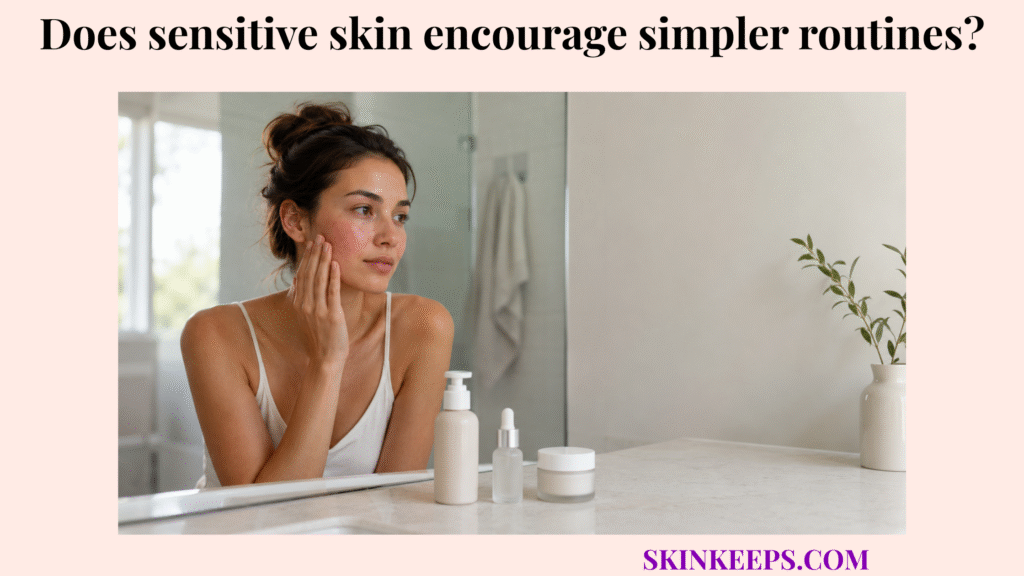
Yes, sensitive skin often encourages simpler routines because reactive skin makes unnecessary products, confusing steps, and poorly tolerated changes easier to notice. Simpler routines can reduce ingredient exposure, rubbing, layering, active overlap, trigger confusion, trend-chasing, and overcorrection during irritation.
This article explains why sensitive skin encourages simpler routines, how fewer variables improve trigger clarity, why product purpose matters, when simple routines are not enough, how to track results, and when professional care is needed.
Why Can Sensitive Skin Encourage Simpler Skincare Routines?
Sensitive skin can encourage simpler skincare routines because repeated reactions make unnecessary products and poorly tolerated steps easier to identify. The reaction itself is not the advantage; the advantage is the discipline that can follow from paying attention.
Simpler routine discipline is one of the practical advantages of sensitive skin when it leads to clearer product choices instead of fear-based restriction.
How Does Reactive Skin Give Faster Feedback?
Reactive skin gives faster feedback when stinging, burning, itching, tightness, bumps, or flushing appears after a product change. That feedback can help the reader slow down and reassess the routine.
Why Do Unnecessary Steps Become Easier to Identify?
Unnecessary steps become easier to identify when the skin feels better after optional products are removed. Products without a clear purpose are easier to question when the full routine causes discomfort.
| Simple-routine behavior | How sensitive skin may encourage it |
|---|---|
| Fewer optional steps | Repeated reactions make unnecessary layers easier to question. |
| Clearer product purpose | Each step must justify its place. |
| Less active stacking | Warning signs make strong overlaps easier to notice. |
| Slower product changes | New steps are introduced with more caution. |
| Better trigger clarity | Fewer variables make reactions easier to trace. |
| Lower trend-chasing | Tolerance becomes more important than popularity. |
| More consistent use | A shorter purposeful routine is easier to repeat. |
| Earlier stop decisions | Burning, stinging, itching, or tightness is less likely to be ignored. |
How Sensitive Skin Rewards Simpler Routine Discipline
This visual shows how sensitive-skin feedback can guide product purpose, fewer variables, and better consistency without turning simplicity into a fixed rule.
Figure 1. Sensitive-skin feedback can encourage simpler routine discipline, but the goal is not permanent under-care.
How Does a Simple Routine Reduce Trigger Confusion?
A simple routine reduces trigger confusion because fewer products, steps, and formula changes make reactions easier to trace. When one product changes at a time, symptom timing and application area become more useful clues.
| Routine pattern | What it means for sensitive skin |
|---|---|
| Simple routine | Fewer useful, tolerated steps with clear purpose. |
| Complicated routine | Many products, duplicate functions, or unclear step value. |
| Simple routine reaction | Easier to compare timing and product role. |
| Complicated routine reaction | Harder to identify whether one product or the whole routine caused the reaction. |
| Simple routine goal | Consistency, tolerance, and trigger clarity. |
| Complicated routine risk | More exposure, rubbing, layering, and active overlap. |
Can Simple Routines Reduce Irritation Load?
Yes, simple routines can reduce irritation load by lowering formula exposure, active overlap, fragrance exposure, layering, and repeated rubbing. Simple routines are especially useful when using too many products makes it hard to tell what the skin is reacting to.
Irritation-Load Reduction Clues
- Stinging decreases after optional steps are removed.
- Moisturizer feels comfortable again.
- Sunscreen stings less over fewer layers.
- The routine requires less rubbing.
- Peeling or tightness becomes less frequent.
- New bumps settle after heavy layers are reduced.
- The trigger becomes easier to identify.
- The routine feels easier to repeat consistently.
Does a Simple Routine Mean Using Only One or Two Products?
No, a simple routine does not always mean using only one or two products. Readers may need to limit routine steps during irritation, but simple still means purposeful, tolerated, and not unnecessarily duplicated.
| Simple-routine principle | What it means |
|---|---|
| Simple is not automatically one product. | It means each step has a reason. |
| Simple is not incomplete. | Essential care can remain. |
| Simple is not permanent restriction. | Steps can return if tolerated. |
| Simple is not fear-based removal. | Useful tolerated products can stay. |
| Simple is not trend avoidance alone. | It is purpose-based routine discipline. |
| Simple is not the shortest routine. | It is the fewest unnecessary variables. |
Which Routine Steps Should Earn Their Place?
A routine step should earn its place by solving a clear problem, staying well tolerated, and avoiding duplication with another step. Strong ingredient awareness supports this audit because it helps the reader understand what each formula adds.
| Step-audit question | Why it matters |
|---|---|
| What problem does this product solve? | A clear answer prevents unnecessary layering. |
| Is another product already doing the same job? | Duplication increases exposure without added value. |
| Does my skin feel better with it? | Tolerance and benefit should guide the decision. |
| Does my skin feel worse after it? | Warning sensations suggest the step may not belong. |
| Is this daily or occasional? | Some products do not need constant use. |
| Was it added during a flare? | Overcorrection can create extra variables. |
| Can I identify the active or purpose? | Unclear products are harder to assess. |
| Would removing it reduce confusion? | The answer supports simplification. |
How Can Sensitive Skin Reduce Trend-Chasing?
Sensitive skin can reduce trend-chasing by making tolerance more important than popularity. A new product becomes less tempting when the reader has learned that every extra formula can add exposure, confusion, and possible warning symptoms.
Trend-Resistance Benefits
- Products are judged by tolerance, not popularity.
- New launches are not added automatically.
- Duplicate products are easier to reject.
- Strong actives are treated with more caution.
- Marketing claims are checked against actual skin response.
- The routine changes only when a clear need exists.
Can Simpler Routines Improve Consistency?
Yes, simpler routines can improve consistency because fewer steps are easier to repeat and assess. Consistency matters because changing products constantly makes it harder to know whether the routine is helping or irritating.
Routine Consistency Checklist
- The routine is easier to complete.
- The same products are used long enough to assess tolerance.
- Fewer steps reduce skipped or rushed applications.
- Product changes become easier to track.
- Symptoms are easier to connect to a specific change.
- The routine becomes less dependent on trends or impulse additions.
How Can a Simple Routine Support Barrier Awareness?
A simple routine can support barrier awareness by making warning signs easier to connect to a specific product or step. When fewer variables are present, stinging, tightness, flaking, burning, or product intolerance becomes easier to interpret.
Barrier Feedback Guide
- Water begins to sting.
- Moisturizer suddenly burns.
- Sunscreen becomes uncomfortable after active use.
- Skin feels tight after the final layer.
- Flakes worsen after rubbing or actives.
- A step repeatedly produces heat, itching, or discomfort.
- Skin improves when a specific optional product is removed.
Can Simple Routines Still Include Active Ingredients?
Yes, simple routines can still include active ingredients when each active has a clear purpose and the skin tolerates it. Readers may patch test new products where appropriate before adding an active, but home testing cannot rule out every delayed or facial reaction.
Active-Use Discipline
- Use one active with a clear purpose.
- Avoid adding several actives together.
- Reduce frequency when warning symptoms appear.
- Do not use actives on raw, burning, or peeling skin.
- Keep the rest of the routine stable when testing an active.
- Stop the newest active if stinging, burning, swelling, or rash returns.
What Signs Show Sensitive Skin Benefits From a Simpler Routine?
Sensitive skin may benefit from a simpler routine when symptoms decrease and product tolerance improves after unnecessary steps are removed. The strongest clue is a repeatable difference between full-routine days and simpler-routine days.
Simple-Routine Improvement Signs
- Stinging decreases after simplification.
- Burning after the routine becomes less frequent.
- Moisturizer and sunscreen feel more comfortable.
- Tightness or peeling improves.
- Bumps or rash-like irritation settle.
- Skin feels less hot, heavy, or itchy after layering.
- The reader can identify which step caused the reaction more easily.
- Symptoms return when unnecessary steps are restarted.
When Can a Simple Routine Become Too Limited?
A simple routine can become too limited when useful support steps are removed out of fear instead of evidence. Simplicity should protect tolerance without removing needed comfort, cleansing, sun protection, or medically directed care.
| Too-limited routine clue | Why it matters |
|---|---|
| Dryness worsens after removing moisturizer. | Comfort support may have been removed too aggressively. |
| Sun exposure continues without protection. | Minimalism should not remove daytime protection. |
| Prescribed care is stopped without guidance. | Medical treatment decisions need professional direction. |
| Residue remains after sunscreen or makeup. | Skipping cleansing can create irritation from buildup. |
| A useful tolerated step is removed only from fear. | Evidence should guide simplification. |
| Skin worsens despite fewer steps. | The issue may not be routine length alone. |
What Myths About Simple Routines Should Be Avoided?
Simple-routine myths should be avoided because simplicity helps only when it protects tolerance without removing needed care. A routine can be short and still irritating if the remaining products are harsh or poorly tolerated.
| Myth | Correction |
|---|---|
| Simple always means one or two products. | Simple means fewer unnecessary steps, not a fixed number. |
| Long routines are always bad. | Longer routines can work when every step is useful and tolerated. |
| Minimal routines should remove sunscreen. | Daytime protection still matters when sun exposure is expected. |
| All actives must disappear forever. | Actives can remain if they are needed, tolerated, and controlled. |
| Natural products make routines safer. | Natural labels do not guarantee tolerance. |
| If skin reacts, remove everything permanently. | Simplify, observe, and reintroduce carefully when appropriate. |
How Can Someone Build a Simpler Routine Mindset?
Someone can build a simpler routine mindset by choosing products for purpose, tolerance, and consistency instead of novelty. This mindset makes the routine easier to maintain and easier to troubleshoot.
Simple Routine Mindset Checklist
- Choose products for a clear skin need.
- Keep products that are well tolerated.
- Remove duplicate steps first.
- Avoid adding products during every flare.
- Introduce changes one at a time.
- Track whether the skin improves after simplification.
- Treat burning, stinging, swelling, or rash as feedback.
- Do not make the routine shorter than the skin’s needs require.
What Mistakes Make Simple Routines Less Helpful?
Simple routines become less helpful when useful support steps are removed, many products are replaced at once, or recurring reactions are ignored. Simplification works best when it removes unnecessary variables without creating new ones immediately.
| Mistake | Why it makes simple routines less helpful |
|---|---|
| Removing useful support steps | The skin may lose comfort or protection. |
| Replacing many products at once | New variables make results unclear. |
| Ignoring recurring reactions | The same trigger may keep returning. |
| Keeping duplicate products | The routine stays more complex than it looks. |
| Using a harsh cleanser as the basic step | A short routine can still be irritating. |
| Restarting all actives together | Trigger clarity disappears. |
| Choosing products by trends | Tolerance evidence becomes secondary. |
| Treating simple as a fixed rule | The routine may become too limited or incomplete. |
How Should Someone Track Whether a Simpler Routine Is Helping?
Someone should track whether a simpler routine is helping by recording removed products, kept products, symptom changes, and reactions after reintroducing each step. Tracking supports pattern recognition, not diagnosis.
Simple-Routine Tracking Worksheet
- Products removed during simplification.
- Products kept during simplification.
- Morning and evening step count.
- Symptoms before simplification.
- Symptoms after simplification.
- Whether stinging, burning, itching, tightness, peeling, or bumps improved.
- Whether moisturizer or sunscreen became more comfortable.
- Date each step was reintroduced.
- Reaction after each reintroduced step.
- Whether symptoms returned as the routine became more complex.
- Photos of visible changes when useful.
When Do Sensitive-Skin Reactions Need Professional Evaluation Even With a Simple Routine?
Sensitive-skin reactions need professional evaluation when symptoms remain severe, persistent, spreading, swollen, blistering, painful, or recurrent despite a stable simple routine. Severe, persistent, swollen, blistering, painful, or recurring reactions are reasons to see a dermatologist.
Professional Evaluation Warning Signs
- Skin reacts even to a stable simple routine.
- Water or basic products sting or burn.
- Burning, itching, or pain is severe or persistent.
- Rash spreads or repeatedly returns.
- Skin swells, blisters, oozes, crusts, or bleeds.
- Eye or eyelid reactions occur.
- Skin becomes deeply cracked or infected-looking.
- Symptoms interfere with sleep or daily comfort.
- Eczema, dermatitis, allergy, rosacea, acne, infection, or another condition is suspected.
Urgent Safety Note
Breathing difficulty, throat tightness, faintness, or rapid facial, lip, or tongue swelling requires emergency medical care.
Simple Routine Decision Loop
This visual shows the practical loop: remove unnecessary steps, observe comfort, reintroduce only useful steps, and stop when warning symptoms return.
Figure 2. Simple routine discipline depends on purpose, tolerance, consistency, and one-at-a-time reintroduction.
What Should You Remember About Sensitive Skin and Simpler Routines?
Sensitive skin can encourage simpler routines by making product purpose, tolerance, and trigger clarity harder to ignore.
What Should You Remember?
- Sensitive skin can encourage simpler routines without making sensitivity desirable.
- Simple routines can reduce unnecessary steps, rubbing, layering, and trigger confusion.
- Simple does not mean the shortest routine possible.
- Each step should have a clear purpose and a tolerance record.
- Longer routines can work when every step is useful and comfortable.
- Active ingredients can stay when they are needed and tolerated.
- Moisturizer and sunscreen should not be removed only to look minimal.
- Trend-chasing becomes easier to resist when tolerance is the main test.
- Tracking helps show whether simplification is working.
- Severe or persistent reactions need professional evaluation.
Frequently Asked Questions
Does sensitive skin always need a simple routine?
No. Sensitive skin does not always need the shortest possible routine. It often benefits from a simpler routine when products cause irritation, confusion, or poor tolerance.
Can a simple routine still use active ingredients?
Yes. A simple routine can include active ingredients when each active has a clear purpose, is introduced carefully, and remains well tolerated.
Is a long routine bad for sensitive skin?
Not automatically. A longer routine can work when every step is useful, non-duplicative, stable, and comfortable.
Can simpler routines reduce breakout-like irritation?
They can reduce irritation that looks like bumps or breakouts when the problem comes from friction, heavy layering, active overlap, or poorly tolerated products.
Should sensitive skin remove moisturizer or sunscreen to stay minimal?
No. A simple routine should not remove useful support out of fear. Moisturizer and daytime sun protection may still be important when they are tolerated and needed.
How can someone know a simple routine is helping?
A simple routine may be helping when stinging, burning, itching, tightness, peeling, bumps, or trigger confusion decrease after unnecessary steps are removed.
Conclusion
Sensitive skin can encourage simpler routines by rewarding consistency, purpose-based product choices, and fewer unnecessary variables. A simpler routine can reduce exposure, friction, active overlap, and trigger confusion while keeping useful, tolerated steps in place.
A simple routine should not remove needed care or turn into fear-based under-care. Products should earn their place through purpose and tolerance, and severe or recurring reactions need professional assessment. The strongest simple routine is not the shortest routine; it is the routine with the fewest unnecessary steps and the clearest evidence of tolerance.
Sources & Evidence
DermNet — Sensitive Skin
Supports sensitive-skin symptoms, product intolerance, and repeated trigger recognition.
[DermNet]DermNet — Irritant Contact Dermatitis
Supports friction, cosmetics, soaps, retinoids, benzoyl peroxide, and cumulative exposure as possible irritant factors.
[DermNet]DermNet — Allergic Contact Dermatitis
Supports professional evaluation for delayed, recurrent, swollen, blistering, or unclear contact reactions.
[DermNet]American Academy of Dermatology — Face Washing Guidance
Supports gentle cleansing, avoiding scrubbing, and reducing irritation from harsh washing behavior.
[AAD]American Academy of Dermatology — Sun Protection
Supports not removing daytime sun protection simply to make a routine shorter.
[AAD]Draelos, 2018 — The Science Behind Skin Care: Moisturizers
Supports moisturizer use for skin comfort and barrier-supportive routine decisions.
[PubMed]Draelos, 2018 — The Science Behind Skin Care: Cleansers
Supports cleanser formulation differences and why a simplified routine still needs gentle cleansing when cleansing is needed.
[PubMed]Narsa et al., 2024 — Strategies to Reduce Topical Retinoid Irritation
Supports active-product irritation and the need to respect tolerability when actives remain in a simple routine.
[PubMed]Disclaimer: This article provides general educational information and does not diagnose or treat irritant contact dermatitis, allergic contact dermatitis, eczema, rosacea, acne, infection, or another skin condition. Stop using clearly irritating products and seek professional advice for severe, persistent, recurrent, spreading, blistering, swollen, oozing, bleeding, painful, or eye-area reactions. Breathing difficulty, throat tightness, faintness, or rapid facial, lip, or tongue swelling requires urgent medical care.