
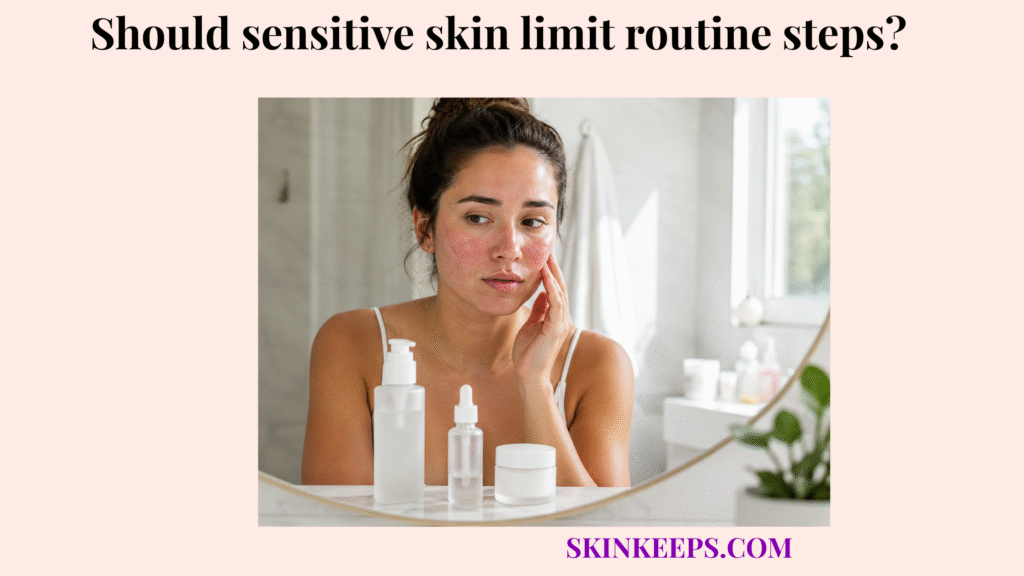
Yes, sensitive skin often benefits from limiting routine steps when the skin is stinging, burning, itching, tight, peeling, flushing, breaking out, or reacting unpredictably. Fewer steps can reduce ingredient exposure, application friction, active overlap, formula conflict, trigger confusion, and overcorrection during flares. Sensitive skin does not always need the shortest possible routine forever.
This article explains why fewer steps may help, which steps are usually essential, which steps are optional, when to simplify immediately, when a longer routine may still be tolerated, how to reintroduce steps, how to track whether simplification helps, and when professional care is needed.
Why Can Fewer Routine Steps Help Sensitive Skin?
Fewer routine steps can help sensitive skin by reducing ingredient exposure, application friction, active overlap, and trigger confusion. A shorter routine lowers the number of formulas, textures, active substances, and rubbing events that touch reactive skin during one routine cycle.
Limiting routine steps can reduce several skincare habits that irritate sensitive skin, including repeated layering, rubbing, active overlap, and adding products during flares.
How Do Fewer Steps Reduce Cumulative Skin Exposure?
Fewer steps reduce cumulative skin exposure by limiting how many formulas, ingredients, textures, and active substances contact the skin each day. This does not mean every product is bad; it means optional exposure should be easier to justify when skin is reactive.
Why Do Simplified Routines Make Triggers Easier to Identify?
Simplified routines make triggers easier to identify because fewer products and steps leave fewer possible causes when a reaction appears. A stable baseline helps show whether symptoms improve after a step is removed or return after a step is reintroduced.
| Limiting routine steps may reduce | Why it matters for sensitive skin |
|---|---|
| Ingredient exposure | Fewer possible irritants touch the skin. |
| Application friction | Less rubbing occurs during layering. |
| Active overlap | The chance of combined irritation may decrease. |
| Formula conflict | Fewer textures and actives interact on the skin. |
| Trigger confusion | Reactions become easier to trace. |
| Barrier stress | Skin receives fewer repeated exposures. |
| Overcorrection | The reader is less likely to add products to fix product-caused irritation. |
How Routine Steps Increase Exposure Variables
Each added step can add ingredient contact, rubbing, active overlap, formula interaction, and trigger confusion. The goal is the fewest effective, well-tolerated steps during reactivity.
Figure 1. Routine simplification lowers exposure variables and trigger confusion, but it does not prove that every long routine is harmful.
Does Sensitive Skin Always Need a Minimal Routine?
No, sensitive skin does not always need the shortest possible routine forever. Some people tolerate several carefully chosen steps when each product has a clear purpose, was introduced gradually, and remains comfortable after the full routine.
The better rule is that sensitive skin should limit steps when the routine is causing symptoms, but it does not need to avoid every optional step if the skin is calm and the products are well tolerated.
Which Skincare Steps Are Usually Essential for Sensitive Skin?
The usually essential steps for sensitive skin are gentle cleansing when needed, moisturizer when helpful, and daytime sun protection when skin will be exposed to sunlight. “When needed” matters because a step should match a real residue, comfort, protection, or condition-specific need.
| Step type | Role in sensitive skin | Usually essential or optional? |
|---|---|---|
| Gentle cleansing | Removes sweat, sunscreen, makeup, and residue when needed. | Essential when needed |
| Moisturizer | Supports comfort when skin feels dry, tight, or reactive. | Often essential |
| Daytime sun protection | Helps reduce sun-related irritation and damage risk. | Essential for daytime exposure |
| Treatment active | Targets acne, pigmentation, texture, or aging concerns. | Optional or condition-specific |
| Toner | May hydrate or treat, but is not always needed. | Optional |
| Essence | Adds an extra hydration layer. | Optional |
| Serum | Depends on the active and the skin goal. | Optional |
| Face oil or balm | May support dryness but can feel heavy for some skin. | Optional |
| Mask | Provides occasional support or treatment. | Optional |
| Scrub or exfoliant | Is not required for basic skin health. | Optional and often risky |
Which Routine Steps Are Easiest to Remove First?
The easiest routine steps to remove first are optional, duplicated, irritating, fragranced, trendy, or unclear-purpose products. Removal should begin with steps that provide the least necessary value or repeatedly produce warning sensations.
A routine should not keep harsh cleansing habits as the basic step, because even a simplified routine can remain irritating if cleansing is too aggressive.
First Steps to Question
- Extra toners without a clear purpose.
- Multiple serums serving the same goal.
- Daily exfoliating steps.
- Strong active treatments during irritation.
- Masks used several times weekly.
- Fragranced finishing products.
- Duplicate moisturizers layered without need.
- Face oils or balms that trap heat or cause bumps.
- Products added only because they are trendy.
- Steps that repeatedly sting, burn, itch, or tighten the skin.
When Should Sensitive Skin Limit Routine Steps Immediately?
Sensitive skin should limit routine steps immediately when the routine causes burning, stinging, peeling, rawness, rash-like irritation, swelling, or sudden intolerance to basic products. During burning, peeling, or rawness, harsh exfoliants should be paused before optional routine steps are rebuilt.
| Skin situation | Better routine decision |
|---|---|
| Skin burns or stings during the routine. | Simplify immediately. |
| Moisturizer suddenly stings. | Pause optional steps. |
| Skin is peeling or raw. | Stop exfoliants and strong actives. |
| Rash-like irritation appears. | Reduce variables and assess. |
| Skin reacts to several products. | Return to tolerated basics. |
| A new routine caused symptoms. | Remove recent additions. |
| Skin is recovering from sun, wind, or over-exfoliation. | Keep steps minimal. |
| Eye or eyelid area reacts. | Avoid unnecessary products near that area. |
How Is Limiting Routine Steps Different From Avoiding Too Many Products?
Limiting routine steps focuses on how simple the routine structure should become, while avoiding too many products focuses on total formula exposure. Routine step limitation explains how simple the routine should become, while using too many products explains how total formula exposure can overwhelm sensitive skin.
| Topic | Main focus | Example |
|---|---|---|
| Limiting routine steps | Deciding how simple the routine should be. | Removing optional steps during irritation. |
| Product overload | Too many formulas overwhelming the skin. | Several products causing cumulative exposure. |
| Step simplification | Reducing routine structure. | Cleanse, moisturize, protect, then reassess. |
| Product reduction | Reducing total formula count. | Stop duplicate serums and overlapping actives. |
| Main goal | Barrier comfort and trigger clarity. | Lower irritation burden and identify triggers. |
Simple Rule
Product overload explains why too many formulas can irritate. Routine step limitation explains how simple the routine should become when skin is reactive.
Can a Long Routine Be Safe for Sensitive Skin?
Yes, a longer routine can be safe for sensitive skin when every step is well tolerated, non-duplicative, introduced slowly, and serving a clear purpose. Long routines become risky when they add duplicate products, repeated rubbing, strong active overlap, or unclear variables during irritation.
Longer Routine May Be Tolerated When
- Skin is calm and stable.
- Products were introduced one at a time.
- No step causes stinging, burning, itching, or tightness.
- Strong actives are not layered aggressively.
- The routine has no unnecessary duplicates.
- The person can identify what each product does.
- Skin remains comfortable after the full routine.
What Signs Show a Routine Has Too Many Steps for Sensitive Skin?
A routine may have too many steps for sensitive skin when symptoms worsen as layers accumulate and improve on simpler routine days. Timing matters because irritation near the final layers often points toward layering, friction, or cumulative exposure.
Too-Many-Steps Warning Signs
- Skin feels worse after the full routine than before it.
- Irritation begins near the final layers.
- The routine takes repeated rubbing to apply.
- Sunscreen or makeup stings over previous layers.
- Skin feels hot, heavy, itchy, or tight after layering.
- The person cannot identify which product caused the reaction.
- Optional products are used even during flares.
- Several products serve the same purpose.
- Skin improves on days with fewer steps.
- Reactions return when the full routine is restarted.
How Should Sensitive Skin Simplify Routine Steps?
Sensitive skin should simplify routine steps by pausing optional products first and keeping only the tolerated steps that cleanse when needed, moisturize when helpful, and protect during daytime exposure. The goal is exposure reduction and clearer interpretation, not a permanent rule against every optional product.
Routine Simplification Protocol
- Stop optional products first.
- Pause exfoliants, strong actives, and duplicate treatments during irritation.
- Keep only steps the skin clearly needs and tolerates.
- Use gentle cleansing only as needed.
- Keep moisturizer if it is tolerated and helpful.
- Keep daytime protection when sun exposure is expected.
- Avoid adding replacements immediately.
- Watch whether stinging, burning, itching, tightness, bumps, or peeling improves.
- Keep the simplified routine stable before reintroducing steps.
Which Steps Should Not Be Removed Without Thinking?
Some routine steps should not be removed without thinking because sensitive skin still needs protection, residue removal, comfort support, or medically directed care in certain situations. Limiting unnecessary steps is different from removing everything at once.
| Step | Why caution matters |
|---|---|
| Sunscreen during daytime exposure | Sun can worsen irritation risk and skin damage risk. |
| Prescribed treatments | These should not be stopped casually without guidance. |
| Moisturizer when skin is dry or tight | Barrier comfort may worsen without support. |
| Gentle cleanser when makeup or sunscreen is worn | Residue may irritate if not removed properly. |
| Condition-specific care | Eczema, acne, rosacea, or dermatitis may need targeted management. |
How Should Sensitive Skin Reintroduce Routine Steps After Simplifying?
Sensitive skin should reintroduce routine steps one at a time while the rest of the routine remains stable. Readers may patch test new products where appropriate before adding a missing step back to the face, but home testing cannot exclude every delayed or facial reaction.
Step-Reintroduction Checklist
- Reintroduce one step at a time.
- Start with the most necessary missing step.
- Keep the rest of the routine unchanged.
- Allow enough observation before adding another step.
- Avoid restarting several active products together.
- Use lower frequency for treatment steps.
- Stop the newest step if symptoms return.
- Keep notes on timing and reaction.
- Do not rebuild optional steps that had no clear benefit.
- Do not deliberately reintroduce a product that caused swelling, blistering, or severe pain.
How to Rebuild a Routine Without Losing Trigger Clarity
Simplify to a stable baseline, observe comfort, reintroduce one step, then assess symptoms before adding another step.
Figure 2. One-at-a-time reintroduction preserves trigger clarity and prevents the routine from becoming complex again too quickly.
How Can Someone Decide Whether a Step Deserves to Stay?
A routine step deserves to stay when it solves a clear problem, remains well tolerated, and is not duplicated by another product. Owning a product, liking the texture, or seeing a marketing claim is not the same as needing the step.
| Question | Why it matters |
|---|---|
| What problem does this step solve? | The answer prevents unnecessary layering. |
| Does my skin feel better with it? | The answer tests practical value. |
| Does my skin feel worse after it? | The answer identifies poor tolerance. |
| Is another product already doing this job? | The answer removes duplication. |
| Is this step essential daily or only occasional? | The answer reduces exposure frequency. |
| Did I add this during a flare? | The answer may reveal emotional overcorrection. |
| Can I remove it without losing benefit? | The answer supports simplification. |
| Does it cause warning sensations? | The answer suggests the step may not belong. |
What Mistakes Make Routine Step Limitation Ineffective?
Routine step limitation becomes ineffective when removed products are replaced immediately, essential protection is removed, or several steps are reintroduced together. The result is a routine that looks simpler for a moment but still contains too many variables.
| Mistake | Why it backfires |
|---|---|
| Removing one product but adding two replacements | Routine complexity stays high. |
| Stopping all steps without considering sunscreen or prescriptions | Necessary protection or care may be removed. |
| Simplifying for only one day | The pattern may remain unclear. |
| Reintroducing several steps together | The true trigger becomes hidden. |
| Keeping duplicate serums | The benefit of simplification is reduced. |
| Using a harsh cleanser as the basic routine | The simplified routine can remain irritating. |
| Adding calming products during every flare | More variables are created. |
| Judging a step by marketing claims | Actual tolerance evidence is missed. |
How Should Someone Track Whether Fewer Steps Help Sensitive Skin?
Someone should track whether fewer steps help sensitive skin by recording step count, removed products, kept products, symptom changes, and reactions after each reintroduced step. Tracking supports pattern recognition but does not diagnose contact dermatitis, eczema, allergy, rosacea, or infection.
Routine Step Tracking Worksheet
- Total number of morning steps.
- Total number of evening steps.
- Products removed during simplification.
- Products kept during simplification.
- Symptoms before reducing steps.
- Symptoms after reducing steps.
- Whether stinging, burning, itching, tightness, peeling, or bumps improved.
- Whether sunscreen, moisturizer, or cleanser became more comfortable.
- Date each step was reintroduced.
- Reaction after each reintroduced step.
- Whether symptoms returned with routine complexity.
- Photographs of visible reactions if needed.
When Should Routine-Related Sensitivity Be Professionally Evaluated?
Routine-related sensitivity should be professionally evaluated when symptoms are severe, persistent, spreading, swollen, blistering, painful, or unchanged after routine simplification. Persistent, severe, spreading, swollen, blistering, or unclear reactions are reasons to see a dermatologist.
A clinician may assess contact dermatitis, eczema, rosacea, acne, infection, allergy, or another skin condition when routine simplification does not explain the reaction.
Professional Evaluation Checklist
- Skin reacts even to a minimal tolerated routine.
- Water or basic products sting or burn.
- Burning, itching, or pain is severe or persistent.
- Rash spreads or repeatedly returns.
- Skin swells, blisters, oozes, crusts, or bleeds.
- Eye or eyelid reactions occur.
- Skin becomes deeply cracked or infected-looking.
- Symptoms do not improve after routine simplification.
- Reactions interfere with sleep or daily comfort.
- Eczema, dermatitis, allergy, rosacea, infection, or another condition is suspected.
Urgent Safety Note
Breathing difficulty, throat tightness, faintness, or rapid facial, lip, or tongue swelling requires emergency medical care.
What Should You Remember About Limiting Routine Steps and Sensitive Skin?
Sensitive skin needs the simplest effective routine it can tolerate, not automatically the shortest routine possible.
What Should You Remember?
- Sensitive skin often benefits from limiting routine steps during irritation.
- Fewer steps can reduce ingredient exposure, friction, active overlap, and trigger confusion.
- Sensitive skin does not always need the shortest routine forever.
- Essential steps should be separated from optional steps.
- Gentle cleansing is needed only when residue, sunscreen, sweat, or makeup must be removed.
- Moisturizer is often useful when skin feels dry, tight, or reactive.
- Daytime sun protection should not be removed casually when sun exposure is expected.
- Optional steps should be paused first during irritation.
- Duplicate products are strong candidates for removal.
- Steps should be reintroduced one at a time.
- A longer routine may be tolerated when every step is stable, useful, and comfortable.
- Severe reactions should not be deliberately reproduced.
- Persistent, spreading, swollen, blistering, oozing, painful, or recurring reactions need professional evaluation.
Frequently Asked Questions
Does Sensitive Skin Need a Minimal Routine?
Sensitive skin does not always need the shortest routine. It needs a routine that contains only useful, well-tolerated steps. During irritation, fewer steps often make reactions easier to calm and understand.
How Many Routine Steps Are Too Many for Sensitive Skin?
No universal number applies to everyone. A routine has too many steps when products duplicate each other, cause warning symptoms, create trigger confusion, or make the skin feel worse after the full routine.
What Steps Should Sensitive Skin Keep?
Sensitive skin usually keeps gentle cleansing when needed, moisturizer when helpful, and daytime sun protection during sun exposure. Treatment products are optional or condition-specific unless prescribed or medically directed.
Should Sensitive Skin Stop All Products During a Flare?
Not automatically. Recently added, optional, duplicated, or clearly irritating products are usually the first to pause. Sunscreen, moisturizer, gentle cleansing, or prescribed care may still matter depending on the situation.
How Should Steps Be Added Back?
Steps should be added back one at a time while the rest of the routine stays stable. The newest step should be stopped if stinging, burning, itching, tightness, peeling, or rash-like irritation returns.
Can a Long Routine Ever Work for Sensitive Skin?
Yes. A longer routine can work when each step has a clear purpose, was introduced gradually, remains comfortable, and does not duplicate another product or create active overlap.
Conclusion
Sensitive skin should limit routine steps when the full routine increases irritation, trigger confusion, or poor tolerance to basic products. Fewer steps can reduce exposure, friction, and active overlap, but routine length alone is not the problem.
Each step should have a clear purpose, optional or duplicated steps should be paused first, and steps should return one at a time. A longer routine can be tolerated when the skin is calm and each step is useful. The best routine for sensitive skin is the simplest effective routine the skin can consistently tolerate.
Sources & Evidence
American Academy of Dermatology — Sensitive Skin Care Tips
Supports gentle product selection, avoiding irritating products, and seeking care when irritation persists.
[AAD]American Academy of Dermatology — Face Washing Guidance
Supports gentle cleansing, avoiding scrubbing, and using lukewarm water when skin is reactive.
[AAD]American Academy of Dermatology — Sunscreen FAQs
Supports maintaining daytime sun protection when sun exposure is expected.
[AAD]DermNet — Sensitive Skin
Supports the role of stinging, burning, itching, flushing, product intolerance, and repeated triggers in sensitive skin.
[DermNet]DermNet — Irritant Contact Dermatitis
Supports friction, water, soaps, cosmetics, retinoids, and benzoyl peroxide as possible irritant exposures.
[DermNet]Draelos, 2018 — The Science Behind Skin Care: Moisturizers
Supports moisturizer use for barrier comfort and the importance of formula tolerance.
[PubMed]Draelos, 2018 — The Science Behind Skin Care: Cleansers
Supports cleanser formulation differences and why cleansing should remain gentle when used as a basic step.
[PubMed]Disclaimer: This article provides general educational information and does not diagnose or treat irritant contact dermatitis, allergic contact dermatitis, eczema, rosacea, acne, infection, or another skin condition. Stop using clearly irritating products and seek professional advice for severe, persistent, recurrent, spreading, blistering, swollen, oozing, bleeding, painful, or eye-area reactions. Breathing difficulty, throat tightness, faintness, or rapid facial, lip, or tongue swelling requires urgent medical care.