
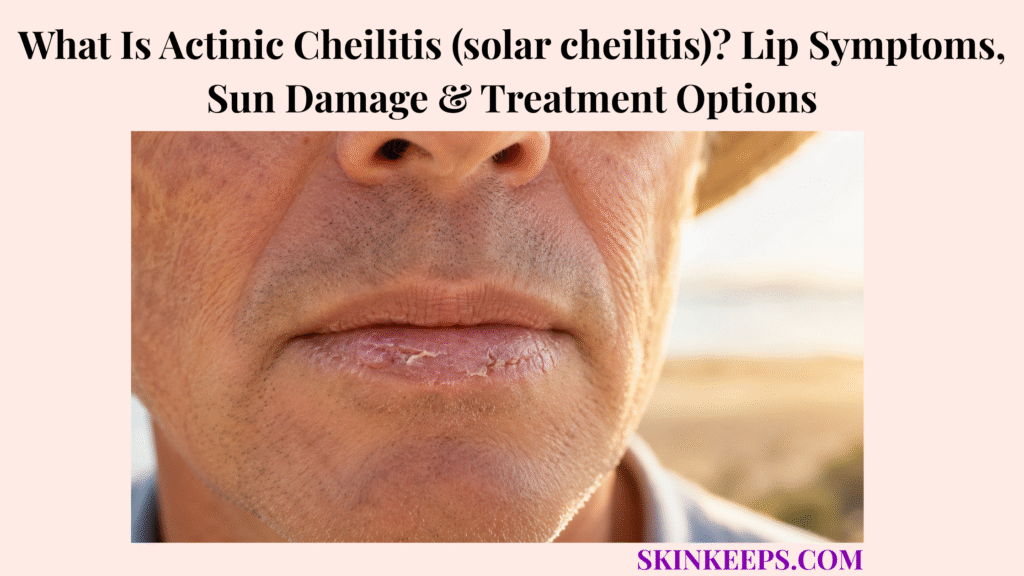
Actinic cheilitis, also called solar cheilitis, is chronic sun damage on the lips that can cause persistent dryness, scaling, roughness, white patches, crusting, or lip-border blurring. It often affects the lower lip and may resemble stubborn chapped lips, but it is not ordinary dryness when it persists or changes.
This guide explains lip symptoms, lower-lip sun damage, risk factors, diagnosis, biopsy logic, treatment options, daily lip protection, mistakes, and urgent signs. Because actinic cheilitis can be precancerous, persistent, ulcerated, bleeding, tender, thickened, or enlarging lip changes should be checked by a dermatologist or qualified clinician.
What Is Actinic Cheilitis and Why Is It Called Solar Cheilitis?
Actinic cheilitis, also called solar cheilitis, is a chronic sun-damage condition of the lips and is considered the lip form of actinic keratosis.
The word solar points to sun exposure, while cheilitis refers to lip inflammation or lip involvement. When sun-related actinic keratosis affects the lip, the lip-specific name is actinic cheilitis.
This condition is more serious than ordinary chapping because it reflects chronic UV injury and can be a precancerous lip lesion. It does not mean cancer is already present, but persistent lower-lip changes deserve clinician review.
| Feature | Actinic cheilitis | Ordinary chapped lips |
|---|---|---|
| Main driver | Chronic UV damage | Dryness, weather, licking, irritation |
| Common location | Often lower lip | Can affect both lips |
| Texture | Rough, scaly, sandpapery, thickened | Dry, cracked, peeling |
| Duration | Persistent or recurring | Often improves with barrier care |
| Border change | Vermilion border may blur | Lip border usually stays clear |
| Safety meaning | Precancerous evaluation may be needed | Usually routine care unless persistent |
| Action | Dermatologist or clinician review | Gentle barrier care first |
Practical rule: Actinic cheilitis should be treated as chronic lip sun damage, not as ordinary chapped lips.
How does actinic cheilitis affect the lower lip?
Actinic cheilitis affects the lower lip more often because the lower lip receives repeated sun exposure and has less natural protection than surrounding skin.
Lower-lip vulnerability comes from frequent exposure, thinner lip tissue, and less protective pigment. The vermilion border, meaning the line between the colored lip and nearby skin, may become less clear when chronic sun damage changes the lip surface.
Why is actinic cheilitis more serious than ordinary chapped lips?
Actinic cheilitis is more serious than ordinary chapped lips because it can represent precancerous sun damage rather than short-term dryness.
Chapped lips often improve with barrier care. Actinic cheilitis may persist, scale, thicken, ulcerate, or blur the lip border, so ongoing lower-lip roughness should be evaluated by a clinician.
What Actinic Cheilitis Symptoms Appear on the Lips?
Actinic cheilitis symptoms can include persistent dryness, scaling, roughness, white thickened patches, fissuring, crusting, soreness, swelling, and loss of the clear line between the lip and surrounding skin.
Symptoms may feel like stubborn dryness at first. The safety issue is persistence, lower-lip dominance, texture change, and whether one area becomes more tender, thickened, ulcerated, or non-healing.
How does early actinic cheilitis feel on the lip?
Early actinic cheilitis may feel like persistent dry, tight, rough, or sandpapery skin on the lower lip.
Early symptoms can be subtle, and ordinary balm may not fully resolve the texture. Every dry lip is not actinic cheilitis, but persistent lower-lip roughness needs attention.
What visible changes suggest actinic cheilitis?
Visible changes that suggest actinic cheilitis include scaly patches, white or discolored areas, thickened plaques, fissures, crusts, and a blurred vermilion border.
Visible signs may look pale, white, yellowish, red, or uneven. Color alone is not enough for self-diagnosis; duration, texture, border change, and lower-lip location matter.
Which actinic cheilitis symptoms suggest progression?
Actinic cheilitis symptoms suggest progression when one area becomes persistently ulcerated, crusted, focally tender, thickened, bleeding, or nodular.
Focal tenderness, a persistent ulcer, or an enlarging nodule needs prompt professional review. These changes do not prove squamous cell carcinoma, but they can trigger biopsy discussion.
| Lip sign | What it may look or feel like | Why it matters |
|---|---|---|
| Persistent dryness | Lower lip stays dry despite balm | Can mimic chapped lips |
| Scaling | Flaky or rough lip surface | Suggests chronic surface damage |
| Sandpapery texture | Lip feels rough when rubbed lightly | Common actinic pattern |
| White thickened patch | Pale, white, or yellowish thick area | May need evaluation |
| Blurred lip border | Lip-skin line becomes less clear | Classic sun-damage clue |
| Fissuring or crusting | Cracks, scabs, or crusted areas | Can reflect progression or irritation |
| Focal tenderness | One spot becomes sore or tender | Red flag for SCC concern |
| Persistent ulcer | Non-healing open area | Needs prompt review |
| Enlarging nodule | Growing lump or thick area | Needs biopsy discussion |
Practical rule: Actinic cheilitis symptoms matter most when they persist, thicken, ulcerate, bleed, or localize to the lower lip.
What Causes Actinic Cheilitis Through Sun Damage?
Actinic cheilitis is mainly caused by repeated, long-term ultraviolet exposure that damages lip cells over time.
Cumulative UV radiation can injure lip tissue and create persistent roughness, scaling, thickening, color change, or border blurring. That chronic sun-damage pattern is why evaluation and lip protection both matter.
Why does UV exposure damage lip skin?
UV exposure damages lip skin because lip tissue is thin, frequently exposed, and less naturally protected than many surrounding skin areas.
Long-term cumulative exposure can affect the lower lip because it receives direct light and has reduced pigment protection. This is why sun damaged lips may show roughness before a person thinks of a medical condition.
Why does actinic cheilitis usually develop slowly?
Actinic cheilitis usually develops slowly because lip damage often builds through years of repeated sun exposure and repeated sunburned-lip episodes.
Outdoor work, outdoor hobbies, and repeated unprotected exposure can contribute to gradual texture change and gradual color change. The slow pattern can make the condition easy to dismiss as dryness.
How are actinic cheilitis and actinic keratosis connected?
Actinic cheilitis and actinic keratosis are connected because actinic cheilitis is essentially the lip form of sun-related actinic keratosis.
Actinic keratosis is part of the sun-damage family of precancerous growths. When that process appears on the lip, especially the lower lip, the term actinic cheilitis is used.
Practical rule: Actinic cheilitis is a chronic UV-damage problem, so sun protection and medical evaluation both matter.
Who Is More Likely to Develop Actinic Cheilitis?
Actinic cheilitis is more likely in people with long-term sun exposure, fair skin, outdoor work history, older age, and low use of lip sun protection.
Risk does not belong to one group only. Exposure history, pigment protection, outdoor work, immune status, smoking context, and prior photodamage can all change the threshold for evaluation.
How does outdoor work increase actinic cheilitis risk?
Outdoor work increases actinic cheilitis risk by exposing the lower lip to repeated ultraviolet radiation during daily or seasonal work.
Farmers, sailors, construction workers, and lifeguards are examples of people with repeated outdoor exposure. Indoor workers can still develop actinic cheilitis if lip UV exposure accumulates over time.
How do skin type, age, and geography affect actinic cheilitis risk?
Skin type, age, and geography affect actinic cheilitis risk because fair skin, cumulative exposure, strong UV climates, and high-altitude or equatorial settings can increase lip sun damage.
Fair skin is a risk factor, but actinic cheilitis is a sun-damage condition rather than a normal skin type. SkinKeeps explains how different skin types can respond differently to external stress while still needing protection.
How can smoking or immune suppression affect lip cancer risk?
Smoking or immunosuppression can affect lip cancer risk by adding risk context when actinic cheilitis is already present or suspected.
Smoking, immune suppression, HPV context, alcohol use, prior skin cancer, and heavy photodamage can lower the threshold for careful monitoring. This is risk-context language, not blame.
- Long-term outdoor work.
- Frequent sun exposure without lip protection.
- Fair skin or low pigment protection.
- Older age with cumulative sun damage.
- History of sunburned lips.
- Living or working in high-UV settings.
- Immunosuppression.
- Smoking or tobacco history.
- Prior skin cancer or heavy photodamage.
Practical rule: Actinic cheilitis risk increases when chronic UV exposure and limited lip protection overlap.
How Is Actinic Cheilitis Different From Other Lip Problems?
Actinic cheilitis can resemble ordinary dryness, irritation, allergic lip inflammation, cold sores, or angular cheilitis, but persistent lower-lip roughness with sun-damage signs deserves medical evaluation.
This comparison is not for self-diagnosis. It helps show when “just dry lips” may not be enough, especially when symptoms persist, thicken, crust, bleed, or affect one lower-lip area repeatedly.
How is actinic cheilitis different from chapped lips?
Actinic cheilitis is different from chapped lips because chapped lips often improve with barrier care, while actinic cheilitis may persist despite ordinary lip balm.
Persistent lower-lip roughness, scale, white patches, lip border loss, or thickened areas should not be managed as routine dryness forever. A clinician can separate ordinary irritation from chronic sun-damaged change.
How is actinic cheilitis different from angular cheilitis?
Actinic cheilitis is different from angular cheilitis because angular cheilitis usually affects the corners of the mouth, while actinic cheilitis usually affects the sun-exposed lower lip.
Mouth-corner cracking follows a different location pattern than lower-lip sun damage. Recurrent painful cracking at the corners fits the topic of angular cheilitis more directly than actinic cheilitis.
How is actinic cheilitis different from cold sores?
Actinic cheilitis is different from cold sores because cold sores tend to blister and recur, while actinic cheilitis is chronic sun damage that persists as roughness, scale, or thickening.
Cold sores are commonly linked with recurrent blistering rather than a chronic rough lip surface. A persistent or changing lip lesion should still be checked, especially if it becomes crusted, bleeding, or non-healing.
| Condition | Common location | Key clue | When to seek care |
|---|---|---|---|
| Actinic cheilitis | Lower lip / vermilion border | Persistent roughness, scale, border blurring | Persistent, ulcerated, tender, thickened, nodular, or non-healing |
| Chapped lips | Often both lips | Dryness improves with barrier care | If persistent or one-sided/focal |
| Angular cheilitis | Mouth corners | Cracking or soreness at corners | If recurrent, painful, or infected-looking |
| Cold sore | Lip edge or nearby skin | Blisters, tingling, recurrent outbreaks | If severe, unusual, or not healing |
| Contact cheilitis | Area touched by irritant/allergen | Itch, redness, swelling after exposure | If repeated or severe |
| Lip SCC concern | Focal area on lip | Non-healing ulcer, lump, bleeding, tenderness | Prompt medical review |
Practical rule: Actinic cheilitis should be considered when lower-lip roughness persists instead of behaving like ordinary chapping.
How Is Actinic Cheilitis Diagnosed or Checked?
Actinic cheilitis is often diagnosed clinically, but biopsy may be needed when skin cancer or another inflammatory lip condition is suspected.
A clinician looks at lower-lip involvement, texture, duration, border clarity, ulceration, thickening, tenderness, and treatment response. Biopsy enters the decision when a lesion is suspicious, resistant, unclear, or changing.
What does a clinician look for in actinic cheilitis?
A clinician looks for actinic cheilitis by checking lower-lip involvement, sandpapery texture, white scale or plaque, blurred vermilion border, ulceration, thickening, and surrounding sun damage.
The lower lip comes first because it is the classic sun-exposed site. Visual exam helps, but it does not always exclude squamous cell carcinoma when focal red flags are present.
When might actinic cheilitis need a biopsy?
Actinic cheilitis might need a biopsy when the lip has a persistent ulcer, enlarging nodule, suspicious thickening, focal tenderness, treatment resistance, or unclear diagnosis.
Biopsy is a diagnostic tool used to clarify suspicious or uncertain lip changes. It is not required for every early dry or scaly lip change, but it should not be delayed when red flags exist.
What should someone prepare before an actinic cheilitis appointment?
Before an actinic cheilitis appointment, prepare the symptom timeline, photos, sun exposure history, outdoor work history, tobacco history, prior lip treatments, and any non-healing changes.
Bring product names and treatment attempts, including balms, acids, exfoliants, or other lip products. Mention bleeding, pain, crusting, ulceration, thickening, or one spot changing faster than the rest.
- How long the lip symptoms have been present.
- Whether the lower lip is the main area.
- Photos showing change over time.
- History of outdoor work or repeated sun exposure.
- History of sunburned lips.
- Tobacco or smoking history.
- Immunosuppression or prior skin cancer history.
- Lip balms, acids, exfoliants, or treatments already tried.
- Any bleeding, pain, crusting, ulceration, thickening, or non-healing area.
- Whether one focal spot is changing faster than the rest.
Practical rule: Actinic cheilitis should be checked by a clinician because visual similarity to chapped lips can delay diagnosis.
What Actinic Cheilitis Treatment Options Are Commonly Used?
Actinic cheilitis treatment depends on the number, location, appearance, severity, and cancer-risk features of the lip changes.
Treatment categories should be dermatologist-led, not DIY. Suspicious lesions may need biopsy discussion before treatment so that squamous cell carcinoma is not missed.
How do sun protection and smoking cessation support actinic cheilitis treatment?
Sun protection and smoking cessation support actinic cheilitis treatment by reducing further UV injury and lowering avoidable lip-cancer risk context where relevant.
Year-round lip sun protection, a wide-brim hat, and SPF lip balm can reduce ongoing UV exposure. Smoking cessation should be framed as supportive risk reduction, not blame.
Which topical treatments may be used for actinic cheilitis?
Topical treatments for actinic cheilitis may include clinician-selected 5-fluorouracil, imiquimod, topical retinoids, or photodynamic therapy in selected cases.
These are clinician-directed options, not general lip-care products. Healing expectations, irritation, follow-up, and whether a lesion needs biopsy should be discussed before treatment.
Which procedures may treat actinic cheilitis?
Procedures that may treat actinic cheilitis include cryotherapy, electrocautery, laser ablation, vermilionectomy, curettage, or excision when selected by a clinician.
Procedure choice depends on lesion extent, focal suspicion, and the overall clinical picture. Cosmetic outcome matters, but cancer-risk evaluation and function come first.
Why should actinic cheilitis treatment not be DIY?
Actinic cheilitis treatment should not be DIY because suspicious lip changes may need biopsy, and harsh self-treatment can delay diagnosis or worsen irritation.
The lip is delicate. Acids, scraping, bleaching, aggressive exfoliation, and repeated picking can irritate the area without ruling out SCC.
| Treatment option | Best fit | What it targets | Caution |
|---|---|---|---|
| Sun protection | All confirmed or suspected cases | Reduces further UV damage | Does not rule out cancer |
| Smoking cessation | Relevant tobacco users | Reduces added lip cancer risk context | Needs supportive framing |
| 5-fluorouracil | Selected field-type changes | Damaged actinic cells | Clinician-directed; irritation expected |
| Imiquimod | Selected cases | Immune-mediated clearance | Clinician-directed; irritation possible |
| Topical retinoids | Selected cases | Surface turnover/support | Not a DIY cure |
| Photodynamic therapy | Field-type actinic damage | Abnormal sun-damaged cells | Requires clinical setting |
| Cryotherapy | Focal lesions | Freezes abnormal tissue | Not for suspicious unbiopsied lesions without evaluation |
| Electrocautery | Selected focal lesions | Destroys abnormal tissue | Clinician procedure |
| Laser ablation | Diffuse or selected lip damage | Removes damaged surface layer | Requires healing and follow-up |
| Vermilionectomy | Extensive or high-risk disease | Removes affected vermilion tissue | Surgical option; specialist-led |
Practical rule: Actinic cheilitis treatment should be dermatologist-led because the main goal is to treat sun-damaged tissue while not missing squamous cell carcinoma.
How Can Daily Lip Protection Help Prevent Actinic Cheilitis From Worsening?
Lip protection can reduce further UV damage, but persistent or suspicious actinic cheilitis still needs professional evaluation.
Protection reduces ongoing injury, but it does not diagnose or clear suspicious lesions. The safest plan is protection plus clinician review when lower-lip changes persist or progress.
How should SPF lip balm be used for actinic cheilitis prevention?
SPF lip balm should be used before UV exposure and reapplied during outdoor time, especially after eating, drinking, sweating, or wiping the lips.
SPF lip balm supports ongoing protection for sun-exposed lips, but it is not treatment for a suspicious lesion. Persistent lower-lip roughness still needs evaluation.
How do hats and shade reduce actinic cheilitis risk?
Hats and shade reduce actinic cheilitis risk by lowering direct UV exposure to the lower lip during outdoor time.
A wide-brim hat, shade seeking, and outdoor job planning can lower direct exposure. Prevention helps, but no prevention step makes the lip risk-free.
What lip habits should be avoided with actinic cheilitis?
Lip habits to avoid with actinic cheilitis include picking scale, peeling crusts, harsh exfoliation, tanning-bed exposure, and smoking where relevant.
Picking or peeling can cause bleeding and make monitoring harder. Tanning beds and smoking add avoidable risk context without helping the sun-damaged lip heal.
- Use broad-spectrum SPF lip balm before outdoor exposure.
- Reapply lip SPF during long outdoor time.
- Reapply after eating or drinking.
- Wear a wide-brim hat outdoors.
- Seek shade during strong UV hours.
- Avoid tanning beds.
- Do not pick, peel, scrape, or exfoliate scale.
- Monitor any persistent, tender, bleeding, thickened, or non-healing area.
- Keep follow-up if actinic cheilitis has been diagnosed.
Practical rule: Lip protection is prevention support, not a substitute for evaluating suspicious actinic cheilitis.
What Actinic Cheilitis Mistakes Should You Avoid?
The biggest actinic cheilitis mistake is assuming persistent lower-lip roughness is only dryness and repeatedly treating it with ordinary balm while the sun-damaged area progresses.
Mistakes either delay diagnosis or irritate fragile lip tissue. Repeated scraping, peeling, exfoliating, bleaching, or ignoring treatment-resistant lesions can hide warning signs.
Why should persistent scaly lips not be ignored?
Persistent scaly lips should not be ignored because actinic cheilitis can look like chapped lips while still carrying precancerous potential.
Persistence matters, especially on the lower lip. Every scaly lip is not precancerous, but symptoms that do not resolve or show red flags should be evaluated earlier.
Why should you not scrape, peel, or exfoliate actinic cheilitis?
You should not scrape, peel, or exfoliate actinic cheilitis because mechanical irritation can cause bleeding, inflammation, delayed healing, and missed warning signs.
Removing scale does not remove underlying sun damage. It can make the lip more irritated and make it harder to judge whether the lesion is changing.
Why should you not use strong acids or bleaching products on actinic cheilitis?
Strong acids or bleaching products should not be used on actinic cheilitis because lip tissue is delicate and chemical irritation does not evaluate cancer risk.
Repeated burning, swelling, or rash after lip products may fit an allergic contact dermatitis pattern, but persistent sun-damaged lip changes still need clinician review rather than DIY acids or bleaching.
Why should treatment-resistant actinic cheilitis be rechecked?
Treatment-resistant actinic cheilitis should be rechecked because a persistent or worsening lip lesion may need biopsy or a different diagnosis.
Non-response is useful information. Persistent ulceration, thickening, nodules, focal tenderness, or a lesion that does not heal should trigger dermatologist follow-up.
| mistake | Risk | Better action |
|---|---|---|
| Treating persistent roughness as simple dryness | Delays diagnosis | Seek evaluation if it persists |
| Using only ordinary balm for suspicious patches | May miss precancerous change | Use balm for protection, not diagnosis |
| Scraping or peeling scale | Bleeding and irritation | Leave scale alone and get checked |
| Using harsh exfoliants | Lip tissue can burn or inflame | Avoid DIY acids |
| Using bleaching products | Irritation without cancer-risk evaluation | Ask a clinician |
| Ignoring treatment-resistant lesions | May miss SCC | Discuss biopsy |
| Skipping lip sun protection | Allows further UV damage | Use lip SPF and hat |
| Delaying care for ulcers or nodules | Increases risk of missed diagnosis | Prompt medical review |
Practical rule: Actinic cheilitis mistakes are dangerous when they make a persistent lip lesion look ordinary or delay biopsy discussion.
When Should Actinic Cheilitis Be Checked Urgently?
Actinic cheilitis should be checked promptly when the lip develops a persistent ulcer, enlarging nodule, focal tenderness, bleeding, crusting, thickening, or any non-healing area.
These signs do not prove cancer, but they do require prompt review because squamous cell carcinoma must be ruled out. A suspicious lip lesion should not be managed with lip balm alone.
Which actinic cheilitis signs may suggest lip cancer risk?
Actinic cheilitis signs that may suggest lip cancer risk include a non-healing sore, persistent ulcer, enlarging lump, bleeding, focal pain, or a thick hard area.
These signs may suggest a need for evaluation, not a self-diagnosis. SkinKeeps covers broader skin cancer warning context separately, but a changing lip lesion should be checked promptly.
When should actinic cheilitis need biopsy discussion?
Actinic cheilitis should prompt biopsy discussion when there is suspicious thickening, ulceration, treatment resistance, unclear diagnosis, focal tenderness, bleeding, or clinician concern for SCC.
Biopsy is a diagnostic tool, not a punishment or extreme step. Not all early cases need biopsy, but suspicious or resistant lesions need a clear plan.
Who should be especially careful with actinic cheilitis symptoms?
People with outdoor work history, older age, fair skin, prior skin cancer, immunosuppression, or smoking history should be especially careful with actinic cheilitis symptoms.
Higher-risk background lowers the threshold for evaluation. Persistent, thickened, tender, bleeding, or non-healing lip changes should be checked earlier in these groups.
Practical rule: Actinic cheilitis red flags should be checked promptly because biopsy may be needed to rule out squamous cell carcinoma.
What Should You Remember About Actinic Cheilitis?
Actinic cheilitis is not just dry lips; it is chronic sun damage on the lip that should be evaluated because of its precancerous potential.
The key pattern is persistent lower-lip roughness, scale, white thickening, crusting, border blurring, or non-healing change. Treatment should be dermatologist-led, and lifelong lip sun protection should continue after diagnosis or treatment.
Practical rule: Actinic cheilitis should be handled with the same seriousness as a precancerous sun-damage warning sign, while still avoiding panic or self-diagnosis.
Frequently Asked Questions About Actinic Cheilitis
Is actinic cheilitis the same as chapped lips?
No. Actinic cheilitis can resemble chapped lips, but it reflects chronic sun damage and may persist despite ordinary balm. Persistent lower-lip roughness, scaling, white thickening, ulceration, tenderness, bleeding, or border blurring should be checked by a qualified clinician.
Is actinic cheilitis cancer?
Actinic cheilitis is not the same as confirmed cancer, but it is considered premalignant or precancerous because it can progress to squamous cell carcinoma. That is why persistent or suspicious lower-lip changes need dermatologist evaluation rather than repeated self-treatment.
Does actinic cheilitis usually affect the lower lip?
Yes. Actinic cheilitis commonly affects the lower lip because it receives repeated sun exposure and has less natural protection than many surrounding skin areas. The upper lip can be involved, but persistent lower-lip roughness is a classic warning pattern.
Can lip balm treat actinic cheilitis?
Lip balm may protect and support comfort, especially if it includes sun protection, but it does not diagnose or safely treat suspicious actinic cheilitis. Persistent scaling, thickening, ulceration, bleeding, focal tenderness, or a growing area needs clinician review.
When does actinic cheilitis need biopsy discussion?
Biopsy discussion may be needed when actinic cheilitis has a persistent ulcer, enlarging nodule, suspicious thickening, focal tenderness, bleeding, treatment resistance, unclear diagnosis, or clinician concern for squamous cell carcinoma. Not every early case needs biopsy.
Sources & Evidence About Actinic Cheilitis
DermNet — Actinic Cheilitis / Solar Cheilitis was used for definition, lip form of actinic keratosis, lower-lip dominance, symptom range, premalignant framing, SCC suspicion signs, diagnosis, biopsy boundaries, general measures, and treatment categories.
StatPearls / NCBI Bookshelf — Actinic Cheilitis was used for precancerous lesion context, lower-lip location, chronic sun exposure cause, risk groups, lip vulnerability, biopsy logic, and treatment goals.
AAFP — Suspicious Lesion Under a Face Mask / Actinic Cheilitis was used for occupational UV risk, advanced lip features, biopsy-not-routine boundary for early changes, and biopsy indications for suspicious hyperkeratotic or nodular areas.
American Academy of Dermatology — Actinic Keratosis Overview was used for actinic keratosis as a sun-caused precancerous growth and for the naming of actinic cheilitis when actinic keratosis forms on the lip.
American Academy of Dermatology — Actinic Keratosis Diagnosis and Treatment was used for treatment-decision factors, clinician-led therapies, procedures, and laser resurfacing as an option for actinic cheilitis.
Cleveland Clinic — Actinic Cheilitis was used for patient-facing definition, long-term sun exposure cause, rough scaly discolored patches, lower-lip tendency, risk groups, lip vulnerability, prevention with sunscreen lip balm and brimmed hat, and evaluation guidance.
Educational Disclaimer: This article is for general skin education only and does not diagnose, treat, prescribe, or replace professional medical advice. If actinic cheilitis is suspected, or if the lip develops a persistent ulcer, enlarging nodule, focal tenderness, bleeding, crusting, thickening, non-healing area, or treatment-resistant change, consult a qualified dermatologist, doctor, or healthcare professional for evaluation and biopsy discussion when appropriate.