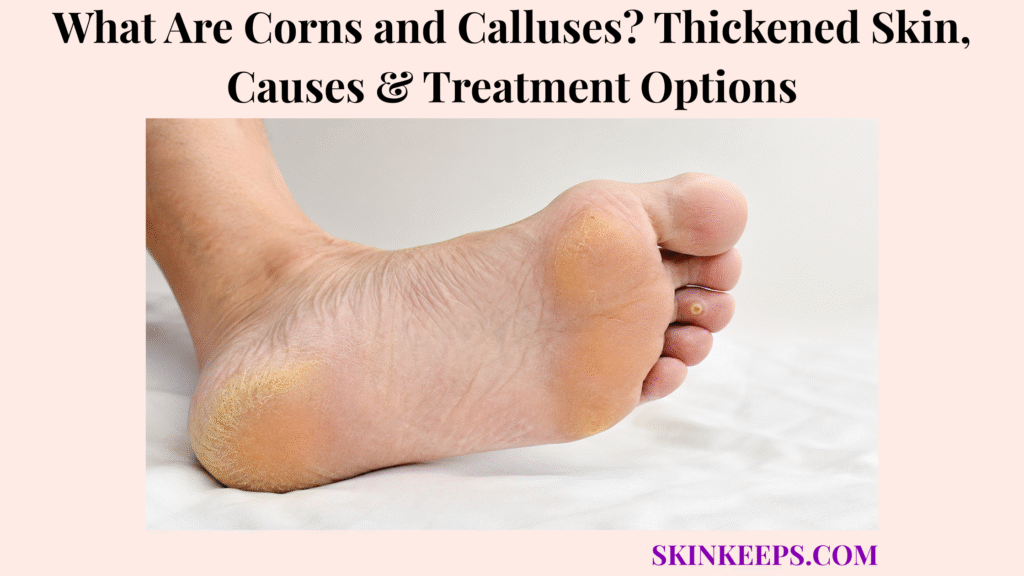
Corns and calluses are hard, thickened areas of skin that form when the skin protects itself from repeated pressure, rubbing, or friction.
Pressure relief is central because the same spot can return if the cause remains active. This page covers corn-vs-callus differences, symptoms, locations, causes, diagnosis, treatment, offloading, recurrence, mistakes, and doctor signs.
What Are Corns and Calluses and Why Does Skin Thicken?
Corns and calluses are hard, thickened areas of skin that form when the skin protects itself from repeated pressure, rubbing, or friction.
The outer skin layer can produce extra keratin when the same area is repeatedly compressed or rubbed. That thickening can protect deeper tissue at first.
When pressure continues, the thickened area can become painful, cracked, recurrent, or unsafe to self-treat, especially on high-risk feet.
Why Does Thickened Skin Form From Pressure?
Thickened skin forms from pressure because repeated rubbing or compression makes the outer skin produce extra keratin as a protective response.
This response is mechanical. A shoe seam, tight toe box, tool handle, bony toe shape, or walking pressure can repeatedly stress the same area.
Removing only the hard skin may give temporary relief, but treatment often fails when the pressure source stays active.
Why Are Corns and Calluses Not Infections by Default?
Corns and calluses are not infections by default because they are mechanical thickening from pressure or friction, not germs spreading through the skin.
They are not usually contagious and are not caused by dirt.
Broken, cracked, or over-filed thickened skin can become infected, so diabetes, neuropathy, poor circulation, previous ulcers, numb feet, bleeding, or open skin changes the safety plan.
Practical rule: Corn and callus care starts with identifying the pressure source, then offloading it safely.
How Are Corns Different From Calluses?
Corns are usually smaller, deeper, and more focused than calluses, while calluses are broader thickened patches caused by more diffuse pressure or friction.
They are related because both form from repeated mechanical stress, but the shape, location, pain pattern, and pressure source can differ.
What Makes a Corn Different?
A corn is usually a smaller, focused thickened spot that may have a hard central core and hurt when direct pressure is applied.
Corns may be round or cone-shaped and can form on toe tops, toe sides, between toes, or other pressure points.
Soft corns may form between moist toes where toe-to-toe pressure and moisture act together.
What Makes a Callus Different?
A callus is usually a larger, broader area of thickened skin caused by repeated pressure or friction across a wider surface.
Calluses often form on soles, heels, balls of the feet, palms, or fingers.
They may be painless unless they become thick, cracked, dry, inflamed, or press into deeper tissue during walking or gripping.
| Feature | Corn | Callus |
|---|---|---|
| Size | Smaller. | Larger or wider. |
| Depth | More focused and deeper. | More diffuse. |
| Core | May have hard center. | Usually broad thickening. |
| Pain | Often painful with direct pressure. | Often painless unless thick or cracked. |
| Common site | Toes, toe tops, between toes, pressure points. | Soles, heels, balls of feet, palms. |
| Main trigger | Shoe or toe pressure point. | Broad repeated friction or load. |
What Do Corns and Calluses Look and Feel Like?
Corns and calluses can look like rough, hard, thick, yellowish, gray, brown, or darker skin patches, and they may feel dry, waxy, tender, or painful when pressure is applied.
Skin tone, thickness, moisture, location, and friction pattern affect appearance. A callus on a sole may look different from a hand callus or a soft corn between toes.
What Symptoms Can Corns Cause?
Corns can cause a small hard bump, a central hard core, and pain when shoes or nearby toes press on the spot.
A corn may feel like a focused pebble-like pressure point in a shoe. Surrounding skin can become irritated, swollen, or sore.
Between toes, a soft corn may look white, rubbery, or macerated because moisture is trapped.
What Symptoms Can Calluses Cause?
Calluses can cause a broad rough patch of thickened skin that may feel dry, waxy, less sensitive, cracked, or painful when walking.
The patch may look yellow, gray, brown, darker, rough, thick, dry, or flattened.
A thick sole callus may cause deeper pressure pain, while a dry heel callus can crack and form fissures.
What Signs Suggest a Complication?
A corn or callus may be complicated when there is bleeding, an open sore, pus, increasing warmth, swelling, bad smell, black tissue, or pain in someone with diabetes or poor circulation.
Numbness or reduced sensation matters because a high-risk foot may not feel pain even when pressure damage is present.
Do not file, cut, acid-treat, or peel a lesion that is bleeding, cracked, open, infected-looking, ulcerated, black, blue, numb, or uncertain.
| Finding | What User May Notice | Why It Matters |
|---|---|---|
| Hard center | Focused painful spot. | Corn clue. |
| Broad thick patch | Larger pressure area. | Callus clue. |
| Soft white thickening | Between toes. | Soft corn / moisture friction clue. |
| Cracks | Dry split skin. | Infection risk. |
| Bleeding or open sore | Skin barrier broken. | Needs review. |
| Pus, warmth, bad smell | Infection concern. | Medical care. |
| Numbness / poor circulation | High-risk foot context. | Avoid self-treatment. |
Where Do Corns and Calluses Usually Appear?
Corns usually form on toes and pressure points, while calluses often form on the soles, heels, balls of the feet, palms, fingers, or other areas exposed to repeated rubbing.
Toe tops, toe sides, between toes, the ball of the foot, heel, sole, side of foot, palms, fingers, and knuckles are common locations.
Location helps identify pressure, but it does not confirm the diagnosis alone. Warts, ulcers, blisters, foreign bodies, cysts, or skin growths can overlap.
| Site | Common Pressure Source | Prevention Note |
|---|---|---|
| Top of toes | Shoe upper, hammertoe pressure. | Roomier toe box. |
| Between toes | Toe rubbing and moisture. | Toe spacing and dry fit. |
| Ball of foot | Forefoot load, high heels, gait pressure. | Cushioning and pressure redistribution. |
| Heel | Repeated walking, dry skin, shoe friction. | Moisturize and offload. |
| Sole | Weight-bearing pressure. | Insoles or orthotics if recurrent. |
| Side of foot | Shoe edge or bony prominence. | Better shoe fit. |
| Palms / fingers | Tools, weights, instruments. | Gloves or padding. |
| Knuckles | Repeated contact or friction. | Protect pressure points. |
What Causes Corns and Calluses?
Corns and calluses are caused by repeated friction or pressure, often from shoes, toe shape, foot mechanics, walking pattern, tools, sports equipment, or repeated hand activity.
The surface thickening is the visible part. The deeper cause is usually the pressure pattern that keeps stressing that site.
How Do Shoes Cause Corns and Calluses?
Shoes cause corns and calluses when they squeeze, rub, slide, press, or shift weight onto the same skin area repeatedly.
Tight shoes squeeze toes. Loose shoes allow the foot to slide and rub. High heels can shift pressure to the forefoot.
Narrow toe boxes, seams, sandals, stiff footwear, or bunched socks can create same-spot friction.
How Do Foot Shape and Walking Mechanics Contribute?
Foot shape and walking mechanics contribute when bones, toes, arches, or gait patterns create repeated pressure on one small area.
Bunions, hammertoes, mallet toes, prominent bones, high arches, flat feet, or uneven walking pressure can keep recreating the same lesion.
Recurring corns may need pressure redistribution, shoe modification, orthotics, or podiatry care rather than repeated surface removal.
How Do Hands Develop Calluses?
Hands develop calluses when tools, weights, sports equipment, musical instruments, or manual work repeatedly rub the same skin area.
Grip pressure can thicken skin on the palms, fingers, or knuckles.
Gloves, handle padding, technique adjustment, and breaks from repetitive pressure can reduce hand callus irritation.
| Cause | Skin Effect | Better Fix |
|---|---|---|
| Tight shoes | Toe compression. | Wider toe box. |
| Loose shoes | Repeated rubbing. | Better fit. |
| High heels | Forefoot pressure. | Lower heel / forefoot offloading. |
| Hammertoe / bunion | Bone pressure point. | Podiatry or orthotic plan. |
| Bunched socks | Local friction. | Smooth, well-fitting socks. |
| Long walking / standing | Repeated load. | Cushioning and pressure redistribution. |
| Tools / weights | Hand friction. | Gloves or handle padding. |
| Dry thick skin | Cracking risk. | Moisturize safely. |
Who Is More Likely to Get Corns and Calluses?
Corns and calluses are more likely when pressure is repeated on the same skin area, especially from footwear, foot shape, walking mechanics, tools, or activities.
Risk factors help identify the pressure source and the safety level for treatment.
- Tight or poorly fitting shoes.
- High heels.
- No socks or rough/bunched socks.
- Bunions, hammertoes, mallet toes, prominent bones, or foot deformity.
- Long walking, standing, running, or sports load.
- Manual work, tools, weights, or instruments.
- Older age with foot structure changes.
- Dry skin.
- Diabetes, neuropathy, poor circulation, reduced sensation, or previous foot ulcers.
Very dry thickened areas may crack more easily, so dry skin care can matter when calluses split or fissure.
How Are Corns and Calluses Different From Other Skin or Foot Problems?
Corns and calluses can resemble plantar warts, blisters, cracked heels, bunions, ulcers, foreign bodies, psoriasis, eczema, or skin growths, so location, pressure pattern, pain type, and skin markings matter.
Wrong treatment can create wounds, miss an ulcer, or delay care for a lesion that is not a corn or callus.
How Are Corns Different From Plantar Warts?
Corns usually form at pressure points, while plantar warts are HPV-related growths that may interrupt skin lines or show tiny dark dots.
Corns often hurt with direct downward pressure. Plantar warts may hurt more with side-to-side squeezing.
Diagnosis can be difficult on soles, so do not acid-treat or cut an uncertain thick foot lesion.
How Are Calluses Different From Blisters?
Calluses are hard thickened skin from repeated pressure, while blisters are fluid-filled pockets caused by friction, burns, or other skin injury.
A blister can form near or under a callus if pressure is high.
Do not pop or cut into a painful fluid-filled area under thickened skin, especially on a high-risk foot.
How Are Corns and Calluses Different From Ulcers?
Corns and calluses are closed thickened skin unless cracked or broken, while ulcers are open wounds that need medical care.
In diabetes, neuropathy, or poor circulation, a callus can hide deeper pressure damage underneath.
Open, draining, bleeding, painful, bad-smelling, black, blue, or non-healing areas should not be filed as routine callus.
How Are Corns and Calluses Related to Bunions or Hammertoes?
Bunions and hammertoes can create abnormal pressure points that cause corns or calluses to keep returning.
Corns may form where toes rub shoes or where toes rub against each other.
Surface treatment alone may fail if the toe shape, shoe fit, or gait pressure is still recreating the same problem.
| Condition | Main Clue | Why Confusion Happens | Safer Next Step |
|---|---|---|---|
| Corn | Small painful hard center. | Looks like wart or callus. | Offload pressure and confirm if uncertain. |
| Callus | Broad thick patch. | Looks like dry skin. | Reduce friction and moisturize safely. |
| Plantar wart | Skin-line disruption / dark dots. | Thick sole lesion. | Confirm diagnosis. |
| Blister | Fluid pocket. | Friction overlap. | Protect skin roof. |
| Ulcer | Open sore or drainage. | May hide under callus. | Medical care. |
| Bunion / hammertoe | Bone or toe deformity. | Causes recurring pressure. | Foot mechanics plan. |
| Foreign body | Sharp localized pain after puncture. | Thick skin may cover it. | Medical assessment if suspected. |
Itchy, scaling foot skin suggests a different process such as athlete’s foot, not a simple pressure callus.
Thick scaly plaques in a broader body pattern may need evaluation for psoriasis rather than routine corn removal.
Itchy inflamed hand or foot skin can also reflect eczema / dermatitis rather than a mechanical callus alone.
How Are Corns and Calluses Diagnosed or Checked?
Corns and calluses are usually diagnosed by examining the thickened skin and checking where pressure or friction is coming from.
A clinician or podiatrist may also check whether the lesion could be a wart, ulcer, cyst, foreign body, or another skin growth.
What Does a Clinician or Podiatrist Check?
A clinician or podiatrist checks the location of thickened skin, pain pattern, shoe fit, foot shape, walking mechanics, skin integrity, and whether the lesion could be a wart, ulcer, cyst, or foreign body.
The exam may include shoe wear pattern, toe deformity, arch shape, gait pressure, cracks, open areas, infection signs, sensation, and circulation.
High-risk patients may need foot-safety screening before any trimming, filing, acid product, or orthotic decision.
When Might Imaging or Further Assessment Be Needed?
Imaging or further assessment may be needed when pain is severe, recurrent, linked to deformity, suspicious for a foreign body, or present in a high-risk foot.
Further assessment may also be needed when a callus may be hiding an ulcer or when a bone pressure point keeps causing recurrence.
Imaging and pressure assessment are clinician-directed; they are not routine for every mild callus.
- Where the thickened skin appears.
- Whether direct pressure causes pain.
- Shoes worn most often.
- Sock fit or seams.
- Work, sports, tools, or instrument activity.
- Whether the lesion keeps returning.
- Cracks, bleeding, pus, odor, warmth, swelling, or open sore.
- Diabetes, neuropathy, poor circulation, heart disease, or prior foot ulcers.
- Reduced sensation or numb feet.
- Treatments already tried, including acid pads, filing, cutting, or creams.
What Treatment Options Help Corns and Calluses?
Corn and callus treatment starts by reducing the pressure or friction that caused the thickened skin, then safely softening, padding, or professionally reducing the hard skin if needed.
Treatment should be matched to risk. Low-risk mild thickened skin is different from a painful diabetic-foot callus or an uncertain lesion.
How Can Mild Corns and Calluses Be Treated at Home?
Mild corns and calluses in low-risk skin may improve with better-fitting shoes, non-medicated padding, brief soaking, gentle pumice use, and daily moisturizing.
Gentle filing should only be done on intact low-risk skin and should stop if pain, bleeding, burning, or irritation occurs.
Do not file, cut, or acid-treat thickened skin if you have diabetes, neuropathy, poor circulation, numb feet, previous ulcers, open skin, bleeding, or infection signs.
When Should a Podiatrist Trim or Reduce Thickened Skin?
A podiatrist should trim or reduce thickened skin when the corn or callus is painful, recurrent, difficult to reach, related to foot deformity, or present in a high-risk foot.
Professional trimming is controlled and sterile. It can reduce painful thickness while also checking for hidden ulceration, wart, cyst, foreign body, infection, or pressure injury.
People with diabetes, neuropathy, poor circulation, reduced sensation, or previous foot ulcers should use medical or podiatry care rather than self-cutting.
When Are Medicated Corn Removers Risky?
Medicated corn removers are risky when they contain acids that can burn nearby healthy skin, especially on high-risk feet or broken skin.
Salicylic-acid products can irritate healthy skin and increase infection risk, especially in diabetes or poor blood flow.
Do not use acid products on cracked, bleeding, infected, ulcerated, numb, high-risk, or uncertain lesions unless a clinician specifically advises.
When Are Orthotics or Surgery Considered?
Orthotics or surgery may be considered when recurring corns or calluses are driven by foot deformity, uneven pressure, or a structural problem that simple padding cannot fix.
Custom inserts, shoe modifications, toe spacers, or pressure redistribution can help when pressure is structural or gait-related.
Surgery is rarely needed and is reserved for selected structural causes after clinical evaluation.
| Situation | Treatment Direction | Key Caution |
|---|---|---|
| Mild low-risk callus | Shoe change, padding, moisturizer, gentle pumice. | Do not over-file. |
| Painful corn | Pressure relief + podiatry if persistent. | Core may recur. |
| Recurrent lesion | Check foot mechanics and shoes. | Surface removal alone fails. |
| Diabetes / poor circulation / neuropathy | Medical or podiatry care. | Avoid self-cutting and acid pads. |
| Cracked or bleeding callus | Protect skin + review. | Infection risk. |
| Suspected wart or ulcer | Confirm diagnosis. | Do not acid-treat as callus. |
| Deformity-related corn | Orthotics / footwear plan. | May need specialist care. |
How Can Shoes, Pads, and Offloading Prevent Corns and Calluses?
Corns and calluses usually return unless the pressure source is removed, so footwear, padding, socks, and offloading are part of treatment—not just prevention.
Choose shoes with enough toe room. Avoid narrow toe boxes, stiff pressure points, shoes that squeeze, and shoes that slide.
Use smooth socks, non-medicated cushioning, insoles, orthotics when advised, and gloves or tool padding for hand calluses.
- Choose shoes with enough toe room.
- Avoid narrow toe boxes.
- Avoid shoes that squeeze or slide.
- Reduce high-heel forefoot pressure if needed.
- Wear smooth, well-fitting socks.
- Use non-medicated cushioning or padding.
- Consider insoles or orthotics for uneven pressure.
- Replace worn shoes.
- Use gloves or padding for tool-related hand calluses.
- Stop footwear or equipment that causes same-spot pain.
How Can Recurrent Corns and Calluses Be Managed?
Recurrent corns and calluses usually mean the same pressure point is still active, even if the thick skin has been removed.
Check the exact return site, shoe fit, sock seams, toe shape, gait pressure, tool grip, sports equipment, and work activity.
Repeated painful lesions should be reviewed, especially when a bunion, hammertoe, foot deformity, uneven pressure, diabetes, neuropathy, poor circulation, or previous ulcer is present.
Recurrence map: Same spot returns → same pressure source → footwear / sock / toe shape / gait / tool trigger check → offloading plan → podiatry review if painful, recurrent, or high-risk.
What Corn and Callus Mistakes Should You Avoid?
The biggest corn and callus mistake is cutting or chemically burning thickened skin while the pressure source continues.
Do not cut corns or calluses with blades at home. Do not file until bleeding, peel thick skin, dig into a hard center, or use acid products on high-risk feet.
Do not ignore pain under a callus, open sores, pus, spreading warmth, bad smell, black or blue discoloration, numb feet, or a lesion that might be a wart or ulcer.
| Mistake | Why It Fails | Better Action |
|---|---|---|
| Cutting at home | Wound and infection risk. | Professional care if needed. |
| Acid plaster in high-risk foot | Burns and infection risk. | Clinician guidance. |
| Ignoring shoe pressure | Lesion returns. | Offload source. |
| Over-filing | Bleeding and cracks. | Gentle limited filing only in low-risk skin. |
| Assuming wart or ulcer is callus | Wrong treatment. | Confirm diagnosis. |
| Ignoring numb feet | Pain warning may be absent. | Foot-safe medical care. |
| Treating recurrence only at surface | Pressure source remains. | Footwear/mechanics review. |
When Should Corns and Calluses Be Checked by a Doctor or Podiatrist?
Corns and calluses should be checked by a doctor or podiatrist when they are painful, recurrent, bleeding, cracked, infected-looking, changing, affecting walking, or occurring in someone with diabetes, poor circulation, numbness, or a history of foot ulcers.
High-risk feet should not be self-treated with blades, aggressive filing, or medicated acids.
Which Corn or Callus Signs Need Medical Review?
Medical review is needed when a corn or callus causes severe pain, walking difficulty, bleeding, cracks, an open sore, pus, warmth, swelling, bad smell, black or blue discoloration, rapid change, or uncertainty about diagnosis.
Review is also needed when a lesion recurs despite footwear changes or when a foreign body, wart, cyst, ulcer, pressure injury, or skin growth is possible.
Spreading warmth, swelling, redness, pus, fever, or worsening pain can suggest infection such as cellulitis, especially if the skin is open.
Which People Should Not Self-Treat Corns and Calluses?
People with diabetes, poor circulation, peripheral neuropathy, previous foot ulcers, immune suppression, frailty, or reduced foot sensation should not self-treat corns and calluses with blades, aggressive filing, or medicated acids.
Medicines that affect healing or bleeding may also change the safety plan.
A podiatrist or qualified clinician can reduce thickened skin safely while checking circulation, sensation, skin integrity, and pressure sources.
Seek medical or podiatry review if there is:
- Diabetes.
- Poor circulation or heart disease with circulation problems.
- Peripheral neuropathy or numb feet.
- Previous foot ulcer.
- Severe pain.
- Pain when walking.
- Bleeding.
- Cracks that do not heal.
- Open sore or ulcer.
- Pus, warmth, swelling, or bad smell.
- Black or blue discoloration.
- Rapid change in shape or color.
- Suspected wart, cyst, foreign body, ulcer, or skin growth.
- Recurrence despite footwear changes.
What Should You Remember About Corns and Calluses?
The most important thing to remember is that corns and calluses are thickened skin caused by pressure or friction, so lasting treatment depends on reducing the pressure—not just removing the hard skin.
Low-risk mild thickening can often be managed gently, but painful, recurrent, cracked, infected-looking, or high-risk foot lesions need medical or podiatry guidance.
- Corns are smaller, deeper, and often painful.
- Calluses are broader thickened patches.
- Both form from repeated pressure or rubbing.
- Shoes, toe shape, foot mechanics, tools, and repeated activity are common causes.
- Low-risk mild cases may improve with padding, shoe changes, moisturizer, and gentle pumice.
- Painful or recurrent lesions need pressure-source correction.
- High-risk feet should not be self-treated with blades or acids.
- Diabetes, poor circulation, numbness, ulcers, infection signs, or severe pain need medical care.
Frequently Asked Questions About Corns and Calluses
Are corns and calluses the same thing?
They are related but not identical. Corns are usually smaller, deeper, and more painful with direct pressure; calluses are broader thickened areas from more diffuse friction or pressure.
What causes corns and calluses?
They are caused by repeated pressure or friction, often from poorly fitting shoes, toe deformities, walking mechanics, tools, sports equipment, instruments, or repeated hand activity.
Can corns and calluses go away?
They may improve if the pressure or friction source is removed, but they often return when the same shoe, toe pressure, tool, or walking pattern continues.
Should you cut off a corn or callus at home?
No. Cutting thickened skin at home can cause wounds or infection, especially in people with diabetes, poor circulation, neuropathy, reduced foot sensation, or previous ulcers.
Are medicated corn pads safe?
They can be risky for some people because many contain salicylic acid, which can irritate healthy skin and increase infection risk, especially in diabetes or poor blood flow.
When should corns and calluses be checked?
They should be checked with diabetes, poor circulation, numbness, severe pain, bleeding, cracks, pus, open sore, bad smell, walking difficulty, recurrent lesions, or uncertainty about whether it is a wart, ulcer, foreign body, cyst, or another skin growth.
What is the best treatment for corns and calluses?
There is no one best treatment for every case. The right treatment depends on the cause: pressure relief, better footwear, non-medicated padding, moisturizer, gentle pumice for low-risk skin, professional trimming, orthotics, or treatment of foot deformity may be needed.
Sources & Evidence About Corns and Calluses
American Academy of Dermatology — How to Treat Corns and Calluses was used for friction/pressure cause, soaking, gentle pumice use, moisturizer, padding, and properly fitting shoes.
Mayo Clinic — Corns and Calluses Symptoms and Causes was used for corn-vs-callus symptoms, thick hardened protective skin, footwear causes, tight and loose shoe friction, tool friction, and high-risk self-care caution.
Mayo Clinic — Corns and Calluses Diagnosis and Treatment was used for diagnosis, ruling out warts or cysts, trimming excess skin, salicylic-acid cautions, custom inserts, orthotics, and rare surgery for structural causes.
NHS — Corns and Calluses was used for high-risk warning language that people with diabetes, heart disease, or circulation problems should not self-treat and should seek medical or foot-specialist care.
DermNet — Corns and Calluses was used for heloma and tyloma terminology, hard corn and soft corn context, localized hard thickened skin, and pressure/friction cause.
StatPearls / NCBI Bookshelf — Corns was used for clavus/heloma terminology, corn-vs-callus distinction, repeated mechanical trauma, footwear/gait causes, and diabetes/neuropathy caution.
Merck Manual Professional — Calluses and Corns was used for wart distinction, pressure redistribution, moleskin/foam padding, orthotic and metatarsal pressure strategies, and intensive foot care in impaired circulation or diabetes.
Educational Disclaimer: This SkinKeeps article is for educational purposes only and does not diagnose or replace medical care. Painful, bleeding, cracked, infected-looking, open, ulcerated, black, blue, bad-smelling, rapidly changing, recurrent, walking-limiting, numb-foot, diabetes-related, poor-circulation, neuropathy-related, immune-risk, previous-foot-ulcer, or uncertain corns/calluses should be checked by a qualified healthcare professional or podiatrist. Do not cut, dig, peel, burn, over-file, or use medicated acid pads on high-risk feet or on cracked, bleeding, infected, ulcerated, or uncertain lesions without appropriate medical guidance.