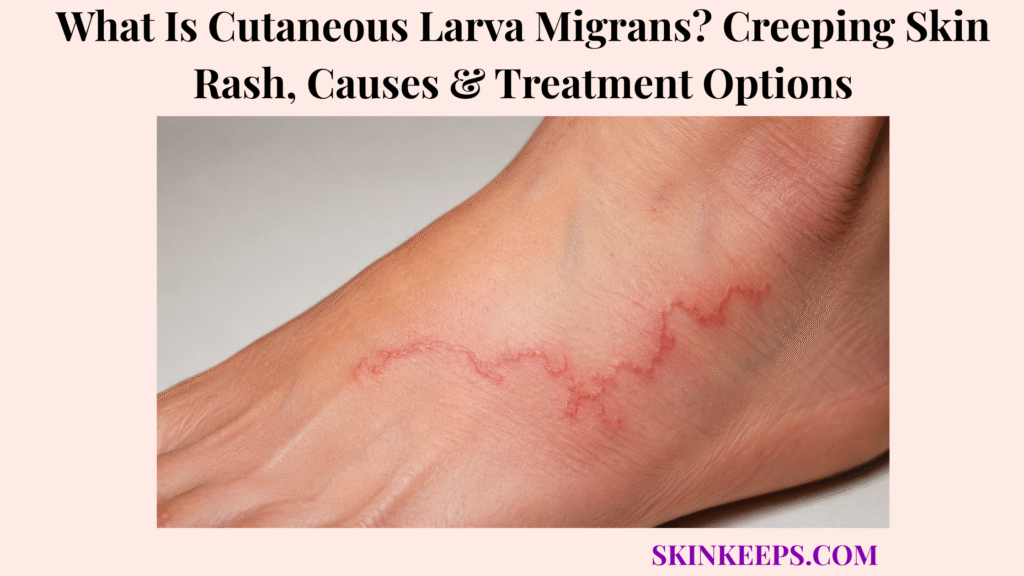
Cutaneous larva migrans is a parasitic skin infection where animal hookworm larvae enter exposed skin and create an intensely itchy, winding, creeping track as they move within the upper skin layer.
Beach, sand, soil, barefoot walking, sitting on sand, pet feces, and travel exposure matter. This page covers symptoms, body sites, causes, risk factors, similar rashes, diagnosis, antiparasitic treatment, skin care, prevention, mistakes, and doctor-warning signs.
What Is Cutaneous Larva Migrans and Why Is It Called a Creeping Rash?
Cutaneous larva migrans is a parasitic skin infection where animal hookworm larvae enter exposed skin and create an intensely itchy, winding, creeping track as they move within the upper skin layer.
It is also called creeping eruption, hookworm rash, zoonotic hookworm skin infection, or beach parasite rash.
The key clue is the combination of a winding or serpiginous track, meaning snake-like, plus bare-skin contact with contaminated soil or sand.
Why Is Cutaneous Larva Migrans Also Called Creeping Eruption?
Cutaneous larva migrans is also called creeping eruption because the rash often forms a raised, winding, snake-like line that seems to move or lengthen over time.
“Cutaneous” means skin. “Larva migrans” means migrating larva.
The track can extend over days as inflammation follows larval movement in the upper skin layer.
Why Are Humans Accidental Hosts?
Humans are accidental hosts because the hookworm larvae usually come from animals and typically cannot complete their normal life cycle in human skin.
Dog and cat hookworms, especially Ancylostoma braziliense and Ancylostoma caninum, are common causes.
Symptoms come from larval movement and local inflammation, not from adult worms completing their usual animal-host life cycle in human skin.
Practical rule: A creeping, winding, intensely itchy line after beach, sand, soil, or barefoot exposure should be assessed as a possible parasite-related eruption, not treated with steroid-only rash care.
What Cutaneous Larva Migrans Symptoms Appear on Skin?
Cutaneous larva migrans usually causes an intensely itchy, raised, red, pink, brown, purple, or darker winding line that slowly extends across the skin.
The rash may be one track or several tracks. The color can look different across skin tones, but the winding shape and exposure history remain important.
What Does the Creeping Track Look Like?
The creeping track usually looks like a wavy, snake-like, raised line that may lengthen over days after beach, sand, soil, or barefoot exposure.
It may look red or pink on lighter skin and brown, purple, gray-brown, or darker on darker skin.
The line may burn, sting, or itch intensely, and the track may seem to shift or extend rather than stay as a stable circular patch.
What Symptoms Can Occur Around the Track?
Around the track, cutaneous larva migrans can cause intense itching, burning, mild swelling, small bumps, blistering, scratch marks, crusting, or sleep disruption.
Some lesions can become blister-like. Scratching can break the skin and raise the risk of secondary bacterial infection.
Severe sleep-disrupting itch is a valid reason to seek treatment instead of simply waiting.
What Symptoms Are Not Typical and Need Caution?
High fever, pus, rapidly spreading warmth, severe swelling, black skin change, eye involvement, widespread illness, or a rash that does not fit a creeping-track pattern should not be assumed to be simple CLM.
These signs may suggest bacterial infection, another parasite, cellulitis, a different travel-related disease, or another skin condition.
Eye-area symptoms or a lesion near the eye should be checked quickly.
| Symptom | What User May Notice | Why It Matters |
|---|---|---|
| Winding track | Snake-like raised line. | Classic CLM clue. |
| Intense itch | Scratching or sleep disruption. | Common symptom. |
| Track extension | Line grows over days. | Larval migration clue. |
| Blistering | Bullous or raised inflamed areas. | More inflamed case. |
| Crusting | Often from scratching. | Secondary infection risk. |
| Pus / warmth / fever | Infection or another diagnosis concern. | Medical review needed. |
| Eye-area lesion | Rash near eye or eye symptoms. | Needs urgent review. |
Where Does Cutaneous Larva Migrans Usually Appear?
Cutaneous larva migrans usually appears on skin that touched contaminated soil or sand, especially the feet, soles, toes, ankles, legs, thighs, buttocks, hands, arms, or trunk.
The site often matches the exposure: barefoot walking, sitting directly on sand, lying on sand, gardening, or touching soil.
Location alone does not diagnose CLM, but a winding track on exposed skin after sand or soil contact is a strong clinical clue.
| Body Site | Exposure Clue | Prevention Note |
|---|---|---|
| Feet / soles | Barefoot walking on sand or soil. | Wear shoes or sandals. |
| Toes / ankles | Exposed lower skin on beach or soil. | Avoid contaminated ground. |
| Legs / thighs | Sitting, kneeling, or outdoor exposure. | Use clothing or mats. |
| Buttocks | Sitting directly on sand. | Sit on towel, mat, or chair. |
| Hands / arms | Gardening or touching soil/sand. | Use gloves when needed. |
| Back / trunk | Lying directly on sand. | Use towel, mat, or chair. |
| Face / eye area | Less common but higher caution. | Prompt medical review. |
What Causes Cutaneous Larva Migrans?
Cutaneous larva migrans is caused when hookworm larvae from contaminated sand or soil penetrate human skin, usually after animal feces contaminate warm moist ground.
The most common exposure pathway is environmental: animal feces contaminate soil or sand, larvae develop there, and bare skin contacts that ground.
How Do Dog and Cat Hookworm Larvae Reach Human Skin?
Dog and cat hookworm larvae reach human skin when infected animals pass eggs in feces, the eggs develop into larvae in soil or sand, and bare skin touches the contaminated ground.
Beaches, sandboxes, tropical or subtropical soil, and areas with stray dogs or cats can be exposure settings.
Humans usually acquire CLM from contaminated ground rather than from larvae becoming adult human intestinal worms in typical CLM.
Why Do Warm, Moist Sand and Soil Increase Risk?
Warm, moist sand and soil increase risk because hookworm larvae survive better in those environments and can penetrate bare skin during walking, sitting, or lying down.
Tropical and subtropical beaches are common exposure settings, especially when animal feces contaminate the ground.
Barefoot walking, sitting directly on sand, or lying directly on sand increases contact time.
Is Cutaneous Larva Migrans Contagious Between People?
Cutaneous larva migrans is not usually spread person-to-person because the usual source is contaminated soil or sand, not casual contact with another person.
The main prevention target is avoiding bare-skin contact with contaminated ground.
Scratched open skin can become secondarily infected, but that is different from spreading CLM larvae to others.
Who Is More Likely to Get Cutaneous Larva Migrans?
Cutaneous larva migrans is more likely after bare-skin contact with warm moist soil or sand in areas where dog or cat hookworms contaminate the environment.
Risk is exposure-based. The same rash pattern becomes more suspicious when it follows beach, travel, soil, pet-feces, or stray-animal exposure.
- Barefoot beach walking.
- Sitting or lying directly on sand.
- Children playing in contaminated sandboxes.
- Tropical or subtropical travel.
- Gardening or outdoor soil work.
- Areas with stray dogs or cats.
- Poorly covered sandboxes.
- Beach sports or outdoor sleeping.
- No towel, mat, shoes, or sandals.
- Pet feces not removed from play or walking areas.
- Pets not dewormed according to veterinary guidance.
How Is Cutaneous Larva Migrans Different From Other Itchy Rashes?
Cutaneous larva migrans can resemble scabies, ringworm, insect bites, allergic dermatitis, larva currens, Lyme erythema migrans, cellulitis, or fungal rash, but the slowly advancing serpiginous track after sand or soil exposure is a key clue.
Matching the pattern matters because CLM treatment is antiparasitic when treatment is needed, not steroid-only, scabies-only, or antifungal-only care.
How Is Cutaneous Larva Migrans Different From Scabies?
Scabies often causes household-cluster itching and small burrows in typical body sites, while cutaneous larva migrans usually forms a larger winding track after soil or sand exposure.
Scabies commonly involves close-contact spread and classic sites such as finger webs, wrists, waistline, and genitals.
CLM is typically acquired from contaminated ground and often involves exposed feet, legs, buttocks, or trunk after sand or soil contact.
How Is Cutaneous Larva Migrans Different From Ringworm?
Ringworm often forms a scaly circular patch, while cutaneous larva migrans forms a creeping, winding line rather than a stable ring-shaped plaque.
Ringworm is a dermatophyte fungal infection, while CLM is a parasite-related skin migration.
On the foot, scaling between toes may suggest athlete’s foot, while a moving snake-like track after sand exposure points toward CLM.
How Is Cutaneous Larva Migrans Different From Allergic Dermatitis or Bites?
Allergic dermatitis and insect bites may itch, but they usually do not create a slowly lengthening snake-like track after contaminated sand or soil exposure.
Allergic contact dermatitis often follows direct product, plant, adhesive, footwear, glove, or chemical exposure.
Insect bites usually appear as discrete itchy bumps rather than a single migrating serpiginous line.
How Is Cutaneous Larva Migrans Different From Larva Currens?
Larva currens is linked to Strongyloides and can move rapidly, while animal-hookworm CLM usually migrates more slowly within the skin.
Rapidly moving recurrent tracks, immune suppression, gastrointestinal symptoms, lung symptoms, or strongyloidiasis risk should prompt medical evaluation.
Larva currens has different internal-disease risks and treatment concerns.
How Is Cutaneous Larva Migrans Different From Cellulitis?
Cellulitis causes deeper spreading bacterial infection with warmth, swelling, pain, and possible fever, while cutaneous larva migrans causes a winding itchy track.
Scratching CLM can lead to secondary bacterial infection.
Crusting, pus, honey-colored drainage, or spreading bacterial changes can overlap with impetigo or other bacterial infection patterns.
| Condition | Main Clue | Main Cause | Safer Next Step |
|---|---|---|---|
| Cutaneous larva migrans | Itchy winding creeping track. | Animal hookworm larvae. | Antiparasitic evaluation. |
| Scabies | Burrows + household itch. | Mite infestation. | Scabies-specific treatment. |
| Ringworm | Scaly ring border. | Dermatophyte fungus. | Antifungal diagnosis. |
| Insect bites | Discrete itchy bumps. | Bite reaction. | Symptom care unless infected. |
| Larva currens | Fast-moving recurrent track. | Strongyloides. | Medical evaluation. |
| Lyme erythema migrans | Expanding patch, usually not a creeping raised track. | Tick-borne infection. | Lyme evaluation if exposure fits. |
| Cellulitis | Warm painful swelling or fever. | Bacterial infection. | Urgent antibiotic assessment. |
A tick-exposure-related expanding patch may need evaluation as a Lyme disease skin rash rather than CLM when the exposure and appearance fit.
How Is Cutaneous Larva Migrans Diagnosed?
Cutaneous larva migrans is usually diagnosed from the classic itchy serpiginous track, exposure history, and travel or sand/soil contact pattern.
Diagnosis is often clinical. A clinician connects the track shape, itch pattern, and exposure setting before deciding treatment.
What Does a Clinician Check With Suspected CLM?
A clinician checks suspected cutaneous larva migrans by looking at the track shape, whether it is lengthening, itch severity, sand or soil exposure, travel history, number of lesions, and infection signs.
The visit may review barefoot walking, sitting or lying on sand, gardening, contact with areas where dogs or cats defecate, travel to tropical or subtropical areas, blisters, crusting, eye-area involvement, pregnancy, child age, diabetes, and immune status.
Bring photos from earlier days if the line has moved or lengthened.
When Are Tests or Biopsy Needed?
Tests or biopsy are not usually needed for classic cutaneous larva migrans, but testing may be considered when diagnosis is unclear, infection is suspected, or another parasite or skin condition is possible.
Biopsy often fails to catch the larva because the visible track does not always show the exact larval position.
A swab or culture may be needed if secondary bacterial infection is suspected. Broader testing may be needed for larva currens, cellulitis, systemic symptoms, eye concerns, or unclear travel-related disease.
- Photo of the track today.
- Photo from earlier days to show movement or lengthening.
- When itching started.
- When the line first appeared.
- Recent beach, sand, soil, gardening, or travel exposure.
- Barefoot walking, sitting, or lying on sand.
- Contact with areas where dogs or cats may defecate.
- Number of tracks.
- Blisters, crusting, pus, warmth, swelling, or fever.
- Eye-area or face involvement.
- Pregnancy, young child, immune suppression, diabetes, or medication-safety concerns.
- Treatments already tried, including steroids, antifungals, antibiotics, home freezing, or home remedies.
What Treatment Options Help Cutaneous Larva Migrans?
Cutaneous larva migrans is commonly treated with antiparasitic medicine such as ivermectin or albendazole, especially when the rash is persistent, widespread, very itchy, or affecting daily life.
Do not self-dose antiparasitic medicine. Treatment choice depends on age, pregnancy status, medication interactions, health history, location, severity, and diagnosis certainty.
When Are Oral Antiparasitic Medicines Used?
Oral antiparasitic medicines are commonly used when cutaneous larva migrans has multiple tracks, widespread lesions, severe itching, persistent symptoms, failed topical treatment, or difficult locations.
Ivermectin and albendazole are common oral treatment options used under medical guidance.
A clinician decides the medicine and safety plan, especially for pregnancy, children, immune suppression, liver disease, medication interactions, or uncertain diagnosis.
When Are Topical Treatments Used?
Topical treatment may be considered for selected localized cutaneous larva migrans when oral medicine is not needed or not suitable.
Topical thiabendazole has been used in some settings, but access varies by country.
Topical care should not undertreat widespread, severe, multiple-track, eye-area, infected-looking, persistent, or high-risk disease.
What Helps Relieve Itching While Treatment Works?
Itch relief can include clinician-approved antihistamines, cool compresses, short nails, gentle cleansing, and covering scratched skin to prevent bacterial infection.
Topical corticosteroids may sometimes be used for severe itch when clinician-directed, but they should not replace antiparasitic treatment when CLM is suspected.
Do not scratch the track until the skin breaks because open skin can become infected.
Why Is Freezing or Cutting the Track Not the Main Treatment?
Freezing or cutting the track is not the main treatment because the larva may not be exactly where the visible line appears, and destructive treatment can scar or fail.
Do not cut, burn, freeze, bleach, or dig into the track at home.
Anthelmintic medicine is the usual medical direction when treatment is needed.
| Situation | Treatment Direction | Key Caution |
|---|---|---|
| Single small localized track | Clinician may consider topical or oral treatment. | Confirm diagnosis. |
| Multiple or widespread tracks | Oral ivermectin or albendazole often used. | Medical dosing needed. |
| Severe itch | Antiparasitic treatment + itch control. | Avoid scratching. |
| Pus / crusting / warmth | Check secondary infection. | May need antibiotics. |
| Eye-area lesion | Urgent medical review. | Eye risk. |
| Pregnancy / young child | Clinician-specific plan. | Medication safety matters. |
| Unclear rash | Reassess diagnosis. | Avoid wrong scabies, fungal, or steroid care. |
How Should the Skin Be Cared for During Cutaneous Larva Migrans?
Skin care during cutaneous larva migrans should reduce scratching, protect broken skin, and prevent secondary bacterial infection while antiparasitic treatment clears the larvae.
Clean gently with mild soap and water, use cool compresses for itch, keep nails short, and cover scratched or broken skin with a clean dressing if needed.
Watch for pus, spreading warmth, swelling, worsening pain, or fever. Avoid barefoot re-exposure in the same setting.
- Do not scratch the track.
- Keep nails short.
- Clean gently with mild soap and water.
- Use cool compresses for itch.
- Cover scratched or broken skin with a clean dressing.
- Avoid harsh acids, bleach, burns, and home freezing.
- Watch for pus, warmth, swelling, worsening pain, or fever.
- Avoid barefoot re-exposure in the same area.
- Seek treatment guidance if the track is spreading, severe, persistent, or high-risk.
How Can Cutaneous Larva Migrans Be Prevented?
Cutaneous larva migrans prevention focuses on avoiding bare-skin contact with contaminated sand or soil and reducing animal feces contamination in areas where people walk, sit, or play.
Wear shoes or sandals on beaches and soil. Sit or lie on towels, mats, or chairs instead of directly on sand.
Avoid areas with visible animal feces, cover sandboxes when not in use, dispose of pet feces promptly, and follow veterinary deworming guidance for pets.
- Wear shoes or sandals on beaches and soil.
- Sit or lie on towels, mats, or chairs.
- Avoid areas with visible animal feces.
- Keep sandboxes covered when not in use.
- Dispose of pet feces promptly.
- Follow veterinary deworming guidance for pets.
- Keep dogs and cats away from children’s play sand.
- Wear gloves for higher-risk soil work.
- Avoid bare-skin sand contact during tropical or subtropical travel.
Can Cutaneous Larva Migrans Go Away on Its Own?
Cutaneous larva migrans may eventually resolve because animal hookworm larvae usually cannot complete their life cycle in human skin, but treatment can shorten symptoms and reduce severe itching, scratching, and secondary infection risk.
Some cases self-limit over several weeks, but the itching can be intense and prolonged.
Waiting is not a safe plan for widespread rash, severe itch, eye-area lesions, infection signs, pregnancy, young children, diabetes, immune-risk patients, or unclear diagnosis.
Course map: Exposure → incubation → creeping itchy track → inflammation and scratching risk → antiparasitic treatment or gradual self-resolution → monitor for infection and recurrence.
What Cutaneous Larva Migrans Mistakes Should You Avoid?
The biggest cutaneous larva migrans mistake is treating a moving winding parasite rash as allergy, fungus, or eczema while the track keeps extending.
Do not use steroid cream alone without diagnosis, scratch until skin breaks, cut the track, freeze it, burn it, bleach it, or dig into the skin.
Do not ignore beach, soil, travel, pet-feces, or stray-animal exposure history, and do not delay care for eye-area lesions, pus, fever, spreading warmth, or worsening pain.
| Mistake | Why It Fails | Better Action |
|---|---|---|
| Steroid-only rash care | Itch may reduce while the parasite cause remains. | Diagnose and treat cause. |
| Scratching | Bacterial infection risk. | Itch control + protect skin. |
| Cutting/freezing at home | Scarring and treatment failure risk. | Antiparasitic care. |
| Calling it ringworm automatically | Wrong medicine may delay care. | Look for moving track and exposure. |
| Ignoring beach/soil exposure | Main clue is missed. | Tell clinician exposure history. |
| Ignoring eye-area lesion | Rare but serious risk. | Urgent medical care. |
| Continuing barefoot exposure | Re-exposure risk remains. | Shoes, mats, towels, pet-feces control. |
When Should Cutaneous Larva Migrans Be Checked by a Doctor?
Cutaneous larva migrans should be checked by a clinician when the rash is very itchy, spreading, widespread, blistered, infected-looking, near the eye, not improving, or follows travel/beach exposure where diagnosis is uncertain.
Medical review is also important when medication safety matters, such as pregnancy, young children, immune suppression, diabetes, poor wound healing, or multiple medicines.
Which Creeping-Rash Signs Need Medical Review?
Medical review is needed when a creeping rash keeps extending, has multiple tracks, causes severe itch, blisters, crusts, forms pus, spreads warmth or swelling, causes fever, appears near the eye or face, or does not fit a classic pattern.
Rash lasting longer than expected, failed treatment, recent tropical or subtropical travel, or unclear diagnosis should also be checked.
Worsening pain, pus, swelling, fever, or spreading warmth may mean secondary bacterial infection.
Which Patients Should Not Wait?
Infants, young children with extensive rash, pregnant people, immunocompromised patients, people with diabetes or poor wound healing, and anyone with eye symptoms or fever should not wait with suspected cutaneous larva migrans.
People taking immune-suppressing medicines, chemotherapy, transplant medicines, or complex medications should get individualized guidance before antiparasitic treatment.
Eye symptoms, face involvement, fever, or widespread lesions deserve prompt care.
Seek medical review if there is:
- Track that continues to extend.
- Multiple tracks.
- Severe sleep-disrupting itch.
- Blisters.
- Pus, crusting, or suspected infection.
- Increasing warmth, swelling, or pain.
- Fever.
- Lesion near the eye or face.
- Widespread rash.
- Unclear diagnosis.
- Recent tropical or subtropical travel.
- Pregnancy.
- Young child or infant with extensive rash.
- Immune suppression.
- Diabetes or poor wound healing.
- Failed treatment or persistent rash.
What Should You Remember About Cutaneous Larva Migrans?
The most important thing to remember about cutaneous larva migrans is that it is a hookworm-larva skin infection, so the safest approach is to recognize the creeping track, connect it to sand or soil exposure, treat appropriately, and prevent re-exposure.
Most care decisions depend on the rash pattern, exposure history, severity, infection signs, location, and patient risk factors.
- Cutaneous larva migrans is also called creeping eruption.
- It is usually caused by animal hookworm larvae.
- It often follows barefoot or bare-skin contact with contaminated sand or soil.
- It causes an intensely itchy winding or serpiginous track.
- It is not usually spread person-to-person.
- Diagnosis is often clinical from rash pattern and exposure history.
- Oral ivermectin or albendazole are common effective treatment options.
- Scratching can cause secondary bacterial infection.
- Prevention means shoes, mats/towels, pet feces control, and avoiding contaminated ground.
- Eye-area, widespread, infected, severe, pregnancy/child, diabetic, or immune-risk cases need clinician review.
Frequently Asked Questions About Cutaneous Larva Migrans
Is cutaneous larva migrans a hookworm infection?
Yes. Cutaneous larva migrans is usually caused by zoonotic animal hookworm larvae that penetrate human skin and create a creeping eruption.
What does cutaneous larva migrans look like?
It often looks like an intensely itchy, raised, winding, snake-like, or serpiginous track that may slowly extend across the skin.
How do people get cutaneous larva migrans?
People usually get it after bare skin contacts contaminated warm moist soil or sand, often where dog or cat feces have introduced hookworm eggs or larvae.
Is cutaneous larva migrans contagious?
It is not usually spread person-to-person. The usual source is contaminated soil or sand. Broken scratched skin can become secondarily infected, but that is a different issue.
What is the best treatment for cutaneous larva migrans?
There is no one best treatment for every case. Treatment depends on severity, location, age, pregnancy status, and health history, but oral ivermectin and albendazole are commonly used effective options; topical treatment may be used for selected localized cases.
Can cutaneous larva migrans go away by itself?
It may eventually resolve because humans are not the usual host, but treatment can reduce the duration of itching and lower scratching-related infection risk. Severe, widespread, infected, eye-area, pregnancy/child, immune-risk, or uncertain cases should be medically checked.
Why should I not freeze or cut the creeping track?
The larva may not be exactly where the visible track appears, and cutting or freezing can cause scarring, infection, treatment failure, or delayed diagnosis. Antiparasitic care is usually the safer medical direction.
When should a creeping rash need medical care?
Medical care is needed for severe itch, spreading tracks, multiple lesions, blisters, pus, fever, eye or face involvement, pregnancy, young child, immune suppression, diabetes, unclear diagnosis, failed treatment, or recent tropical/subtropical travel exposure.
Sources & Evidence About Cutaneous Larva Migrans
CDC — Clinical Features of Zoonotic Hookworm was used for CLM as an inflammatory reaction from zoonotic hookworm larvae penetrating skin, raised itchy tracks, pruritus, vesiculobullous lesions, biopsy limitations, and possible ocular/deeper tissue caution.
CDC DPDx — Zoonotic Hookworm was used for creeping-eruption terminology, A. braziliense and A. caninum, intensely pruritic serpiginous tracks, and occasional bullous lesions.
CDC — About Zoonotic Hookworm was used for animal feces to soil/sand exposure, larvae burrowing into bare skin, feet/legs involvement, rare deeper tissue or eye migration, and 5–6 week self-limited recovery context.
CDC — Clinical Care of Zoonotic Hookworm was used for self-limited course, clinical care framing, topical anthelminthic impracticality over large areas, and pregnancy medication-safety context.
CDC Yellow Book — Post-Travel Dermatologic Conditions was used for post-travel CLM as an extremely itchy linear or serpiginous lesion, 4–6 week self-limited course, and albendazole/ivermectin effectiveness context.
Merck Manual Professional — Cutaneous Larva Migrans was used for dog/cat hookworm causes, warm moist soil/sand transmission, and oral ivermectin/albendazole treatment options.
DermNet — Cutaneous Larva Migrans was used for hookworm larvae from cats, dogs, and other animals; topical thiabendazole context; and oral treatment when widespread or topical treatment fails.
StatPearls / NCBI Bookshelf — Cutaneous Larva Migrans was used for clinical diagnosis, occasional biopsy, treatment options, larva currens distinction, and freezing/destructive therapy caution.
Educational Disclaimer: This SkinKeeps article is for educational purposes only and does not diagnose or replace medical care. A suspected cutaneous larva migrans rash that is near the eye or face, severe, widespread, blistered, infected-looking, pus-filled, fever-associated, increasingly warm, swollen, painful, recurrent, not improving, travel-related with unclear diagnosis, pregnancy-related, child-related, diabetes-related, immune-risk, or medication-safety-related should be checked by a qualified healthcare professional. Do not cut, burn, freeze, dig into, bleach, or use steroid-only treatment on a suspected creeping eruption without appropriate medical guidance.