
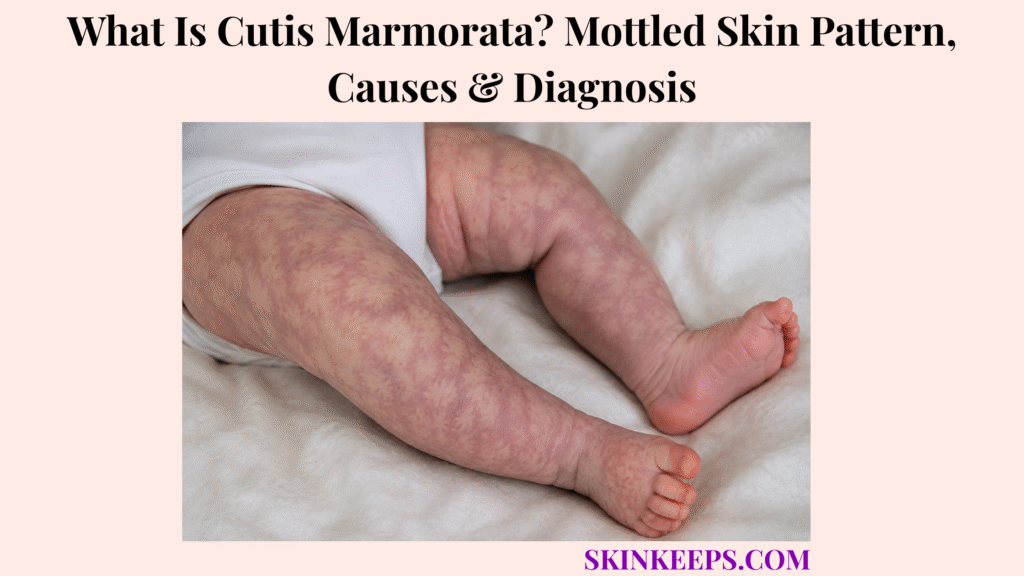
Cutis marmorata is a temporary mottled, marbled, or lace-like skin pattern that appears when skin is exposed to cold and usually fades after the skin is warmed.
Typical cutis marmorata is a vascular color pattern, not usually a rash. This page covers appearance, common locations, causes, infant and adult context, similar conditions, diagnosis, what to do, treatment, prevention, mistakes, and doctor-warning signs.
What Is Cutis Marmorata and Why Does Skin Look Mottled?
Cutis marmorata is a temporary mottled, marbled, or lace-like skin pattern that appears when skin is exposed to cold and usually fades after the skin is warmed.
It happens because superficial blood vessels respond unevenly to cooling. Some tiny vessels constrict while nearby vessels dilate, creating pale centers with darker lacy lines.
In a well person, the key clue is the warming response: the pattern fades or clears after gentle warming.
Why Is Cutis Marmorata Often Called Marbled Skin?
Cutis marmorata is often called marbled skin because the surface can look lacy, net-like, or reticulated, with pale areas between pink-blue, reddish-blue, purple, brownish, grayish, or darker lines.
“Marmorata” refers to a marble-like appearance.
The pattern is usually most visible when the skin is cool and less visible after the skin warms.
Why Is Cutis Marmorata Usually Not a Rash?
Cutis marmorata is usually not a rash because it is mainly a temporary blood-vessel color pattern rather than inflamed, infected, scaly, or blistered skin.
Typical skin surface is smooth. It is usually not itchy, crusted, pus-filled, blistered, ulcerated, or contagious.
Pain, swelling, fever, ulcers, blue-black skin, or persistent discoloration means the pattern should be checked as something beyond simple cold mottling.
Practical rule: Warm gently, check whether the pattern fades, and assess whether the person otherwise looks well.
What Does Cutis Marmorata Look Like?
Cutis marmorata usually looks like a fine lacy, net-like, mottled, or marbled pattern on the skin, often with pale areas inside reddish-blue, purple, brown, gray-blue, or darker lines.
The color may become more visible during cold exposure, after bathing, during a diaper change, in a cool room, or outdoors in cold weather.
What Colors Can the Mottled Pattern Have?
The mottled pattern can look pink-blue, reddish-blue, purple, violet, gray-blue, brownish-purple, or darker depending on skin tone and temperature.
On lighter skin, the pattern may look pink, red-blue, or purple. On darker skin, it may appear brownish-purple, gray-blue, violet, or darker.
The skin surface should remain smooth in typical cases.
What Symptoms Are Typical or Not Typical?
Typical cutis marmorata usually causes color change only, without pain, itch, scale, crust, pus, blisters, or broken skin.
It usually fades with gentle warming and does not leave sores or scars.
Persistent symptoms, pain, swelling, ulceration, blue-black change, fever, or a sick appearance suggest another cause.
What Signs Suggest It Is Not Simple Cutis Marmorata?
It may not be simple cutis marmorata if the pattern does not fade with warming, is fixed or one-sided, or appears with pain, swelling, ulcers, black skin, fever, or illness symptoms.
In babies, concern rises with fever, low temperature, poor feeding, lethargy, breathing trouble, weak cry, blue lips, dehydration signs, eye concerns, limb-size difference, or abnormal development.
In adults, new persistent mottling, painful cold limb, numbness, weakness, ulcers, black skin, neurologic symptoms, chest pain, shortness of breath, clotting history, autoimmune disease, or vascular symptoms should be checked.
| Feature | Simple Cutis Marmorata Clue | When to Check |
|---|---|---|
| Pattern | Fine lacy or marbled mottling. | Broken, irregular, fixed, or one-sided pattern. |
| Trigger | Cold exposure. | Appears without cold or persists. |
| Warming | Fades with warming. | Does not fade. |
| Symptoms | Usually painless and non-itchy. | Pain, swelling, ulcer, fever, lethargy, poor feeding. |
| Skin surface | Smooth, no scale or pus. | Blistering, crusting, sores, black skin. |
Where Does Cutis Marmorata Usually Appear?
Cutis marmorata can appear on the arms, legs, trunk, hands, feet, thighs, abdomen, or other skin areas when the skin becomes cool.
In babies, it may be noticed during diaper changes, bathing, cool room exposure, or when skin is uncovered.
Location alone does not diagnose the pattern. Trigger, symmetry, warming response, skin surface, and overall wellness matter more.
| Body Site | Common Trigger | Safety Note |
|---|---|---|
| Legs | Cold room, bath, uncovered skin. | Check if one-sided, painful, or persistent. |
| Arms | Cold exposure or uncovered skin. | Should fade with warming. |
| Trunk | Bathing, diaper changes, cool air. | Check baby’s feeding, breathing, and alertness. |
| Hands / feet | Peripheral cooling. | Blue lips, cold limb, pain, or reduced pulses need care. |
| Thighs / abdomen | Exposed during changing or bathing. | Photograph if persistent. |
| Whole-body infant mottling | Cooling in newborn or infant. | Reassure only if baby is otherwise well and pattern fades. |
What Causes Cutis Marmorata?
Cutis marmorata happens when superficial small blood vessels in the skin dilate and constrict at the same time, creating a mottled pattern that becomes more obvious with cooling.
Some areas look darker from vessel dilation and blood pooling, while nearby areas look pale from vessel constriction.
How Does Cold Create the Marbled Pattern?
Cold creates the marbled pattern by changing how tiny blood vessels near the skin surface constrict and dilate.
The mixed response creates a net-like or marbled appearance rather than one even color change.
In physiologic cutis marmorata, gentle warming reverses the vessel response and the pattern fades.
Why Do Babies Often Show Cutis Marmorata?
Babies often show cutis marmorata because newborn and infant blood-vessel responses are still maturing, so cold can make mottling more visible.
It may appear during bathing, diaper changes, clothing changes, or cool-room exposure.
In typical physiologic infant cutis marmorata, the baby otherwise looks well and the pattern improves with warming; it usually becomes less noticeable with age.
Can Adults Get Cutis Marmorata?
Adults can have cold-induced mottling, but new persistent adult mottling should be assessed more carefully because it may overlap with livedo reticularis or vascular/systemic causes.
A cold-triggered pattern that clears with warming is more reassuring than a fixed, painful, irregular, ulcerated, one-sided, or adult-onset persistent pattern.
Adults with autoimmune disease, clotting history, kidney disease, neurologic symptoms, vascular symptoms, medication exposures, or painful cold limbs should seek medical review.
| Trigger or Mechanism | Skin Effect | Practical Meaning |
|---|---|---|
| Cold exposure | Temporary vessel constriction and dilation. | Warm the skin gently. |
| Infant vessel immaturity | More visible mottling. | Usually improves with warming and age. |
| Emotion / temperature change | Pattern may appear. | Watch warming response. |
| Persistent blood-flow disruption | Fixed or recurrent mottling. | Evaluate for livedo/vascular causes. |
| Congenital vascular malformation | Mottling from birth that does not clear. | Consider CMTC evaluation. |
Who Is More Likely to Show Cutis Marmorata?
Cutis marmorata is most often noticed in newborns and infants, but it can also appear in children or adults during cold exposure.
Safe reassurance depends on the full context: cold trigger, fine lacy pattern, smooth skin surface, fading with warming, and a person who otherwise looks well.
- Newborn or young infant.
- Cold room, bath, diaper change, or outdoor cold exposure.
- Fine lacy or marbled pattern.
- Pattern is symmetric or widespread rather than fixed one-sided.
- Skin surface is smooth.
- Baby or person otherwise looks well.
- Pattern fades after gentle warming.
- No pain, ulceration, fever, breathing trouble, or poor feeding.
How Is Cutis Marmorata Different From Other Mottled Skin Conditions?
Cutis marmorata is usually temporary and cold-related, while other mottled skin patterns may be fixed, persistent, heat-related, congenital, painful, or associated with vascular or systemic disease.
The safest comparison uses trigger, warming response, age of onset, symptoms, skin surface, and whole-person wellness.
How Is Cutis Marmorata Different From CMTC?
Physiologic cutis marmorata fades with warming, while cutis marmorata telangiectatica congenita is present from birth and does not mostly or rapidly clear with warming.
CMTC may be fixed, localized, asymmetric, ulcerated, or associated with skin atrophy, limb-size difference, eye concerns, or vascular findings.
Persistent congenital mottling needs pediatric or dermatology evaluation rather than simple reassurance.
How Is Cutis Marmorata Different From Livedo Reticularis?
Cutis marmorata is often used for transient cold-induced mottling, while livedo reticularis is a broader term for lace-like mottled skin that may be primary or secondary.
Primary livedo can be benign, but secondary livedo can be persistent and linked with systemic disease.
New adult-onset, persistent, irregular, painful, ulcerated, or illness-associated livedo-like mottling should be medically checked.
How Is Cutis Marmorata Different From Livedo Racemosa?
Livedo racemosa tends to have larger, broken, irregular circles and is more concerning for blood-flow disruption or systemic disease than simple cold mottling.
It does not behave like a fine cold-triggered pattern that fades with warming.
Persistent livedo racemosa-like patterns should be evaluated, especially with clotting, neurologic, autoimmune, kidney, vascular, or ulcer symptoms.
How Is Cutis Marmorata Different From Erythema Ab Igne?
Cutis marmorata is cold-related, while erythema ab igne is a heat-related net-like discoloration from repeated or prolonged heat exposure.
Erythema ab igne may follow heating pads, hot water bottles, heated blankets, laptops, fireplaces, or chronic heat exposure.
Flat cold-related mottling that fades with warming is different from heat rash, which usually involves sweat-related bumps or irritation.
How Is Cutis Marmorata Different From Sepsis or Shock Mottling?
Simple cutis marmorata fades with warming and the person otherwise looks well, while sepsis or shock mottling appears with illness signs such as fever, lethargy, breathing trouble, confusion, cold extremities, or poor circulation.
In babies, watch for fever or low temperature, poor feeding, lethargy, weak cry, blue lips, breathing trouble, vomiting, dehydration, or a baby who looks very unwell.
In adults, watch for confusion, fever, severe illness, fast heart rate, cold clammy skin, low blood pressure, shortness of breath, chest pain, fainting, or collapse.
| Condition | Main Clue | Warming Response | Safety Action |
|---|---|---|---|
| Cutis marmorata | Fine cold-triggered mottling. | Clears or fades. | Warm and monitor if well. |
| CMTC | Congenital fixed mottling. | Does not rapidly clear. | Pediatric dermatology evaluation. |
| Livedo reticularis | Lace-like mottling. | Variable. | Evaluate if persistent or adult-onset. |
| Livedo racemosa | Broken irregular pattern. | Often persistent. | Check vascular/systemic causes. |
| Erythema ab igne | Heat-exposure pattern. | Not cold-related. | Stop heat exposure; assess if persistent. |
| Sepsis/shock mottling | Mottling plus illness signs. | Warming does not reassure. | Urgent care. |
Raised transient welts suggest hives rather than a flat vascular mottling pattern.
Warmth, swelling, pain, fever, or spreading redness can suggest cellulitis or another infection rather than simple cold mottling.
Persistent adult livedo-like mottling with autoimmune symptoms may need evaluation for conditions such as lupus erythematosus or clotting-related disease.
An itchy product-contact rash may fit allergic contact dermatitis, not typical cutis marmorata.
How Is Cutis Marmorata Diagnosed?
Cutis marmorata is usually diagnosed clinically by its cold-triggered lacy pattern, normal skin surface, and improvement after the skin is warmed.
A clinician also checks whether the person is otherwise well and whether the pattern has red flags that suggest CMTC, livedo, vascular disease, infection, shock, or another cause.
What Does a Clinician Check?
A clinician checks the patient’s age, cold exposure history, pattern symmetry, warming response, skin surface, overall wellness, and any signs of vascular or systemic disease.
The review may include fever or low temperature, feeding, breathing, alertness, limb color and temperature, pulses, pain, numbness, weakness, congenital onset, limb-size difference, eye concerns, development, autoimmune history, clotting history, kidney disease, neurologic symptoms, and medication exposure.
Photos before and after warming can help show whether the pattern fades.
When Are Tests Usually Not Needed?
Tests are usually not needed when an infant or child has a classic symmetric cold-related pattern that clears with warming and the child is otherwise well.
The skin surface should be smooth, and there should be no fever, poor feeding, breathing trouble, pain, ulcers, swelling, limb differences, developmental concerns, or sick appearance.
Medical review is still appropriate if parents are worried or the pattern does not behave typically.
When Might Further Evaluation Be Needed?
Further evaluation may be needed when mottling does not clear with warming, is fixed or one-sided, starts newly and persistently in an adult, or appears with illness, limb, eye, developmental, vascular, autoimmune, clotting, or neurologic signs.
Persistent congenital mottling may need CMTC evaluation. Adult persistent livedo-like mottling may need vascular, autoimmune, clotting, kidney, neurologic, medication, or infection review.
Mottling with fever, confusion, blue lips, breathing trouble, shock-like symptoms, or a painful cold limb needs urgent assessment.
- Photo before warming.
- Photo after warming.
- What temperature or cold exposure triggered it.
- How long the pattern lasted.
- Whether it is symmetric, one-sided, fixed, or localized.
- Whether it was present from birth.
- Pain, swelling, ulcers, sores, blue-black color, or cold limb.
- Baby’s feeding, breathing, alertness, temperature, and behavior.
- Limb-size difference, eye concerns, or developmental concerns.
- Adult autoimmune, clotting, vascular, kidney, neurologic, or medication history.
- Fever, confusion, shortness of breath, chest pain, fainting, or shock-like symptoms.
What Should You Do When Cutis Marmorata Appears?
If mottling appears with cold exposure and the person otherwise looks well, gently warm the skin and watch whether the pattern fades.
Move to a warm room, add safe clothing or a blanket, and warm gradually. Avoid hot water, heating pads, direct heat, or unsafe overheating.
For babies, check feeding, breathing, alertness, temperature, cry, and comfort. Photograph the pattern if it is persistent, unusual, one-sided, or concerning.
- Move to a warm room.
- Add safe clothing or a blanket.
- Warm gradually; avoid direct heat or hot water.
- Watch whether the pattern fades.
- Check overall wellness.
- For babies, check feeding, breathing, alertness, temperature, and comfort.
- Photograph persistent or unusual mottling.
- Seek care if the pattern does not fade or illness signs appear.
Does Cutis Marmorata Need Treatment?
Typical cutis marmorata does not need medicine because it is a temporary vascular response to cold that improves with warming.
No cream treats the simple vessel color pattern. Steroid, antifungal, or antibiotic creams are not needed for classic cold-related mottling that clears and has a normal skin surface.
Medicine or specialist care may be needed only when the pattern is not simple physiologic cutis marmorata, such as CMTC, livedo racemosa, vascular disease, autoimmune disease, erythema ab igne, sepsis, shock, or another diagnosis.
| Pattern Type | Main Action | Medicine Needed? |
|---|---|---|
| Cold-related and clears | Warm and avoid cold. | No. |
| Infant, well, fades | Reassure and monitor. | No. |
| Fixed since birth | Evaluate for CMTC. | Depends on findings. |
| Persistent adult mottling | Evaluate livedo/vascular/systemic causes. | Treat cause if found. |
| Mottling with illness | Urgent medical care. | Depends on emergency cause. |
How Can Cold-Related Mottling Be Prevented?
Cold-related cutis marmorata can often be reduced by keeping the skin and body comfortably warm.
Warm the room before bathing or changing, dry skin quickly after bathing, use safe layers, and avoid prolonged cold exposure.
Do not overheat babies or use heating pads, hot water, or extreme heat to clear mottling. Comfortable warming is the goal.
- Keep skin comfortably warm.
- Warm the room before bathing or changing.
- Dry skin quickly after bathing.
- Use safe layers, socks, mittens, or blankets when appropriate.
- Avoid prolonged cold exposure.
- Avoid overheating babies.
- Follow safe infant sleep guidance.
- Adults can use warm clothing and avoid sudden cold exposure.
- Do not use heating pads, hot water, or extreme heat to clear mottling.
What Cutis Marmorata Mistakes Should You Avoid?
The biggest cutis marmorata mistake is assuming every mottled skin pattern is harmless without checking whether it clears with warming and whether the person is otherwise well.
Do not ignore mottling with fever, lethargy, poor feeding, breathing difficulty, blue lips, confusion, pain, ulcers, black skin, cold limb, numbness, weakness, or reduced pulses.
Do not apply rash creams to typical simple color mottling, overheat a baby, burn skin with hot water or heating pads, or dismiss new persistent adult livedo-like mottling.
| Mistake | Why It Fails | Better Action |
|---|---|---|
| Calling all mottling harmless | Misses CMTC, sepsis, shock, or vascular disease. | Check warming response and illness signs. |
| Applying rash creams | Simple cutis marmorata is not an inflammatory rash. | Warm and observe. |
| Overheating baby | Burn and unsafe sleep risk. | Gentle safe warming. |
| Ignoring fixed congenital pattern | CMTC possibility. | Pediatric dermatology review. |
| Ignoring adult persistent pattern | Secondary livedo/vascular risk. | Medical evaluation. |
| Ignoring painful cold limb | Circulation emergency possible. | Urgent assessment. |
When Should Mottled Skin Be Checked by a Doctor?
Mottled skin should be checked by a clinician when it does not fade with warming, appears fixed or one-sided, is painful or ulcerated, appears with illness symptoms, or starts newly and persistently in an adult.
Medical review is also needed when the person has limb symptoms, vascular symptoms, autoimmune history, clotting history, kidney disease, neurologic symptoms, or medication exposures that may affect circulation.
Which Infant Signs Need Medical Review?
Infant mottling needs medical review when it does not fade after warming or appears with fever, low temperature, poor feeding, lethargy, breathing trouble, blue lips, weak cry, dehydration signs, skin sores, limb differences, eye concerns, or abnormal development.
Mottling present from birth that is localized, fixed, ulcerated, or asymmetric should be checked for CMTC or another vascular condition.
A baby who looks unwell should be assessed based on the whole condition, not reassured by skin appearance alone.
Which Adult Signs Need Medical Review?
Adult mottling needs medical review when it is new, persistent, painful, irregular, associated with limb coldness, numbness, weakness, ulcers, black skin, fever, neurologic symptoms, chest pain, or shortness of breath.
Adults with clotting history, autoimmune disease, vasculitis, kidney disease, blood disorders, medication exposure, or vascular symptoms should not dismiss persistent livedo-like mottling.
Cold limb, reduced pulses, neurologic symptoms, chest pain, shortness of breath, confusion, or shock-like symptoms need prompt care.
Seek medical review if mottling:
- Does not fade with warming.
- Is fixed, one-sided, or asymmetric.
- Is painful, swollen, ulcerated, or blue-black.
- Appears with fever, low temperature, lethargy, poor feeding, or weak cry.
- Appears with breathing trouble or blue lips.
- Is present from birth and localized or fixed.
- Appears with limb-size difference or eye concerns.
- Starts newly and persistently in an adult.
- Appears with cold limb, numbness, weakness, or reduced pulses.
- Appears with neurologic symptoms, chest pain, shortness of breath, confusion, or shock-like symptoms.
- Occurs in someone with clotting, autoimmune, vasculitis, kidney, or blood-disorder history.
What Should You Remember About Cutis Marmorata?
Cutis marmorata is usually a cold-related marbled skin pattern, so the key question is whether the mottling fades when the skin is warmed.
Safe interpretation depends on the cold trigger, lacy pattern, smooth skin surface, warming response, age, and whether the person otherwise looks well.
- Cutis marmorata is a mottled or marbled skin pattern.
- It often appears with cold exposure.
- It usually fades after warming.
- It is common in infants and often improves with age.
- It is not usually itchy, scaly, painful, crusted, blistered, or infected.
- Persistent or fixed mottling suggests another diagnosis.
- CMTC is congenital and does not rapidly clear with warming.
- New persistent adult livedo-like mottling may need systemic evaluation.
- Mottling with fever, breathing difficulty, poor feeding, lethargy, severe pain, ulcers, black skin, confusion, or shock signs needs prompt medical care.
Frequently Asked Questions About Cutis Marmorata
Is cutis marmorata normal in babies?
It can be a normal cold-related finding in babies when it fades with warming and the baby is otherwise well. Persistent, fixed, one-sided, illness-associated, or non-warming mottling should be checked.
What does cutis marmorata look like?
It may look like pink-blue, reddish-blue, purple, gray-blue, brownish, or darker lacy, net-like, marbled mottling that becomes more visible in cold and usually clears with warming.
What causes cutis marmorata?
Cooling changes how superficial small blood vessels dilate and constrict, producing darker lines and paler centers that create a marbled pattern.
Is cutis marmorata dangerous?
Typical cold-related cutis marmorata that clears with warming is usually benign, but persistent, fixed, painful, ulcerated, one-sided, adult-onset, or illness-associated mottling needs medical evaluation.
Is cutis marmorata the same as CMTC?
No. Physiologic cutis marmorata usually fades with warming; cutis marmorata telangiectatica congenita is congenital and does not mostly or rapidly clear with warming.
Is cutis marmorata the same as livedo reticularis?
Not exactly. Cutis marmorata often refers to temporary cold-related mottling, while livedo reticularis is a broader lace-like mottling pattern that may be primary or secondary. Persistent adult-onset livedo-like mottling should be assessed.
Does cutis marmorata need treatment?
Typical cutis marmorata does not need medicine; gentle warming and avoiding cold exposure are usually enough. Other persistent or illness-associated mottling patterns need diagnosis-specific care.
When should mottled skin be checked urgently?
Urgent care is needed when mottling appears with fever, poor feeding, lethargy, breathing difficulty, blue lips, confusion, severe pain, cold limb, reduced pulses, ulcers, black skin, signs of shock, or persistent non-warming mottling.
Sources & Evidence About Cutis Marmorata
DermNet — Cutis Marmorata was used for cold-triggered pink-blue mottling, rewarming response, superficial vessel dilation/constriction mechanism, benign framing, and no-treatment guidance for typical cases.
Cleveland Clinic — Mottled Skin / Livedo Reticularis was used for physiologic cutis marmorata as cold-related and temporary, livedo reticularis/livedo racemosa distinctions, and adult persistent mottling evaluation context.
GeneReviews / NCBI Bookshelf — Isolated and Classic Cutis Marmorata Telangiectatica Congenita was used for physiologic cutis marmorata in newborns, worsening with cold or emotion, resolution with warming, typical fading by 4–6 months, and CMTC distinction.
StatPearls / NCBI Bookshelf — Cutis Marmorata Telangiectatica Congenita was used for persistent mottling after warming as a CMTC clue and the need to distinguish physiologic cutis marmorata from congenital vascular/syndromic conditions.
DermNet — Cutis Marmorata Telangiectatica Congenita was used for CMTC marks not fading with warming and for separating CMTC from physiologic cutis marmorata.
DermNet — Livedo Reticularis was used for net-like discoloration, primary vs secondary livedo framing, and livedo-pattern differentials.
Cleveland Clinic — Erythema Ab Igne / Toasted Skin Syndrome was used for the heat-related netlike pattern caused by repeated or prolonged heat exposure.
PubMed — Cutis Marmorata Telangiectatica Congenita Prospective Study was used for CMTC-associated findings such as limb asymmetry and other malformations, supporting evaluation when congenital mottling is fixed or associated with anomalies.
Educational Disclaimer: This SkinKeeps article is for educational purposes only and does not diagnose or replace medical care. Mottled, marbled, or lacy skin that does not fade with warming, is fixed, one-sided, painful, swollen, ulcerated, blue-black, black, adult-onset and persistent, congenital and localized, or associated with fever, low temperature, poor feeding, lethargy, weak cry, breathing trouble, blue lips, confusion, chest pain, shortness of breath, cold limb, numbness, weakness, reduced pulses, neurologic symptoms, dehydration, shock-like symptoms, limb-size difference, eye concerns, or abnormal development should be checked by a qualified healthcare professional. Do not use extreme heat, heating pads, hot water, steroid creams, antifungals, or antibiotics for suspected cutis marmorata without appropriate medical guidance.