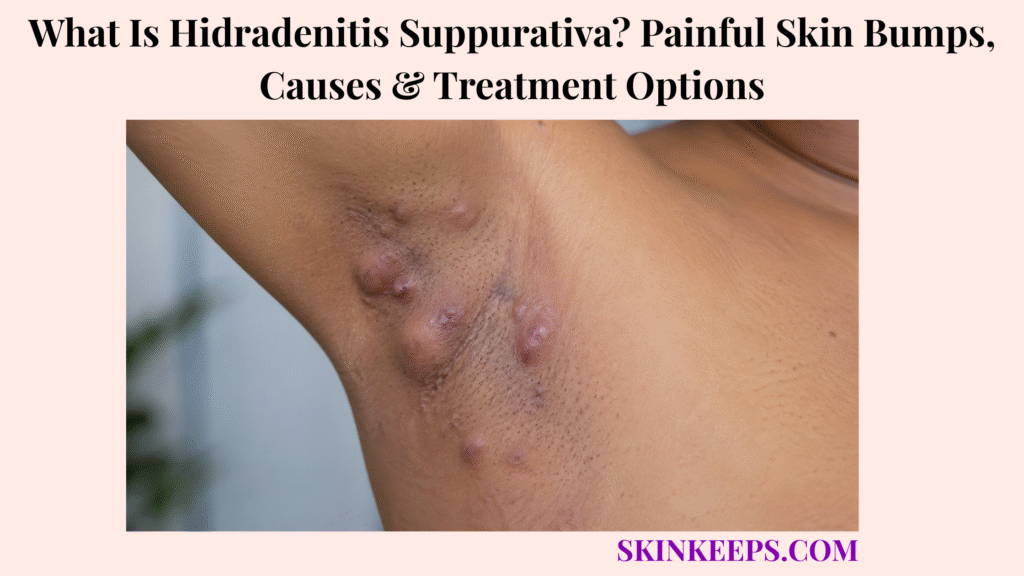
Hidradenitis suppurativa is a chronic inflammatory hair-follicle disease that causes recurrent deep, painful lumps in skin-fold areas. It is often shortened to HS and is also called acne inversa, although it is not ordinary acne.
Lesions can progress from nodules into abscess-like swellings, open wounds, malodorous drainage, interconnected tunnels and permanent scars. HS is not contagious or caused by poor hygiene, and early treatment can reduce pain and help prevent structural damage.
How Can You Recognize Hidradenitis Suppurativa Skin Bumps?
Hidradenitis suppurativa is most strongly suggested by recurrent painful lumps in typical skin-fold areas, especially when drainage, paired openings, tunnels or scars develop.
- Deep, firm or rubbery painful nodules.
- Repeated boil-like swellings.
- Abscess-like lesions that enlarge over days.
- Rupture with thick, bloody or pus-like drainage.
- Slow-healing open sores.
- Paired or double-ended comedones.
- Small openings that repeatedly leak.
- Tunnels connecting lesions beneath skin.
- Rope-like, thick or contracted scars.
- Burning, stinging, itching or pressure before a visible lump.
- Repeated outbreaks in the same region.
The central clue is typical lesions in typical locations with recurrence or persistence—not one isolated lump.
Figure 1. HS is suggested by recurrent deep nodules or abscesses in characteristic skin folds, especially when paired openings, persistent drainage, subcutaneous tunnels or rope-like scars develop.
Where Does Hidradenitis Suppurativa Usually Appear?
HS usually appears in hair-bearing skin folds exposed to friction, heat, pressure, moisture or occlusion.
| Location | Typical Pattern | Functional Concern |
|---|---|---|
| Armpits | Deep recurrent nodules and tunnels | Pain raising arms |
| Groin and inner thighs | Nodules, drainage and scars | Walking and friction pain |
| Beneath breasts | Moist fold lesions | Clothing and wound-care difficulty |
| Abdominal folds | Friction-related recurrent lesions | Moisture and movement |
| Buttocks | Abscesses, tunnels and scars | Sitting pain |
| Perianal area | Drainage and complex tunnels | Bowel-disease differential |
| Genital or pubic skin | Hair-bearing fold lesions | Urination, intimacy or mobility |
| Neck, ears or scalp | Less typical follicular-occlusion sites | Broader syndrome assessment |
Location supports diagnosis but does not confirm HS without the correct lesions and chronic course.
Which Types of Lesions Can Hidradenitis Suppurativa Produce?
What Do Early HS Nodules Feel Like?
Early HS nodules are deep, firm, tender lumps that can hurt before redness or swelling becomes obvious.
They may feel pea-sized or larger, become painful with pressure, walking or arm movement and recur near neighbouring follicles.
What Do HS Abscesses Look Like?
HS abscess-like lesions are larger swollen collections that can become fluctuant, rupture and release thick, bloody or pus-like material.
Drainage may reduce pressure temporarily, but lesions often refill when inflammation and structural disease remain active.
What Are Double-Ended Comedones?
Double-ended comedones are two dark openings connected beneath repeatedly inflamed or scarred skin.
They are more specific for HS than isolated blackheads because the paired openings can share an underground tract.
What Are Draining Tunnels?
Draining tunnels are epithelialized inflammatory channels beneath skin that connect previous nodules or abscesses.
They can leak chronically, swell along the same route and respond poorly to repeated short antibiotic courses.
What Scars Can HS Leave?
HS can leave dark or pale marks, raised scars, rope-like bands, contracted skin and persistent drainage openings.
Scar contraction can restrict shoulder, hip or leg movement.
How Does Hidradenitis Suppurativa Develop Inside a Hair Follicle?
HS begins with follicular blockage and rupture, followed by strong immune inflammation around the damaged follicular unit.
Keratin and cellular material obstruct the follicle, which expands and can rupture. Keratin, bacteria and debris then enter surrounding tissue and trigger an inflammatory response.
Repeated rupture affects nearby follicles. Chronic inflammation can create epithelialized tunnels, fibrosis and permanent scars.
Apocrine-rich folds are commonly involved, but the process does not start as a primary disorder of sweat glands.
Figure 2. HS begins with follicular obstruction and rupture; repeated immune inflammation can create abscess-like cavities, epithelialized tunnels and permanent fibrotic scars.
What Causes Hidradenitis Suppurativa?
The precise initiating cause of HS remains incompletely understood, but follicular obstruction, immune dysregulation, genetics, hormones and external aggravators can interact.
| Factor | Possible Role | What It Does Not Mean |
|---|---|---|
| Follicular obstruction | Starts rupture pathway | Every blocked pore becomes HS |
| Immune dysregulation | Sustains inflammation | The condition is contagious |
| Genetic susceptibility | Runs in some families | One gene explains every case |
| Hormonal influence | Changes activity in some people | Hormones explain all disease |
| Friction and pressure | Can aggravate lesions | Friction alone creates HS |
| Bacterial colonization | Can complicate open wounds | One bacterium is the universal cause |
Is Hidradenitis Suppurativa Contagious or Caused by Poor Hygiene?
HS is not contagious, is not sexually transmitted and is not caused by inadequate washing.
It cannot spread through touching, sex, clothing, towels or toilet seats. Drainage does not mean the condition came from another person.
Aggressive washing or scrubbing cannot correct follicular inflammation and may worsen friction and pain.
An individual open wound can develop secondary bacterial infection, which is a separate complication requiring targeted assessment.
| Statement | Accurate? | Reason |
|---|---|---|
| HS spreads by touch | No | It is an inflammatory follicular disease |
| Inadequate washing starts HS | No | Washing does not control the initiating biology |
| Drainage means STI | No | Genital-fold HS is not sexually transmitted |
| Open wounds can become infected | Yes | Secondary infection can occur |
Who Is More Likely to Develop Hidradenitis Suppurativa?
HS often begins after puberty and is associated with family history, smoking, higher body weight, friction and hormonal or inflammatory factors, but it can affect many different people.
| Factor | Possible Relationship | Cannot Prove | Clinical Response |
|---|---|---|---|
| Puberty and hormones | Timing or flare influence | Explains every case | Track patterns |
| Family history | Inherited susceptibility | Guaranteed transmission | Ask family history |
| Smoking | May worsen inflammatory activity | Personal fault | Offer cessation support |
| Higher body weight | May increase friction and inflammation | Universal cause | Treat now and support goals |
| Friction and occlusion | May aggravate folds | Sole cause | Reduce irritation |
| Metabolic or inflammatory disease | Association | Automatic diagnosis | Targeted screening |
Lifestyle support should accompany medical treatment rather than delay it.
Is Hidradenitis Suppurativa Inherited?
HS can run in families, but most cases are not explained by one simple genetic test.
Severity can differ between relatives, and a parent with HS does not guarantee that a child will develop it.
Routine genetic testing is unnecessary for most typical cases. Specialist genetic assessment may be considered for very early onset, many severely affected relatives or syndromic inflammatory patterns.
How Can Hormones Influence Hidradenitis Suppurativa?
Hormones can influence HS activity in some people, which may help explain puberty onset, menstrual flares or pregnancy-related changes.
- Premenstrual flare pattern.
- Pregnancy improvement, worsening or no change.
- Postpartum hormonal and friction changes.
- Possible change around menopause.
- Androgen sensitivity in selected patients.
- Polycystic ovary syndrome signs.
- Contraceptive or medication response.
| Cycle Phase | New Lesions | Location | Severity | Treatment Response |
|---|---|---|---|---|
Which Factors Can Trigger or Worsen HS Flares?
HS flares may worsen with friction, heat, sweating, shaving injury, pressure, smoking, stress, hormonal timing or delayed treatment, but triggers vary.
- Tight clothing and skin friction.
- Heat and heavy sweating.
- Shaving cuts or repeated waxing.
- Equipment or sitting pressure.
- Cigarette smoking.
- Menstrual timing.
- Stress and sleep disruption.
- Irritating deodorants or skin products.
- Delayed treatment of early inflammation.
A trigger is personally useful only when it repeatedly precedes flares.
How Can HS Look Different Across Skin Tones?
HS inflammation may appear red-brown, purple, grey-purple or darker than surrounding skin, and tenderness can precede obvious colour change.
Post-inflammatory hyperpigmentation can persist after a flare, while scars may become darker, lighter or raised.
Drainage openings, paired comedones, deep tenderness, regional recurrence and scar texture can be more reliable than bright redness.
How Is Hidradenitis Suppurativa Severity Classified?
What Is Hurley Stage I Hidradenitis Suppurativa?
Hurley stage I describes nodules or abscesses without established draining tunnels or broad scar networks.
Early treatment offers the greatest opportunity to prevent structural progression.
What Is Hurley Stage II Hidradenitis Suppurativa?
Hurley stage II includes recurrent nodules or abscesses with one or more tunnels and scarring, while some normal skin remains between involved areas.
What Is Hurley Stage III Hidradenitis Suppurativa?
Hurley stage III describes extensive regional disease with multiple interconnected tunnels, recurrent abscesses and broad scarring.
How Does the IHS4 Measure Active Inflammatory Disease?
IHS4 measures active disease using nodules multiplied by 1, abscesses multiplied by 2 and draining tunnels multiplied by 4.
A total of 3 or fewer is mild, 4–10 is moderate and 11 or more is severe.
| Measure | What It Captures | Use |
|---|---|---|
| Hurley stage | Permanent structural damage | Procedure and regional planning |
| IHS4 | Current inflammatory lesions | Dynamic activity and treatment response |
How Is Hidradenitis Suppurativa Different From Ordinary Boils?
HS differs from ordinary boils because it recurs in typical skin folds and can form paired comedones, tunnels and scars.
Repeated “boils” in armpits, groin, breast folds or buttocks should raise suspicion when they recur, drain, scar or form tunnels.
| Feature | HS | Ordinary Boil |
|---|---|---|
| Pattern | Recurrent regional disease | Usually isolated |
| Location | Skin folds common | Can occur almost anywhere |
| Comedones | Paired openings possible | Not typical |
| Tunnels | Can develop | Not a routine network |
| Response | Needs chronic plan | Often resolves with infection-directed care |
How Is Hidradenitis Suppurativa Different From Acne?
HS is sometimes called acne inversa, but it is not ordinary acne.
The name can be confusing because ordinary acne usually affects the face, chest or back and does not routinely form draining tunnels in skin folds.
| Feature | HS | Acne Vulgaris |
|---|---|---|
| Main sites | Armpits, groin, breast and buttock folds | Face, chest and back |
| Lesions | Deep nodules, abscesses and tunnels | Comedones, papules and pustules |
| Drainage | Chronic openings possible | Less typical |
| Scarring | Rope-like and contracted | Pitted, raised or pigment change |
| Isotretinoin response | Inconsistent | More predictable for severe acne |
How Is HS Different From Ingrown Hairs or Razor Bumps?
Ingrown hairs often follow shaving and remain superficial, while HS causes deeper recurrent fold nodules that may tunnel and scar.
Superficial follicle irritation or folliculitis may follow shaving, but HS recurs in characteristic regions and can create underground tracts.
| Feature | Ingrown Hair / Razor Bump | HS |
|---|---|---|
| Timing | After hair removal | Can occur without shaving |
| Depth | Usually superficial | Deep dermal or subcutaneous |
| Centre | Visible trapped hair may appear | No trapped hair required |
| Course | Often resolves | Chronic recurrence |
| Tunnels/scars | Unusual | Characteristic in established disease |
How Is Hidradenitis Suppurativa Different From an Epidermoid Cyst?
An epidermoid cyst is often one encapsulated lump, while HS usually creates multiple recurrent nodules across a characteristic region.
An epidermal cyst may have a central punctum and drain keratin when inflamed, whereas HS can create comedones, tunnels and broad regional scarring.
| Feature | Epidermoid Cyst | HS |
|---|---|---|
| Number | Often one persistent lump | Multiple recurring lesions |
| Punctum | Common | Not required |
| Drainage | Keratin when ruptured | Bloody or pus-like chronic drainage |
| Distribution | Any site | Characteristic folds |
| Management | Excision when indicated | Medical plus procedural plan |
How Is Groin HS Different From a Bartholin Cyst or Abscess?
Groin or vulval HS usually affects hair-bearing fold skin, while a Bartholin cyst or abscess develops near the Bartholin duct opening.
| Feature | Groin / Vulval HS | Bartholin Cyst or Abscess |
|---|---|---|
| Number | Several recurrent nodules possible | Usually one lower-vulval swelling |
| Site | Hair-bearing fold or outer vulva | Bartholin duct region |
| Other clues | Scars, comedones, drainage openings | Localized gland swelling |
| Other body areas | Armpit or breast HS may coexist | Not typical |
| Care | Dermatology plan | Gynecologic duct-specific care |
How Is Perianal HS Different From Crohn-Related Fistulas?
Perianal HS can create skin tunnels, while Crohn-related fistulas may connect to the anal canal or rectum.
| Feature | Perianal HS | Crohn-Related Fistula |
|---|---|---|
| Tunnel level | Often dermal or subcutaneous | May connect to bowel |
| Other skin sites | Groin, buttock or armpit HS | Not required |
| Skin clues | Comedones and scars | External opening may be present |
| Bowel symptoms | May be absent | Diarrhea, weight loss or abdominal pain |
| Assessment | Dermatology and imaging | GI, colorectal and pelvic imaging |
HS and Crohn disease can coexist, so complex perianal disease needs multidisciplinary assessment.
How Is Hidradenitis Suppurativa Diagnosed?
HS is primarily a clinical diagnosis based on typical lesions, typical locations and recurrence or persistence.
- Nodules, abscesses, comedones, tunnels or scars.
- Armpit, groin, inner-thigh, breast, buttock or perianal distribution.
- Recurrence or persistence over time.
- Age at onset and family history.
- Number of regions and flare frequency.
- Hormonal pattern and smoking exposure.
- Drainage, pain and movement impact.
- Previous antibiotics or drainage procedures.
- Quality-of-life burden.
There is no single blood test that confirms HS.
When Are Cultures, Ultrasound or Skin Biopsy Needed?
When Is a Bacterial Culture Useful?
Culture is useful when fever, spreading redness, a sudden drainage change, worsening wound pain, treatment failure or resistant-organism concern suggests secondary infection.
Routine culture does not independently diagnose HS.
How Can Ultrasound Help Evaluate HS?
Ultrasound can detect fluid collections, hidden tunnels, lesion depth, active inflammation and fibrosis.
It can also help plan deroofing or excision.
When Is a Skin Biopsy Needed?
Biopsy is considered for atypical lesions, tumour concern, a changing long-standing wound or suspected Crohn disease, infection or another inflammatory disorder.
Classic HS usually does not need biopsy only to confirm the clinical pattern.
Which Medical Conditions Commonly Occur With HS?
HS care should include targeted screening for metabolic, inflammatory, follicular-occlusion and mental-health conditions when symptoms or risk factors support it.
| Category | Examples | Screening Clue |
|---|---|---|
| Metabolic | Obesity, diabetes, hypertension, abnormal lipids | Weight, BP and laboratory risk |
| Hormonal | PCOS | Cycle irregularity or androgen signs |
| Bowel | Inflammatory bowel or Crohn disease | Diarrhea, pain or perianal fistula |
| Joint | Inflammatory arthritis | Persistent joint pain or swelling |
| Skin | Psoriasis, severe acne, pilonidal disease | Clinical pattern |
| Mental health | Depression and anxiety | Mood, withdrawal or hopelessness |
| Sexual health | Pain and relationship difficulty | Patient-defined impact |
How Does HS Affect Pain, Movement and Quality of Life?
HS severity cannot be measured by lesion count alone because pain, drainage, movement restriction and emotional burden can be severe.
- Constant or episodic pain.
- Throbbing pressure from abscess-like lesions.
- Burning from open wounds.
- Difficulty raising arms, walking or sitting.
- Sleep disruption.
- Clothing and dressing difficulty.
- Leakage and odour.
- Reduced intimacy.
- Missed school or work.
- Social withdrawal.
- Depression, anxiety or low self-esteem.
Does Hidradenitis Suppurativa Require Treatment?
Recurrent HS should be medically assessed because early inflammatory disease can progress into irreversible tunnels and scars.
Treatment aims to reduce new lesions, pain and drainage; heal wounds; preserve movement; treat structural disease and improve daily life.
Mild disease may need preventive treatment, while moderate or severe HS often requires combination medical and procedural care.
There is no one-size plan or guaranteed universal cure.
How Should HS-Affected Skin Be Cared for Daily?
Daily HS skin care should reduce irritation, moisture and friction without harsh scrubbing.
- Wash gently and rinse thoroughly.
- Use a clinician-recommended antimicrobial wash when appropriate.
- Pat skin dry.
- Choose a non-irritating deodorant or antiperspirant.
- Avoid fragrance on active wounds.
- Wear loose breathable clothing.
- Change sweaty clothing.
- Protect draining areas with dressings.
- Avoid waxing active or high-risk areas.
- Shave cautiously if necessary.
- Discuss laser hair reduction when suitable.
How Should Draining HS Wounds Be Managed?
Draining HS wounds need gentle cleansing, non-adherent absorbent dressings, moisture protection and treatment of the underlying inflammation or tunnel.
- Clean without aggressive rubbing.
- Match dressing absorbency to drainage volume.
- Change saturated dressings.
- Protect surrounding skin from moisture.
- Reduce adhesive trauma.
- Monitor odour, pain and discharge changes.
- Seek specialist wound support when needed.
- Assess secondary infection when symptoms change.
A dressing controls leakage but cannot close an active epithelialized tract.
How Can HS Pain Be Managed Safely?
HS pain management should identify whether pain comes from active inflammation, abscess pressure, open wounds, tunnels, nerve irritation or scar restriction.
| Pain Source | Possible Support | Needed Review |
|---|---|---|
| Early inflammatory nodule | Warm or cool compress and anti-inflammatory treatment | Rapid worsening |
| Tense abscess-like lesion | Clinical drainage when necessary | Do not drain at home |
| Open wound | Non-adherent dressing and suitable analgesia | Infection signs |
| Neuropathic pain | Neuropathic-pain assessment | Persistent burning or shooting |
| Scar restriction | Therapy or procedure review | Movement limitation |
Paracetamol or acetaminophen and NSAIDs may be used when medically suitable; persistent severe pain may need specialist pain care.
Which Topical and Injected Treatments Can Help Mild HS?
How Is Topical Clindamycin Used?
Topical clindamycin may reduce selected mild pustular or superficial inflammatory lesions, but it has limited effect on deep tunnels and carries resistance risk.
How Can Resorcinol Be Used?
Resorcinol has keratolytic and anti-inflammatory activity and may help selected early nodules, but it can irritate or peel skin and should not be used over large areas without guidance.
When Are Corticosteroid Injections Used?
Intralesional corticosteroid can reduce inflammation in selected painful nodules, but benefit is temporary and thinning, indentation or pigment change can occur.
Can Topical Antiseptics Treat HS?
Antiseptic washes may reduce odour and surface bacterial burden, but they do not reverse deep tunnels and harsh products can irritate active skin.
| Option | Best Role | Main Limitation |
|---|---|---|
| Topical clindamycin | Mild superficial inflammation | Resistance and tunnel limits |
| Resorcinol | Selected early nodules | Irritation and peeling |
| Steroid injection | Rapid local nodule relief | Temporary and local adverse effects |
| Antiseptic wash | Surface bacterial and odour support | Does not treat deep structure |
How Are Oral Antibiotics Used for Hidradenitis Suppurativa?
Oral antibiotics in HS are often used for anti-inflammatory control and bacterial-burden modification, not because HS is simply an infection.
Tetracycline-class medicines or combination regimens may be used for longer periods than ordinary boil treatment.
Culture-directed antibiotics are used when secondary infection is suspected. Established epithelialized tunnels usually persist and may require procedures.
| Antibiotic Role | Example Context | Limit |
|---|---|---|
| Anti-inflammatory | Active nodules and abscesses | Disease may recur |
| Bacterial-burden modification | Draining inflammatory disease | Resistance and adverse effects |
| Culture-directed treatment | Secondary infection | Does not cure HS biology |
| Rescue or surgical preparation | Selected severe disease | Specialist use |
When Can Hormonal Treatment Help Hidradenitis Suppurativa?
Hormonal treatment may help selected patients whose flares follow menstrual cycles, androgen features or PCOS patterns.
| Option | Potential Fit | Safety Review |
|---|---|---|
| Combined hormonal contraception | Cycle-related flares | Clotting and other contraindications |
| Spironolactone | Androgen-sensitive pattern | Pregnancy, kidney function and potassium |
| Metformin | Selected PCOS or metabolic context | Kidney and gastrointestinal tolerance |
Hormonal treatment is individualized and not suitable for every person.
Are Oral Retinoids Effective for Hidradenitis Suppurativa?
Retinoids are not a universal HS answer, even though HS is sometimes called acne inversa.
Isotretinoin has inconsistent effectiveness and may fit better when severe acne coexists. Acitretin may help selected keratinization-dominant disease.
Retinoids do not reliably remove draining tunnels and require liver, lipid and pregnancy-risk monitoring. They can cause severe fetal harm.
Which Biologic Medicines Can Treat Moderate-to-Severe HS?
How Does Adalimumab Treat Hidradenitis Suppurativa?
Adalimumab blocks tumour necrosis factor and is given by subcutaneous injection for eligible moderate-to-severe HS.
Current U.S. labeling includes patients aged 12 years and older.
How Does Secukinumab Treat HS?
Secukinumab inhibits interleukin-17A and is used for eligible moderate-to-severe HS.
Current U.S. labeling includes adults and paediatric patients aged 12 years and older.
How Does Bimekizumab Treat HS?
Bimekizumab inhibits interleukin-17A and interleukin-17F and is labeled in the United States for adults with moderate-to-severe HS.
How Is the Best HS Biologic Selected?
Selection depends on age, active inflammation, tunnel burden, previous response, infection and tuberculosis risk, inflammatory bowel disease, pregnancy plans, access and surgery needs.
Biologics suppress inflammation but do not reliably erase mature scars or every established tunnel.
| Biologic | Immune Target | Current U.S. HS Age Group | Key Consideration |
|---|---|---|---|
| Adalimumab | TNF | 12 years and older | TB and serious-infection screening |
| Secukinumab | IL-17A | 12 years and older | TB, infection and IBD review |
| Bimekizumab | IL-17A and IL-17F | Adults | TB, liver, candidiasis and IBD review |
Which Safety Checks Are Needed Before Biologic Treatment?
Biologic treatment requires infection screening, vaccination review and monitoring for adverse effects.
- Tuberculosis testing.
- Hepatitis screening.
- Vaccination review.
- Current and previous infection history.
- Inflammatory bowel disease history.
- Complete blood count when appropriate.
- Liver tests.
- Pregnancy discussion.
- Malignancy and immune-condition review.
- Current wound and infection assessment.
During treatment, report fever, persistent cough, painful infection, thrush, new diarrhea, abdominal pain, injection reactions, liver symptoms or unexpected neurologic changes.
When Is Deroofing Used for HS Tunnels?
Deroofing treats persistent localized HS tunnels by removing the tunnel roof and allowing the tract to heal open.
- Map the full tunnel.
- Remove its roof.
- Preserve the floor when appropriate.
- Allow secondary-intention healing.
- Use for localized tunnels and recurrent lesions.
- Continue wound care.
- Continue inflammation control to reduce new disease elsewhere.
Deroofing removes less tissue than wide excision, but recurrence can occur at treated edges or in untreated skin.
When Is Surgical Excision Needed for Hidradenitis Suppurativa?
Surgical excision may be needed when HS has produced extensive tunnels, persistent drainage, severe scarring or treatment-resistant regional disease.
- Interconnected tunnels.
- Persistent regional drainage.
- Repeated inflammation in one area.
- Severe scarring or movement restriction.
- Failure of adequate medical treatment.
- Concern for squamous cell carcinoma.
| Procedure | Possible Closure | Main Trade-Off |
|---|---|---|
| Local excision | Primary or open healing | Limited region |
| Wide excision | Open healing, graft or flap | Larger wound and recovery |
| Staged reconstruction | Graft or regional flap | Multiple procedures possible |
Surgery can remove chronically diseased tissue in one region but does not prevent HS elsewhere.
Why Is Incision and Drainage Not a Permanent HS Treatment?
Incision and drainage can relieve pressure from a tense abscess but does not remove the diseased follicular unit or tunnel lining.
| Procedure Effect | What It Accomplishes | What Remains |
|---|---|---|
| Pressure release | Rapid pain relief | Inflammatory cavity biology |
| Fluid drainage | Empties collection | Tunnel lining |
| Short-term improvement | Makes acute lesion more tolerable | Recurrence risk |
| Repeated I&D | Temporary rescue | Additional scarring possible |
More durable options can include medication, punch removal, deroofing or excision.
Can Laser Treatment Help Hidradenitis Suppurativa?
How Can Laser Hair Reduction Help HS?
Laser hair reduction may decrease follicle density and future blockage in selected mild-to-moderate hair-bearing areas.
Multiple sessions are needed, settings must suit the skin tone and mature tunnels need another treatment.
How Is Carbon-Dioxide Laser Used?
Carbon-dioxide laser can vaporize or excise selected chronically diseased tissue, tunnels or scarred regions.
It requires specialist expertise and structured wound care.
How Are Smoking and Body Weight Addressed in HS Care?
Smoking cessation and weight-related support can help some patients, but active medical treatment should not be withheld until a person stops smoking or loses weight.
Smoking is associated with HS and may worsen inflammation. Higher body weight can increase friction, sweating and inflammatory burden.
HS pain can make exercise and weight management difficult. Support may include cessation services, nutrition care, metabolic assessment and low-friction activity planning.
Is There a Specific Diet That Cures Hidradenitis Suppurativa?
No single diet is proven to cure HS.
Balanced eating can support metabolic and cardiovascular health, but universal avoidance of dairy, high-glycaemic foods or brewer’s yeast is not justified by current evidence.
Food tracking is useful only when one exposure repeatedly correlates with flares. Extreme restriction, detox regimens and supplements should not replace treatment.
How Is Hidradenitis Suppurativa Managed During Pregnancy?
HS may improve, worsen or remain unchanged during pregnancy, so medication, wound and pain plans should be reviewed before conception when possible.
- Avoid retinoids because of fetal risk.
- Review antibiotics and hormonal medicines.
- Make a medicine-specific biologic decision.
- Review pain medicines.
- Plan wound and mobility support.
- Coordinate urgent procedures with obstetric care.
- Prepare for postpartum hormonal, friction and breastfeeding changes.
Do not stop prescribed treatment abruptly without dermatology and obstetric coordination.
Which HS Treatment Mistakes Should Be Avoided?
Unsafe or incomplete HS care can increase pain, tissue injury, resistance or diagnostic delay.
| Mistake | Why It Fails | Safer Direction |
|---|---|---|
| Squeeze or pierce nodules | Increases trauma and inflammation | Clinical treatment |
| Aggressive scrubbing | Adds friction and barrier injury | Gentle washing |
| Bleach or undiluted acids | Can burn skin | Clinician-approved products |
| Wax active areas | Injures follicles | Avoid during active disease |
| Repeated short antibiotics | No staging or tunnel plan | Long-term strategy |
| Treat drainage as proof of infection | HS drainage can be inflammatory | Culture when infection suspected |
| Use I&D as permanent care | Leaves diseased tract | Deroofing or excision review |
| Delay dermatology until tunnels form | Misses prevention window | Early referral |
| Stop biologic without review | Can destabilize control | Specialist plan |
| Ignore bowel or joint symptoms | Misses comorbidity | Targeted screening |
| Blame weight or hygiene | Adds stigma and delays care | Treat disease now |
| Ignore changing chronic wound | Misses malignancy | Biopsy assessment |
How Long Does Hidradenitis Suppurativa Last?
HS is generally long term and can flare, quiet down, recur or leave structural damage.
Individual nodules may settle within days or weeks, while some wounds drain for months. Tunnels and scars usually remain after active inflammation improves.
Disease activity can change with age, hormones, smoking, body weight and treatment. Some patients achieve prolonged remission, but recurrence can develop in the same or another area.
Can Hidradenitis Suppurativa Be Cured Permanently?
There is no guaranteed universal cure for HS, but many patients can achieve much better control with individualized treatment.
Medication can reduce inflammation, while deroofing or excision can permanently remove an individual tunnel or diseased region.
Surgery does not prevent HS elsewhere. Useful goals include minimal new inflammation, healed wounds, controlled drainage, preserved movement and acceptable quality of life.
Which Complications Can Hidradenitis Suppurativa Cause?
HS complications can include chronic pain, open wounds, secondary infection, scarring, movement restriction, mental-health burden and rare skin cancer in long-standing severe disease.
| Complication | Early Clue | Clinical Direction |
|---|---|---|
| Secondary infection | Fever, warmth or spreading redness | Culture and urgent assessment |
| Fibrosis and movement restriction | Tight scars and reduced range | Procedure and rehabilitation |
| Lymphatic obstruction | Persistent swelling | Specialist review |
| Anaemia | Fatigue with chronic inflammation or drainage | Blood testing |
| Depression or anxiety | Withdrawal, hopelessness or poor sleep | Mental-health support |
| Squamous cell carcinoma | Growing, hard, bleeding or non-healing wound | Urgent biopsy |
When Should Painful Skin Bumps Be Checked by a Dermatologist?
Painful recurrent lumps in armpits, groin, breast folds, buttocks or perianal skin should be checked early, before tunnels and disabling scars form.
- Two or more outbreaks in a similar region.
- Lesions leave scars.
- Paired comedones appear.
- Drainage openings form.
- Antibiotics help only temporarily.
- Several fold areas are affected.
- Walking, sitting or arm movement hurts.
- Sleep, school, work or intimacy is affected.
- A relative has HS.
- Repeated diagnoses of boils or ingrown hairs.
When Does Hidradenitis Suppurativa Require Urgent Medical Care?
HS requires urgent medical care when a flare is accompanied by systemic illness, rapidly spreading inflammation, functional obstruction, uncontrolled bleeding, necrosis or a changing chronic wound.
- Fever or chills.
- Rapidly spreading redness.
- Marked warmth beyond the usual lesion.
- Severe escalating pain.
- Confusion or extreme weakness.
- Red streaks.
- Uncontrolled bleeding.
- Inability to walk, sit or move an arm.
- Severe genital or perianal swelling.
- Difficulty urinating or passing stool.
- Dehydration.
- Black or necrotic tissue.
- A long-standing wound that grows, hardens or bleeds.
- New severe symptoms during immune-suppressing treatment.
Rapidly spreading warmth, redness, fever or red streaking may suggest secondary infection such as cellulitis rather than an ordinary localized HS flare.
Figure 3. Hurley staging describes structural damage, IHS4 measures active inflammation, medical therapy controls inflammatory activity, and deroofing or excision addresses persistent tunnels and scarred regions.
What Should You Remember About Hidradenitis Suppurativa?
Hidradenitis suppurativa is a chronic inflammatory follicular disease that causes recurrent nodules, abscess-like lesions, tunnels and scars in skin folds.
- HS is not contagious, sexually transmitted or caused by poor hygiene.
- Follicular blockage and rupture trigger immune inflammation.
- Diagnosis depends on typical lesions, locations and recurrence.
- Hurley stage measures structural damage.
- IHS4 measures active inflammatory severity.
- Early treatment can reduce progression.
- Antibiotics may reduce inflammation but do not remove mature tunnels.
- Eligible biologics include adalimumab, secukinumab and bimekizumab.
- Deroofing and excision treat persistent structural disease.
- Wound care, pain care and psychological support are core treatment components.
- Changing chronic wounds need assessment for rare squamous cell carcinoma.
Frequently Asked Questions About Hidradenitis Suppurativa?
Is hidradenitis suppurativa the same as acne inversa?
Yes. Acne inversa is a clinical synonym for hidradenitis suppurativa, but HS is not ordinary acne. It is a chronic inflammatory follicular disease that commonly affects skin folds.
What do early HS bumps look and feel like?
Early HS often causes deep, firm, tender or painful nodules that may burn, sting, itch or feel pressurized before obvious surface change.
Why does HS occur in the armpits and groin?
HS favours hair-bearing skin folds exposed to friction, heat, pressure, moisture and occlusion.
Is hidradenitis suppurativa caused by blocked sweat glands?
No. Current understanding places the initiating process in blocked and ruptured hair follicles, with secondary immune inflammation.
Is HS contagious or sexually transmitted?
No. HS is not contagious or sexually transmitted, although an individual open wound can occasionally develop secondary infection.
Does poor hygiene cause hidradenitis suppurativa?
No. Poor hygiene does not cause HS, and aggressive scrubbing can increase friction, pain and barrier damage.
How is HS different from an ordinary boil?
HS recurs in typical fold areas and can form paired comedones, tunnels and scars, while a boil is often an isolated bacterial follicle infection.
Can HS be mistaken for ingrown hairs?
Yes. Early HS may resemble shaving bumps or ingrown hairs, but HS is deeper, recurrent and may form tunnels or permanent scars.
What are HS tunnels or sinus tracts?
They are inflamed epithelialized channels beneath the skin that connect previous nodules or abscesses and can cause repeated swelling, leakage and odour.
What are the three Hurley stages of HS?
Stage I has nodules or abscesses without established tunnels, stage II has recurrent lesions with separated tunnels and scarring, and stage III has diffuse interconnected tunnels and scarring across a region.
How is the IHS4 score calculated?
IHS4 equals nodules multiplied by 1, abscesses multiplied by 2 and draining tunnels multiplied by 4. Three or fewer is mild, 4–10 moderate and 11 or more severe.
Does hidradenitis suppurativa require a biopsy?
Typical HS usually does not require biopsy, but atypical lesions, tumour concern, a changing long-standing wound or suspected alternative disease may require one.
Can antibiotics permanently cure HS?
No. Antibiotics may reduce inflammation or treat secondary infection, but they do not permanently remove established tunnels or guarantee cure.
Which biologic medicines are approved for HS?
Current U.S. labels include adalimumab and secukinumab for eligible patients aged 12 years and older and bimekizumab for adults with moderate-to-severe HS.
Can HS tunnels heal without surgery?
Active inflammation may improve with medicine, but established epithelialized tunnels often need deroofing, excision or selected laser treatment.
What is the difference between abscess drainage and deroofing?
Incision and drainage releases pressure from a tense abscess but usually leaves the diseased tract, while deroofing removes the roof of a persistent tunnel so it can heal open.
Can laser hair removal reduce HS flares?
It may help selected mild-to-moderate hair-bearing areas by reducing follicle density, but it does not remove mature tunnels.
Does losing weight or stopping smoking cure HS?
No guaranteed cure follows either change, but supportive smoking cessation and weight-related care may reduce flare burden in some people and improve general health.
Is there a proven HS diet?
No single diet is proven to cure HS. Food tracking may help when one repeated personal trigger is clear, but restrictive diets should not replace treatment.
Can hidradenitis suppurativa affect pregnancy?
Yes. HS may improve, worsen or remain unchanged during pregnancy, and medication, wound, pain and postpartum plans should be reviewed with dermatology and obstetric care.
Can HS turn into skin cancer?
Rarely, long-standing severe perineal, buttock or perianal HS can be associated with squamous cell carcinoma, so changing or non-healing wounds need assessment.
When do painful HS bumps require urgent treatment?
Urgent assessment is needed for fever, chills, spreading redness or warmth, red streaks, rapidly escalating pain, confusion, functional obstruction, necrosis, uncontrolled bleeding or a chronic wound that grows, hardens or bleeds.
Which Sources Support This Hidradenitis Suppurativa Guidance?
American Academy of Dermatology — HS Causes — Hair-follicle obstruction and rupture, cause boundaries, genetics, hormones and non-hygiene framing.
American Academy of Dermatology — HS Diagnosis and Treatment — Clinical diagnosis, individualized medical, wound, pain and procedural treatment and early disease control.
DermNet — Hidradenitis Suppurativa — Lesion morphology, characteristic sites, recurrence, diagnosis, Hurley staging and procedural care.
PubMed — IHS4 Development and Validation — Validated IHS4 formula and mild, moderate and severe activity thresholds.
European S2k Guideline — HS Treatment — Inflammatory medical treatment, irreversible structural disease, antibiotics, biologics and surgery.
DailyMed — HUMIRA Prescribing Information — Current U.S. adalimumab indication for moderate-to-severe HS in patients aged 12 years and older.
DailyMed — COSENTYX Prescribing Information — Current U.S. secukinumab indication for moderate-to-severe HS in adults and patients aged 12 years and older.
DailyMed — BIMZELX Prescribing Information — Current U.S. bimekizumab indication and baseline safety evaluations for adults with moderate-to-severe HS.
This SkinKeeps article is educational and does not diagnose or replace dermatology, wound, surgical, gynecologic, gastrointestinal, pregnancy, pain, mental-health or emergency care. Seek urgent assessment for fever, chills, spreading redness or warmth, red streaks, escalating pain, confusion, severe genital or perianal swelling, functional obstruction, uncontrolled bleeding, necrosis, immune-suppression illness, or a chronic wound that grows, hardens, bleeds or fails to heal. Do not squeeze, pierce, scrub, bleach, acid-treat or drain lesions at home, and do not stop biologic treatment without specialist guidance.