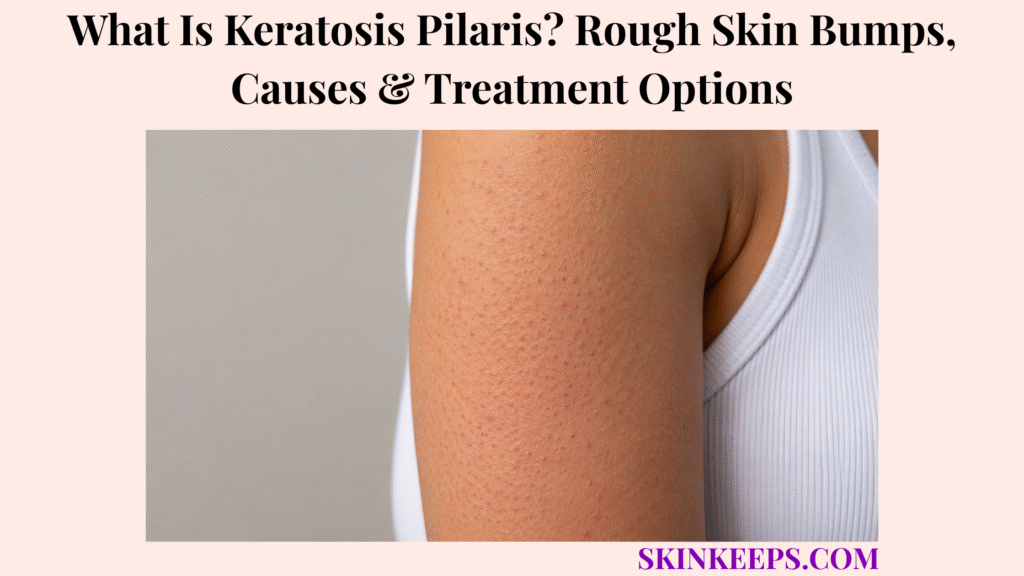
Keratosis pilaris, abbreviated KP, is a common harmless follicular keratinization condition that causes tiny rough bumps around hair follicles. The texture is often described as chicken skin, goosebumps or sandpaper and commonly affects the upper arms, thighs, cheeks and buttocks.
The bumps can be skin-coloured, white, red, purple-brown or darker than nearby skin. KP often begins in childhood, may become more noticeable during adolescence and can worsen with dryness, cold weather or harsh skin care. Treatment is optional unless texture, itch, redness or appearance is bothersome.
How Can You Recognize Keratosis Pilaris?
Keratosis pilaris is recognized by tiny, uniform, rough bumps centred around hair follicles.
What Do Keratosis Pilaris Bumps Look and Feel Like?
Keratosis pilaris bumps usually feel rough, dry and sandpaper-like rather than painful or pus-filled.
- Numerous tiny follicular bumps.
- Goosebump-like or chicken-skin texture.
- Skin-coloured, white, red, pink, purple-brown or dark dots.
- Fine dryness or scale.
- A trapped or coiled hair in some bumps.
- Relatively uniform and persistent.
- Usually painless, though mild itch can occur.
Where Does Keratosis Pilaris Usually Develop?
Keratosis pilaris usually develops on hair-bearing areas such as the upper arms, thighs, cheeks and buttocks.
- Outer and back upper arms.
- Front or outer thighs.
- Buttocks and cheeks.
- Forearms and lower legs.
- Less commonly trunk or chest.
- Palms and soles are spared because they lack hair follicles.
How Can KP Look Across Different Skin Tones?
KP can look different across skin tones, so texture and follicular location are more reliable than redness alone.
- Skin-coloured or white bumps.
- Pink or red colour on lighter skin.
- Red-brown, purple-brown or dark spots on darker skin.
- Residual colour after irritation.
- Roughness may be easier to feel than see.
Picking and over-exfoliation can leave hyperpigmentation around follicles.
Figure 1. Keratosis pilaris produces tiny uniform follicular bumps with a dry, rough texture. Colour varies across skin tones, while the upper arms, thighs, cheeks and buttocks are the commonest sites.
Why Does Keratosis Pilaris Develop?
Keratosis pilaris develops when keratin builds up inside hair-follicle openings.
How Does Keratin Create the Rough Bumps?
Keratin creates KP bumps when retained skin cells block the upper hair follicle.
- Keratin normally protects the outer skin.
- Follicular cells do not shed normally.
- Keratin accumulates at the opening.
- A small firm bump forms around the hair.
- Mild inflammation can create colour change.
- Dryness makes scale more visible.
Is Keratosis Pilaris Inherited?
Keratosis pilaris often runs in families, although common KP is not explained by one universal gene.
- Family tendency is common.
- Severity differs between relatives.
- A parent may have only mild arm roughness.
- Routine genetic testing is not needed.
- Barrier-related factors may contribute.
Which Skin Conditions Commonly Occur With KP?
KP commonly appears alongside dry or sensitive skin conditions.
- Atopic dermatitis.
- Ichthyosis vulgaris.
- Generally dry or sensitive skin.
- Other keratinization disorders less commonly.
KP can coexist with atopic dermatitis when barrier dryness is prominent.
Ichthyosis vulgaris can make follicular roughness more persistent.
Why Does KP Often Worsen in Winter?
KP often worsens in winter because dry air and harsh bathing make follicular scale more visible.
- Cold air and indoor heating reduce moisture.
- Long hot showers increase water loss.
- Harsh soap worsens dryness.
- Warm humid weather may reduce visibility.
Dry skin / xerosis can make plugs and scale more visible.
Which Forms of Keratosis Pilaris Can Occur?
Keratosis pilaris ranges from common rough bumps to redness-dominant and rare scarring variants.
What Is Common Keratosis Pilaris?
Common keratosis pilaris causes rough follicular bumps without true scarring or permanent hair loss.
- Upper-arm and thigh predominance.
- Minimal symptoms.
- Mild surrounding colour.
- No true scar or permanent hair loss.
- Possible improvement with age.
What Is Keratosis Pilaris Rubra?
Keratosis pilaris rubra is a redness-dominant form of KP.
- Prominent follicular redness.
- Broad flushed areas.
- Facial or limb involvement.
- No atrophy or permanent hair loss.
What Is Keratosis Pilaris Atrophicans?
Keratosis pilaris atrophicans is a rarer KP-spectrum disorder that can cause follicular damage, scarring or eyebrow loss.
- Follicular bumps around eyebrows or face.
- Persistent inflammation.
- Loss of lateral eyebrow hair.
- Small facial depressions.
- Honeycomb-like cheek changes.
- Possible scalp involvement.
Figure 2. Keratosis pilaris begins with abnormal follicular keratinization and plugging. Common KP does not scar, KP rubra is redness-dominant, and atrophicans-spectrum disease can damage follicles and cause eyebrow loss or facial depressions.
How Is Keratosis Pilaris Different From Similar Skin Bumps?
KP must be separated from acne, folliculitis, ingrown hairs, eczema and milia because treatment differs.
How Is KP Different From Acne?
KP differs from acne because it forms dry follicular plugs rather than comedones, pustules, nodules or cysts.
| Feature | Keratosis Pilaris | Acne |
|---|---|---|
| Main lesion | Tiny uniform dry bumps | Comedones, papules or pustules |
| Texture | Rough and sandpaper-like | Variable; may be oily or inflamed |
| Common sites | Arms, thighs, cheeks, buttocks | Face, chest and back |
| Pain | Usually little or none | Tender nodules can occur |
| Scarring | Not typical in common KP | Possible after inflammatory acne |
KP is often mistaken for acne, but the lesion pattern and mechanism differ.
How Is KP Different From Folliculitis?
KP differs from folliculitis because ordinary KP bumps are dry and firm, not pus-filled or newly infected.
- Folliculitis may be tender or burning.
- Pus, crust or drainage can occur.
- Onset may be sudden.
- Ordinary KP is long-standing and uniform.
- Antibiotics do not treat uncomplicated KP.
Painful or pus-filled hair-centred bumps suggest folliculitis.
How Is KP Different From Ingrown Hairs?
KP is widespread and uniform, while ingrown hairs are usually isolated around recently shaved or waxed follicles.
- A curved hair may be visible.
- Bumps are larger and isolated.
- Pain is more common.
- Shaving or waxing closely precedes the lesion.
How Is KP Different From Eczema or Milia?
KP is follicular and rough, while eczema is patchy and milia are cyst-like.
- Eczema creates itchy patches between follicles.
- Severe eczema can crack or weep.
- Milia are firm white cysts not centred on follicles.
- Milia leave surrounding skin smooth.
Dermatitis / eczema can overlap with KP but forms broader inflamed patches.
How Is Keratosis Pilaris Diagnosed?
Keratosis pilaris is usually diagnosed clinically from its rough follicular texture, typical body sites and harmless course.
Which Findings Support the Diagnosis?
Typical KP is supported by age of onset, family tendency, follicular texture and common body distribution.
- Age of onset.
- Family history.
- Typical sites.
- Rough follicular distribution.
- Seasonal worsening.
- Dry-skin history.
- Absence of deep pain or pus.
Can Dermoscopy Help?
Dermoscopy can help show follicular plugs and trapped hairs when KP is difficult to see clearly.
- Follicular keratin plugs.
- Fine scale.
- Perifollicular redness.
- Thin or coiled hairs.
When Is a Skin Biopsy Needed?
A skin biopsy is rarely needed for KP but may be considered when the pattern is atypical or scarring.
- Unusual distribution.
- Painful or ulcerated lesions.
- Scarring or permanent hair loss.
- Repeated treatment failure.
- Concern for another follicular disorder.
Does Keratosis Pilaris Need Treatment?
Keratosis pilaris does not always need treatment because it is harmless and non-contagious.
- Treatment is optional.
- Consider it for dryness, itch, redness, roughness or appearance.
- Mild childhood KP may improve gradually.
- Scarring or hair-loss variants need earlier care.
- Maintenance is usually required.
What Are the Main Treatment Goals?
KP treatment goals are to hydrate the skin, loosen plugs, reduce irritation and maintain improvement.
- Restore moisture.
- Loosen keratin plugs.
- Reduce irritation and redness.
- Avoid added inflammation.
- Improve colour gradually.
- Maintain gains.
How Long Does Improvement Take?
KP improvement usually takes weeks, and redness or pigmentation may improve more slowly than texture.
- Texture can take several weeks.
- Review after about 4–6 weeks.
- Colour may improve more slowly.
- Stopping treatment often allows return.
Which Daily Skin-Care Routine Helps Keratosis Pilaris?
A KP routine should protect the skin barrier before adding exfoliating or prescription ingredients.
How Should KP-Prone Skin Be Washed?
KP-prone skin should be washed gently with warm water and a mild cleanser.
- Warm rather than hot water.
- Short showers or baths.
- Mild fragrance-free cleanser.
- Pat rather than rub dry.
- Moisturize while slightly damp.
Should Keratosis Pilaris Be Scrubbed?
KP should not be scrubbed aggressively because friction can worsen redness, irritation and pigmentation.
- Use only light exfoliation.
- Stop if burning or soreness develops.
- Avoid stiff brushes and rough scrubs.
- Do not pick or squeeze plugs.
How Should Moisturizer Be Applied?
Moisturizer should be applied soon after bathing and repeated when KP-prone skin feels dry.
- Use thick fragrance-free cream or ointment.
- Apply within about 5 minutes after bathing.
- Reapply when dry.
- Use 2–3 times daily during dry flares when practical.
- Continue during treatment breaks.
How Should Shaving and Waxing Be Managed?
Shaving and waxing should be reduced or modified when they inflame KP-prone follicles.
- Avoid dry shaving.
- Use shaving gel and a clean sharp razor.
- Shave with hair growth.
- Reduce frequency during flares.
- Laser hair reduction is optional.
Which Topical Treatments Can Smooth Keratosis Pilaris?
Topical KP treatments smooth the skin by hydrating the outer layer, loosening plugs or normalizing follicular turnover.
How Do Urea and Lactic Acid Help?
Urea and lactic acid soften dry keratin and improve rough texture.
- Urea draws water into outer skin.
- Urea softens compact keratin.
- Lactic acid loosens retained cells.
- Both can sting irritated skin.
How Do Glycolic and Salicylic Acid Help?
Glycolic acid and salicylic acid loosen rough surface scale and follicular keratin but can irritate when overused.
- Glycolic acid exfoliates surface skin.
- It may improve texture and colour.
- Salicylic acid loosens compact keratin.
- Overuse can cause burning or raw skin.
When Are Topical Retinoids Used?
Topical retinoids may be used for persistent KP when moisturizer and keratolytic ingredients are not enough.
- They normalize follicular turnover.
- They can reduce new plugs.
- Dryness and peeling can occur.
- Introduce gradually.
- Review use during pregnancy or pregnancy planning.
When Can a Topical Corticosteroid Be Used?
A topical corticosteroid can reduce inflammation during selected itchy or irritated flares but does not remove plugs.
- Significant itch.
- Inflamed follicles.
- Eczema overlap.
- Irritation from an active product.
- Brief clinician-directed use only.
How Should Active Products Be Introduced Safely?
Active KP products should be introduced one at a time so irritation can be identified early.
- Establish moisturizer first.
- Add one keratolytic.
- Start every second or third day if sensitive.
- Pause when raw or inflamed.
- Avoid aggressive combinations.
- Reduce frequency after improvement.
When Can Laser or Light Treatment Help Keratosis Pilaris?
Laser or light treatment may help selected KP features when consistent topical care has not achieved the desired result.
Which Procedures May Reduce Redness?
Vascular-targeting procedures may help KP redness more than the underlying keratin plugs.
- Pulsed-dye laser.
- Intense pulsed light.
- Other vascular-targeting devices.
- Several sessions may be needed.
Which Lasers May Improve Rough Texture?
Some lasers may improve KP texture or hair-related follicular plugging in selected patients.
- Long-pulsed Nd:YAG.
- Diode laser.
- Alexandrite laser.
- Selected ablative lasers.
- Laser-assisted hair reduction.
What Are the Limitations and Risks?
KP procedures involve cost, repeated sessions and pigment-risk considerations.
- Temporary redness or swelling.
- Burns.
- Hyperpigmentation or hypopigmentation.
- Inconsistent response.
- Recurrence without maintenance.
- Limited standardized long-term evidence.
How Can KP Flares and Treatment Irritation Be Prevented?
KP flares and treatment irritation are prevented by protecting the barrier and avoiding over-exfoliation.
Which Factors Commonly Make KP More Noticeable?
KP often becomes more noticeable when the skin is dry, irritated or exposed to repeated friction.
- Cold or dry weather.
- Long hot showers.
- Harsh soap.
- Aggressive scrubbing or picking.
- Tight clothing.
- Shaving or waxing.
- Several active products together.
Which Treatment Mistakes Should Be Avoided?
The main treatment mistakes create inflammation while trying to remove plugs too aggressively.
| Mistake | Why It Fails | Safer Action |
|---|---|---|
| Squeezing | Inflammation and colour change | Leave follicles untouched |
| Hard scrubbing | Barrier injury | Exfoliate lightly |
| Several acids daily | Irritant dermatitis | Introduce one active |
| Actives on cracked skin | Burning | Use bland moisturizer |
| Immediate-result expectations | Frequent product switching | Review after several weeks |
| Antibiotics | No effect on uncomplicated KP | Target keratinization |
| Continuous steroid | Skin thinning | Brief flares only |
| Stopping all care | Roughness returns | Use maintenance |
Why Is Maintenance Treatment Necessary?
Maintenance is necessary because the tendency toward follicular plugging remains after the bumps look smoother.
- Improvement does not permanently normalize keratinization.
- Active treatment may reduce to a few weekly applications.
- Moisturizer should continue.
- Increase frequency temporarily during dry flares.
When Should Keratosis Pilaris Be Checked by a Dermatologist?
Keratosis pilaris should be checked when the diagnosis is uncertain, the burden is high or the pattern suggests more than ordinary KP.
When Is a Routine Assessment Helpful?
A routine dermatology assessment is helpful when KP is persistent, distressing, widespread or treatment-resistant.
- Uncertain diagnosis.
- No improvement after consistent care.
- Widespread bumps.
- Substantial itch.
- Prominent facial redness or pigment concern.
- Quality-of-life effect.
- Considering prescription retinoids or laser.
Which Changes Suggest Something Other Than Ordinary KP?
Pus, pain, swelling, crusting or blistering suggests something other than ordinary KP.
- Pus.
- Increasing pain.
- Marked warmth or swelling.
- Spreading redness.
- Thick crusting.
- Large nodules.
- Blistering or ulceration.
- Fever or sudden widespread illness.
Which Facial Changes Need Earlier Dermatology Review?
Facial scarring, eyebrow loss or scalp hair loss needs earlier review because it can signal an atrophicans-spectrum disorder.
- Progressive eyebrow thinning.
- Permanent eyebrow loss.
- Small facial indentations.
- Honeycomb-like cheek scarring.
- Scalp hair loss.
- Eye irritation with severe follicular disease.
Assessment route: pus, pain, warmth, spreading redness, blistering, ulceration, fever, eyebrow loss, facial indentations or scalp hair loss should not be assumed to be ordinary KP.
Figure 3. Care starts with gentle washing and prompt moisturization. One keratolytic or retinoid is introduced gradually, procedures are reserved for selected persistent features, and maintenance helps prevent rapid return of roughness.
What Should You Remember About Keratosis Pilaris?
Keratosis pilaris is harmless follicular keratin plugging that can be smoothed but usually needs maintenance.
- KP produces tiny rough bumps often called chicken skin.
- Upper arms, thighs, cheeks and buttocks are common sites.
- Bumps vary in colour.
- KP is not contagious and is not a cleanliness problem.
- Family and barrier factors contribute.
- Dry weather and harsh care worsen texture.
- Diagnosis is usually clinical.
- Treatment is optional unless bothersome.
- Gentle washing, moisturizer and controlled exfoliation form the foundation.
- Urea, lactic acid, glycolic acid and salicylic acid can help.
- Topical retinoids may help persistent disease but can irritate.
- Laser may target selected redness or texture concerns.
- Maintenance is usually required.
- Eyebrow loss or facial scarring may indicate an atrophicans variant.
Frequently Asked Questions About Keratosis Pilaris?
What causes keratosis pilaris bumps?
The bumps form when retained keratin and skin cells block hair-follicle openings. Family tendency, dry skin and seasonal barrier dryness can make the plugs and rough texture more noticeable.
Is keratosis pilaris contagious or a form of acne?
No. Keratosis pilaris is not contagious and is not acne. It is a follicular keratinization condition rather than a bacterial infection or a sebum-driven disorder with blackheads, pustules, nodules or cysts.
Which ingredients work best for keratosis pilaris?
Common options include urea, lactic acid, glycolic acid, salicylic acid and selected topical retinoids. Introduce one active gradually and support it with a thick moisturizer.
How long does keratosis pilaris take to improve?
Texture usually improves over several weeks. An early treatment review may occur after about 4–6 weeks, while redness or pigmentation can improve more slowly.
Can keratosis pilaris be permanently cured?
Keratosis pilaris can be controlled but usually cannot be permanently cured. Bumps often return when treatment stops, although some people improve with age. Maintenance care is commonly needed.
Which Sources Support This Keratosis Pilaris Guidance?
DermNet — Keratosis Pilaris — Definition, follicular plugging, sites, associations, variants, diagnosis and treatment.
AAD — Diagnosis and Treatment — Clinical diagnosis, optional treatment, urea, lactic acid, laser, 4–6 week review and maintenance.
AAD — Self-Care — Gentle exfoliation, warm bathing, moisturizer timing and shaving or waxing precautions.
AAD — Signs and Symptoms — Texture, colour variation, winter worsening and typical body sites.
AAD — Who Gets and Causes — Early onset, family and dry-skin risk, non-contagious nature and follicular plugging.
DermNet — Keratosis Pilaris Atrophicans Faciei — Eyebrow hair loss, follicular atrophy, facial depressions and diagnosis.
PubMed — 2025 Systematic Review — Evidence for lactic and glycolic acids, Nd:YAG and other lasers, and stepwise treatment.
PubMed — Treatment Paradigms Review — Topical and laser evidence and limitations from inconsistent outcomes.
This SkinKeeps article is educational and does not replace dermatology, pediatric, primary-care, pharmacy, pregnancy, procedure or emergency care. Seek assessment for painful, pus-filled, crusted, blistering, ulcerated, rapidly spreading, swollen or warm bumps; fever; sudden widespread disease; persistent treatment failure; or major distress. Seek earlier dermatology review for progressive eyebrow thinning, permanent eyebrow loss, facial indentations, cheek scarring, scalp hair loss or eye irritation with severe follicular disease. Do not pick or squeeze plugs, scrub aggressively, combine several acids or retinoids at once, apply actives to raw skin, use antibiotics for uncomplicated KP or use topical corticosteroids continuously.