
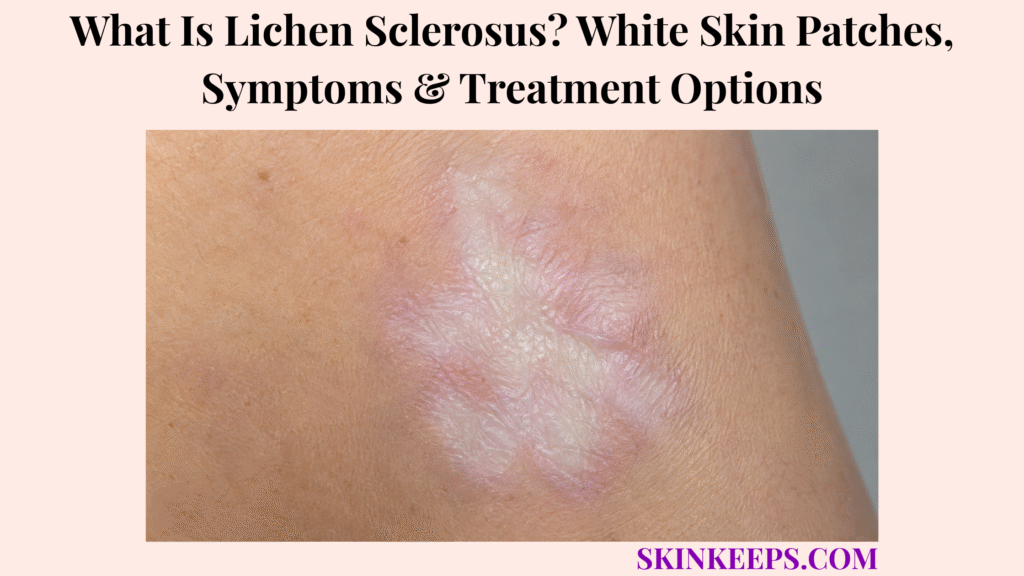
Lichen sclerosus is a chronic inflammatory skin disease that most often affects genital and perianal skin, causing white fragile patches, itching, fissuring and progressive scarring when inflammation remains uncontrolled. Vulvar skin, the foreskin and glans, and perianal skin are the main anogenital sites.
Lichen sclerosus can occur at any age, with vulvar disease especially recognized after menopause and in prepubertal girls, while boys can present with foreskin tightening or phimosis. Early anti-inflammatory treatment helps suppress active disease and limit permanent structural damage.
Persistent genital whitening, tearing, itching, painful intercourse or urinary difficulty deserves clinical assessment. Seek earlier review for a new lump, persistent ulcer, thickened area, repeated bleeding, persistent crusting or a sore that does not heal despite appropriate treatment. These focal changes matter because genital lichen sclerosus carries an increased squamous cell carcinoma risk, although cancer is not inevitable.
How Can You Recognize Lichen Sclerosus?
Lichen sclerosus usually causes pale or porcelain-white, fragile genital or perianal skin with itching, fissures, easy tearing and progressive scarring.
What Does Lichen Sclerosus Look and Feel Like?
Lichen sclerosus commonly produces pale or white, thin and fragile skin that may itch, burn, fissure or tear easily.
Early disease may show redness, swelling and irritation before the classic whitening becomes obvious. Established disease can look porcelain-white, shiny or crinkled, with thin skin, fissures, soreness and red-purple bruising-like areas from minor trauma. Some patients have substantial visible change with surprisingly little discomfort.
How Does Vulvar Lichen Sclerosus Present?
Vulvar lichen sclerosus affects the external genital and perianal skin and can progressively distort normal vulvar architecture through scarring.
The labia, clitoral area, perineum and perianal skin can be involved. Chronic inflammation can cause labial fusion or shrinkage, clitoral hood scarring and narrowing of the vaginal opening, which can make intercourse painful or occasionally interfere with urination. The vagina itself is generally not the main site in uncomplicated LS; significant vaginal disease raises consideration of another disorder such as erosive lichen planus.
How Does Male Genital Lichen Sclerosus Present?
Male genital lichen sclerosus commonly affects the foreskin and glans, causing whitening, fissuring, tightening and progressive phimosis.
The foreskin may become inflexible or scarred and difficult to retract. Meatal involvement can narrow the urinary opening, leading to spraying, discomfort or urinary difficulty. Balanitis xerotica obliterans is an older term for male genital lichen sclerosus.
How Does Lichen Sclerosus Present in Children?
Children with lichen sclerosus can develop genital whitening, itching, soreness, fissures and scarring, with girls and boys showing site-specific patterns.
Girls can develop pale vulvar skin, bruising-like colour, fissures and perianal involvement; painful fissures can contribute to constipation. Boys may develop foreskin whitening, tightening and phimosis. Pediatric genital LS can be mistaken for irritation, infection or trauma, so diagnosis should be clinical rather than assumed from a photograph or symptom list.
Can Lichen Sclerosus Affect Skin Outside the Genitals?
Yes; extragenital lichen sclerosus can produce pale, smooth or wrinkled patches on areas such as the trunk, breasts, shoulders, neck or thighs.
Extragenital lesions are generally less likely to create the severe genital architectural complications that make anogenital disease urgent. Their presence can still support the diagnosis when genital morphology is uncertain.
Figure 1. Lichen sclerosus can progress from active inflammation and fragile white skin to fissuring and permanent anatomical change. Early control aims to suppress inflammation before scarring becomes established.
Why Does Lichen Sclerosus Develop, and Who Is More Likely to Get It?
The exact cause of lichen sclerosus is not fully understood, but immune dysregulation, genetic susceptibility and local mechanical factors appear to contribute.
Is Lichen Sclerosus an Autoimmune Disease?
Lichen sclerosus has strong autoimmune associations, but it cannot currently be reduced to one proven autoimmune mechanism.
Immune dysregulation is strongly suspected, and autoimmune thyroid disease is more common in affected populations. Genetic susceptibility, local irritation, trauma and other biological factors may also contribute. Thyroid disease does not itself cause LS.
Is Lichen Sclerosus Contagious or Sexually Transmitted?
No; lichen sclerosus is neither contagious nor sexually transmitted.
It cannot be acquired through ordinary touching, sexual intercourse or sharing personal items. It is not evidence of poor hygiene and should not be framed as an infection.
Can Friction or Skin Injury Make Lichen Sclerosus Worse?
Yes; friction, scratching and repeated skin irritation can aggravate existing lichen sclerosus even though they are not necessarily its original cause.
Koebner-type worsening can follow scratching or trauma. Urine exposure, incontinence pads, tight clothing and repeated mechanical irritation can intensify active symptoms. An aggravating factor is not the same as a proven primary cause.
Who Develops Lichen Sclerosus Most Often?
Lichen sclerosus can affect any age or sex, but vulvar disease is especially recognized after menopause and in prepubertal girls.
Females are diagnosed more often than males, but boys and adult men can present with foreskin disease or phimosis. Family clustering occurs in a minority of patients, although most cases do not follow a simple single-gene inheritance pattern.
Does Hormone Status Cause Lichen Sclerosus?
No; hormonal status may influence susceptibility, but lichen sclerosus is not simply an estrogen-deficiency disorder.
The postmenopausal age pattern suggests hormones may modify risk, but hormone replacement is not a substitute for evidence-based anti-inflammatory treatment of active LS.
How Is Lichen Sclerosus Distinguished and Diagnosed?
Lichen sclerosus is often diagnosed clinically from its characteristic white fragile skin and scarring pattern, while biopsy is used when the diagnosis is uncertain or malignant change is suspected.
How Is Lichen Sclerosus Different From Vitiligo?
Vitiligo causes pigment loss without the skin fragility, fissuring, itching and scarring typical of active lichen sclerosus.
Vitiligo changes colour while usually preserving normal skin texture. Lichen sclerosus changes both colour and tissue quality, producing thinning, fragility, fissures or scarring.
How Is Lichen Sclerosus Different From Lichen Planus?
Genital lichen sclerosus typically causes pale fragile external skin and architectural scarring, while genital lichen planus more often produces painful red erosions and may involve the vagina.
Genital lichen planus can show red erosive disease with white lacy borders and may involve the vagina or mouth. Mixed or overlapping patterns can require biopsy.
Which Other Conditions Can Resemble Lichen Sclerosus?
Contact dermatitis, eczema, psoriasis and candidal or other inflammatory genital conditions can resemble lichen sclerosus when itching and irritation dominate.
Allergic contact dermatitis can cause intense itch, burning and inflamed skin after exposure to a sensitizer, but persistent whitening, fissuring and architectural loss suggest another diagnosis.
Dermatitis / eczema often produces barrier dryness and inflammation without the characteristic progressive genital scarring pattern of LS.
Psoriasis can affect genital skin with less scale than elsewhere, but typical extragenital plaques or a different surface pattern can support the diagnosis.
Can Lichen Sclerosus Be Diagnosed by Examination Alone?
Yes; an experienced clinician can often diagnose typical lichen sclerosus from the history and characteristic examination findings.
Assessment looks for whitening, fissures, bruising, erosions, thickened areas, active inflammation, anatomical loss and established scarring. Making the diagnosis and measuring disease severity are separate tasks because a patient can have little itch but substantial architectural change.
When Is a Skin Biopsy Needed for Lichen Sclerosus?
Biopsy is most important when lichen sclerosus is diagnostically uncertain, responds unexpectedly to treatment or develops a persistent suspicious focal lesion.
Persistent thickening, ulceration, crusting, a new lump or failure to respond as expected can justify biopsy to confirm diagnosis or exclude precancerous or malignant change. Biopsy is generally avoided in children when the clinical diagnosis is sufficiently clear.
Are Blood Tests Needed for Lichen Sclerosus?
No blood test confirms lichen sclerosus itself.
Targeted testing can be used for associated conditions when clinically indicated, such as thyroid testing in an appropriate context. Broad laboratory panels should not replace genital examination or biopsy of a suspicious focal lesion.
| Condition | Colour | Texture | Scarring | Key Distinguishing Clue |
|---|---|---|---|---|
| Lichen sclerosus | White / pale | Thin, fragile, crinkled or fissured | Yes | Architectural change and genital fragility. |
| Vitiligo | Depigmented | Usually normal | No | Pigment loss without characteristic tissue fragility. |
| Lichen planus | Red / violaceous / white lacy | Erosive or papular | Can scar | Painful erosions; vaginal or oral involvement may occur. |
| Eczema / contact dermatitis | Red / inflamed | Dry, weeping or irritated | Not typical | Exposure or barrier-injury pattern without LS architecture loss. |
| Psoriasis | Red / pink | Smooth genital plaque or scaly elsewhere | No | Typical psoriasis pattern elsewhere supports diagnosis. |
How Is Lichen Sclerosus Treated?
Genital lichen sclerosus is treated primarily with potent or ultrapotent topical corticosteroids plus supportive skin care to suppress inflammation and prevent progressive scarring.
What Is the First-Line Treatment for Genital Lichen Sclerosus?
Potent or ultrapotent topical corticosteroids are the evidence-based first-line treatment for genital lichen sclerosus in females, males and children.
Clobetasol propionate is a commonly used example in clinician-directed treatment. Initial anti-inflammatory treatment is followed by reassessment and, when needed, maintenance therapy. Symptom improvement does not equal permanent cure, and emollient care supports rather than replaces anti-inflammatory treatment.
Are Strong Steroid Ointments Safe on Genital Skin?
Yes; appropriately prescribed potent topical corticosteroids are considered safe and effective for lichen sclerosus when used correctly under clinical supervision.
The risk of undertreated inflammation includes fissuring, scarring and permanent anatomical change. Supervised treatment is different from indiscriminate unsupervised steroid use, so fear of the word strong should not prevent adequate treatment.
Why Are Emollients and Gentle Skin Care Important?
Emollients and gentle skin care reduce friction and protect fragile lichen sclerosus skin but do not replace anti-inflammatory treatment.
Soap substitutes, gentle cleansing, avoidance of perfumed or harsh washes, reduced rubbing and a protective barrier ointment can help when urine or friction aggravates the area.
When Are Tacrolimus or Pimecrolimus Used?
Tacrolimus or pimecrolimus can be used as second-line treatments in selected lichen sclerosus cases when topical corticosteroids are unsuitable or insufficient.
They do not have the same first-line evidence position as potent topical corticosteroids and should be presented as selected alternatives rather than routine substitutes.
When Is Surgery Needed in Females With Lichen Sclerosus?
Surgery is used mainly to correct selected structural complications of vulvar lichen sclerosus rather than to treat active inflammation itself.
Severe narrowing, adhesions, urinary interference or sexual-function impairment can justify surgical correction. Medical control of inflammation remains necessary because surgery does not remove the underlying disease tendency.
When Is Circumcision Used for Male Lichen Sclerosus?
Circumcision is an established treatment for LS-related phimosis that persists despite appropriate medical therapy, particularly when disease is confined to the foreskin.
Persistent meatal or urethral disease can require urology referral. Circumcision should not be presented as universal first-line treatment for every male patient.
How Is Extragenital Lichen Sclerosus Treated?
Extragenital lichen sclerosus can be treated with potent topical corticosteroids, with phototherapy considered in selected cases.
Evidence is more limited than for genital disease. The genital squamous-cell-carcinoma surveillance pathway should not automatically be transferred to isolated extragenital lesions.
Do Laser or Other New Treatments Replace Steroid Therapy?
No; laser and other emerging treatments do not currently replace evidence-based topical corticosteroid therapy for routine lichen sclerosus.
Laser and other investigational approaches have limited evidence and should not be promoted as established substitutes. Borax and unproven home remedies should not replace treatment with demonstrated anti-inflammatory benefit.
| Clinical Situation | Treatment Direction |
|---|---|
| Active genital LS | Potent or ultrapotent topical corticosteroid + emollient support. |
| Good response | Continue clinician-directed maintenance and skin protection. |
| Steroid unsuitable / inadequate response | Reassess diagnosis, adherence and consider selected second-line therapy. |
| Female structural complication | Specialist surgical correction only when anatomy or function requires it. |
| Male phimosis after medical treatment | Consider circumcision; persistent meatal/urethral disease may need urology. |
| Extragenital LS | Topical corticosteroid; selected phototherapy where appropriate. |
Figure 2. Genital lichen sclerosus management starts with effective anti-inflammatory treatment, then continues with maintenance and long-term review. Persistent focal thickening, ulceration, bleeding, crusting or a new lump requires reassessment and may need biopsy.
What Long-Term Problems Can Lichen Sclerosus Cause, and How Should It Be Monitored?
Longstanding lichen sclerosus can cause permanent genital scarring, functional problems and an increased risk of squamous cell carcinoma, so continued surveillance remains important after symptoms improve.
Can Lichen Sclerosus Cause Permanent Scarring?
Yes; uncontrolled lichen sclerosus inflammation can permanently alter genital anatomy through progressive scarring.
Vulvar disease can cause labial fusion, clitoral hood scarring and narrowing of the opening. Male disease can cause phimosis, meatal narrowing or urethral complications. Treatment aims to prevent damage, not only relieve itch.
Can Lichen Sclerosus Affect Sexual or Urinary Function?
Yes; fissuring, narrowing and scarring from lichen sclerosus can interfere with sexual activity or urinary function.
Painful intercourse, penile tightness or discomfort, altered urine flow and urinary difficulty deserve specialist assessment because they may reflect structural disease rather than active itch alone.
Does Lichen Sclerosus Increase Skin Cancer Risk?
Yes; genital lichen sclerosus carries a small but clinically important increased risk of squamous cell carcinoma.
A systematic review of 14 studies included 14,030 women with vulvar lichen sclerosus and no previous vulvar neoplasia; vulvar cancer occurred in about 2.2% of that defined group. A 2024 Danish nationwide cohort also found substantially increased incidence of vulvar high-grade squamous precancer and SCC after biopsy-confirmed vulvar LS. This supports treatment and surveillance, not fear that cancer is inevitable. When relevant, readers can learn more about squamous cell carcinoma.
Which Changes Should Be Biopsied or Reviewed Promptly?
Persistent thickening, a new lump, ulceration, crusting, bleeding or a sore that does not improve should be reviewed promptly and may require biopsy.
A persistent focal lesion despite correct treatment is different from the background white LS pattern and should be assessed specifically to exclude differentiated precancer or SCC.
Is Lichen Sclerosus a Lifelong Condition?
Genital lichen sclerosus is usually a chronic condition that can become quiet for long periods but may persist or reactivate over time.
Symptom remission does not equal permanent cure, and maintenance treatment may continue. Childhood disease can improve around puberty, but persistence or recurrence remains possible.
What Should Long-Term Follow-Up Include?
Long-term lichen sclerosus follow-up should assess inflammation control, correct maintenance treatment, anatomical change and any new focal lesion suspicious for malignancy.
Follow-up can include symptom review, skin examination, treatment use, scarring and anatomy, sexual or urinary function where relevant, and self-monitoring for new thickening, ulceration, soreness, bleeding or crusting.
What Should You Remember About Lichen Sclerosus?
Lichen sclerosus is a chronic non-contagious inflammatory disease of genital and perianal skin that requires effective inflammation control and long-term surveillance to reduce scarring and detect malignant change early.
- Lichen sclerosus commonly causes white fragile genital skin.
- It can fissure, tear and scar.
- It is not an STI and is not caused by poor hygiene.
- The exact cause remains uncertain.
- Diagnosis is often clinical.
- Biopsy is used for uncertain or suspicious focal disease.
- Potent or ultrapotent topical corticosteroids remain first-line treatment.
- Maintenance therapy can matter after initial control.
- Surgery addresses selected structural complications rather than ordinary active inflammation.
- Male phimosis may require circumcision when medical treatment is insufficient.
- Genital SCC risk is increased but remains a minority outcome.
- Long-term surveillance continues after symptoms improve.
The practical pathway is recognize → diagnose → suppress inflammation → prevent scarring → maintain control → monitor for SCC.
Frequently Asked Questions About Lichen Sclerosus?
The most important lichen sclerosus questions concern its cause, contagiousness, first-line treatment, permanent scarring and long-term cancer risk.
What Causes Lichen Sclerosus?
The exact cause of lichen sclerosus is unknown, although immune dysregulation, genetic susceptibility and local mechanical factors may contribute. No single autoimmune, hormonal or friction-based explanation accounts for every case.
Is Lichen Sclerosus Contagious or Sexually Transmitted?
No; lichen sclerosus is neither contagious nor sexually transmitted. It is not caused by poor hygiene and cannot be passed through ordinary touching, intercourse or shared personal items.
What Is the First-Line Treatment for Lichen Sclerosus?
Potent or ultrapotent topical corticosteroids are the first-line treatment for genital lichen sclerosus. Emollients and gentle skin care support barrier protection, while maintenance treatment may be needed to keep inflammation controlled.
Can Lichen Sclerosus Permanently Scar Genital Skin?
Yes; uncontrolled lichen sclerosus can permanently scar and alter genital anatomy. Vulvar disease can cause fusion or narrowing, while male disease can produce phimosis or meatal narrowing.
Can Lichen Sclerosus Increase the Risk of Skin Cancer?
Yes; genital lichen sclerosus increases the risk of squamous cell carcinoma, although the absolute risk remains relatively low. Long-term surveillance and biopsy of persistent focal changes help detect malignant transformation early.
Which Sources Support This Lichen Sclerosus Guidance?
EuroGuiDerm / Evidence- and Consensus-Based Guideline on Lichen Sclerosus — Current evidence-based management across women, men, girls and boys; potent or ultrapotent topical corticosteroids plus emollients as standard genital therapy; maintenance, second-line treatment, circumcision and structural complications.
British Association of Dermatologists — Lichen Sclerosus in Females — Vulvar morphology, chronic course, non-contagious status, Koebner aggravation, steroid safety, emollient care, childhood context and biopsy of suspicious thickened or open lesions.
British Association of Dermatologists — Lichen Sclerosus in Female Children — Pediatric vulvar signs, diagnostic caution, biopsy restraint, early strong topical corticosteroid treatment and long-term follow-up context.
DermNet — Lichen Sclerosus — Extragenital disease, age distribution, family clustering, genital architecture, male meatal disease, diagnosis, biopsy and long-term monitoring.
ACOG — Diagnosis and Management of Vulvar Skin Disorders — Vulvar inflammatory-disease differential including lichen sclerosus, lichen planus and contact dermatitis, with diagnostic and management context.
PubMed — Systematic Review of Vulvar Cancer Risk in Lichen Sclerosus — Fourteen studies with 14,030 women without prior vulvar neoplasia; vulvar cancer occurred in 2.2% of that defined subgroup, supporting long-term surveillance.
PubMed — 2024 Danish Cohort of Biopsy-Verified Vulvar Lichen Sclerosus — Nationwide data showing increased incidence of vulvar high-grade squamous precancer and squamous cell carcinoma after biopsy-confirmed vulvar lichen sclerosus.