
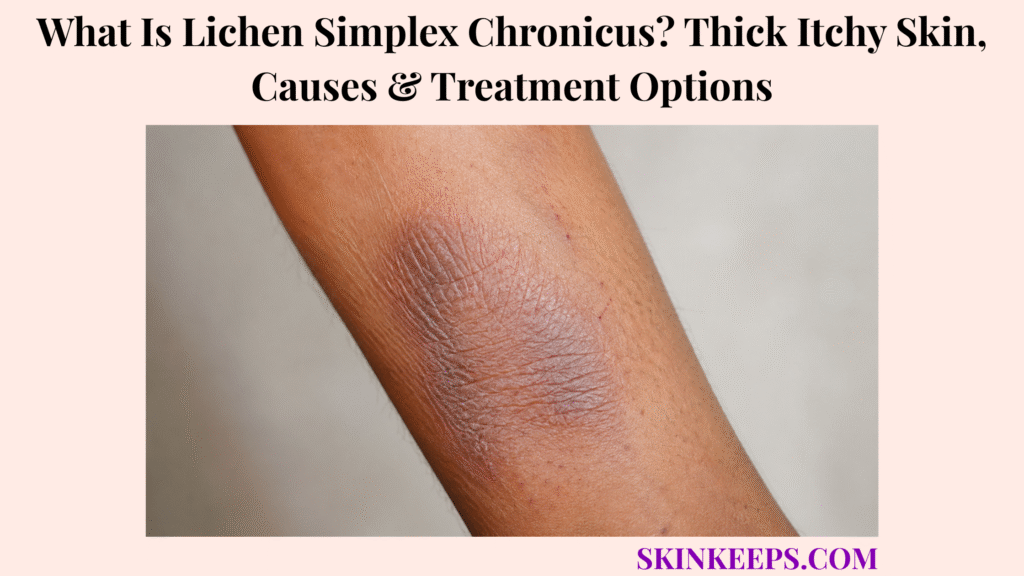
Lichen simplex chronicus is a chronic itchy skin condition in which repeated scratching or rubbing transforms the affected skin into a thick, rough and leathery plaque. This thickening is called lichenification and usually develops in one or several localized areas that a person can repeatedly reach.
The central mechanism is an itch–scratch cycle: scratching may briefly relieve itch, but repeated mechanical injury thickens and irritates the skin, which can make the area itch more. Effective treatment therefore has two jobs—interrupt scratching and identify the dermatologic, environmental, neuropathic or behavioural factor that started or continues the itch.
Medical assessment is appropriate for persistent unexplained itching, rapidly changing plaques, significant pain, spreading redness, pus, fever, progressive hair loss, repeated bleeding, ulceration or lesions that do not improve with appropriate care. Generalized chronic itching may reflect another dermatologic, neurologic or systemic condition rather than uncomplicated localized lichen simplex chronicus.
How Can You Recognize Lichen Simplex Chronicus?
Lichen simplex chronicus usually appears as a well-defined, intensely itchy patch of thick, rough or leathery skin with exaggerated normal skin markings.
What Does Lichen Simplex Chronicus Look Like?
Lichen simplex chronicus produces lichenification—a thickened plaque with exaggerated skin lines caused by repeated scratching or rubbing.
The surface may feel rough, dry, firm or leathery and may show scale, scratch marks, crusting or small excoriations. Normal skin lines become more obvious and can form a criss-cross pattern that helps distinguish lichenification from simple redness or temporary irritation.
Colour is not a reliable defining feature. A plaque may look red, brown, darker, lighter or simply differently pigmented than nearby skin depending on skin tone, inflammation and prior scratching.
How Intense Is the Itching in Lichen Simplex Chronicus?
Itching is usually the dominant symptom of lichen simplex chronicus and may be continuous, episodic or severe enough to disrupt sleep.
Some people scratch most when resting, reading, watching television or trying to sleep. Scratching can also occur automatically or during sleep, so a patient may wake with new excoriations even when they do not remember scratching.
Stress can intensify the urge to scratch in some people, but itch severity does not have to match plaque size and psychological factors should not replace a search for dermatologic or neurologic triggers.
Where Does Lichen Simplex Chronicus Usually Develop?
Lichen simplex chronicus most often develops on areas that are easy to reach and repeatedly scratch or rub.
Typical sites include the neck, scalp, ankles, lower legs, forearms, wrists, genital region and perianal skin. One plaque is common, but several separate plaques can occur when more than one area is repeatedly irritated.
Can Lichen Simplex Chronicus Affect Hair?
Yes; repeated scratching of scalp lichen simplex chronicus can break hairs and produce localized hair loss.
Hair can regrow when scratching stops if follicles remain intact. Progressive hair loss, obvious scarring or loss that continues despite control of scratching should prompt reconsideration of the diagnosis because primary scarring alopecias are different disorders.
Figure 1. A trigger starts itching; scratching gives brief relief but repeatedly injures and thickens the skin. Lichenified skin can then itch more, sustaining the cycle.
Why Does Lichen Simplex Chronicus Develop?
Lichen simplex chronicus develops when persistent itching leads to repeated scratching or rubbing that thickens the skin and perpetuates further itching.
How Does the Itch–Scratch Cycle Thicken the Skin?
Repeated scratching thickens lichen simplex chronicus skin by chronically injuring and mechanically stimulating the epidermis.
The sequence often begins with an original itch. Scratching briefly reduces the sensation, but repeated mechanical injury drives epidermal thickening, inflammation and altered sensory signalling. The newly lichenified surface then becomes easier to irritate, so the urge to scratch returns.
This distinction matters because scratching is the mechanism that produces the plaque, but scratching is not always the first cause of the itch.
Which Skin Conditions Can Trigger Lichen Simplex Chronicus?
Atopic dermatitis can trigger secondary lichen simplex chronicus when persistent itch leads to repeated scratching.
Allergic contact dermatitis can start the same cycle when an allergen repeatedly inflames and itches the skin.
Psoriasis may also become secondarily lichenified when a plaque is scratched or rubbed over time.
Dry skin or xerosis can provide the original barrier-related itch that keeps a localized scratching cycle active.
Scabies is another intensely itchy disorder that can create repeated scratching, although the underlying infestation has its own distribution and treatment. Treating only the thick plaque leaves recurrence likely if the original dermatosis remains active.
Can Heat, Sweat or Irritation Trigger the Cycle?
Yes; heat, sweating, friction and irritating exposures can initiate or perpetuate itching that maintains lichen simplex chronicus.
Tight clothing, repetitive rubbing, chemicals, sweat and insect bites can increase itch in susceptible skin. These are aggravating factors, not proof that they were the original cause in every patient.
Can Nerve-Related Itch Cause Lichen Simplex Chronicus?
Yes; neuropathic itch can trigger repeated scratching that eventually produces a lichen simplex chronicus plaque.
Altered nerve signalling, radiculopathy or disorders such as brachioradial pruritus can create localized itch before visible lichenification appears. In that situation, the thick plaque is secondary to the nerve-origin itch rather than the source of the original sensation.
Do Stress or Habitual Scratching Cause Lichen Simplex Chronicus?
Stress and habitual scratching can maintain or intensify lichen simplex chronicus, but they should not automatically be assumed to be the original cause of itching.
Anxiety, stress, automatic rubbing and learned scratching can reinforce the loop once it is established. Dermatologic, environmental and neurologic triggers should still be considered before symptoms are reduced to psychology or habit alone.
Can Widespread Itching Suggest an Internal Cause?
Yes; generalized itching rather than one localized LSC plaque can justify evaluation for another dermatologic or systemic cause of pruritus.
A lichenified plaque may simply mark where a person scratches most. When itching is widespread, persistent or unexplained, the diagnostic question expands beyond the plaque itself. SkinKeeps covers that broader context in its guide to pruritus.
Figure 2. Lichen simplex chronicus can be the final visible result of several different itch pathways. The original trigger still matters after lichenification has formed.
How Is Lichen Simplex Chronicus Distinguished and Diagnosed?
Lichen simplex chronicus is diagnosed by recognizing lichenification and repeated scratching while also identifying or excluding the condition responsible for the original itch.
How Is Lichen Simplex Chronicus Different From Eczema?
Lichen simplex chronicus emphasizes a localized thickened plaque produced by repeated scratching, whereas eczema may produce broader inflammatory, dry, weeping or flexural skin disease.
The conditions can overlap. Eczema may be the original itchy dermatosis and repeated scratching can create secondary lichenification on top of it. Exaggerated skin markings and a persistent scratchable plaque support the LSC pattern, but they do not prove that eczema is absent.
How Is Lichen Simplex Chronicus Different From Psoriasis?
Psoriasis typically produces sharply demarcated scaly plaques in characteristic locations, while lichen simplex chronicus is defined by scratching-driven lichenification and exaggerated skin markings.
Elbows, knees and scalp are common psoriasis sites, and plaques may carry more characteristic scale or occur with other psoriatic findings. Psoriasis itself can also become lichenified when heavily scratched, so a thick plaque should not automatically be labelled primary LSC.
How Is Genital Lichen Simplex Chronicus Distinguished From Fungal Infection or Contact Dermatitis?
Genital lichen simplex chronicus is distinguished by a chronic scratching-driven plaque, but fungal infection and contact dermatitis must be excluded when exposure history or accompanying findings support them.
Distribution, products used on the area, laundry products, topical medications, moisture, accompanying lesions and the pattern of itch all matter. Fungal microscopy or culture may be appropriate when the morphology or location makes fungal disease plausible rather than assuming every itchy genital plaque is LSC.
What Does a Dermatologist Ask During Lichen Simplex Chronicus Diagnosis?
A dermatologist focuses on when the itch began, what triggers or relieves it, how often scratching occurs and which exposures contact the affected area.
The history includes onset, constant versus intermittent itch, night scratching, products, work and environmental exposure, temporary relief after scratching and any relationship with stress. Examination should also look beyond the plaque for eczema, psoriasis, infection or another itchy dermatosis.
When Are Patch Testing, Swabs or Fungal Tests Needed?
Patch testing, swabs and fungal testing are used selectively when the history or examination suggests contact allergy, infection or fungal disease rather than routine uncomplicated LSC.
A swab may help when crusting, pus or other signs suggest secondary bacterial infection. Patch testing is considered when allergic contact dermatitis is plausible, while fungal testing is targeted to selected groin or genital lesions. Testing is targeted, not routine.
When Is a Skin Biopsy Needed for Lichen Simplex Chronicus?
A skin biopsy is considered when a thick itchy plaque is atypical, treatment-resistant or difficult to distinguish from another chronic dermatosis.
Biopsy may help when morphology is unusual, appropriate treatment fails or psoriasis and other chronic dermatoses remain plausible. Its role is often to exclude another disease rather than simply prove that scratching occurred.
| Condition | Primary Pattern | Surface | Main Clue That Changes the Work-Up |
|---|---|---|---|
| Lichen simplex chronicus | Localized chronic itch with repeated scratching. | Thick, leathery, exaggerated skin lines. | Search for the original source of itch. |
| Eczema | Inflammatory itchy dermatitis; may be broader or flexural. | Dry, red, scaly, weeping or lichenified. | Eczema can trigger secondary LSC rather than exclude it. |
| Psoriasis | Sharply defined plaques in characteristic locations. | Scaly, often thicker plaque. | Look for typical distribution and other psoriatic signs. |
| Fungal/contact-related genital eruption | Location and exposure pattern guide suspicion. | Variable redness, scale, border or irritation. | Use fungal testing or patch testing when the history supports it. |
Figure 3. Diagnosis starts with the lichenified plaque but does not end there. Testing is selected according to the suspected trigger or mimic, and biopsy is reserved for atypical or treatment-resistant disease.
How Is Lichen Simplex Chronicus Treated?
Lichen simplex chronicus is treated by stopping the itch–scratch cycle, suppressing local inflammation, repairing the skin barrier and treating the trigger that caused the itch.
What Is the Main Goal of Lichen Simplex Chronicus Treatment?
The main treatment goal is to stop itching and scratching long enough for the lichenified skin to heal and soften.
The practical sequence is stop itch → reduce scratching → allow barrier recovery → let the plaque gradually soften. Medication alone is unlikely to work well if frequent rubbing or scratching continues.
How Do Topical Corticosteroids Help Lichen Simplex Chronicus?
Topical corticosteroids reduce inflammation and itching in lichen simplex chronicus and can gradually soften thick lichenified plaques.
Thick skin may reduce topical penetration, but treatment strength and duration must still be matched to the body site. An ankle plaque and genital skin do not have the same safety profile, so corticosteroid choice is clinician-directed rather than one-strength-fits-all.
Why Is Occlusion Sometimes Used for Lichen Simplex Chronicus?
Occlusion can help lichen simplex chronicus by physically limiting scratching and increasing topical medication penetration through thickened skin.
A protective covering can be especially useful when unconscious night scratching keeps reopening the area. Because occlusion can increase corticosteroid absorption, it should be clinician-guided when used with potent topical corticosteroids.
How Do Moisturizers and Cool Compresses Help?
Moisturizers reduce dryness and barrier-related itch, while cool compresses can temporarily calm itching and soften thickened skin.
Regular emollients support barrier repair and remain useful after prescription treatment is reduced. A brief cool soak or compress can reduce the immediate urge to scratch, but neither measure replaces treatment of active inflammation or the original trigger.
When Are Tacrolimus or Pimecrolimus Used for Lichen Simplex Chronicus?
Tacrolimus or pimecrolimus can be considered as steroid-sparing treatments for selected lichen simplex chronicus lesions, particularly on sensitive skin sites.
They may be useful when prolonged corticosteroid exposure is a concern or when the body site makes steroid-sparing treatment desirable. Their evidence base is less extensive than corticosteroids, so they should not be presented as universal first-line therapy.
How Is Severe Night-Time Itching Managed?
Severe night-time itching is managed by reducing nocturnal scratching and improving sleep while the underlying itch is treated.
Protective covering, a cool environment and strategies that reduce automatic scratching can help. A clinician may sometimes use a sedating antihistamine at night, but that does not prove histamine is the underlying mechanism of LSC and dosing should be individualized.
What If Standard Lichen Simplex Chronicus Treatment Does Not Work?
Treatment-resistant lichen simplex chronicus should trigger reassessment of scratching control, the original itch trigger and the diagnosis before stronger treatment is added.
First ask whether scratching is still occurring, whether the trigger remains present and whether the diagnosis is correct. Then reconsider contact allergy, infection, neuropathic itch or another dermatosis before moving toward specialist options such as intralesional therapy, phototherapy, selected antipruritic treatment or neuromodulatory approaches.
Figure 4. LSC treatment works best when itch suppression, scratching control, anti-inflammatory care, barrier repair and treatment of the original trigger are combined.
How Can the Itch–Scratch Cycle Be Prevented From Returning?
Lichen simplex chronicus recurrence is reduced by controlling the original itch trigger, preventing habitual scratching and maintaining the repaired skin barrier.
How Can Scratching Be Reduced?
Scratching can be reduced by limiting access to the plaque and replacing scratching with less damaging responses.
Short nails, a suitable protective covering, brief pressure instead of scratching, cool compresses and awareness of automatic rubbing can reduce repeated injury. Habit-reversal techniques can help when scratching has become automatic, without treating the patient as responsible for having an itchy disorder.
Which Triggers Should Be Avoided?
The most useful triggers to avoid are the specific exposures that repeatedly provoke itching in that individual patient.
Heat, sweat, tight clothing, irritating products and friction may matter for one person and not another. A personalized trigger pattern is more useful than a universal list of everything to avoid.
How Long Does Thickened Lichen Simplex Chronicus Skin Take to Return Toward Normal?
Lichenified skin usually improves more slowly than itching, and longstanding plaques may require weeks or months to flatten and soften after scratching stops.
Itch may improve first, then inflammation settles, while thickening and texture changes take longer. Residual pigmentation may persist even after the itch–scratch cycle has become quiet, so visible colour does not always mean active disease.
Can Dark or Light Marks Remain After Lichen Simplex Chronicus?
Yes; lichen simplex chronicus can leave post-inflammatory hyperpigmentation or hypopigmentation after active itching has improved.
Dark or light marks can be especially noticeable in darker skin tones and may fade more slowly than inflammation. Residual pigment should be interpreted separately from active itch, excoriation and new plaque thickening.
What Complications Can Persistent Scratching Cause?
Persistent scratching can cause excoriations, bleeding, open sores, secondary infection and localized hair damage.
Repeated injury can create erosions or crusted areas that allow bacterial infection to develop. Scalp LSC can break hairs, and genital scratching can produce soreness and functional discomfort even without another complication.
When Should Lichen Simplex Chronicus Be Reassessed?
Lichen simplex chronicus should be reassessed when the plaque enlarges, remains intensely itchy despite appropriate care, becomes painful or infected, or no longer behaves like ordinary LSC.
Changing morphology, severe pain, treatment resistance or infection should trigger another diagnostic review. Persistent LSC should prompt another search for the original cause of itch rather than endless escalation of plaque treatment.
Recurrence logic: treat the original trigger → suppress itch → prevent scratching → allow the barrier to heal → let the plaque soften → maintain trigger control.
What Should You Remember About Lichen Simplex Chronicus?
Lichen simplex chronicus is a scratching-driven lichenified skin disorder that improves when both the itch–scratch cycle and the original cause of itching are controlled.
- LSC produces thick, leathery and usually intensely itchy plaques.
- Repeated scratching or rubbing produces lichenification and exaggerated skin markings.
- The itch usually begins before or alongside plaque formation.
- Eczema, contact allergy, psoriasis, dry skin, infection, irritation or neuropathic itch may start the cycle.
- Stress and habitual rubbing can maintain symptoms but should not automatically be blamed as the original cause.
- Diagnosis includes searching for the source of itch, not only recognizing the plaque.
- Patch testing, swabs, fungal testing and biopsy are selective rather than routine.
- Treatment combines scratching control, topical anti-inflammatory therapy, barrier support and trigger treatment.
- Thickened skin and pigment change can improve more slowly than itch.
- Persistent atypical or treatment-resistant disease requires reassessment.
Find trigger → break itch → stop scratching → heal skin → prevent recurrence.
Frequently Asked Questions About Lichen Simplex Chronicus
The most common lichen simplex chronicus questions concern its triggers, contagiousness, skin thickening, treatment and recurrence.
What Causes Lichen Simplex Chronicus?
Lichen simplex chronicus is caused by repeated scratching or rubbing in response to persistent itching, often triggered by another skin, environmental or nerve-related problem. Scratching then thickens and irritates the skin, allowing the itch–scratch cycle to sustain itself.
Is Lichen Simplex Chronicus Contagious?
No; lichen simplex chronicus is not contagious and cannot spread from one person to another. Its mechanism is chronic itching followed by repeated scratching or rubbing, not person-to-person transmission.
Why Does Lichen Simplex Chronicus Become Thick and Leathery?
Repeated scratching stimulates chronic epidermal thickening and exaggerates normal skin lines, producing the leathery appearance called lichenification. Longstanding plaques can stay thick after itching begins to settle.
What Is the Best Treatment for Lichen Simplex Chronicus?
The most effective treatment strategy is to stop scratching, suppress inflammation, repair the skin barrier and treat the condition that triggered the itch. Topical treatment is adjusted to the body site and the suspected cause.
Can Lichen Simplex Chronicus Come Back After Treatment?
Yes; lichen simplex chronicus can recur if the original itch trigger or habitual scratching returns after the plaque has improved. Ongoing trigger control, barrier care and scratching prevention reduce recurrence.
Which Sources Support This Lichen Simplex Chronicus Guidance?
American Academy of Dermatology — Neurodermatitis Overview — Definition of neurodermatitis/lichen simplex chronicus, the itch–scratch cycle, typical localized itchy patches and non-contagious framing.
American Academy of Dermatology — Neurodermatitis Diagnosis and Treatment — Diagnostic history, examination, swabbing when infection is suspected, scratching control and treatment approaches.
DermNet — Lichen Simplex Chronicus (Lichen Simplex / Neurodermatitis) — Morphology, distribution, underlying itchy conditions, recurrence and the importance of treating the condition that predisposes to itch.
StatPearls / NCBI Bookshelf — Lichen Simplex Chronicus — Evaluation, differential diagnosis, genital fungal testing, patch testing, biopsy, topical therapy and selected refractory-treatment options.