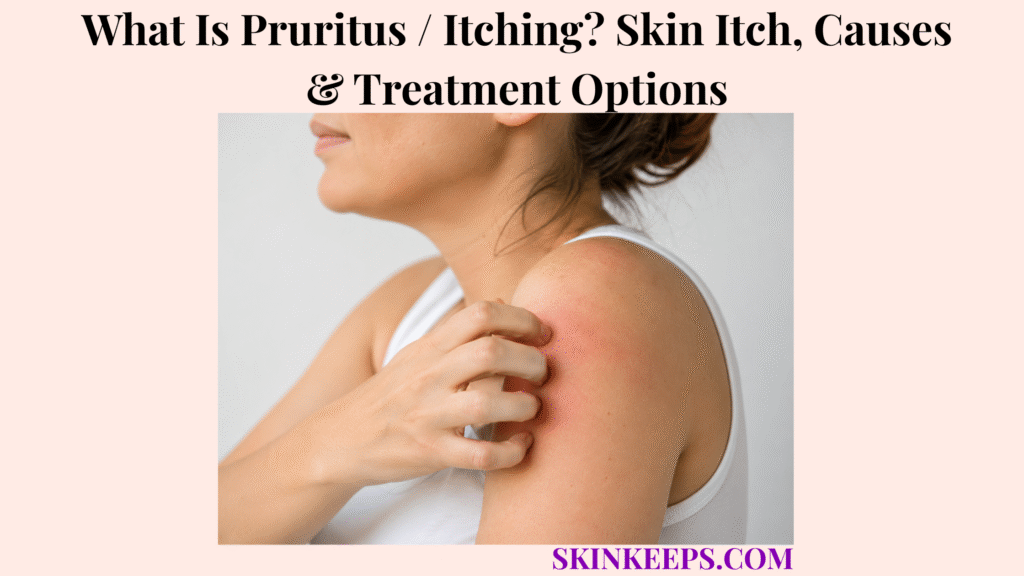
Pruritus is the medical term for itching—a skin sensation that creates an urge to scratch and can arise from skin disease, internal illness, medication effects or abnormal nerve signaling. It is a symptom rather than one single diagnosis, which is why similar-looking itch can come from very different mechanisms.
Pruritus becomes easier to understand when you first separate localized from generalized itch and visible rash from no visible primary rash. Those pattern clues narrow the cause category, guide evaluation and help explain why successful treatment depends on finding the mechanism instead of chasing one universal anti-itch remedy.
This article is for educational purposes only. Persistent, widespread, severe or unexplained itching—especially without a clear rash—should be medically evaluated.
What Is Pruritus and What Patterns Help Identify Its Cause?
Pruritus is the sensation of itching, and its cause becomes easier to narrow when you first determine whether the itch is localized or generalized and whether a primary rash is present.
How Does the Nervous System Create the Sensation of Itching?
Pruritus develops when itch-sensitive signals travel from the skin or nerves through the spinal cord to the brain, creating the urge to scratch.
The basic sequence is stimulus in the skin or nerve pathway → transmission through itch-sensitive neural circuits → spinal cord processing → brain perception → scratching urge. Histamine can drive some itch, but non-histamine pathways also exist, so pruritus is not always an “allergy-type” signal.
Why Can Scratching Make Pruritus Worse?
Scratching may briefly reduce the sensation of itch but can damage the skin, increase inflammation and create a self-perpetuating itch–scratch cycle.
The pattern is itch → scratch → injury → irritation or inflammation → more itch. Repeated scratching may produce excoriations, crusting, thickened skin and even nodular scratch-driven disease such as prurigo nodularis.
What Is the Difference Between Localized and Generalized Pruritus?
Localized pruritus affects one limited area and often points toward a local skin or nerve problem, while generalized pruritus affects multiple regions and can have broader dermatologic or systemic causes.
A small area of itch may reflect one local process, whereas widespread itch raises broader questions—especially when the skin looks normal at first glance.
What Does Itching With or Without a Rash Mean?
A primary rash often points toward a skin disorder, while persistent itching without a visible primary eruption may require evaluation for systemic, medication-related or neurologic causes.
No-rash itch should not be dismissed as meaningless, and rash-based itch should still be interpreted through lesion pattern rather than treated as one generic problem.
Figure 1. The fastest way to narrow pruritus is to sort the itch by rash versus no primary rash and localized versus generalized pattern, because each quadrant points toward a different cause category and evaluation pathway.
What Causes Pruritus or Persistent Skin Itching?
Pruritus can result from dry or inflamed skin, infections or infestations, internal medical conditions, medicines or contact reactions, and abnormal nerve signaling.
Which Skin Conditions Commonly Cause Pruritus?
Dry skin, eczema or dermatitis, psoriasis, hives, scabies, fungal infections and insect bites are common dermatologic causes of itching.
Barrier-related itch commonly occurs with dry skin. Inflammatory itch is also common in atopic dermatitis. Plaque disease such as psoriasis can itch substantially. Wheal-based itch can occur in hives. Infestation-related itch may appear in scabies. Fungal itch can occur with ringworm.
Which Internal Health Conditions Can Cause Generalized Pruritus?
Persistent generalized pruritus without a clear primary rash can sometimes be associated with kidney, liver or bile-flow, thyroid, blood or other systemic disorders.
This does not mean internal disease is the most common explanation for every itch, but generalized unexplained pruritus deserves a broader diagnostic lens than a small itchy patch with an obvious rash.
Can Allergies, Medicines or Irritants Cause Pruritus?
Yes; allergic or irritant skin reactions and some medicines can cause pruritus, but unexplained itching should not automatically be labeled an allergy.
Exposure history matters because skin products, environmental contactants and medications can all trigger itch through different mechanisms.
Can Nerve Problems Cause Itching Without a Rash?
Yes; neuropathic pruritus can result from nerve dysfunction or injury and may cause localized itching even when little or no primary skin eruption is visible.
That is why pruritus without a rash can still have a real medical basis rather than being dismissed as imagined or trivial.
Figure 2. Pruritus is a shared symptom reached by multiple mechanisms—barrier failure, inflammatory skin disease, infestation, internal illness, exposures, medicines and nerve dysfunction—so the right treatment depends on the route feeding the itch pathways.
How Is Persistent or Unexplained Pruritus Diagnosed?
Persistent pruritus is diagnosed by combining the itch history, distribution, presence or absence of primary skin lesions and targeted testing when the clinical pattern does not reveal an obvious cause.
Which Questions Help Doctors Find the Cause?
The most useful pruritus history identifies when the itching began, where it occurs, whether a rash came first, possible triggers, medications and associated symptoms.
Onset, duration, localization, exposure pattern, prior skin disease and systemic symptoms all matter because the answer is usually hidden in the pattern rather than in one laboratory result.
What Does the Skin Examination Look For?
Skin examination separates primary lesions caused by the underlying disorder from secondary scratches, crusts or thickening created by repeated rubbing.
Primary lesions are diagnostic clues; secondary changes show what the itching has done to the skin but may not reveal the original cause on their own.
When Are Blood Tests, Skin Tests or Biopsy Needed?
Testing is targeted rather than routine and may include skin biopsy, allergy evaluation or selected blood tests when the history and examination suggest a dermatologic, systemic or allergic cause.
Examples of targeted evaluation can include blood count, liver function, kidney function, thyroid function, biopsy or skin-focused testing, but pruritus does not have one fixed universal test panel.
Figure 3. Pruritus diagnosis starts with history and skin examination; tests are added only when the itch remains unexplained, generalized, atypical or disconnected from a clear primary skin process.
How Is Pruritus Treated?
Pruritus treatment works best when the underlying cause is identified and treated while itch relief and skin-barrier care are used to interrupt scratching and allow damaged skin to recover.
Why Does Treatment Depend on the Underlying Cause?
Different itch mechanisms require different treatments, so treating eczema, scabies, neuropathic itch or systemic pruritus as though they were the same problem can fail.
The correct hierarchy is identify cause → treat cause → relieve itch → restore the barrier → reduce scratching. That logic is stronger than starting with “the best anti-itch cream.”
Which Topical Treatments Can Help Relieve Pruritus?
Topical treatment can include moisturizers, appropriate anti-inflammatory therapy, cooling or antipruritic preparations and cause-specific medication depending on why the skin is itching.
Emollients can support a dry barrier, anti-inflammatory therapy can calm inflammatory itch, and local relief measures may reduce symptoms. Topical corticosteroids help selected inflammatory conditions, but they are not a universal pruritus treatment.
When Are Oral Medicines or Other Treatments Used?
Persistent or severe pruritus may require systemic or specialist treatment directed at the underlying mechanism, including selected medications or phototherapy.
Antihistamines may help some types of itch, especially histamine-mediated forms, but they do not solve every pathway. Specialist therapy is chosen by mechanism and severity rather than by the word “itch” alone.
Figure 4. Pruritus treatment should climb in a cause-first sequence: identify the mechanism, support the barrier, use targeted symptom relief, escalate when necessary, and actively break the itch–scratch cycle instead of assuming one universal anti-itch remedy.
How Can Pruritus Be Relieved Safely, and When Should It Be Medically Reassessed?
Daily pruritus care should reduce dryness, overheating, irritation and scratching, while persistent, generalized, sleep-disrupting or unexplained itch requires cause-focused medical reassessment.
How Do Moisturizers and Gentle Skin Care Reduce Itching?
Regular moisturization and gentle cleansing can reduce dryness and support the skin barrier, which helps when dryness contributes to pruritus.
Barrier-supportive care works best when paired with reduced over-washing and non-irritating cleansing habits.
How Can Heat, Clothing and Irritants Affect Pruritus?
Very hot bathing, overheating, irritating fabrics and personal contact triggers can worsen itching in some people, so cooler and gentler skin care can provide useful symptom relief.
Lukewarm bathing, more comfortable fabrics and avoidance of known irritants are practical ways to reduce unnecessary aggravation.
How Can the Itch–Scratch Cycle Be Broken?
Breaking the itch–scratch cycle requires reducing the itch itself while limiting repeated rubbing and protecting skin that has already been damaged.
Keeping nails short, cooling itchy areas, avoiding friction and protecting injured skin can reduce the damage that keeps the cycle active. “Just stop scratching” is not a treatment plan.
When Should Persistent Itching Be Evaluated by a Doctor?
Medical evaluation is appropriate when pruritus persists or worsens, becomes widespread without a clear cause, disrupts sleep or daily life, produces significant skin injury, or occurs without a visible rash.
Bleeding, infection, major quality-of-life impact or failure of reasonable self-care should also prompt reassessment. Persistent unexplained pruritus may occasionally reflect an underlying medical condition rather than a primary skin disorder.
What Should You Remember About Pruritus?
Pruritus is a symptom rather than one disease, and successful treatment depends on identifying whether the itch comes from the skin, an internal condition, an exposure or medicine, or abnormal nerve signaling.
- Pruritus is the medical term for itching.
- It is a symptom, not one single diagnosis.
- Neural pathways create the itch sensation.
- Histamine is not the only itch pathway.
- Scratching can perpetuate itch.
- Scratching can create secondary lesions such as excoriations and lichenification.
- Localized versus generalized pattern matters.
- Rash versus no-rash pattern matters.
- Dry skin is a common cause of itch.
- Eczema, psoriasis, hives, scabies and fungal disease can all cause itching.
- Systemic illness, exposures, medicines and neuropathic processes may also be relevant.
- Diagnosis starts with history and skin examination.
- Primary and secondary lesions should be distinguished.
- Tests should be targeted rather than routine.
- Treatment begins with the underlying cause.
- Topical steroids are not universal.
- Antihistamines are not universal.
- Moisturizers and gentle care support the skin barrier.
- Repeated scratching should be reduced whenever possible.
- Persistent unexplained itch needs medical evaluation.
Pattern the itch → identify the cause category → evaluate selectively → treat the cause → relieve the itch → protect the skin → reassess if the problem persists.
Frequently Asked Questions About Pruritus / Itching
The main pruritus questions concern its meaning, itching without a rash, dry-skin itch, nighttime worsening and whether persistent itching can indicate an internal condition.
Is Pruritus the Same Thing as Itching?
Yes; pruritus is the medical term for the sensation commonly described as itching.
Why Does My Skin Itch When There Is No Rash?
Pruritus can occur without a visible primary rash because systemic conditions, medicines or abnormal nerve signaling can generate itch before obvious skin changes appear. Scratching itself may later create marks that were not part of the original cause.
Can Dry Skin Cause Severe Pruritus?
Yes; dry skin can produce significant itching, particularly when the skin barrier becomes increasingly disrupted or irritated. Moisturization and gentle care can help, but persistent severe itch still deserves reassessment.
Why Does Pruritus Sometimes Get Worse at Night?
Some people experience more noticeable itching at night, but the reason depends on the underlying cause and should not be assumed to be the same in every patient.
Can Persistent Pruritus Be a Sign of an Internal Health Condition?
Yes; persistent generalized itching without a clear primary skin rash can sometimes be associated with systemic illness and may warrant targeted medical evaluation.
Which Sources Support This Pruritus Guidance?
DermNet — Pruritus — Used for definition, symptom framing, itch pathways, itch–scratch cycle, localized versus generalized itch, neuropathic itch and primary versus secondary lesion logic.
MSD Manual Professional Edition — Pruritus — Used for pruritus without rash, generalized itch, systemic-disease context, targeted investigation and cause-directed treatment principles.
American Academy of Dermatology — Itchy Skin: Self-Care — Used for patient-facing itch relief, moisturization, gentle skin care, cooling, trigger reduction and when evaluation is appropriate.
American Academy of Dermatology — Itchy Skin Overview — Used for common skin-related examples of pruritus and the importance of identifying cause categories rather than assuming one universal diagnosis.