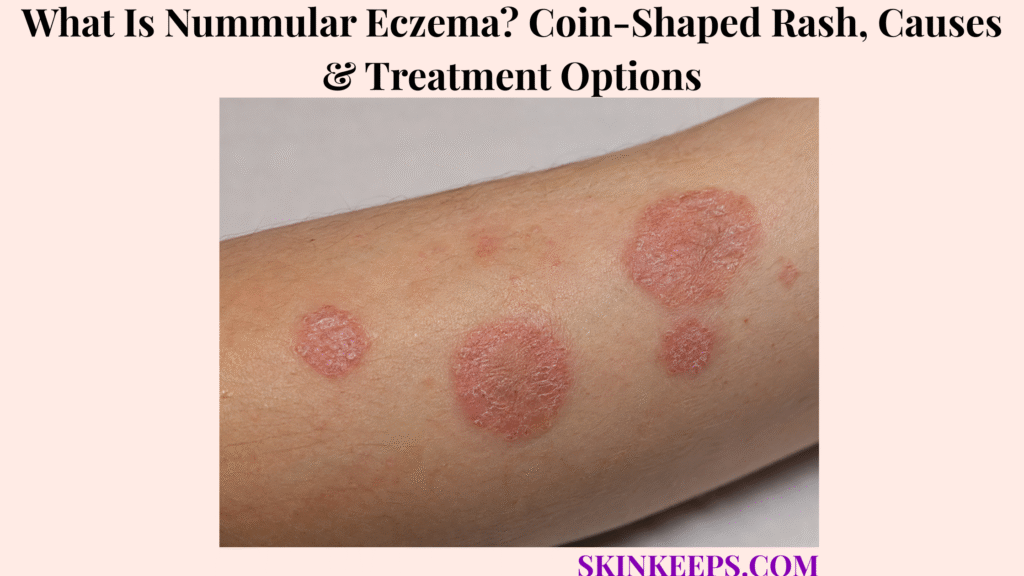
Nummular eczema is a chronic or recurrent form of eczema that produces intensely itchy, well-defined round or oval plaques that can become blistered, weepy, crusted, dry or scaly. Also called nummular dermatitis or discoid eczema, it most often affects the arms and lower legs and can look different as the same plaque moves from an acute wet phase into a chronic dry phase.
Very dry barrier-impaired skin is an important susceptibility factor, but individual triggers vary and can include injury, weather, irritation, allergy or infection. Ringworm is a major practical mimic, so successful treatment depends on restoring the skin barrier, suppressing true eczema inflammation and reassessing fungal or infectious alternatives when the pattern does not behave as expected.
This article is for educational purposes only and does not constitute medical advice, diagnosis, or treatment. A circular rash that keeps enlarging, does not improve as expected with appropriate eczema treatment, develops significant pain, pus, yellow or golden crusting, spreading warmth or swelling, or occurs with fever or systemic illness should be evaluated by a licensed dermatologist or qualified healthcare professional.
How Can You Recognize Nummular Eczema?
Nummular eczema usually produces intensely itchy, well-defined round or oval plaques that may begin with small bumps or blisters and later become wet, crusted, dry, cracked or scaly.
What Does Nummular Eczema Look Like From an Acute to a Chronic Flare?
Nummular eczema can begin as small itchy papules or vesicles that merge into a coin-shaped plaque, then progress from a swollen weeping phase into a drier scaly or cracked phase.
Acute lesions can be inflamed, swollen, blistered, oozing or crusted. As the flare becomes more chronic, vesiculation becomes less obvious and the plaque often becomes dry, flaky, scaly or fissured.
Wet appearance alone does not prove bacterial infection because active eczema itself can weep or crust.
Where Does Nummular Eczema Usually Develop?
Nummular eczema most often affects the arms and lower legs, although the trunk and other body sites can also develop coin-shaped plaques.
Forearms, backs of the hands and lower legs are common sites, and lesions can appear on both sides of the body. Lower-leg disease can be asymmetrical when venous factors contribute, while scalp and facial involvement are less typical.
How Does Nummular Eczema Look on Darker Skin?
On darker skin, active nummular eczema may appear dark brown, grey-brown or lighter than surrounding skin rather than obviously pink or red.
Texture, scale, itching and the plaque border can be more useful than erythema alone. After inflammation settles, flat hyperpigmented or hypopigmented marks can persist for months and do not automatically mean active dermatitis remains.
Can Nummular Eczema Develop Central Clearing and Look Like Ringworm?
Yes; a healing nummular eczema plaque can become less inflamed centrally while its edge remains active, producing a ring-like appearance that resembles tinea corporis.
Coin shape plus central clearing does not diagnose either eczema or fungus. Clinical context, progression and fungal testing decide the pathway when appearance overlaps.
Figure 1. Nummular eczema can evolve from grouped papules or vesicles to a wet coin-shaped plaque, then become dry, cracked and finally flat with residual pigment.
Why Does Nummular Eczema Develop, and What Can Trigger a Flare?
The exact cause of nummular eczema is unknown, but markedly dry barrier-impaired skin can become more vulnerable to injury, weather, irritation, allergy and other triggers that provoke eczematous inflammation.
Why Is Dry, Barrier-Impaired Skin Important in Nummular Eczema?
Very dry skin weakens the outer barrier, increasing water loss and making irritants and environmental stress more likely to provoke nummular eczema.
A healthy barrier retains water and limits entry of irritants. A dry impaired barrier loses water more easily and becomes more reactive, which is why moisturization functions as both treatment and recurrence prevention rather than as cosmetic skin care alone.
Can Skin Injury or Weather Trigger Nummular Eczema?
Yes; scratches, insect bites, abrasions, burns and environmental changes such as cold dry air can trigger lesions in susceptible skin.
Low humidity and dry seasons are common aggravators, while heat and sweating worsen disease in some people. Trigger patterns are individual, so winter or heat should not be presented as universal causes.
Can Contact Allergy or Infection Contribute to Persistent Disease?
Yes; contact allergy and local bacterial colonization or infection can contribute to persistent or treatment-resistant nummular eczema in selected patients.
Allergic contact dermatitis becomes more plausible when recurrence follows repeated exposure to products, metals or occupational materials, and chronic disease can justify patch testing.
Nickel and chromate are reported contact-allergy associations. Scratched or compromised skin can also carry Staphylococcus aureus, and true infection can intensify inflammation.
Can Medicines Trigger Nummular Eczema, and Is the Condition Contagious?
Some medicines associated with marked skin dryness may contribute to nummular eczema, but the eczema itself is not contagious and does not spread from person to person.
A medication relationship is an association rather than certainty, and prescribed treatment should not be stopped independently; a clinician can review timing and likelihood. Nummular eczema is also not a simple inherited disorder in the way some atopic predispositions can cluster within families.
Figure 2. Nummular eczema is best understood as dry barrier-impaired skin that becomes inflamed after a patient-specific trigger rather than a disease with one universal cause.
How Is Nummular Eczema Distinguished and Diagnosed?
Nummular eczema is usually diagnosed clinically, but fungal testing, bacterial swabs, patch testing or biopsy may be needed when the appearance or treatment response suggests another condition.
How Is Nummular Eczema Different From Ringworm?
Nummular eczema often causes a uniformly inflamed, intensely itchy and sometimes weeping plaque, while ringworm / tinea corporis more often has a progressively advancing scaly outer border with relatively greater central clearing.
Nummular eczema can still develop central clearing during healing, and ringworm can vary in appearance. The overlap is large enough that fungal scraping or mycology is useful when the diagnosis would change treatment.
Why Does the Ringworm Differential Matter Before Increasing Steroid Treatment?
Topical corticosteroids can suppress inflammation in fungal infection without eradicating the fungus, potentially altering its appearance while infection persists or spreads.
An uncertain annular plaque should therefore be reassessed or tested rather than repeatedly treated with progressively stronger corticosteroids on the assumption that shape alone proves eczema.
How Is Nummular Eczema Different From Psoriasis, Atopic Dermatitis and Contact Dermatitis?
Nummular eczema is defined mainly by intensely itchy coin-shaped eczematous plaques, while psoriasis typically has thicker sharply demarcated scale, atopic dermatitis follows a broader eczema pattern, and contact dermatitis reflects a specific exposure distribution.
Psoriasis can form round plaques but commonly has thicker scale and characteristic distribution clues.
Atopic dermatitis follows a broader age- and distribution-dependent eczema pattern, although it can coexist with nummular eczema.
Contact dermatitis is strengthened by a reproducible exposure relationship. None of these comparisons should be treated as mutually exclusive diagnoses.
Which Tests Are Used When Nummular Eczema Is Uncertain or Keeps Returning?
Testing should target the competing diagnosis: fungal scraping for possible ringworm, bacterial swab for suspected infection, patch testing for contact allergy and biopsy for persistent atypical disease.
Mycology is useful when an annular lesion could be fungal. A bacterial swab is more appropriate when pus, tenderness, increasing warmth or convincing infection signs develop.
Patch testing is most useful for recurrent exposure-linked disease, while biopsy is reserved for persistent atypical morphology or unresolved inflammatory or neoplastic alternatives. None of these tests is mandatory in every classic first flare.
Figure 3. Ringworm remains a key practical mimic; when fungal disease remains plausible, scraping or mycology should guide the pathway before repeatedly intensifying corticosteroid treatment.
How Is Nummular Eczema Treated?
Nummular eczema treatment combines intensive skin-barrier repair with appropriate topical anti-inflammatory therapy, while infection, contact allergy or widespread refractory disease requires additional targeted management.
Why Are Moisturizers and Gentle Bathing Core Treatments?
Regular fragrance-free creams or ointments restore moisture to the impaired skin barrier and should usually continue even after active nummular plaques improve.
Creams and ointments are generally more occlusive than light lotions and help retain water in dry skin. Applying moisturizer while skin is still damp after bathing supports hydration and should continue between flares.
Lukewarm rather than hot water, shorter baths or showers and mild non-drying cleansers reduce avoidable barrier stress.
Which Anti-Inflammatory Medicines Treat Active Nummular Eczema?
Topical corticosteroids are a main treatment for active nummular eczema, while tacrolimus or pimecrolimus can provide steroid-sparing anti-inflammatory therapy in selected cases.
Corticosteroid strength should match body site, plaque thickness and disease severity rather than follow one universal potency or duration. Thick active plaques may require stronger treatment than thin sensitive-site lesions.
Tacrolimus and pimecrolimus are selected alternatives when steroid-sparing treatment is useful, not universal replacements for corticosteroids.
How Is Secondary Infection Treated?
Antibiotics are used when bacterial infection is actually present rather than automatically prescribed for every wet or crusted nummular eczema plaque.
Yellow or golden crust, pus, increasing pain, warmth, swelling, spreading redness or systemic illness raises infection concern. Treatment may be topical or oral depending on severity and clinical context.
What If Nummular Eczema Is Widespread or Keeps Failing Treatment?
Widespread or repeatedly treatment-resistant nummular eczema may require specialist therapy, but persistent failure should first trigger reassessment for fungus, allergy, infection, ongoing irritation or another diagnosis.
Selected escalation options include medicated dressings, phototherapy and specialist-directed systemic treatment. Sedating antihistamines can help sleep when itch is severe, but they do not treat the underlying eczematous inflammation.
A practical troubleshooting order is: is ringworm excluded → is contact allergy present → is bacterial infection active → is ongoing irritation continuing → is treatment being used as directed → is the diagnosis correct?
| Clinical Situation | Main Management Direction | Key Reason |
|---|---|---|
| Dry barrier-impaired skin | Intensive moisturizer + gentle skin care | Restore barrier and reduce water loss |
| Active inflammatory plaque | Appropriate topical anti-inflammatory treatment | Suppress eczema inflammation |
| Confirmed bacterial infection | Add targeted antibiotic treatment | Weeping alone is not enough to diagnose infection |
| Possible ringworm | Test or reassess before more steroid | Avoid masking untreated fungal disease |
| Chronic exposure-linked recurrence | Consider patch testing | Identify relevant contact allergy |
| Widespread / refractory disease | Specialist escalation / phototherapy | Recheck diagnosis before escalation |
How Long Does Nummular Eczema Last, and How Can Recurrence Be Reduced?
Individual nummular eczema flares can improve within weeks with appropriate treatment, but the disorder commonly recurs and may return in the same previously affected areas.
How Long Can Nummular Eczema Last, and Can It Return?
Some treated plaques improve within several weeks, while untreated or difficult disease can persist much longer, and recurrence at previous sites is common.
AAD notes that early appropriately treated nummular eczema can sometimes clear in roughly three to four weeks, but this is an approximate outcome rather than a guaranteed timetable. Untreated or recurrent discoid eczema can persist for months or longer.
How Can Dry-Skin and Irritant Flares Be Reduced?
Long-term moisturization and protection from personally relevant irritants reduce barrier damage that can contribute to recurrent nummular eczema.
Use a fragrance-free cream or ointment, moisturize damp skin, reduce excessive hot water and use a gentle cleanser. Dry indoor air, friction, detergents and solvents should be reduced when they are relevant triggers.
Appropriate gloves can protect skin during wet or chemical work, while maintenance barrier care should continue after plaques clear.
Can Scratching Cause Infection, and Can Dark or Light Marks Remain?
Scratching can further damage the barrier and increase infection risk, while flat dark or light marks can remain after the active eczema has resolved.
Excoriation creates open areas that bacteria can enter. Secondary infection should be suspected from clinical signs rather than from scratching or weeping alone.
Post-inflammatory hyperpigmentation or hypopigmentation can be especially noticeable in darker skin and may persist for months. Residual flat colour change does not automatically justify more corticosteroid.
When Should Recurrent Nummular Eczema Be Reassessed?
Recurrent nummular eczema should be reassessed when lesions keep spreading or returning despite good treatment, ringworm was never excluded, infections recur, a specific exposure repeatedly triggers flares or the morphology changes.
The next step may include fungal testing, patch testing, a bacterial swab or selective biopsy depending on the competing diagnosis. Indefinitely increasing treatment without confirming why the plaques persist can miss fungus, allergy, infection or another inflammatory disorder.
What Should You Remember About Nummular Eczema?
Nummular eczema is a recurrent eczematous disorder that produces intensely itchy coin-shaped plaques and is best managed by combining skin-barrier repair, appropriate inflammation control and reassessment of fungal, allergic or infectious mimics when treatment fails.
- Nummular eczema is also called nummular dermatitis or discoid eczema.
- The lesions are round or oval.
- Itching is common and can be intense.
- Acute plaques may blister, ooze and crust.
- Chronic plaques become dry, scaly and cracked.
- Weeping does not automatically mean bacterial infection.
- Arms and lower legs are common sites.
- Colour varies across skin tones.
- Residual hyperpigmentation or hypopigmentation may persist.
- The exact cause remains uncertain.
- Dry barrier-impaired skin is a central susceptibility factor.
- Injury, weather, irritants, allergy and infection can trigger flares.
- Nummular eczema itself is not contagious.
- Ringworm is the major practical mimic.
- Central clearing can occur in eczema.
- Fungal testing is useful when uncertainty changes treatment.
- Diagnosis is usually clinical.
- Testing is targeted rather than routine.
- Moisturizers are core treatment and maintenance.
- Topical corticosteroids suppress active inflammation.
- True bacterial infection needs separate treatment.
- Treatment failure should trigger diagnostic reassessment.
- Recurrence is common.
- Maintenance barrier care reduces flare risk.
Recognize → Exclude fungus when needed → Repair barrier → Suppress inflammation → Treat complications → Maintain skin care → Reassess recurrence.
Frequently Asked Questions About Nummular Eczema
The most important nummular-eczema questions concern its triggers, ringworm differentiation, contagiousness, treatment and tendency to recur.
What Causes Coin-Shaped Nummular Eczema Patches?
The exact cause is uncertain, but very dry barrier-impaired skin combined with triggers such as injury, weather, irritation, allergy or infection can provoke coin-shaped eczema plaques. No single trigger explains every case.
How Can You Tell Nummular Eczema From Ringworm?
Nummular eczema is often more uniformly inflamed and intensely itchy, while ringworm more typically has an advancing scaly edge, but overlap can require fungal testing. Central clearing can occur in both contexts, so an uncertain circular rash should not be treated from appearance alone.
Is Nummular Eczema Contagious?
No; nummular eczema itself is not contagious and cannot be transmitted between people. Ringworm is infectious, which is one reason correct diagnosis matters.
What Treatments Work for Nummular Eczema?
Treatment usually combines intensive moisturization with an appropriate topical anti-inflammatory medicine, while infection, allergy or widespread disease requires targeted additional management. Topical corticosteroids are central for active plaques, with steroid-sparing options used selectively.
Why Does Nummular Eczema Keep Coming Back?
Nummular eczema can recur because underlying barrier dryness and individual triggers remain even after a visible plaque has cleared. Maintenance moisturization and reassessment for irritants, allergy or fungal disease can help when flares keep returning.
Which Sources Support This Nummular Eczema Guidance?
American Academy of Dermatology — Nummular Eczema Signs and Symptoms — Used for papule/vesicle beginnings, coin-shaped morphology, common sites, intense itch, darker-skin appearance, infection warning features, central flattening and residual pigment.
American Academy of Dermatology — Nummular Eczema Causes — Used for uncertain cause, severe dryness, skin injury, dry air, heat/humidity, infection and medication-associated xerosis.
DermNet — Discoid Eczema — Used for wet versus dry forms, body distribution, ringworm overlap, fungal scraping, bacterial swabs, contact-allergy context, patch testing and persistent pigment change.
American Academy of Dermatology — Nummular Eczema Diagnosis and Treatment — Used for clinical diagnosis, targeted testing, moisturizer, corticosteroids, tacrolimus/pimecrolimus, phototherapy, infection treatment and treatment-failure reassessment.
American Academy of Dermatology — Nummular Eczema Self-Care — Used for fragrance-free creams/ointments, damp-skin moisturization, lukewarm bathing, humidification and protection from injury and irritants.
British Association of Dermatologists — Discoid Eczema — Used for recurrence, treatment maintenance, emollients, topical corticosteroids, infection treatment, central clearing and the role of targeted testing.
NHS — Discoid Eczema Treatment — Used for ongoing emollients, soap substitution, topical corticosteroids, infection treatment, antihistamine symptom context and specialist escalation.
American Family Physician — Annular Lesions: Diagnosis and Treatment — Used specifically for the annular-rash differential, psoriasis comparison and KOH/fungal testing when nummular eczema resembles tinea corporis.