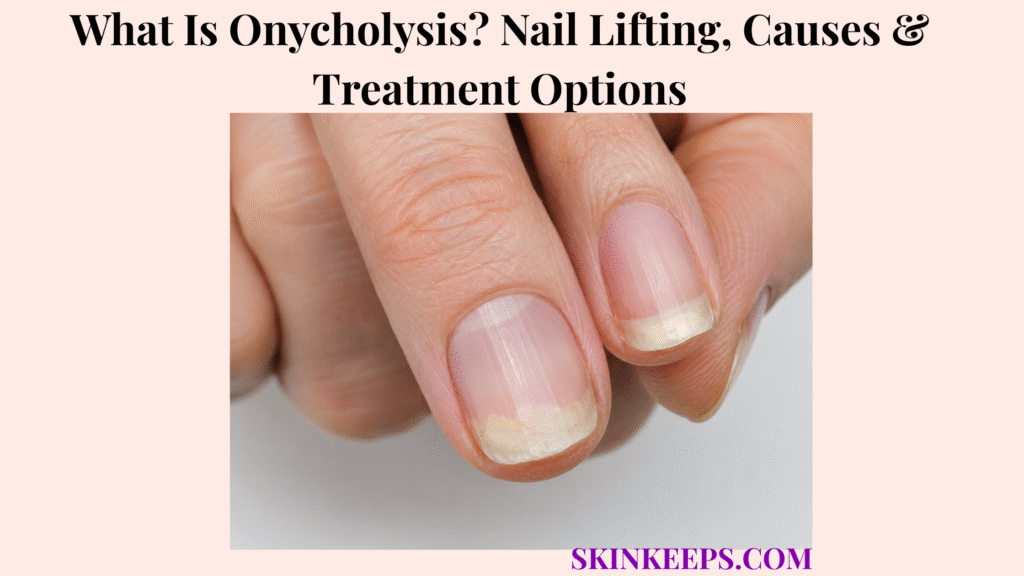
Onycholysis is separation of the nail plate from the underlying nail bed, usually creating a sharply defined white or opaque area that begins near the nail tip or side. The remaining attached nail looks pink because it still lies against the vascular nail bed, while either a fingernail or toenail can develop distal or lateral lifting.
Onycholysis is a physical sign rather than one single disease, and causes include trauma, prolonged wet or chemical exposure, psoriasis, fungal infection and selected medications. The detached portion generally does not reattach, so recovery depends on stopping the cause and allowing new nail to grow forward while remaining attached to the bed.
This article is for educational purposes only and does not constitute medical advice, diagnosis, or treatment. A lifting nail that continues spreading, affects several nails without an obvious cause, develops significant pain, swelling, drainage, green or unusual dark discoloration, or is accompanied by a new dark streak, pigment spreading onto surrounding skin, persistent bleeding or a lump beneath the nail should be evaluated by a licensed dermatologist or qualified healthcare professional.
How Can You Recognize Onycholysis?
Onycholysis is recognized by a clearly demarcated area where the nail plate has lifted from the nail bed, changing from attached pink nail to detached white or opaque nail.
What Does Onycholysis Look Like, and Where Does It Usually Begin?
Onycholysis usually begins at the distal free edge or side of the nail and creates a distinct white or opaque lifted zone that can gradually extend toward the nail base.
The border between attached and detached nail can be straight, curved or irregular but is usually sharply defined. The distal edge is most common, although lateral and less commonly proximal separation can occur.
The detached nail looks white because air occupies the space where the plate no longer contacts the vascular nail bed.
Is Onycholysis Painful or Associated With Other Nail Changes?
Chronic onycholysis is often painless, but trauma, inflammation or secondary infection can produce tenderness, while thickening, pitting, crumbling or debris may reveal the underlying cause.
Pitting can support a psoriatic process, while subungual debris, thickening or crumbling can raise suspicion for fungal disease. Acute trauma or infection can add pain, swelling or surrounding inflammation.
None of these secondary features proves a cause by itself.
Why Can a Lifted Nail Turn Yellow or Green?
The detached space can collect moisture and microorganisms, allowing secondary Candida or Pseudomonas colonization or infection to alter the nail colour.
Pseudomonas classically produces a greenish discoloration, while Candida and other organisms can contribute to yellow, brown or mixed colour changes. Debris beneath the plate can also change the nail’s appearance.
Green colour is a clue to secondary microbial involvement rather than proof of why the original onycholysis began.
How Is Onycholysis Different From a Nail That Simply Looks White?
In onycholysis the white area reflects physical separation from the nail bed, whereas leukonychia and other white-nail disorders can leave the nail plate fully attached.
The practical distinction is white because air is under a detached plate versus white nail material or apparent whitening while the plate still adheres to the bed.
Figure 1. True onycholysis creates a sharply defined boundary between attached pink nail and detached white or opaque nail, usually starting distally or laterally.
What Causes Onycholysis, and Which Triggers Matter Most?
Onycholysis can result from repeated trauma, prolonged wet or chemical exposure, nail psoriasis, fungal infection, medication reactions or selected systemic diseases.
How Do Trauma, Manicuring and Wet Work Cause Nail Lifting?
Repeated mechanical or moisture-related stress can progressively disrupt the attachment between the nail plate and nail bed and produce onycholysis.
Aggressive manicuring, repeated cleaning beneath the nail, long nails striking objects, occupational friction and tight footwear can all create mechanical separation. Many cases reflect repeated microtrauma rather than one dramatic injury.
Prolonged immersion, detergents, solvents and nail cosmetics can weaken or irritate the nail unit and make repeated detachment more likely in susceptible nails.
How Do Nail Psoriasis and Nail Fungus Cause Onycholysis?
Nail psoriasis disrupts nail-bed attachment through inflammation, while fungal infection damages the nail unit and can produce lifting together with discoloration, debris, brittleness or crumbling.
Psoriatic clues include pitting, oil-drop or salmon-patch change, subungual hyperkeratosis and splinter haemorrhages. Fungal disease more often raises concern when the nail is thick, discoloured, crumbly or filled with subungual debris.
Nail fungus / onychomycosis can coexist with psoriasis or another cause of onycholysis, so these diagnoses are not mutually exclusive.
Can Medicines Cause Onycholysis?
Yes; some medicines can trigger nail separation directly or through photo-onycholysis, in which a photosensitizing drug and ultraviolet exposure interact.
Medication-related onycholysis is reported with selected chemotherapy agents and other photosensitizing medicines. Photo-onycholysis links drug exposure with ultraviolet light rather than ordinary mechanical lifting.
A suspected medication cause should be discussed with the prescribing clinician rather than prompting independent discontinuation of treatment.
When Should Systemic Disease Be Considered?
Systemic disease becomes more relevant when several nails lift without a clear local trigger or when history and symptoms suggest conditions such as thyroid dysfunction.
A multi-nail unexplained pattern raises the value of broader history and selective testing. Thyroid testing is not routinely necessary for every isolated lifted nail with an obvious local cause.
Figure 2. Trauma, wet or chemical exposure, psoriasis, fungus, medication effects and selected systemic conditions can all disrupt nail-bed attachment and produce the same onycholysis sign.
How Is Onycholysis Distinguished and Diagnosed?
The physical nail separation is usually diagnosed clinically, while the main diagnostic task is determining whether trauma, psoriasis, fungus, medication or another disorder caused it.
How Can Fungal, Psoriatic and Trauma-Related Onycholysis Be Distinguished?
Fungal onycholysis often accompanies debris and crumbling, psoriatic onycholysis may show pitting or oil-drop changes, and trauma-related lifting usually follows a recognizable mechanical exposure pattern.
Fungal disease becomes more plausible with thickening, yellow-brown discoloration and subungual debris. Psoriatic disease becomes more plausible with pitting, a salmon or oil-drop change, a proximal pink border, subungual hyperkeratosis or splinter haemorrhages.
Traumatic lifting fits repeated manicuring, subungual cleaning, occupational pressure, wet work or footwear contact. Morphology narrows probability but does not always prove the cause.
When Are Nail Clippings, Scrapings or Cultures Needed?
Nail testing is useful when fungal or bacterial infection remains possible and confirmation would change treatment.
Nail clippings or subungual scrapings can be examined or cultured when onychomycosis is plausible. Bacterial or yeast testing becomes more relevant with secondary discoloration, drainage or inflammatory signs.
Testing is not mandatory for every uncomplicated traumatic nail with a clear exposure history.
When Are Blood Tests Useful?
Blood tests are targeted rather than routine and are most appropriate when the clinical pattern suggests an underlying systemic condition such as thyroid dysfunction.
Several affected nails, no convincing local trigger and compatible systemic symptoms or medical history can justify a broader workup. A broad laboratory panel should not replace focused history and examination.
When Should a Nail Tumour Be Considered?
A persistent unexplained abnormality affecting one nail deserves careful evaluation when lifting occurs with new pigmentation, bleeding, splitting or a persistent mass beneath the nail.
A dark longitudinal band, pigment spreading onto surrounding skin, a subungual nodule, persistent bleeding or unusual erosion changes the risk context. Nail-unit melanoma is uncommon, and nail lifting alone does not indicate melanoma.
Figure 3. After confirming onycholysis, associated morphology and exposure history guide whether fungal testing, psoriasis assessment, medication/systemic review or tumour evaluation is appropriate.
How Is Onycholysis Treated?
Onycholysis is treated by stopping the factor causing separation, protecting and trimming the detached nail, and treating any confirmed fungal, psoriatic, medication-related or secondary infectious cause.
Can a Lifted Nail Reattach, and Should the Detached Portion Be Trimmed?
The already detached nail usually does not reattach, so the lifted portion should be kept reasonably short while newly growing nail replaces it.
Progressive trimming of the unattached free portion reduces catching and leverage on the remaining attached nail. Healthy attached nail should not be cut away unnecessarily.
Aggressive digging or scraping under the separated plate can create more trauma and extend the onycholysis. Recovery occurs from the nail base forward.
How Should Trauma, Wet Work and Chemical Exposure Be Managed?
Repeated mechanical and moisture exposure should be reduced so the new nail is not continually separated from the nail bed as it grows.
Keep nails reasonably short, avoid subungual manipulation and reduce repetitive impact. For toenails, footwear should provide adequate room and avoid repeated pressure against the nail.
For fingernails, prolonged water immersion and repeated contact with detergents or solvents should be reduced where practical. Suitable protective gloves can help during wet work.
How Are Fungal, Psoriatic or Drug-Related Causes Treated?
Treatment should target the confirmed cause: antifungal therapy for onychomycosis, psoriasis therapy for psoriatic nail disease, and clinician-guided medication review for suspected drug-related onycholysis.
Fungal treatment can be topical or oral depending on the confirmed infection and clinical context, while nail psoriasis may use local or systemic therapy according to disease extent and severity.
Medication-related management depends on the importance of the drug, the severity of nail toxicity and whether ultraviolet exposure contributes. Any change to a prescribed medicine belongs with the prescribing clinician.
How Is Secondary Green or Infected Onycholysis Managed?
Secondary discoloration or infection should be assessed and treated according to the organism and clinical severity rather than assuming every green, yellow or tender nail needs the same antimicrobial.
Colour, drainage, pain, erythema and swelling help determine whether secondary infection is likely. Fungal, bacterial or yeast testing can be added when the result would change treatment.
When nail-fold inflammation becomes prominent, paronychia should be considered separately rather than treating all periungual redness as uncomplicated onycholysis.
Figure 4. Successful recovery means attached nail appears at the base and advances outward; the old detached nail is progressively trimmed away rather than sticking back down.
How Long Does Onycholysis Take to Recover, and How Can Recurrence Be Reduced?
Onycholysis improves only as new nail grows forward attached, so recovery takes months and can become incomplete when the nail bed remains detached for too long.
How Long Do Fingernails and Toenails Take to Grow Out?
A fingernail can take roughly 4–6 months to replace itself, while toenail replacement usually takes considerably longer.
DermNet notes that toenails can take about twice as long as fingernails to fully regrow. These are approximate biological timelines rather than guarantees because growth rate varies between people and circumstances.
The useful sign of improvement is new attached nail appearing at the base, not immediate disappearance of the older white detached zone.
Can Longstanding Onycholysis Become Permanent?
Yes; prolonged detachment can alter the exposed nail bed so that newly growing nail may no longer attach normally.
Chronic separation can lead to cornification and structural change of the nail bed, sometimes called a disappearing nail bed. The longer detachment persists, the less predictable full reattachment becomes.
How Can Trauma and Wet-Work Recurrence Be Reduced?
Keeping nails reasonably short and reducing repeated impact, subungual manipulation, prolonged wet work and chemical exposure can reduce recurrent onycholysis.
For fingernails, avoid digging underneath the plate and use protective gloves when prolonged wet or chemical work cannot be avoided. For toenails, adequate shoe room and reduction of repeated toe impact protect the attachment zone.
When Should Onycholysis Be Reassessed?
Onycholysis should be reassessed when separation keeps moving toward the base, treatment fails, several nails become affected without explanation, or pain, inflammation, unusual discoloration or structural change develops.
A persistent dark streak, pigment on surrounding skin, repeated bleeding, an unexplained subungual lump or other lasting single-nail abnormality should not be managed indefinitely as presumed fungus or trauma.
What Should You Remember About Onycholysis?
Onycholysis is nail-plate separation rather than one single disease, so successful treatment depends on identifying the cause and allowing new attached nail to grow forward.
- Onycholysis means the nail plate has separated from the nail bed.
- Distal or lateral onset is common.
- The detached portion usually looks white or opaque.
- Chronic onycholysis can be painless.
- Yellow or green colour can reflect secondary microbial involvement.
- Trauma is a common cause.
- Wet work and chemical exposure can contribute.
- Nail psoriasis can cause lifting.
- Nail fungus can cause or coexist with lifting.
- Lifting alone does not prove fungal infection.
- Selected medications can cause onycholysis or photo-onycholysis.
- Multiple unexplained nails may justify systemic evaluation.
- The separation itself is usually diagnosed clinically.
- Fungal, bacterial and blood testing are cause-directed.
- Persistent atypical single-nail disease needs closer assessment.
- Detached nail generally does not reattach.
- Recovery depends on new nail growing attached from the base.
- Keeping the nail short reduces repeated leverage and trauma.
- Wet-work and chemical protection support recovery.
- Fungus and psoriasis require cause-specific treatment.
- Fingernail regrowth takes months and toenail recovery is slower.
- Longstanding detachment can become permanently difficult to reattach.
- Recurrence prevention focuses on protecting nail-bed attachment.
Recognize lifting → Identify cause → Test when needed → Remove trigger → Protect new growth → Wait for attached nail replacement → Reassess persistent or atypical disease.
Frequently Asked Questions About Onycholysis
The most important onycholysis questions concern why nails lift, whether the detached nail can reattach, how fungus differs from psoriasis or trauma, how long regrowth takes and when evaluation is needed.
What Causes a Fingernail or Toenail to Lift From the Nail Bed?
Common causes include repeated trauma, wet or chemical exposure, psoriasis, fungal infection and selected medication-related reactions. Onycholysis is the separation sign, while the underlying cause differs between patients.
Can a Nail With Onycholysis Reattach to the Nail Bed?
No; the portion that has already detached usually does not reattach, so recovery depends on new attached nail growing forward from the base. The detached portion is progressively trimmed as it moves outward.
How Can You Tell Fungal Onycholysis From Nail Psoriasis or Trauma?
Fungal lifting often accompanies debris and crumbling, psoriasis may produce pitting or oil-drop changes, and trauma usually follows a recognizable mechanical exposure pattern. Targeted testing can help when morphology does not provide enough certainty.
How Long Does Onycholysis Take to Grow Out?
Fingernail recovery often takes several months, while toenails usually require substantially longer because they grow more slowly. Improvement starts with attached nail at the base while the old white detached portion remains visible until it grows out.
When Does a Lifting Nail Need Medical Evaluation?
Evaluation is appropriate when lifting keeps spreading, several nails become affected without explanation, infection signs develop or one nail shows new pigmentation, bleeding or a persistent underlying lump. Atypical single-nail change should not be self-diagnosed indefinitely as trauma or fungus.
Which Sources Support This Onycholysis Guidance?
DermNet — Onycholysis — Primary source for nail-bed separation, distal/lateral appearance, white detached nail, trauma/wet work, infections, systemic and medication causes, testing, non-reattachment, trimming, wet-work protection, regrowth timelines and disappearing nail bed.
DermNet — Nail Psoriasis — Used specifically for psoriatic onycholysis, pitting, oil-drop or salmon-patch change, subungual hyperkeratosis and splinter haemorrhages.
American Academy of Dermatology — How to Check Your Nails for Melanoma — Used only for atypical single-nail warning signs such as a dark band, pigment around the nail, lifting, splitting or an underlying nodule.
American Academy of Dermatology — Nail Fungus: Diagnosis and Treatment — Used for confirmatory sampling and cause-specific topical or oral antifungal treatment when onychomycosis is actually present.
DermNet — Drug-Induced Nail Disease — Used selectively for medication-associated nail separation, chemotherapy context and photo-onycholysis.