Prurigo nodularis is a chronic inflammatory skin disease that causes intensely itchy firm nodules and is sustained by abnormal itch signaling, inflammation and repeated scratching. The itch often precedes the nodules, and repeated scratching or rubbing can make lesions thicker, rougher, more numerous and harder to heal.
PN is not simply another name for eczema, and scratching alone does not explain the disease. Current understanding includes neuroimmune dysregulation and nerve sensitization, while treatment aims to reduce itch, calm inflammation, heal nodules and break the itch–scratch cycle.
This article is for educational purposes only. Persistent, severe, infected-looking or unexplained itchy nodules should be evaluated by a qualified healthcare professional.
What Is Prurigo Nodularis and What Does It Look and Feel Like?
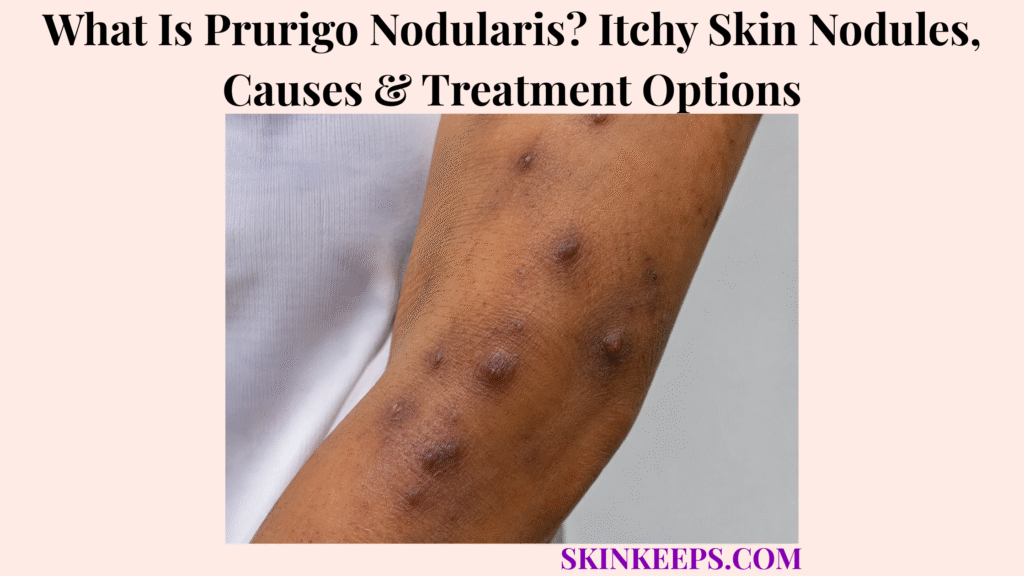
Prurigo nodularis is a chronic inflammatory skin disease that causes intensely itchy firm nodules and is sustained by abnormal itch signaling, inflammation and repeated scratching.
How Does the Itch–Scratch Cycle Drive Prurigo Nodularis?
Persistent PN itch promotes repeated scratching and rubbing, which injures the skin, increases inflammation and thickens lesions, creating even more itch.
The sequence is itch → scratch/rub → injury → inflammation → thickened nodule → stronger itch. Scratching perpetuates PN but does not fully explain its origin.
How Do Immune Signals and Skin Nerves Contribute to PN?
PN also involves abnormal immune signaling and sensitized itch pathways in the skin, which can keep itching active even when the original trigger is no longer obvious.
What Do PN Nodules Look Like, and Where Do They Appear?
PN typically produces firm raised nodules with rough, thickened, scratched or crusted surfaces, commonly affecting the arms, legs, trunk and back in a broadly symmetrical pattern.
Lesions may be skin-coloured, pink, red, brown or darker than surrounding skin, and open sores or scabs can form after repeated scratching.
What Symptoms Can Occur Besides Intense Itching?
PN can also cause burning, stinging, bleeding, crusting, skin discoloration, scarring and substantial sleep disruption when itch is severe.
Repeated inflammation and healing may leave persistent hyperpigmentation or lighter marks after nodules improve.
Figure 1. PN Recognition Map — intense itch, firm nodules, common distribution and secondary skin effects.
What Causes or Contributes to Prurigo Nodularis?
PN usually reflects a combination of chronic itch susceptibility, neuroimmune dysfunction and repeated scratching rather than one single universal cause.
Can Other Skin Conditions Contribute to PN?
Yes; chronic itchy inflammatory conditions such as atopic dermatitis can increase the itch burden associated with PN, although PN remains a distinct disease.
Can Other Causes of Chronic Itching Be Associated With PN?
Yes; when the history suggests another source of persistent itch, clinicians may investigate skin or systemic contributors rather than assuming every PN case begins without an identifiable driver.
For broader chronic-itch evaluation beyond PN itself, see pruritus.
Does Everyone With PN Have an Identifiable Trigger?
No; some people have a recognizable itch driver, while others do not, and established PN can persist through its own neuroimmune itch–scratch feedback.
Figure 2. PN Itch–Scratch Disease Loop — scratching amplifies injury, inflammation and neuroimmune sensitization, which can feed itch back into the cycle.
How Is Prurigo Nodularis Diagnosed and Distinguished From Other Itchy Skin Conditions?
PN is primarily diagnosed clinically from chronic intense itch, characteristic firm nodules, scratching history and skin examination, with biopsy or laboratory testing reserved for selected uncertain cases.
How Does a Dermatologist Diagnose PN?
A dermatologist usually identifies PN from persistent severe itch, typical nodular lesions, evidence of scratching and the overall distribution of the eruption.
When Are Skin Biopsy or Laboratory Tests Needed?
Skin biopsy is used when lesion appearance is atypical or another skin disorder must be excluded, while laboratory evaluation may be used when an underlying contributor to chronic itch is suspected.
What Conditions Can Resemble Prurigo Nodularis?
Other chronic pruritic, inflammatory, infectious, infestational, blistering or hyperkeratotic disorders can resemble PN, so the differential should follow lesion pattern and clinical history.
When scratching mainly produces localized thick plaques rather than multiple nodules, lichen simplex chronicus can be a useful comparison.
Figure 3. PN Diagnostic Decision Path — diagnosis is usually clinical, while biopsy or laboratory evaluation is reserved for selected atypical or unexplained cases.
How Is Prurigo Nodularis Treated?
PN treatment aims to suppress itch, reduce inflammation, heal nodules and interrupt scratching, with therapy escalating from topical or lesion-directed treatment to phototherapy or targeted systemic treatment when needed.
How Do Topical and Lesion-Directed Treatments Help?
Topical corticosteroids, selected intralesional corticosteroids and other dermatologist-directed anti-inflammatory or anti-itch treatments can reduce inflammation and itch in individual PN lesions.
When Is Phototherapy Used?
Dermatologist-supervised phototherapy can be considered when PN is more extensive or when topical and lesion-directed treatment has not provided adequate control.
Which Targeted Biologic Treatments Are Used for PN?
Dupilumab and nemolizumab-ilto are FDA-approved targeted systemic treatments for adults with prurigo nodularis, with selection based on disease severity, previous treatment and individual clinical factors.
Dupilumab became the first FDA-approved PN treatment in 2022, while nemolizumab-ilto was approved for adults with PN on August 12, 2024.
When Might Other Systemic Treatments Be Considered?
Other dermatologist-directed systemic or off-label therapies may be considered for difficult PN when standard topical, phototherapy or targeted approaches are unsuitable or insufficient.
Figure 4. PN Treatment Escalation Staircase — treatment progresses from supportive and lesion-directed care toward phototherapy or systemic options when needed.
How Can People With Prurigo Nodularis Reduce Itching, Protect Their Skin, and Know When to Seek Reassessment?
Daily PN care should reduce scratching, support the skin barrier and control individual itch triggers, while persistent, worsening, infected or treatment-resistant disease should be reassessed by a dermatologist.
How Can Scratching and Skin Injury Be Reduced?
Reducing scratching helps weaken the itch–scratch cycle and gives inflamed PN nodules a better chance to heal.
Keeping nails short, covering vulnerable lesions where appropriate, using cool measures instead of scratching and avoiding repetitive rubbing can reduce mechanical injury.
How Does Moisturizing Support PN Care?
Regular moisturizing supports the damaged skin barrier and can reduce dryness-related irritation, but it is an adjunct rather than a stand-alone PN treatment.
Which Personal Triggers Should Be Avoided?
People with PN should identify exposures or situations that reliably increase their own itching rather than following an unsupported universal trigger list.
When Should PN Be Evaluated or Reassessed?
Dermatology evaluation is appropriate when intensely itchy nodules persist or multiply, lesions become open or infected-looking, sleep is significantly disrupted, treatment fails or the diagnosis remains uncertain.
PN can often be controlled effectively, but treatment should not be presented as a guaranteed permanent cure.
What Should You Remember About Prurigo Nodularis?
Prurigo nodularis is a chronic inflammatory itch disorder in which neuroimmune signaling and repeated scratching produce persistent firm nodules that require treatment of both itch and skin inflammation.
- Severe itch is central to PN.
- Firm nodules are characteristic.
- Scratching perpetuates disease but is not the only mechanism.
- Neuroimmune dysfunction and nerve sensitization matter.
- Lesions can crust, bleed, scar and leave pigment change.
- Sleep disruption can be substantial.
- Arms, legs, trunk and back are common sites.
- Atopic dermatitis is associated but PN is distinct from eczema.
- Diagnosis is usually clinical.
- Biopsy and laboratory testing are selective.
- Topical and lesion-directed treatment can help.
- Phototherapy is an escalation option.
- Dupilumab and nemolizumab-ilto are approved targeted options for adults.
- Moisturizing supports barrier care.
- Persistent or worsening disease deserves reassessment.
- Permanent cure should not be guaranteed.
Itch → scratching → inflammation/nodules → diagnose PN → suppress itch/inflammation → protect skin → escalate treatment when necessary.
Frequently Asked Questions About Prurigo Nodularis
The main PN questions concern contagion, long-term control, the role of scratching, its relationship with eczema and whether lesions can leave scars or dark marks.
Is Prurigo Nodularis Contagious?
No; PN is an inflammatory itch disorder and is not spread through ordinary person-to-person contact.
Can Prurigo Nodularis Go Away Completely?
PN can improve substantially and may become well controlled with treatment, but a permanent cure cannot be guaranteed for every patient.
Does Scratching Cause Prurigo Nodularis?
Scratching strongly drives and perpetuates PN lesions, but immune and nerve-signaling abnormalities also contribute to the disease.
Is Prurigo Nodularis the Same as Eczema?
No; PN is a distinct disease, although atopic dermatitis and other chronic itchy skin conditions can be associated with it.
Can Prurigo Nodularis Leave Scars or Dark Marks?
Yes; repeated inflammation, scratching and healing can leave scars or persistent areas of skin discoloration after active nodules improve.
Which Sources Support This Prurigo Nodularis Guidance?
American Academy of Dermatology — Signs and Symptoms — Used for lesion appearance, symmetry, distribution, crusting, bleeding, burning/stinging, pigment change, scarring and sleep impact.
American Academy of Dermatology — Causes — Used for nerve sensitization, immune overactivity and atopic-dermatitis association.
American Academy of Dermatology — Diagnosis and Treatment — Used for clinical diagnosis, selective biopsy/labs, topical care, phototherapy and systemic treatment.
DermNet — Nodular Prurigo — Used for the chronic firm-nodule phenotype and symmetrical body distribution.
U.S. FDA — Dupilumab Approval — Used for the 2022 adult PN approval.
U.S. FDA — NEMLUVIO Drug Trials Snapshot — Used for nemolizumab-ilto’s August 12, 2024 adult PN approval.