“Skin allergy” is a broad term for immune-related skin reactions rather than one specific disease. The main patterns include delayed allergic contact dermatitis, transient hives or urticaria, and deeper angioedema, each of which produces a different combination of itching, rash, welts, blistering or swelling.
The safest approach is to identify the reaction pattern before deciding what caused it or how to treat it. A rash after product exposure may be allergic or irritant, hives may have allergic or non-allergic triggers, and angioedema has several mechanisms; targeted testing and reaction-specific treatment are more useful than a universal “allergy panel” or one “allergy cream.”
This article is for educational purposes only. Severe swelling, breathing difficulty, throat tightness, fainting or rapidly worsening systemic symptoms require urgent medical care.
What Is a Skin Allergy and What Do Different Allergic Skin Reactions Look Like?
A skin allergy is an immune-mediated reaction that may appear as delayed eczematous dermatitis, transient hives or deeper angioedema depending on the immune pathway and tissue level involved.
How Does the Immune System Cause an Allergic Skin Reaction?
An allergic skin reaction develops when the immune system recognizes a substance as an allergen and responds through an immediate or delayed pathway that produces inflammation in the skin or deeper tissues.
In immediate reactions, mast-cell mediators such as histamine can rapidly produce wheals, itching and swelling. Delayed allergic contact dermatitis follows a different, T-cell-mediated pathway after sensitization, so it should not be reduced to “histamine release.” The practical sequence is allergen exposure → immune recognition → immediate mediator release or delayed cellular response → itch, rash or swelling.
What Does Allergic Contact Dermatitis Look Like?
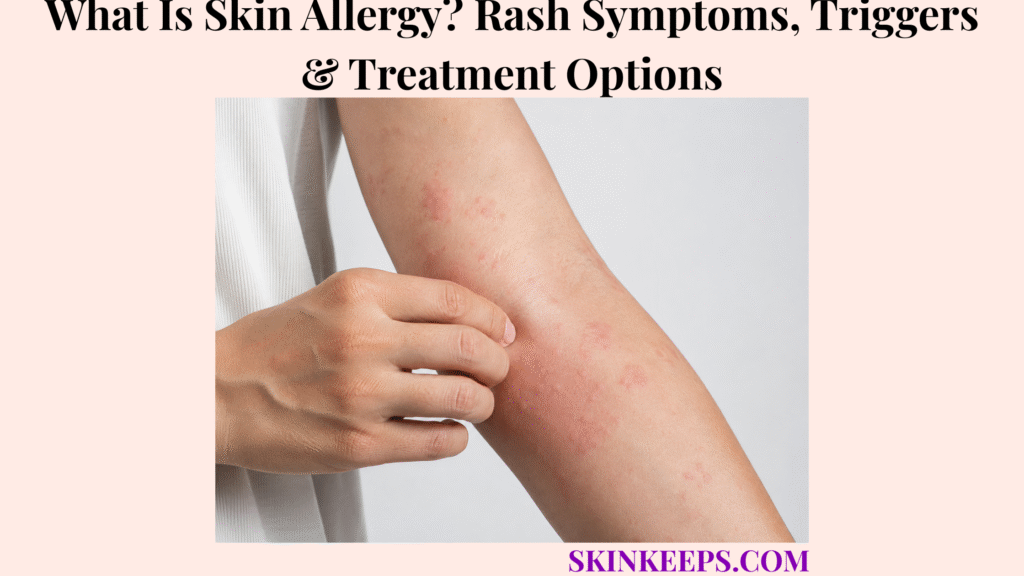
Allergic contact dermatitis usually causes an intensely itchy eczematous eruption at or near exposed skin, with swelling, bumps, vesicles or blisters, weeping, crusting and later scaling possible depending on severity and timing.
The dedicated allergic contact dermatitis page explains the delayed contact-allergy pattern in more depth; the key distinction here is that immune sensitization must occur, so a person can react after previously tolerating the same substance.
What Do Allergic Hives Look Like?
Hives are raised itchy wheals that appear suddenly, often change shape or location and usually fade from an individual spot within hours, although new wheals can continue appearing elsewhere.
The hives / urticaria page covers the full urticaria spectrum; allergy is only one possible trigger because infections, heat, cold, pressure, sweating, sunlight and chronic spontaneous mechanisms can also produce wheals.
What Does Angioedema Look Like?
Angioedema causes deeper swelling beneath the skin, commonly involving the lips, eyelids, face, hands or feet and sometimes the tongue or throat.
The angioedema page explains its different mechanisms in detail. Some episodes are histamine-mediated and occur with hives, while others are non-histamine-mediated, so deeper swelling should not automatically be labeled an allergic reaction.
How Can Skin Allergy Look Different Across Skin Tones?
Allergic skin reactions should be recognized from itching, swelling, texture, raised lesions, blistering and change from a person’s baseline color rather than requiring bright redness.
On darker skin, hives may be close to the surrounding skin tone or appear purple, gray or darker, while eczematous inflammation can be less obviously red. Morphology, palpability, itch, swelling and distribution therefore remain important diagnostic clues.
Figure 1. “Skin allergy” contains different reaction patterns. Delayed eczematous dermatitis, transient wheals and deeper angioedema should be separated before choosing tests or treatment.
What Can Trigger a Skin Allergy and Why Is the Real Cause Sometimes Hard to Find?
Skin allergy triggers depend on the reaction type, ranging from contact allergens such as nickel or fragrance to foods, medicines, latex or insect venom in selected immediate reactions, while many hives and some angioedema are not caused by an external allergen at all.
Which Substances Commonly Trigger Allergic Contact Dermatitis?
Common allergic contact dermatitis triggers include nickel, fragrances, preservatives, cosmetics, hair-dye chemicals, rubber accelerators, plant allergens such as poison ivy and selected topical medicines.
The important feature is skin contact followed by a delayed dermatitis pattern after sensitization. The substance that caused the reaction may be hidden in a personal-care product, occupational material, adhesive, glove, metal object or multiple-component cosmetic, so the label “allergy” should follow a plausible exposure pattern rather than guesswork.
Can Foods, Medicines or Insect Stings Cause Hives or Swelling?
Yes; foods, medicines, latex and insect venom can trigger hives or angioedema in immediate allergic reactions, but these are only some of the possible causes of wheals or swelling.
Hives can also be triggered by infection, heat, cold, pressure, exercise or sweating, sunlight and chronic spontaneous mechanisms. This is why recurrent hives should not automatically lead to food blame or a broad elimination diet.
Can Someone Become Allergic to a Product They Used Safely Before?
Yes; allergic contact dermatitis can develop after sensitization, so a person may begin reacting to a product after months or years of previously uneventful exposure.
The sequence is previous exposure → immune sensitization → later re-exposure → delayed dermatitis. Prior tolerance therefore makes a contact allergy less obvious but does not rule it out.
Why Is Finding the Trigger Sometimes Difficult?
Trigger identification can be difficult because delayed reactions, multiple simultaneous exposures, hidden ingredients and non-allergic mimics can obscure the true cause.
A facial rash may follow cosmetics used hours or days earlier; hand dermatitis may reflect several occupational exposures; and hives may appear without a stable external allergen. A useful investigation tracks reaction type, timing, location, likely exposures and whether the same pattern reliably recurs.
Figure 2. Trigger hunting works best when it starts with phenotype and timing. A recent exposure is not automatically the cause, especially with delayed contact dermatitis or chronic hives.
How Is a Skin Allergy Diagnosed and Distinguished From Irritation or Other Rashes?
Skin allergy diagnosis depends on the reaction pattern, timing, body location and exposure history, with testing selected according to the suspected immune mechanism instead of ordering an indiscriminate allergy panel.
How Does a Dermatologist or Allergist Evaluate a Suspected Skin Allergy?
Evaluation begins with the morphology of the rash or swelling, its timing and duration, body location, exposures, medicines, foods and physical examination before deciding whether allergy testing is useful.
A clinician asks whether individual lesions remain fixed or move, whether dermatitis follows an exposure distribution, whether swelling occurs with hives, and whether systemic symptoms accompanied the reaction. This pattern → timing → exposure → examination sequence keeps testing tied to a specific clinical question.
How Does Patch Testing Diagnose Allergic Contact Dermatitis?
Patch testing evaluates delayed contact allergy by exposing the skin to selected standardized allergens under controlled conditions and checking later for a dermatitis response.
It is designed for suspected allergic contact dermatitis, particularly recurrent or chronic disease in which history suggests a contact allergen. Patch testing is not the same as skin-prick testing and does not diagnose irritant contact dermatitis.
Are Skin-Prick or Blood Allergy Tests Useful for Every Rash?
No; skin-prick and specific-IgE blood tests are useful for selected suspected immediate allergic mechanisms and do not diagnose every eczematous, chronic or unexplained rash.
Testing without a compatible history can generate sensitization results that are not clinically relevant and can lead to unnecessary avoidance. Chronic spontaneous hives, for example, frequently have no identifiable external allergen, so broad food or inhalant panels are usually low yield unless the history points to a specific trigger.
What Conditions Can Be Mistaken for a Skin Allergy?
Irritant contact dermatitis, atopic dermatitis, infections, infestations and other inflammatory eruptions can mimic allergic skin disease, so “itchy” or “red” alone does not establish allergy.
Atopic dermatitis can produce chronic itchy eczematous skin without a single external contact allergen, and its distribution, history and barrier dysfunction can differ from a classic exposure-linked allergic contact reaction.
Scabies can produce severe itching and papules, but burrows, characteristic body distribution and similar symptoms among close contacts point toward infestation rather than allergy.
Why Can Chronic Hives Occur Without an Identifiable Allergen?
Chronic urticaria often occurs without a clearly identifiable external allergen, so failure to find one does not mean the symptoms are unreal or untreatable.
When hives recur for more than six weeks, evaluation shifts away from automatically searching for one food or product and toward confirming the urticaria pattern, reviewing medications and physical triggers, considering associated conditions when clinically indicated and treating the disease effectively even when no single trigger is found.
Figure 3. Allergy testing is useful only when the phenotype points to a testable mechanism. Patch testing, immediate-type testing and mimic exclusion solve different diagnostic questions.
How Are Skin Allergies Treated?
Skin allergy treatment must match the reaction type: allergic contact dermatitis requires allergen avoidance and skin-directed care, hives usually use antihistamine-centered management, and angioedema treatment depends on mechanism and severity.
Why Is Avoiding a Confirmed Allergen Important?
Avoiding a confirmed allergen is fundamental in allergic contact dermatitis because repeated contact can reactivate the delayed inflammatory rash.
Useful avoidance is specific: identify the relevant chemical or exposure, learn where it occurs and select alternatives that do not contain it. Avoiding many unconfirmed products or foods “just in case” can create restrictions without improving the actual disease.
How Is Allergic Contact Dermatitis Treated?
Allergic contact dermatitis treatment combines stopping the relevant exposure, supporting the skin barrier and using clinician-selected anti-inflammatory therapy when needed.
Moisturizers and gentle care help repair barrier disruption, while topical anti-inflammatory treatment may be used for active dermatitis and more extensive disease may need clinician-directed escalation. Treatment should address the dermatitis itself while confirmed allergen avoidance prevents repeat exposure.
How Are Hives Treated?
Hives are commonly managed with oral H1-antihistamine-based therapy, with additional clinician-directed options available when chronic urticaria remains uncontrolled.
The treatment goal is to control itch and swelling and prevent new wheals. Finding a trigger can help when one is obvious, but successful treatment does not depend on discovering an external allergen in every chronic case.
How Is Angioedema Treated?
Angioedema treatment depends on whether the swelling is histamine-mediated, another mechanism is involved, and whether airway or systemic danger is present.
Mild histamine-mediated swelling may follow an urticaria-style treatment pathway, while non-histamine-mediated angioedema requires a different assessment and treatment strategy. Tongue or throat swelling, voice change, swallowing difficulty or breathing symptoms move the problem out of routine skin management and into urgent care.
Why Is One “Allergy Cream” Not Appropriate for Every Reaction?
One topical treatment cannot address all skin-allergy patterns because dermatitis, hives, angioedema and systemic allergic reactions occur at different tissue levels and use different immune mechanisms.
A contact-dermatitis cream does not treat airway-threatening angioedema, and a topical product is not the central treatment for hives. Matching therapy to the phenotype prevents undertreating an emergency and avoids over-treating a benign transient reaction with the wrong intervention.
Figure 4. Treatment follows the reaction pattern. A delayed dermatitis, transient wheals, deeper angioedema and a systemic allergic emergency require different management pathways.
How Can Skin Allergy Flares Be Prevented, and When Is the Reaction an Emergency?
Recurrence prevention depends on avoiding confirmed triggers and protecting the skin barrier, while airway, breathing or circulatory symptoms indicate a possible systemic allergic emergency rather than an isolated skin reaction.
How Can Confirmed Allergens Be Avoided?
Once a relevant allergen is confirmed, recurrence prevention focuses on recognizing that allergen on ingredient labels, avoiding known occupational or personal-care sources and choosing appropriate alternatives.
Keep the allergy name specific whenever possible rather than recording vague labels such as “all cosmetics.” Accurate records are especially useful for fragrance components, preservatives, metals, rubber chemicals and medicines because the same allergen may appear under different product names or in several settings.
How Does Gentle Skin Care Support Allergy-Prone Skin?
Gentle cleansing and appropriate moisturization can reduce secondary irritation and support the skin barrier while allergic dermatitis heals.
Barrier care does not eliminate the allergen itself, but it can reduce cracking, burning and irritant overlap that make dermatitis harder to interpret and control.
Should Someone Avoid Every Possible Allergen “Just in Case”?
No; broad speculative avoidance can create unnecessary restrictions and should be replaced by confirmed or consistently reproducible trigger avoidance.
Unnecessary food elimination is particularly problematic when hives are chronic and no food-linked pattern exists. A focused history and mechanism-specific testing are more reliable than repeatedly removing unrelated foods, skin products or environmental exposures.
Why Should Recurrent Reactions Be Recorded?
Recording exposure, timing, rash type, body location, duration and treatment response can make later dermatology or allergy evaluation more precise.
A useful record captures exposure → timing → morphology → location → duration → response, and photographs taken during transient hives or swelling can sometimes help a clinician understand a reaction that has disappeared by the appointment.
When Should a Skin Allergy Be Medically Reassessed?
Medical reassessment is appropriate when a rash is severe, widespread, repeatedly unexplained, blistering, peeling, persistent despite avoidance, drug-associated or accompanied by recurrent significant angioedema.
Hives recurring for more than six weeks deserve evaluation as chronic urticaria rather than repeated assumptions of acute food allergy. Persistent dermatitis, uncertain diagnosis, treatment failure or reactions that interfere substantially with sleep or daily function also justify professional assessment.
Which Symptoms May Signal Anaphylaxis?
Trouble breathing, wheezing, throat tightness, tongue or throat swelling, trouble swallowing, dizziness, fainting or low blood pressure together with an allergic reaction can signal anaphylaxis and require emergency care.
Anaphylaxis can involve skin symptoms such as hives or swelling, but dangerous reactions can also occur without a prominent rash. The safety distinction is isolated skin reaction → type-specific evaluation, versus skin or allergic symptoms plus airway, breathing or circulatory compromise → possible anaphylaxis → emergency treatment.
What Should You Remember About Skin Allergy?
“Skin allergy” is an umbrella term, so the safest and most useful approach is to identify the reaction pattern and mechanism before choosing tests, treatment or avoidance strategies.
- Allergic contact dermatitis is a delayed immune reaction after sensitization to a contact allergen.
- Hives are transient wheals and are not always caused by allergy.
- Angioedema is deeper swelling and can have histamine-mediated or non-histamine mechanisms.
- Allergy differs from direct irritant skin damage.
- Bright redness is not required; morphology and change from baseline matter across skin tones.
- Nickel, fragrance, preservatives, hair-dye chemicals and rubber chemicals are important contact-allergen groups.
- Foods, medicines, latex and insect venom can trigger selected immediate allergic reactions.
- A person can become sensitized after previously tolerating the same contact exposure.
- Diagnosis starts with morphology, timing, location and exposure history.
- Patch testing evaluates suspected allergic contact dermatitis.
- Skin-prick and specific-IgE testing are reserved for selected immediate-type allergy questions.
- Broad allergy panels are not appropriate for every itchy rash or chronic hives.
- Atopic dermatitis and scabies are among the conditions that can mimic an allergic eruption.
- Chronic hives may remain treatable even when no external allergen is found.
- Confirmed allergen avoidance is central for allergic contact dermatitis.
- Hives are commonly managed with antihistamine-centered therapy.
- Angioedema treatment depends on mechanism and airway risk.
- No single “allergy cream” treats dermatitis, hives, angioedema and systemic reactions.
- Blanket food or product avoidance should be replaced by targeted avoidance when possible.
- Reaction records can improve later diagnostic accuracy.
- Breathing difficulty, throat or tongue swelling, fainting or circulatory symptoms change the situation into a possible emergency.
Core pathway: Identify reaction pattern → review timing and exposures → select mechanism-specific testing → treat the correct phenotype → avoid confirmed triggers → escalate airway, breathing or circulatory symptoms immediately.
Frequently Asked Questions About Skin Allergy
The main skin-allergy questions concern irritation, delayed sensitization, hives, diagnostic testing and emergency symptoms.
What Is the Difference Between a Skin Allergy and Skin Irritation?
A skin allergy requires an immune response to an allergen, while irritation results from direct skin damage and does not require allergic sensitization.
Can a Skin Allergy Develop After Years of Using the Same Product?
Yes; sensitization can develop after repeated exposure, so a previously tolerated product can later trigger allergic contact dermatitis.
Are Hives Always Caused by an Allergy?
No; allergy can cause hives, but infections, physical triggers and chronic spontaneous urticaria can also produce wheals.
How Can Doctors Find the Cause of an Allergic Skin Rash?
Doctors use the rash pattern, timing, exposure history and targeted testing such as patch testing when the suspected mechanism supports it.
When Does a Skin Allergy Become an Emergency?
A reaction becomes an emergency when skin symptoms occur with breathing difficulty, throat or tongue swelling, fainting, low blood pressure or other signs of anaphylaxis.
AAAAI — Skin Allergy — Used for the umbrella framing, allergic contact dermatitis, hives, angioedema, chronic urticaria and reaction-specific treatment concepts.
DermNet — Allergic Contact Dermatitis — Used for delayed sensitization, morphology, exposure history, patch testing and allergen avoidance.
DermNet — Skin Tests and Investigations — Used to distinguish patch testing from skin-prick/IgE testing and to support targeted rather than indiscriminate allergy testing.
American Academy of Dermatology — Hives: Causes — Used for allergic and non-allergic hives triggers, including physical and infectious contexts.
American Academy of Dermatology — Hives: Diagnosis and Treatment — Used for chronic-urticaria definition, skin-tone presentation and antihistamine-centered management.
DermNet — Angioedema — Used for deeper-swelling recognition, mechanism-specific assessment and airway-risk framing.
AAAAI — Anaphylaxis — Used for airway, breathing and circulatory emergency warning signs.