
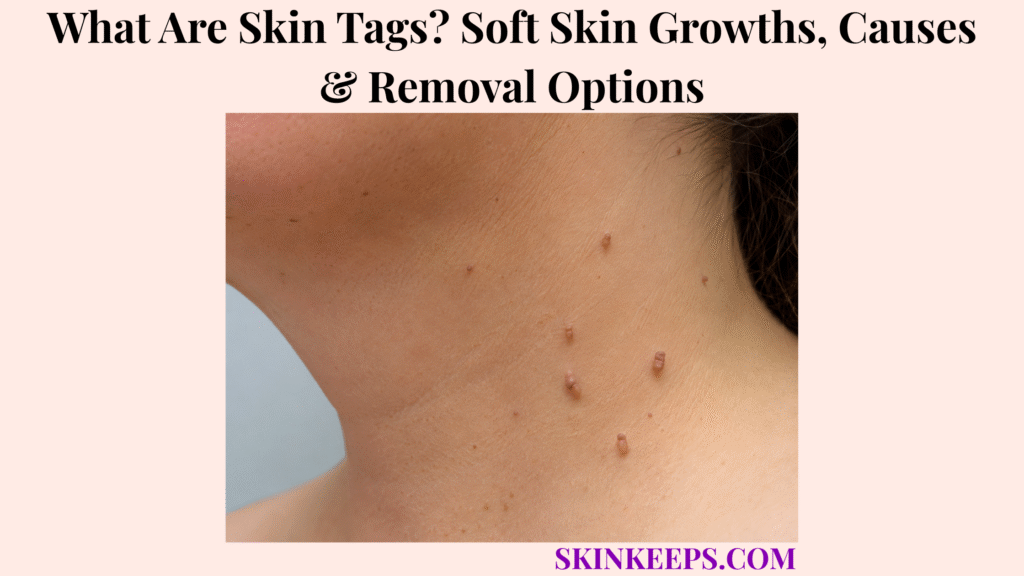
Skin tags, or acrochordons, are common benign fibroepithelial growths that are usually soft and may project from the skin on a small stalk. They are most often found in friction-prone folds such as the neck, armpits and groin, although they can occur in other areas as well.
Skin tags are associated with age, friction, obesity, metabolic factors, pregnancy and family susceptibility, but no single factor explains every tag. Most need no treatment; the main safety task is confirming that a growth really is a skin tag before choosing professional removal and avoiding home cutting, tying, freezing or chemical destruction.
This article is for educational purposes only. Rapidly changing, repeatedly bleeding, painful, ulcerated or diagnostically uncertain skin growths should be professionally evaluated.
What Are Skin Tags and What Do They Look and Feel Like?
Skin tags are soft benign fibroepithelial growths that are often flesh-colored or darker and may project from the skin on a narrow stalk.
What Is an Acrochordon?
An acrochordon is the medical term for a skin tag, a fibroepithelial polyp composed of loose connective tissue, collagen fibers and small blood vessels covered by epidermis.
This structure explains why a typical tag feels softer and more pliable than many keratotic growths. The lesion is benign tissue rather than a viral wart or a cancerous growth.
Why Do Skin Tags Often Hang From a Stalk?
Many skin tags grow outward through a narrow attachment point, producing the characteristic hanging or pedunculated appearance.
The stalk is a useful clue, not a diagnostic requirement. Some tags have a short broad attachment and look more like a small soft bump than a dangling projection.
What Color, Shape and Texture Can Skin Tags Have?
Skin tags are usually soft and fleshy and may be smooth or slightly wrinkled, round, elongated or thread-like, and skin-colored, tan, brown or darker.
Size also varies. Many tags are only a few millimeters across, while some become larger. Color alone cannot confirm the diagnosis because moles, seborrheic keratoses and other lesions can share similar pigmentation.
Where Do Skin Tags Commonly Develop?
Skin tags commonly occur in friction-prone folds such as the neck, armpits, groin, beneath the breasts, eyelids and upper-thigh folds.
These sites support friction as one contributor because skin rubs against skin, clothing or jewelry. Location helps recognition, but a growth should not be labeled a skin tag solely because it sits in a fold.
Do Skin Tags Hurt, Itch or Bleed?
Most skin tags cause no symptoms, but repeated rubbing, shaving or twisting can make a tag tender, irritated or occasionally bleed.
Sudden pain or marked darkening can occur if a tag twists and its blood supply is compromised, but substantial change should be assessed if the diagnosis is uncertain. Persistent spontaneous bleeding, ulceration or rapid enlargement is not a routine feature to dismiss.
What Causes Skin Tags and Who Is More Likely to Develop Them?
The exact cause of skin tags is not completely understood, but friction, increasing age, metabolic factors, pregnancy and inherited susceptibility are associated with a greater likelihood of developing them.
Does Friction Cause Skin Tags?
Friction probably contributes to skin-tag development in some people because tags frequently occur where skin rubs against skin, clothing or jewelry, but friction does not explain every acrochordon.
This is an association rather than a universal mechanism. Tags can occur outside obvious high-friction sites, so the article should not reduce every lesion to rubbing alone.
Why Do Skin Tags Become More Common With Age?
Skin tags become increasingly common during adulthood and tend to occur more frequently with increasing age.
Age is best treated as a risk pattern rather than a complete biological explanation. Older age does not make every new growth a skin tag, and changing lesions still require ordinary diagnostic scrutiny.
Are Obesity, Insulin Resistance or Diabetes Associated With Skin Tags?
Yes; multiple skin tags are associated with obesity, insulin resistance, metabolic syndrome and type 2 diabetes, but having skin tags does not diagnose any of these conditions.
The association may be clinically relevant in context, particularly when other metabolic risk factors are present, but a skin tag is not a diabetes test. Medical screening decisions should be based on the person’s broader health history and risk profile rather than the presence of one or several tags alone.
Why Can Skin Tags Increase During Pregnancy?
Pregnancy is associated with increased skin-tag development, probably through a combination of hormonal or growth-related influences and increased friction in certain body areas.
No single pregnancy mechanism explains all tags. The practical point is that pregnancy can change the number of benign tags without making every new growth automatically benign.
Can Skin Tags Run in Families?
Yes; people with close relatives who develop skin tags may be more likely to develop them as well, suggesting individual or familial susceptibility.
Family tendency modifies likelihood rather than confirming diagnosis. Atypical growths should still be assessed on their own morphology and behavior.
How Are Skin Tags Diagnosed and Distinguished From Other Skin Growths?
Typical skin tags are usually diagnosed clinically from their softness, attachment, location and stable growth history, while firm, irregular or changing lesions require a broader differential diagnosis.
How Does a Dermatologist Diagnose a Skin Tag?
A dermatologist usually identifies a skin tag from its soft texture, stalk or attachment, anatomical location, growth history and comparison with nearby lesions.
Classic tags generally need no special test. The diagnostic task changes when the lesion is unusually firm, ulcerated, rapidly changing, heavily pigmented, persistently painful or unlike the person’s other tags.
How Is a Skin Tag Different From a Wart?
Skin tags are generally soft and fleshy, while warts are firmer viral-driven epidermal growths with a different, often rougher surface structure.
Warts are caused by human papillomavirus and require a different treatment approach. That distinction is one reason wart-removal products should not be applied to a presumed skin tag.
How Is a Skin Tag Different From a Mole?
Moles arise from melanocytic cells and may be flat or raised, whereas skin tags are soft fibroepithelial growths often attached by a narrow stalk.
A mole should be evaluated by its own morphology and change pattern. A raised or stalk-like pigmented lesion should not be destroyed merely because it resembles a tag from a distance.
Can Seborrheic Keratosis Look Like a Skin Tag?
Some seborrheic keratoses can be raised or pedunculated enough to resemble skin tags, but they usually have a more keratotic, waxy or “stuck-on” surface.
Seborrheic keratosis is another benign growth, yet its surface and tissue origin differ from an acrochordon. Diagnostic certainty still matters before destructive treatment.
Can Skin Cancer Be Mistaken for a Skin Tag?
Occasionally a malignant or otherwise atypical lesion can be mistaken for a skin tag, which is why rapidly changing, ulcerated, firm or repeatedly bleeding growths should be reassessed.
The skin cancer guide covers broader warning signs. The important boundary here is that a typical skin tag is benign, but “looks like a tag” is not sufficient reassurance for an atypical growth.
When Does a Skin Tag Need a Biopsy?
A typical skin tag usually does not need biopsy, but tissue examination may be appropriate when the lesion is atypical or the diagnosis remains uncertain after examination.
A dark, changing or irregular growth may require a pigmented-lesion assessment rather than tag removal; melanoma is only one important differential in that specific context and should not be implied to commonly look like a skin tag.
How Are Skin Tags Removed?
Skin tags usually need no treatment, but symptomatic or unwanted confirmed tags can be removed professionally with snip excision, cryotherapy or electrodesiccation depending on size and location.
Do Skin Tags Need to Be Removed?
No; a confirmed harmless skin tag can usually be left alone unless it causes irritation, bleeding, functional problems or significant cosmetic concern.
Common practical reasons for removal include repeated catching on clothing or jewelry, shaving trauma and eyelid tags that interfere with vision. Cosmetic removal is elective rather than medically required for most asymptomatic tags.
How Does Snip Excision Remove a Skin Tag?
Snip excision removes a skin tag at its base using a sterile clinical instrument, allowing the small treated area to heal afterward.
This description is intentionally high-level. The size and blood supply of a tag affect bleeding risk, so clinical removal is different from cutting a lesion at home without diagnostic confirmation or bleeding control.
How Does Cryotherapy Remove a Skin Tag?
Cryotherapy freezes selected skin-tag tissue so the treated tag is damaged and separates as the area heals.
A temporary blister or scab can occur. Suitability depends on the tag and site, and pigment alteration can occur after freezing, particularly where post-inflammatory color change is a concern.
How Does Electrodesiccation Remove Skin Tags?
Electrodesiccation uses controlled electrical energy to destroy selected tag tissue and may also help control bleeding at the treatment site.
The method is clinician-directed because energy delivery must be controlled to minimize unnecessary injury to surrounding skin. It is one option rather than a default procedure for every tag.
Which Skin Tag Removal Method Is Best?
No removal method is universally best; selection depends on tag size, number, location, sensitive-area involvement, bleeding risk and cosmetic priorities.
A small stalked tag may be well suited to a different approach than a broad-based eyelid lesion or numerous tiny tags. Diagnostic certainty, skin type, scar tendency and the need for tissue examination can also influence the choice.
Can Skin Tags Grow Back, Be Prevented, or Safely Removed at Home?
A completely removed skin tag is unlikely to regrow at exactly the same site, but new tags can form elsewhere and there is no guaranteed way to prevent them completely.
Can the Same Skin Tag Return After Removal?
Complete removal makes regrowth of the same tag unlikely, although a person can continue developing new skin tags in other areas.
That distinction matters: removing one tag treats that lesion, not the person’s underlying tendency to form tags. A new nearby growth is not automatically recurrence of the original tag.
Can Skin Tags Be Completely Prevented?
No guaranteed prevention strategy exists because age, inherited susceptibility and metabolic or hormonal associations cannot always be modified.
Reducing repeated friction may reduce irritation and possibly some fold-related formation, but prevention should not be promised. Weight or metabolic care should be pursued for general health reasons when indicated, not sold as a guaranteed skin-tag cure.
Is It Safe to Cut, Tie Off or Burn Skin Tags at Home?
No; DIY skin-tag removal can cause bleeding, infection, scarring, surrounding-skin injury and delayed diagnosis if the lesion was not actually a skin tag.
Commercial or improvised destructive methods also remove the opportunity for a clinician to reconsider an atypical diagnosis before tissue is damaged. The risk is not only wound complications; it is treating the wrong lesion.
Should Wart Remover Be Used on Skin Tags?
No; wart-removal chemicals are designed for a different lesion type and can damage normal skin when applied to an acrochordon.
Because skin tags are soft fibroepithelial growths rather than viral wart tissue, using a wart product substitutes chemical injury for diagnosis. Sensitive sites such as eyelids, groin and skin folds make uncontrolled application especially inappropriate.
When Should a Skin Tag Be Checked by a Dermatologist?
A supposed skin tag should be assessed when it grows unusually quickly, becomes persistently painful, repeatedly bleeds, changes substantially, ulcerates, feels firm or fixed, interferes with vision or no longer clearly fits a typical tag.
A sudden unusually large number of presumed tags or a lesion that looks very different from the person’s other tags also justifies reassessment. The correct safety distinction is typical skin tag becoming cancer ≠ another lesion being mistaken for a skin tag.
Stable typical tags can often be observed; changing or uncertain growths need diagnostic confirmation before removal.
What Should You Remember About Skin Tags?
Skin tags are common benign fibroepithelial growths, and the safest management principle is to confirm that a lesion really is a skin tag before deciding whether it needs professional removal.
- Skin tag, acrochordon and fibroepithelial polyp refer to the same benign type of growth.
- Typical tags contain loose connective tissue, collagen fibers and small vessels covered by epidermis.
- Many tags are stalked, but an obvious stalk is not required.
- Neck, armpits, groin and other skin folds are common sites.
- Most skin tags are painless unless repeatedly irritated, twisted or traumatized.
- The exact cause is uncertain; friction is a contributor, not a universal explanation.
- Age, obesity, insulin resistance, diabetes, pregnancy and family tendency are associations, not diagnostic proof.
- Typical skin tags are benign and noncontagious.
- Warts, moles, seborrheic keratoses and atypical lesions can mimic a tag.
- Biopsy is selective and used when the diagnosis remains uncertain.
- Most confirmed asymptomatic tags need no treatment.
- Professional options include snip excision, cryotherapy and electrodesiccation.
- No removal method is best for every tag.
- A fully removed tag usually does not regrow at the same site, but new tags can appear elsewhere.
- No method guarantees prevention of future skin tags.
- Home cutting, tying, burning, freezing and chemical removal are discouraged.
- Rapid change, repeated bleeding, ulceration, firmness or diagnostic uncertainty should prompt assessment.
Frequently Asked Questions About Skin Tags
The main skin-tag questions concern cancer, fold location, metabolic associations, recurrence after removal and home removal safety.
Are Skin Tags Cancerous?
No; typical skin tags are benign, although another type of growth can occasionally be mistaken for one.
Why Do Skin Tags Develop on the Neck and Armpits?
The neck and armpits are common sites because repeated skin-on-skin and clothing friction occurs there, although friction does not explain every skin tag.
Are Skin Tags Associated With Diabetes or Insulin Resistance?
Skin tags are associated with insulin resistance, metabolic syndrome and type 2 diabetes, but having skin tags does not diagnose any of those conditions.
Can Skin Tags Grow Back After Removal?
A completely removed tag is unlikely to regrow at the same site, but new skin tags can form elsewhere.
Is It Safe to Remove a Skin Tag at Home?
No; home removal can cause bleeding, infection or scarring and can be dangerous if the growth was incorrectly identified.
American Academy of Dermatology — Skin tags: why they develop and how dermatologists remove them. Supports common locations, age/pregnancy/metabolic/family associations, symptoms, professional removal methods and the warning against at-home removal.
DermNet — Skin tag. Supports acrochordon/fibroepithelial-polyp terminology, connective-tissue structure, benign status, color/size variation, friction and metabolic associations, and differential diagnosis.
Cleveland Clinic — Skin Tags (Acrochordons). Supports clinical diagnosis, selective biopsy when another lesion is suspected, professional removal and the distinction between same-site regrowth and new tags.
NHS — Skin tags. Supports common associations, same-site recurrence being uncommon after removal, pigment-change/scarring considerations and the warning not to remove tags at home.
U.S. FDA — Warning concerning OTC mole and skin-tag removal products. Supports the safety boundary against unapproved consumer chemical lesion-removal products and the risk of injury, scarring and delayed diagnosis.