
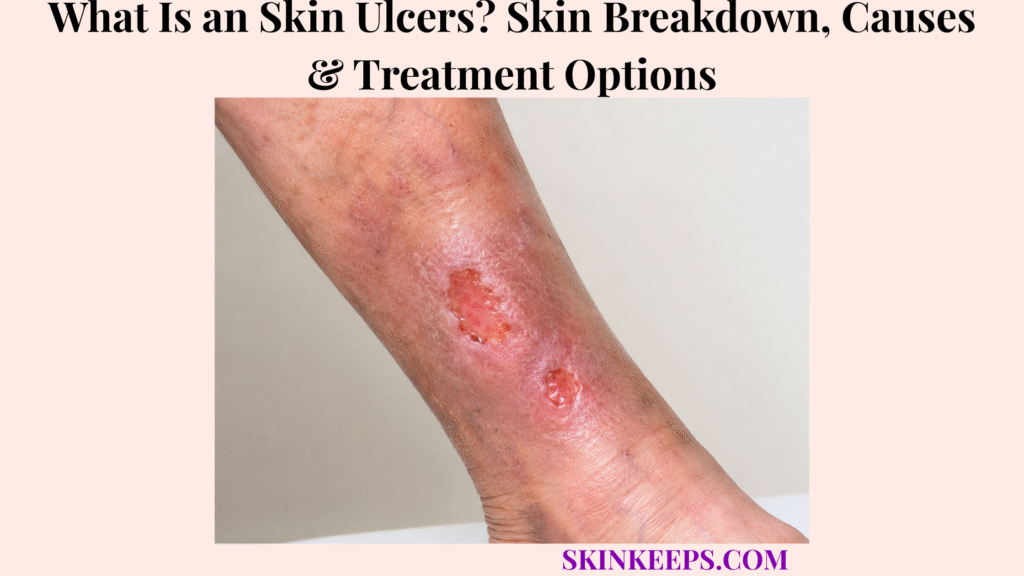
A skin ulcer is an open wound in which the entire epidermis has been lost and tissue damage extends into at least part of the dermis. Unlike a superficial erosion, an ulcer can reach deeper tissue and may heal with scarring, depending on its depth, cause and complications.
Skin ulcers are not one disease with one treatment. Venous hypertension, arterial ischemia, neuropathy, sustained pressure, inflammation, infection, malignancy and mixed mechanisms can all produce ulceration, so successful care starts by identifying what is keeping the wound open.
Medical disclaimer: This article is for educational purposes only. Rapidly worsening ulcers, spreading infection, fever, exposed deep tissue, black tissue, poor limb circulation or unexplained non-healing wounds require prompt medical assessment.
What Is a Skin Ulcer and What Does Skin Breakdown Look Like?
A skin ulcer is a full-thickness open wound in which the epidermis and at least part of the dermis have been lost, with severity ranging from shallow dermal loss to exposure of deeper structures.
How Is a Skin Ulcer Different From an Erosion or Superficial Cut?
An erosion is limited mainly to epidermal loss, while an ulcer extends through the epidermis into the dermis. Because the dermis is damaged, deeper ulcers can heal with a scar rather than restoring the surface without trace.
What Happens When Normal Wound Healing Fails?
A skin ulcer persists when a continuing problem—such as poor arterial flow, venous hypertension, repeated pressure, neuropathy or inflammation—keeps interrupting repair. The visible wound is therefore only one part of the problem; the persistent driver must also be corrected.
When Does a Skin Ulcer Become Chronic?
An ulcer becomes clinically concerning as chronic when it remains open or fails to make expected healing progress. There is no single time cutoff that applies to every ulcer type, so the more useful question is whether the wound is progressing and whether an underlying cause is still active.
What Does a Typical Skin Ulcer Look Like?
Skin ulcers can appear shallow, irregular, punched-out or crater-like and may contain healthy granulation tissue, yellow slough, drainage, callus, discoloration or necrotic tissue. The edge, base and surrounding skin often provide clues to the mechanism.
Are Skin Ulcers Always Painful?
No; pain varies with cause. Arterial ulcers are often painful, venous ulcers may ache, and neuropathic ulcers can be surprisingly painless because sensory loss reduces the warning signal from injured tissue. Little pain does not mean little tissue damage.
Can Skin Ulcers Extend Into Muscle or Bone?
Yes; a deep ulcer can extend through subcutaneous tissue into tendon, joint structures, muscle or bone. Deep wounds that expose or threaten bone raise concern for osteomyelitis and need professional assessment rather than home probing.
Figure 1. Ulcer severity depends partly on depth; deeper wounds can involve structures well below the visible skin surface.
What Causes Skin Ulcers and Which Ulcer Type Is Most Likely?
Skin ulcers can result from venous hypertension, arterial ischemia, neuropathy, sustained pressure or less common inflammatory, infectious and malignant processes, so identifying the mechanism is essential before choosing treatment.
How Does Venous Disease Cause Skin Ulcers?
Venous ulcers develop when sustained venous hypertension and poor return of blood from the lower leg contribute to edema, inflammatory skin changes and tissue breakdown. They commonly occur in the lower leg or ankle region and often sit within discolored, swollen or hardened surrounding skin.
How Does Poor Arterial Blood Flow Cause Skin Ulcers?
Arterial ulcers develop when inadequate blood flow deprives tissue of oxygen and nutrients. They often affect toes, the distal foot or heel and may occur with a cool limb, reduced pulses, ischemic color change or pain, although pain can be blunted when neuropathy also exists.
How Do Neuropathy and Diabetes Cause Skin Ulcers?
Neuropathy reduces protective sensation, allowing unnoticed pressure and minor trauma to continue until the skin breaks down. Diabetes can contribute both nerve injury and vascular disease. The separate Trophic Ulcers guide explains the sensory-loss and pressure-point pathway in greater detail.
How Does Sustained Pressure Cause Skin Ulcers?
Sustained external pressure and shear can compress tissue over a bony prominence, especially in people with limited mobility, reduced sensation or difficulty repositioning. This pressure-injury pathway differs from an ambulatory neuropathic ulcer caused by repeated loading of an insensate foot.
What Inflammatory Disorders Can Cause Skin Ulcers?
Immune-mediated disease can produce painful, rapidly progressive or unusually shaped ulcers that do not fit a typical vascular or pressure pattern. Pyoderma Gangrenosum is one important inflammatory ulcerative disorder and requires a different treatment strategy from infection or ischemia.
Can Infection Cause or Complicate Skin Ulcers?
Yes; bacterial infection can complicate an existing ulcer, but an open wound is not automatically infected. Spreading surrounding bacterial inflammation may represent Cellulitis, particularly when warmth, swelling, tenderness or expanding discoloration extends beyond the wound.
Can Skin Cancer Present as a Non-Healing Ulcer?
Yes; malignancy should be reconsidered when an ulcer is unexplained, enlarging, persistently bleeding, raised or rolled at the edge, or fails to heal despite appropriate treatment of the suspected cause. Such wounds may require biopsy rather than repeated dressing changes alone.
Figure 2. The location and surrounding skin provide clues, but mixed mechanisms are common enough that classification should include circulation, sensation and pressure assessment.
How Are Skin Ulcers Diagnosed and Their Underlying Cause Identified?
Skin-ulcer diagnosis requires more than looking at the wound; clinicians assess location, depth, edge, surrounding skin, circulation, sensation, pressure exposure and systemic history to identify the mechanism keeping the ulcer open.
What Does a Clinician Examine in a Skin Ulcer?
Evaluation includes the ulcer’s site, size, depth, edge and base together with surrounding edema, discoloration, callus, temperature, pain, pulses, sensation and areas of mechanical loading. These findings help separate venous, arterial, neuropathic, pressure and atypical ulcer patterns.
Why Are Circulation Tests Important?
Circulation testing helps identify whether arterial insufficiency is contributing to a leg or foot ulcer. Clinical pulse assessment, Doppler testing and ankle-brachial pressure assessment may be used, with further vascular testing selected when the result or clinical picture remains concerning.
Why Must Arterial Disease Be Checked Before Strong Compression?
Compression is central to many venous-ulcer pathways, but it can worsen limb blood flow when significant arterial insufficiency is present. Arterial supply therefore needs assessment before strong compression is chosen rather than assuming every lower-leg ulcer is purely venous.
When Are Wound Cultures Needed?
Wound cultures are most useful when clinical infection is suspected, infection is worsening or failing treatment, or deeper infection is a concern. Finding bacteria in an open wound does not by itself prove infection because chronic ulcers are frequently colonized.
When Is a Skin Biopsy Needed?
Biopsy becomes important when an ulcer is unexplained, atypical, persistently non-healing, enlarging or suspicious for inflammatory disease or malignancy. The clinical question should drive the biopsy rather than routinely sampling every chronic wound.
When Is Bone or Deep-Tissue Assessment Needed?
Deep-tissue or bone evaluation becomes important when an ulcer is very deep, exposes or approaches bone, has persistent infection or fails to heal as expected. Suspected osteomyelitis requires clinician-directed testing rather than self-probing the wound.
Figure 3. Ulcer classification is a mechanism-finding process; testing is selected after the bedside pattern suggests what needs confirmation.
How Are Skin Ulcers Treated and Helped to Heal?
Skin-ulcer treatment combines appropriate wound care with correction of the mechanism keeping the wound open, such as venous hypertension, arterial ischemia, neuropathic pressure or sustained compression.
What Basic Wound Care Is Used?
Basic ulcer care may include appropriate cleansing, moisture-balanced dressings, protection of the surrounding skin, wound measurement and clinician-directed removal of devitalized tissue when indicated. Debridement is a professional procedure, not a reason to cut or probe an ulcer at home.
How Are Venous Skin Ulcers Treated?
When venous disease is confirmed and arterial circulation is adequate, compression is often central because it reduces venous hypertension and edema. Compression is not a universal leg-ulcer treatment and should follow an appropriate circulation assessment.
How Are Arterial Skin Ulcers Treated?
Arterial ulcers require vascular assessment and improvement of arterial perfusion when possible because wound care cannot compensate for critically inadequate blood flow. Treatment therefore follows a different pathway from a venous ulcer.
How Are Neuropathic Skin Ulcers Treated?
Neuropathic ulcers require pressure offloading because continued loading of an insensate area can repeatedly damage the tissue even when the dressing is appropriate. Footwear, orthotic or device decisions should be individualized by the treating team.
How Are Pressure Ulcers Treated?
Pressure injuries require pressure redistribution together with direct wound care and management of mobility, friction, moisture and nutritional or medical factors that interfere with healing. Repositioning and support surfaces may be part of the plan when immobility is driving the injury.
Do All Skin Ulcers Need Antibiotics?
No; antibiotics are used when clinically meaningful bacterial infection is present or strongly suspected, not simply because an ulcer is open. Colonization is common in chronic wounds and does not equal clinical infection.
Can an Infected Ulcer Form a Deeper Abscess?
Yes; a localized deep bacterial complication can form a pus collection requiring a different pathway from uncomplicated ulcer care. A true Skin Abscess may need procedural and antimicrobial management chosen by a clinician.
Figure 4. Effective treatment matches the ulcer mechanism instead of applying one generic wound-care formula to every ulcer.
How Can Skin Ulcers Heal Without Returning, and When Do They Need Urgent Care?
Long-term healing requires control of the mechanism that caused the ulcer, continued prevention of recurrence and rapid escalation when infection, severe ischemia, gangrene or atypical non-healing behavior develops.
What Factors Can Prevent a Skin Ulcer From Healing?
Persistent venous disease, neuropathy, arterial insufficiency, repeated pressure, edema, diabetes, smoking, immobility, nutritional problems and inflammatory disease can all interfere with wound closure. A stalled ulcer should therefore trigger a search for the continuing barrier rather than an endless change of dressings.
How Can Venous Ulcers Be Prevented From Returning?
Venous-ulcer recurrence prevention requires long-term control of venous hypertension and leg edema. Compression can remain an important preventive tool when clinically appropriate and when arterial supply has been shown to be adequate.
How Can Neuropathic Ulcers Be Prevented From Returning?
Neuropathic-ulcer prevention relies on inspection of numb skin, pressure-relieving footwear and reduction of repeated mechanical stress. Because sensation may remain impaired after the wound closes, a healed ulcer does not mean the original risk has disappeared.
How Can Pressure Ulcers Be Prevented From Returning?
Pressure-injury prevention requires continued pressure redistribution, appropriate repositioning and management of mobility, friction, moisture and support-surface needs. The prevention strategy should match the same mechanical problem that produced the original wound.
When Should a Non-Healing Skin Ulcer Be Reassessed?
An ulcer should be reassessed when it enlarges, repeatedly reopens, fails to show expected healing, develops an unusual or raised edge, bleeds unexpectedly or remains unexplained. Persistent atypical ulceration may require reconsideration of ischemia, inflammatory disease, chronic infection or malignancy.
Which Infection Signs Need Prompt Assessment?
Spreading redness or discoloration, increasing warmth or swelling, worsening pain, purulent drainage, systemic illness or fever can indicate clinically important infection beyond simple wound colonization. Serious infection should not be managed only with home dressing changes.
When Is Black Tissue or Gangrene an Emergency Warning?
Black or gangrenous tissue can signal severe ischemia, tissue death or serious infection and requires urgent medical assessment. The Gangrene guide covers tissue-death complications in more detail.
Which Skin-Ulcer Findings Can Be Limb- or Life-Threatening?
Rapidly increasing tissue destruction, systemic illness, a cold poorly perfused limb, exposed or threatened bone, suspected deep infection or gangrene can represent limb- or life-threatening disease. These findings need urgent or emergency evaluation rather than routine outpatient wound care.
What Should You Remember About Skin Ulcers?
A skin ulcer is deep tissue loss rather than one specific disease, so effective care depends on identifying why the wound formed and correcting the mechanism that prevents it from healing.
- A skin ulcer extends through the epidermis into at least part of the dermis.
- Venous, arterial, neuropathic and pressure ulcers have different mechanisms and cannot share one generic treatment plan.
- Pain is an imperfect severity marker because neuropathic ulcers may be deep yet painless.
- Circulation, sensation, ulcer location, edge, base and surrounding skin help classify the wound.
- Venous compression requires appropriate arterial assessment first.
- Neuropathic ulcers require offloading; pressure injuries require pressure redistribution.
- An open ulcer is not automatically infected, and antibiotics are not routine for clinically uninfected wounds.
- Atypical or persistently non-healing ulcers may require biopsy or broader diagnostic reassessment.
- Gangrene, severe ischemia, deep infection and systemic illness are urgent warning signs.
- Recurrence prevention must continue even after the wound closes because the original risk can persist.
Frequently Asked Questions About Skin Ulcers
The main skin-ulcer questions concern wound depth, impaired healing, poor circulation, antibiotic use and the warning signs that make a non-healing ulcer more concerning.
What Is the Difference Between a Skin Ulcer and a Normal Wound?
A skin ulcer involves complete epidermal loss with damage extending into the dermis, while many minor wounds are more superficial and heal without a persistent vascular, neuropathic, pressure or inflammatory driver.
Why Do Some Skin Ulcers Not Heal?
Ulcers can remain open when venous hypertension, inadequate arterial flow, neuropathy, repeated pressure, inflammation, edema or other medical factors continue interfering with normal tissue repair.
Are All Skin Ulcers Caused by Poor Circulation?
No; vascular disease is important, but neuropathy, sustained pressure, inflammatory disease, infection, malignancy and mixed mechanisms can also produce or perpetuate ulceration.
Do All Skin Ulcers Need Antibiotics?
No; antibiotics are used for clinically meaningful bacterial infection rather than every open or colonized ulcer.
When Can a Non-Healing Skin Ulcer Be a Sign of Something Serious?
A persistent enlarging, atypical, bleeding or irregular ulcer can indicate severe vascular disease, deep infection, inflammatory disease or occasionally malignancy and should be reassessed.
DermNet — Leg ulcers / wound healing. Supports the venous, arterial, neuropathic and pressure-ulcer framework, mixed mechanisms, chronic-wound assessment and biopsy of doubtful or non-healing ulcers.
NICE — ABPI and leg-ulcer arterial assessment. Supports assessment for peripheral arterial disease before compression because compression can worsen flow in some people with arterial disease.
NICE — Leg ulcer infection: antimicrobial prescribing. Supports the distinction between colonization and clinical infection and reserving antibiotics for ulcers with infection signs.
IWGDF/IDSA — Diabetes-related foot infections guideline. Supports not treating clinically uninfected ulcers with antibiotics, selective cultures and escalation for gangrene, deep infection, severe ischemia or suspected osteomyelitis.
MSD Manual Professional — Pressure injuries. Supports pressure reduction, repositioning, support surfaces, wound care and complication assessment in pressure-related wounds.
NHS — Venous leg ulcer diagnosis. Supports Doppler/arterial assessment before compression and specialist evaluation when arterial disease or another cause is suspected.