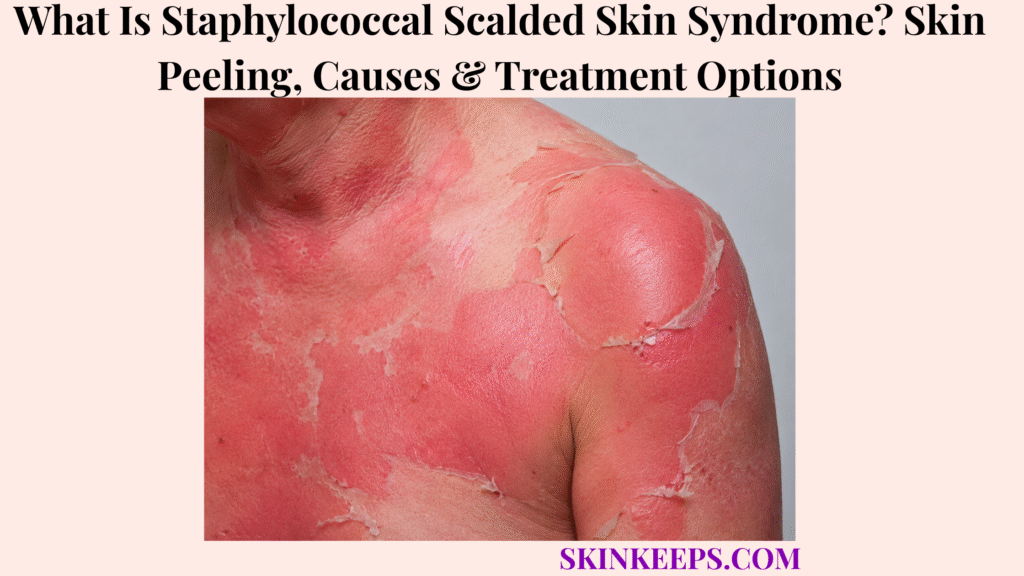
Staphylococcal scalded skin syndrome (SSSS) is a serious toxin-mediated blistering disorder in which certain strains of Staphylococcus aureus release exfoliative toxins that cause widespread superficial skin separation. It mainly affects infants and young children and can progress quickly from skin tenderness to fragile blisters and sheet-like peeling.
The syndrome is not a thermal burn and is not caused by bacteria invading every area of peeling skin. Diagnosis depends on the clinical pattern and context, with cultures or biopsy used selectively, and suspected SSSS requires urgent hospital care with systemic antistaphylococcal treatment plus fluid, temperature, pain and skin-barrier support.
This article is for educational purposes only. Suspected SSSS requires urgent hospital-based medical evaluation and should not be managed as an ordinary peeling rash at home.
What Is Staphylococcal Scalded Skin Syndrome and What Does It Look and Feel Like?
SSSS is an acute toxin-mediated disease that causes tender widespread skin inflammation followed by fragile superficial blisters and sheet-like epidermal peeling.
How Do Staphylococcal Exfoliative Toxins Cause SSSS?
Toxigenic Staphylococcus aureus produces exfoliative toxins, particularly exfoliative toxins A and B, that circulate through the body and disrupt desmoglein-1, a key adhesion protein in the superficial epidermis.
The sequence is localized toxin-producing bacteria → circulating toxin → desmoglein-1 cleavage → loss of keratinocyte adhesion → superficial blistering and peeling. This is why the disease can affect large skin areas even when the original bacterial infection is small or located elsewhere.
Why Does SSSS Look Like Scalded Skin?
The skin appears scalded because fragile superficial epidermis separates and peels away, exposing moist and very tender underlying skin.
The appearance can resemble a burn, but the mechanism is completely different: toxin-mediated epidermal separation is not thermal injury. The damaged layer is very superficial, which also helps explain the generally limited scarring in uncomplicated pediatric recovery.
What Symptoms Can Appear Before the Skin Peels?
Fever, irritability, lethargy, malaise and marked skin tenderness can appear before widespread blistering and peeling become obvious.
The skin may become painful before large areas visibly detach. In darker skin tones, early erythema can be less obvious, so clinicians also rely on tenderness, texture change, wrinkling, blister fragility and the speed of progression rather than requiring bright redness.
How Does the SSSS Rash Progress?
SSSS can progress rapidly from tender widespread erythema or discoloration to wrinkled superficial skin, fragile flaccid blisters and sheet-like peeling over a short period.
Large blisters rupture easily, and gentle friction may cause superficial epidermal separation, producing a positive Nikolsky sign. That sign supports epidermal fragility but is not specific for SSSS and cannot confirm the diagnosis by itself.
Why Are the Mouth and Mucous Membranes Usually Spared?
Prominent mucosal erosions are usually absent in SSSS because the exfoliative toxins primarily disrupt desmoglein-1 in superficial skin, while mucosal adhesion relies more heavily on other adhesion proteins.
Mucosal sparing is therefore a useful diagnostic clue when comparing SSSS with severe mimics such as SJS/TEN, but it should be interpreted with the full clinical picture rather than used as a stand-alone proof.
What Causes Staphylococcal Scalded Skin Syndrome and Who Is Most at Risk?
SSSS is caused by toxin-producing strains of Staphylococcus aureus, with infants and young children most susceptible because toxin-neutralizing immunity and renal toxin clearance are less mature.
Which Bacteria Cause SSSS?
SSSS is caused by particular strains of Staphylococcus aureus capable of producing exfoliative toxins.
Not every S. aureus strain can cause the syndrome. The disease depends on toxin production and host susceptibility, not simply the presence of ordinary staphylococcal colonization.
Where Can the Original Staphylococcal Infection Begin?
The toxin-producing infection can begin at a localized site away from the peeling skin, including the nose, throat, conjunctiva, ear, umbilical area or an infected wound.
The primary source can be small or difficult to identify. This explains why widespread skin disease does not necessarily mean widespread bacterial growth inside the exposed skin.
Why Does SSSS Mainly Affect Babies and Young Children?
Young children are more vulnerable because they have less mature antibody protection against exfoliative toxins and less efficient renal clearance of those toxins.
Once toxin enters the circulation, reduced neutralization and clearance can increase the amount that reaches superficial skin. This age-related susceptibility is one reason SSSS occurs far more often in young children than in healthy adults.
Why Is SSSS More Serious in Adults?
Adult SSSS is rare and is more strongly associated with severe kidney impairment, immunosuppression or serious underlying illness.
These patients may clear toxin less effectively or have reduced host defenses, and the underlying illness itself can increase complication risk. Pediatric recovery expectations should therefore not be automatically applied to adults.
Is SSSS Contagious?
SSSS itself is the result of toxin effects, but the toxin-producing Staphylococcus aureus responsible for it can spread between people or from colonized carriers.
Impetigo provides a useful comparison because it is a superficial bacterial skin infection that can involve S. aureus. Ordinary impetigo should not be described as routinely progressing to SSSS; the syndrome requires the relevant toxin-producing strain and a susceptible host.
How Is Staphylococcal Scalded Skin Syndrome Diagnosed and Distinguished From Other Peeling Disorders?
SSSS is diagnosed mainly from rapid tender superficial blistering and peeling, typical age or risk context and relative mucosal sparing, with cultures or biopsy used selectively to identify the bacterial source or exclude dangerous mimics.
How Do Doctors Diagnose Suspected SSSS?
Doctors look for rapidly progressive skin tenderness, superficial fragile blisters, sheet-like peeling, mucosal sparing and the patient’s age and overall clinical condition.
A positive Nikolsky sign can support superficial epidermal fragility, but the diagnosis still depends on the full pattern. Prominent mucosal erosions, a strong medication trigger, deeper necrosis or an atypical age and disease course increase the importance of competing diagnoses.
Why Can Cultures From SSSS Blisters Be Negative?
Blister cultures may be negative because the widespread skin injury is caused by circulating toxin rather than large numbers of bacteria multiplying in each blister.
When clinicians look for the organism, cultures are often more informative from a suspected primary source such as the nasopharynx, conjunctiva, umbilical area, wound or another infected focus. Culture strategy is clinician-directed and depends on the presentation.
When Are Blood Cultures or Skin Biopsy Needed?
Blood cultures may be used when bacteremia or sepsis is suspected, while skin biopsy is reserved for diagnostically uncertain cases and can show a very superficial epidermal split.
Biopsy is especially useful when SSSS must be distinguished from deeper epidermal injury such as SJS/TEN. It is not automatically required in every classic pediatric case.
How Is SSSS Different From Bullous Impetigo?
Bullous impetigo is a localized toxin-mediated staphylococcal infection, while SSSS results from systemic circulation of exfoliative toxin and produces widespread superficial skin injury.
Bullous impetigo generally contains bacteria at the affected skin site, so blister material may yield the organism. In SSSS, the bacterial source is often distant from the peeling skin and intact blister cultures may be sterile.
How Is SSSS Different From SJS, TEN or Autoimmune Blistering Disease?
SSSS usually produces very superficial epidermal separation and relative mucosal sparing, whereas SJS/TEN commonly causes prominent mucosal injury and deeper epidermal damage.
Pemphigus vulgaris is an autoimmune blistering disease in which mucosal involvement and a different clinical context can point away from SSSS. It should remain a differential diagnosis rather than being presented as a common pediatric cause of scalded-skin syndrome.
Bullous pemphigoid has a different age distribution, blister morphology and level of skin separation. Its inclusion reinforces that widespread blistering must be diagnosed by mechanism and clinical context, not by one visual sign.
How Is Staphylococcal Scalded Skin Syndrome Treated?
SSSS requires hospital treatment with systemic antistaphylococcal antibiotics plus active management of fluid loss, pain, temperature and the damaged skin barrier.
Why Does SSSS Usually Require Hospital Treatment?
Hospitalization is required because rapid epidermal barrier loss can cause dehydration, electrolyte disturbance, temperature instability, secondary infection and systemic deterioration.
Infants and young children can become unwell quickly, and adults who develop SSSS often have serious underlying disease. Hospital monitoring allows simultaneous treatment of the bacterial source and the physiologic consequences of widespread barrier loss.
How Do Intravenous Antibiotics Treat SSSS?
Systemic antistaphylococcal antibiotics treat the underlying toxin-producing Staphylococcus aureus source, reducing further toxin production so the epidermis can recover.
The practical sequence is control the bacterial source → stop ongoing toxin production → support the patient while skin adhesion recovers. The article intentionally does not provide antibiotic doses or a fixed IV-to-oral schedule because treatment is individualized.
When Is MRSA Coverage Considered?
MRSA-active therapy is considered when resistant Staphylococcus aureus is suspected or confirmed, but it is not mandatory treatment for every SSSS case.
Choice of antimicrobial therapy depends on illness severity, local resistance patterns, culture and susceptibility results, allergies and the clinical source. Methicillin-sensitive S. aureus remains a common cause.
Why Are Fluids, Electrolytes and Temperature Support Important?
Extensive epidermal loss allows substantial fluid and heat loss, so hydration, electrolyte balance, circulation and body temperature require active monitoring.
Barrier loss can cause dehydration and electrolyte abnormalities, and young children have less physiologic reserve. Supportive care addresses these consequences while antimicrobial treatment stops further toxin production.
How Is Peeled or Blistered Skin Cared For?
Supportive skin care uses gentle handling, protection of raw surfaces, appropriate emollient or non-traumatic dressing strategies, pain control and temperature support while systemic treatment controls the source.
Cellulitis becomes relevant if compromised skin develops a spreading secondary bacterial infection. This is a complication pathway, not the mechanism that causes the original widespread peeling in SSSS.
What Complications Can SSSS Cause, How Does the Skin Recover, and When Is Care Urgent?
SSSS can cause dehydration, electrolyte disturbance, hypothermia, secondary infection, sepsis and kidney complications, although promptly treated children often heal well because the epidermal split is superficial.
Why Can Skin Peeling Cause Dehydration or Temperature Problems?
The epidermis normally limits water loss and helps regulate heat, so widespread superficial loss can lead to dehydration, electrolyte imbalance and hypothermia.
These complications can develop even though the split is superficial. The large involved surface area makes fluid balance and thermal support clinically important, especially in infants and small children.
Can SSSS Cause Sepsis or Secondary Infection?
Yes; severe SSSS can be complicated by secondary bacterial infection, pneumonia, sepsis or kidney injury, but these complications do not occur in every case.
Loss of the protective skin barrier creates an entry route for additional infection, while systemic illness and dehydration can worsen organ function. Rapid deterioration requires immediate reassessment in hospital.
Does SSSS Usually Leave Permanent Scars?
Substantial permanent scarring is uncommon in uncomplicated pediatric SSSS because the epidermal split occurs very superficially and re-epithelialization is usually rapid with effective treatment.
Many appropriately treated children recover over roughly one to two weeks, but timing should not be treated as a guarantee. Severe infections, secondary complications and adult disease can follow a different course.
Can Staphylococcal Scalded Skin Syndrome Come Back?
Recurrence is uncommon, but relapse or additional cases can occur when a toxin-producing bacterial source or outbreak transmission remains uncontrolled.
A repeat episode should prompt reassessment of bacterial source, colonization or exposure context rather than an assumption that the first treatment simply failed.
How Are SSSS Outbreaks Prevented?
Outbreak prevention focuses on controlling transmission of toxigenic Staphylococcus aureus through rigorous hand hygiene, infection-control precautions and investigation of relevant infected or colonized sources.
This is particularly important in nurseries, neonatal units and childcare settings where susceptible infants may share caregivers. Decolonization or outbreak protocols should be directed by healthcare and infection-control teams rather than improvised at home.
When Does Suspected SSSS Need Emergency Medical Care?
Suspected SSSS itself warrants urgent hospital assessment, especially when tender skin changes rapidly progress to fragile blistering or sheet-like peeling.
Warning features include fever, reduced drinking, dehydration, marked lethargy, widespread tenderness, large fragile blisters, rapidly extending peeling, temperature instability or systemic deterioration. Adult cases are also especially urgent because the syndrome is rare in adults and often occurs with serious renal or immune compromise.
Rapid widespread tender blistering or peeling compatible with SSSS → emergency medical assessment, not home rash treatment.
What Should You Remember About Staphylococcal Scalded Skin Syndrome?
SSSS is an acute toxin-mediated staphylococcal emergency in which circulating exfoliative toxins cause superficial epidermal separation, making prompt diagnosis, hospital antibiotics and barrier-supportive care essential.
- SSSS is caused by toxin-producing Staphylococcus aureus, not by bacteria directly invading every peeling skin site.
- Exfoliative toxins A and B target desmoglein-1 and weaken superficial epidermal adhesion.
- The skin can look scalded, but SSSS is not a thermal burn.
- Tenderness, fever or irritability may appear before obvious sheet-like peeling.
- Flaccid blisters and a positive Nikolsky sign can occur, but Nikolsky sign is not specific.
- Mucous membranes are usually spared, which helps distinguish SSSS from SJS/TEN.
- Early erythema can be less obvious in darker skin, so tenderness, texture and fragility also matter.
- Infants and young children are most affected because toxin immunity and renal clearance are less mature.
- Adult SSSS is rare and is more strongly associated with kidney impairment, immunosuppression and serious illness.
- The original staphylococcal infection can be distant from the peeling skin.
- Diagnosis is mainly clinical; blister cultures may be negative because the disorder is toxin-mediated.
- Source cultures and blood cultures are used selectively, and biopsy can help when the diagnosis is uncertain.
- Bullous impetigo is more localized because toxin action remains near the bacterial skin infection.
- SJS/TEN usually has more prominent mucosal involvement and deeper epidermal injury.
- SSSS requires hospital-based systemic antistaphylococcal treatment rather than topical rash creams.
- MRSA-active treatment is selective rather than mandatory in every case.
- Fluids, electrolytes, temperature control, pain relief and gentle skin-barrier care are core supportive measures.
- Dehydration, secondary infection, sepsis and kidney complications can occur.
- Permanent scarring is uncommon in uncomplicated pediatric disease because the split is superficial.
- Outbreak control focuses on preventing transmission of toxigenic S. aureus.
Frequently Asked Questions About Staphylococcal Scalded Skin Syndrome
The main SSSS questions concern transmission, toxin-driven peeling, bullous impetigo, scarring and adult disease.
Is Staphylococcal Scalded Skin Syndrome Contagious?
The peeling syndrome itself results from circulating toxin, but the toxin-producing Staphylococcus aureus responsible for it can spread between people or from colonized carriers.
Why Does the Skin Peel in SSSS?
Exfoliative staphylococcal toxins disrupt desmoglein-1, causing superficial epidermal cells to lose adhesion and peel away.
How Is SSSS Different From Bullous Impetigo?
Bullous impetigo is primarily a localized toxin-mediated infection, while SSSS results from circulating exfoliative toxin and causes widespread superficial skin injury.
Does Staphylococcal Scalded Skin Syndrome Leave Scars?
Permanent scarring is uncommon in uncomplicated pediatric SSSS because the epidermal split is very superficial, although recovery can differ in severe or complicated disease.
Can Adults Develop Staphylococcal Scalded Skin Syndrome?
Yes, but adult SSSS is rare and is more strongly associated with severe kidney dysfunction, immune suppression or serious underlying illness.
DermNet — Staphylococcal scalded skin syndrome. Supports the toxin-mediated mechanism, exfoliative toxins A/B, desmoglein-1 disruption, mucosal sparing, pediatric susceptibility, progression, complications, hospitalization and supportive care.
MSD Manual Professional — Staphylococcal Scalded Skin Syndrome. Supports clinical diagnosis, source cultures, frequently sterile bullae, superficial histologic split, SSSS-vs-SJS/TEN distinctions and antistaphylococcal treatment principles.
NCBI Bookshelf / StatPearls — Staphylococcal Scalded Skin Syndrome. Supports adult renal/immunosuppression risk, toxin dissemination from a distant source, clinical evaluation, inpatient treatment, fluid replacement and complication monitoring.
Peer-reviewed review — Staphylococcal Scalded Skin Syndrome and Bullous Impetigo. Supports the mechanistic distinction between localized toxin activity in bullous impetigo and hematogenous toxin dissemination in SSSS.