Stretch marks, or striae distensae, are linear scar-like changes within the dermis that develop when rapid body change interacts with hormonal, genetic and connective-tissue susceptibility. They usually begin as newer colored striae rubrae and gradually remodel into lighter, less vascular striae albae.
Pregnancy, puberty, rapid weight change and rapid muscle growth are common settings, while corticosteroid exposure and selected systemic disorders can produce atypical striae. Most stretch marks are harmless and fade with time; treatment is cosmetic and aims to make them less noticeable rather than restore completely unchanged skin.
This article is for educational purposes only. Unusually broad, rapidly developing or unexplained stretch marks—especially with significant corticosteroid exposure or other systemic symptoms—should be medically evaluated.
What Are Stretch Marks and How Do Their Appearance and Stage Change Over Time?
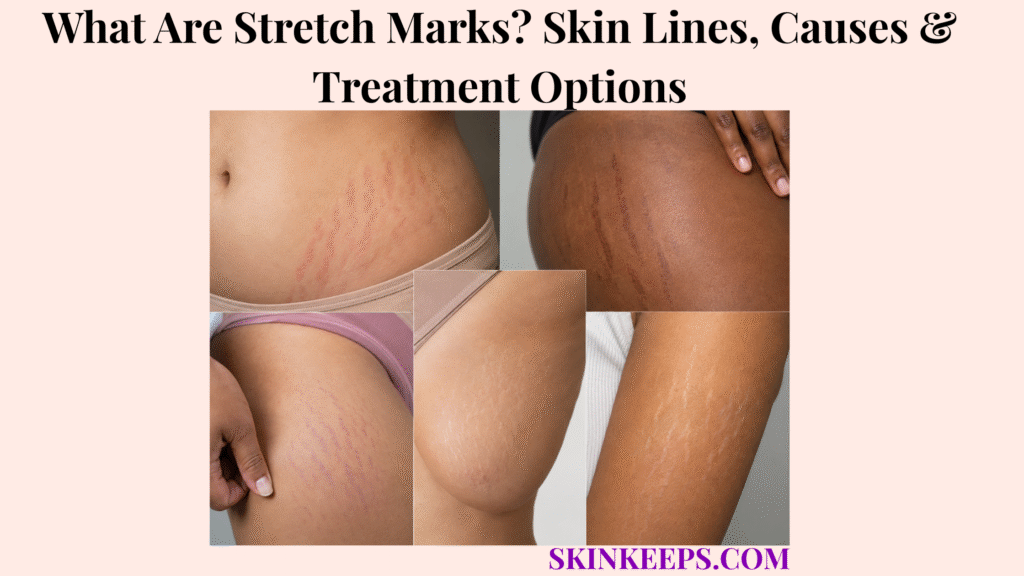
Stretch marks are linear dermal scar-like changes that usually begin as colored striae rubrae and gradually mature into lighter, flatter or slightly depressed striae albae.
What Happens to Collagen and Elastin When Stretch Marks Develop?
Rapid stretching or shrinking combined with hormonal and genetic susceptibility can disrupt normal collagen and elastic-tissue support and trigger dermal remodeling that forms linear striae.
Stretch marks are therefore more than a surface color change. Their development reflects structural alteration within the dermis, including changes in collagen bundles and elastic tissue, which helps explain why mature striae can remain visible even after their color fades.
Are Stretch Marks Scars or Just Changes in Skin Color?
Stretch marks are scar-like structural changes in the dermis rather than simple pigmentation, although their color can change substantially as they mature.
Early lesions can look strikingly colored because vascularity and background skin tone influence their appearance. Over time, the dermis remodels and the marks become paler, less vascular and often slightly depressed.
What Are Striae Rubrae?
Striae rubrae are newer active stretch marks that can appear red, pink, purple, reddish-brown or dark brown and may be slightly raised or occasionally itchy.
Darker early striae can visually resemble hyperpigmentation, but the primary process is dermal structural remodeling rather than a pigment disorder alone. Linear shape, timing and body-change history are more useful than insisting that early stretch marks must look bright red.
What Are Striae Albae?
Striae albae are mature stretch marks that become lighter, less vascular and often slightly depressed as the early lesion remodels.
Mature pale striae can resemble hypopigmentation because they are lighter than surrounding skin, but their main pathology remains a scar-like dermal change. The shift from rubrae to albae also helps explain why older lesions respond differently to treatment.
Where Do Stretch Marks Commonly Develop?
Stretch marks commonly occur on the abdomen, breasts, hips, buttocks, thighs, upper arms, back and shoulders where rapid growth, expansion or body-composition change places repeated mechanical demands on the skin.
Distribution often reflects context: abdominal and breast striae are common in pregnancy, thighs and buttocks are frequent during puberty, and shoulders or upper arms may be affected during rapid muscular growth. Location alone does not identify the cause.
What Causes Stretch Marks and Who Is More Likely to Develop Them?
Stretch marks most often develop during rapid body growth or change, but genetics, hormones, corticosteroids and selected systemic disorders can increase susceptibility.
How Do Pregnancy and Puberty Cause Stretch Marks?
Pregnancy and puberty combine rapid tissue growth with hormonal changes that increase susceptibility to dermal remodeling and striae formation.
Mechanical expansion alone does not explain every case. Two people can experience similar growth or pregnancy-related changes and develop very different degrees of striae, which is consistent with individual hormonal, genetic and connective-tissue susceptibility.
Can Rapid Weight Change or Muscle Growth Cause Stretch Marks?
Yes; rapid weight gain, rapid weight loss and rapid muscular hypertrophy can all create mechanical changes associated with stretch-mark formation.
Weight gain is therefore only one context. Fast body-size change in either direction, as well as rapid muscle development during training, can alter the mechanical environment of the dermis and contribute to striae in susceptible people.
Does Family History Affect Stretch-Mark Risk?
Yes; genetic susceptibility appears important, and people with relatives who develop stretch marks may be more likely to develop them themselves.
Family tendency does not determine severity with certainty, but it helps explain why similar body changes produce extensive striae in some people and few or none in others.
Can Corticosteroids Cause Stretch Marks?
Yes; prolonged or excessive topical or systemic corticosteroid exposure can weaken normal dermal connective-tissue support and contribute to striae.
Medication history should include prescribed and nonprescribed topical corticosteroids, oral or other systemic steroids, relevant injections and anabolic-steroid exposure. A person should not abruptly stop prescribed corticosteroids because of stretch marks; medication changes require clinician guidance.
Which Medical Conditions Can Cause Unusual Stretch Marks?
Cushing syndrome, Marfan syndrome and selected connective-tissue disorders can be associated with unusually broad, extensive or otherwise atypical striae.
Most stretch marks do not indicate systemic disease. Concern rises when the pattern is unusually wide, rapidly progressive or unexplained and occurs with other compatible clinical features rather than from the presence of striae alone.
How Are Stretch Marks Diagnosed and When Should an Underlying Cause Be Investigated?
Typical stretch marks are diagnosed clinically from their linear appearance, stage, location and history, while unusually broad or unexplained striae may require investigation for medication or systemic causes.
How Does a Doctor Diagnose Stretch Marks?
Diagnosis usually relies on the appearance and location of the marks plus a history of pregnancy, growth, weight change, exercise or medication exposure.
Typical striae usually need no special laboratory test or biopsy. The clinician first asks whether the morphology and timing fit a common physiologic setting before looking for a less common medical explanation.
Why Is Medication History Important?
Medication history matters because prolonged corticosteroid or anabolic-steroid exposure can produce striae that resemble common physiologic stretch marks.
Reviewing product names, route of use and duration can reveal an exposure that is not obvious from the skin examination alone. This history is especially important when marks are wider or more extensive than expected for the person’s recent body changes.
When Can Stretch Marks Suggest Excess Cortisol?
Unusually broad, extensive or unexplained stretch marks can justify evaluation for cortisol excess when they occur with other compatible systemic features.
Features that increase concern include central weight gain with relatively thinner limbs, fat accumulation around the neck or shoulders and a rounded facial appearance. Striae alone do not diagnose Cushing syndrome; testing is targeted to the broader clinical picture.
Do Stretch Marks Usually Need a Skin Biopsy?
No; ordinary striae are a clinical diagnosis, and biopsy is generally reserved for an atypical linear lesion when another condition is being considered.
An atypical depressed, firm or otherwise non-classic linear lesion may require a different differential, including morphea. This does not mean morphea commonly causes stretch marks; it means the diagnosis should be reconsidered when the lesion does not behave like soft, typical striae.
How Are Stretch Marks Treated and Which Options Can Make Them Less Noticeable?
Stretch-mark treatment can reduce color contrast or improve texture, but no current treatment reliably removes striae completely and newer lesions generally respond better than mature ones.
Can Stretch Marks Be Completely Removed?
No; stretch marks can fade and become less noticeable, but treatment cannot reliably restore completely unchanged pre-striae skin.
This expectation applies to both topical and procedural treatments. A useful goal is improvement in visibility, color or texture rather than a promise that dermal structural change can be erased.
Why Are New Stretch Marks Easier to Treat?
Early striae rubrae still have more active vascular and remodeling features, making them more responsive to selected topical or procedural treatments than mature striae albae.
Once the mark has matured into a pale, less vascular and often depressed stria alba, treatment goals shift more toward texture and collagen remodeling. Stage should therefore be identified before choosing a cosmetic approach.
Can Tretinoin or Other Retinoids Improve Stretch Marks?
Prescription tretinoin may make some early stretch marks less noticeable by influencing collagen remodeling, but irritation is possible and treatment is not appropriate for everyone.
Topical products can also cause irritation or inflammatory reactions that are separate from the stretch marks themselves; the skin allergy guide explains allergic skin reactions, while simple retinoid irritation is not automatically an allergy. Retinoid-containing products should not be self-used during pregnancy, and pregnancy treatment decisions should be clinician-directed.
How Can Laser or Light Treatment Improve Stretch Marks?
Laser and light treatments may target redness, pigment contrast, collagen remodeling or texture depending on the stretch-mark stage and skin tone.
No single laser should be described as universally best. Selection depends on whether the lesion is rubrae or albae, its color, the person’s baseline skin tone, the main cosmetic goal and the clinician’s experience with pigment-change risk.
Can Microneedling Improve Stretch Marks?
Microneedling creates controlled microinjury intended to stimulate collagen remodeling and may be considered when texture improvement is the main goal.
Mayo Clinic notes that microneedling carries less risk of skin-color change than laser therapy and may therefore be preferred as an initial procedural approach for some people with darker skin. Individual scar tendency, active skin disease and treatment goals still matter.
What About Chemical Peels, Microdermabrasion or Radiofrequency?
Chemical peels, microdermabrasion, radiofrequency and other cosmetic procedures can be used selectively, but improvement varies and none should be presented as a guaranteed cure.
Procedure choice should be based on stage, skin type, expected benefit, cost and adverse-effect risk. Combining treatments may be considered by a dermatologist, but the evidence does not support promising complete removal.
Do Stretch Marks Fade Naturally, Can They Be Prevented, and When Should They Be Checked?
Stretch marks usually fade naturally but cannot be reliably prevented, and unusually broad, rapid or unexplained striae should be evaluated before cosmetic treatment is pursued.
Do Stretch Marks Fade Without Treatment?
Yes; many stretch marks naturally become lighter and less noticeable over time, although they may never disappear completely.
The common progression is from more noticeable rubrae to paler albae as vascularity and color contrast decrease. Fading is expected, but the underlying scar-like dermal change can remain visible indefinitely.
Can Moisturizers, Cocoa Butter, Oils or Vitamin E Prevent Stretch Marks?
No commonly promoted moisturizer or oil has been shown to reliably prevent stretch marks.
Moisturizers can support comfort when skin feels dry or itchy, and the dry skin / xerosis guide covers that barrier-care task. Cocoa butter, olive oil, almond oil and vitamin E should not be marketed as proven striae-prevention methods.
Can Stretch Marks Be Completely Prevented?
No; genetics, hormones and unavoidable body growth mean that stretch marks cannot be reliably prevented in everyone.
Avoiding unnecessary rapid weight change may reduce one modifiable contributor, but it cannot overcome every genetic or hormonal factor. Prevention claims should therefore remain probabilistic rather than guaranteed.
When Should Stretch Marks Be Evaluated by a Doctor?
Medical evaluation is appropriate when stretch marks are unusually broad, extensive, rapidly developing, unexplained or associated with substantial corticosteroid exposure or symptoms suggesting hormonal disease.
Evaluation is also reasonable when the location or morphology is unusual, when there is no clear pregnancy, growth, weight or training context, or when the person is uncertain that the lines are actually stretch marks.
When Should Someone See a Dermatologist About Treatment?
Dermatology consultation is useful when cosmetic concern is significant, procedural treatment is being considered, pigment-change risk matters or realistic treatment expectations need clarification.
This is particularly useful for darker skin tones, prior unsuccessful treatment, pregnancy-related timing questions and decisions between texture-focused procedures. Typical stretch marks → natural fading plus optional cosmetic management. Unusual, extensive or unexplained stretch marks → investigate the cause first.
What Should You Remember About Stretch Marks?
Stretch marks are common dermal scar-like changes that usually evolve from colored striae rubrae into lighter striae albae, fade naturally and require treatment only when cosmetic improvement is desired or an unusual cause needs investigation.
- Stretch marks are also called striae distensae.
- They are scar-like structural changes within the dermis, not simply surface discoloration.
- Collagen and elastic tissue are altered during dermal remodeling.
- Rapid mechanical change interacts with hormonal and genetic susceptibility.
- Striae rubrae are newer and may be red, pink, purple, reddish-brown or dark brown.
- Striae albae are older, lighter, less vascular and often slightly depressed.
- Common sites include the abdomen, breasts, hips, thighs, buttocks, upper arms, back and shoulders.
- Pregnancy and puberty are common physiologic settings.
- Rapid weight gain, weight loss or muscle growth can contribute.
- Family susceptibility affects risk.
- Prolonged corticosteroid exposure can cause or worsen striae.
- Cushing syndrome and selected connective-tissue disorders are uncommon but important contexts for atypical striae.
- Typical diagnosis is clinical and routine biopsy is unnecessary.
- Medication history matters when striae are broad or unexplained.
- Complete removal cannot be promised.
- Newer striae generally respond better than mature striae.
- Prescription tretinoin may help selected early lesions but can irritate the skin.
- Retinoids should not be self-used during pregnancy.
- Laser, light, microneedling and other cosmetic procedures have individualized roles.
- Pigment-change risk should be considered, especially in darker skin tones.
- Many stretch marks fade naturally but may remain visible long term.
- Cocoa butter, common oils and vitamin E do not reliably prevent striae.
- No prevention method works for everyone.
- Unusually broad, rapid or unexplained striae deserve medical review before cosmetic treatment.
Frequently Asked Questions About Stretch Marks
The main stretch-mark questions concern permanence, red-versus-white stages, complete removal, prevention during pregnancy and signs of an underlying medical cause.
Are Stretch Marks Permanent?
Stretch marks usually fade and become less noticeable over time, but mature striae can remain visible indefinitely.
What Is the Difference Between Red Stretch Marks and White Stretch Marks?
Red, pink, purple or brown striae rubrae are newer lesions, while pale striae albae are older mature marks that have undergone further dermal remodeling.
Can Stretch Marks Disappear Completely With Treatment?
No treatment reliably removes stretch marks completely, although topical or procedural therapies may reduce color contrast or improve texture.
Can Creams or Oils Prevent Stretch Marks During Pregnancy?
Commonly promoted creams and oils have not reliably prevented pregnancy-related stretch marks in studies, so prevention cannot be guaranteed.
When Can Stretch Marks Signal an Underlying Medical Condition?
Unusually broad, extensive, unexplained or rapidly developing striae—especially with corticosteroid exposure or symptoms of cortisol excess—can justify medical investigation.
American Academy of Dermatology — Stretch marks: Why they appear and how to get rid of them. Supports the scar-like dermal framing, collagen/elastin disruption, skin-tone variation in early striae, pregnancy/puberty/weight/muscle-growth contexts, family susceptibility, corticosteroid association, natural fading, early-treatment advantage, tretinoin, procedures and limits of cocoa butter, oils and vitamin E for prevention.
DermNet — Stretch marks (striae). Supports striae rubrae and striae albae terminology, collagen and elastic-tissue changes, common distribution, corticosteroid and Cushing/Marfan associations, mature scar-like histology and the generally cosmetic nature of treatment.
Mayo Clinic — Stretch marks: Diagnosis & treatment. Supports clinical diagnosis, selective cortisol testing, incomplete disappearance despite treatment, tretinoin for selected newer lesions, laser/light therapy, microneedling and the lower pigment-change risk of microneedling compared with laser in darker skin.
Mayo Clinic — Stretch marks: Symptoms & causes. Supports common body sites, wide color variation, natural fading, harmlessness in typical cases and medical review for unusually extensive stretch marks.
NHS — Stretch marks. Supports pregnancy/puberty/weight-change/steroid associations, incomplete disappearance, weak evidence for creams and lotions, pregnancy avoidance of retinoid creams and assessment when large striae occur with features suggestive of Cushing syndrome.