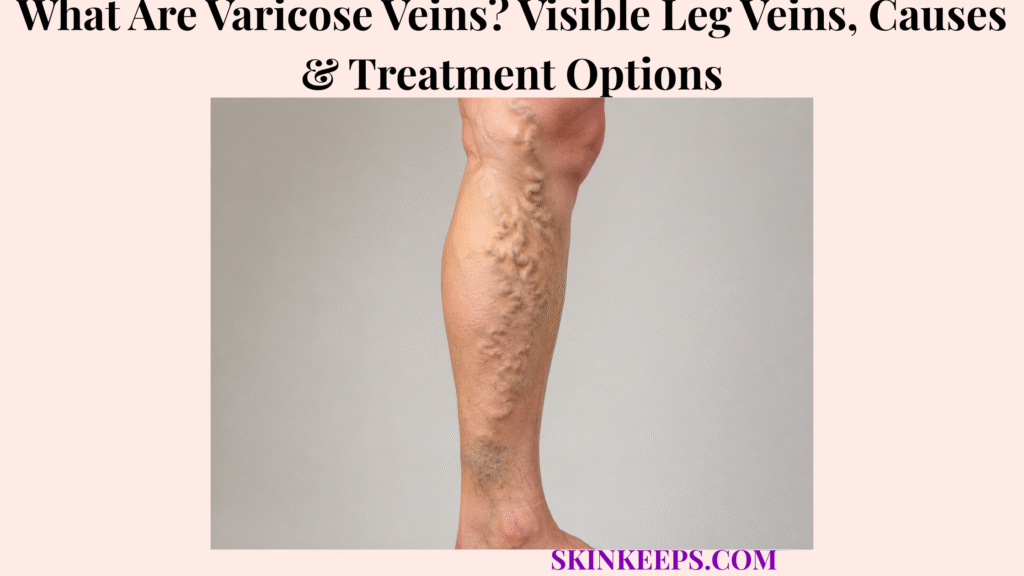
Varicose veins are enlarged, twisted superficial leg veins that form when venous valves do not keep blood moving efficiently toward the heart. Backward flow, or venous reflux, raises pressure inside superficial veins until they stretch, become tortuous and may bulge visibly beneath the skin.
Some varicose veins cause little more than a visible change, while others produce aching, heaviness, itching, ankle swelling or progressive venous skin damage. Clinical assessment and, when treatment is being planned, duplex ultrasound help determine whether observation, symptom control or a vein-closing procedure is appropriate.
Medical note: This article is for educational purposes only. Bleeding varicose veins, sudden one-sided painful leg swelling, rapidly worsening venous skin changes or a new non-healing leg ulcer require prompt medical assessment.
What Are Varicose Veins and What Do They Look and Feel Like?
Varicose veins are enlarged, tortuous superficial leg veins caused by venous reflux and can range from painless visible veins to symptomatic disease with aching, swelling and chronic skin changes.
How Do Healthy Leg Veins Normally Return Blood to the Heart?
Healthy leg veins rely on the calf-muscle pump and one-way venous valves. Calf contraction pushes blood upward, and functioning valves close between contractions to limit backward flow as blood travels against gravity.
What Happens When Venous Valves Stop Working Properly?
Faulty or incompetent valves allow blood to flow backward. This reflux increases pooling and pressure within superficial veins, progressively stretching the vein wall so the vessel enlarges, lengthens and becomes tortuous.
What Do Typical Varicose Veins Look Like?
Typical varicose veins are larger superficial veins that look blue, green or purple and may become rope-like, knotted or visibly raised above the skin. Their size and shape can vary considerably along the leg or foot.
What Symptoms Can Varicose Veins Cause?
Varicose veins can cause aching, heaviness, discomfort, itching and ankle or lower-leg swelling. Symptoms often become more noticeable after prolonged standing and may improve after rest or leg elevation.
How Are Spider Veins Different From Varicose Veins?
Spider or thread veins are much smaller superficial red, blue or purple vessels near the skin surface. Varicose veins are larger dilated and tortuous veins that may bulge above the skin and are more closely associated with superficial venous reflux.
Are Varicose Veins the Same as Chronic Venous Insufficiency?
Not exactly. Varicose veins are one visible manifestation of venous disease, while chronic venous insufficiency is a broader failure of venous return that can also produce persistent edema, pigmentation, eczema, tissue fibrosis and venous ulceration.
Which Skin Changes Suggest More Advanced Venous Disease?
Persistent edema, brown pigmentation, lower-leg inflammation, hardened tissue or ulceration suggest that venous hypertension is affecting more than the visible vein. Varicose Eczema is the better-owner page for chronic venous dermatitis driven by edema and venous hypertension.
Figure 1. Venous disease progression. Small surface vessels are not the same as true varicose veins, and advanced venous disease is signaled by swelling, skin inflammation, fibrosis or ulceration—not by vein visibility alone.
What Causes Varicose Veins and Which Factors Increase the Risk?
Varicose veins develop primarily from venous-valve incompetence and reflux, while family susceptibility, age, pregnancy, higher body weight, prolonged dependency and previous venous thrombosis can increase risk or worsen venous pressure.
Why Is Venous Valve Failure the Main Cause?
When a valve no longer closes effectively, blood can move backward through the vein. The resulting pressure stretches the vein, which can further separate valve leaflets and make reflux progressively more likely.
Does Family History Increase Risk?
Yes. Varicose veins occur more often in people with affected relatives, suggesting inherited susceptibility in venous walls, valves or the way the superficial venous system handles pressure.
How Do Age and Body Weight Affect Risk?
Varicose veins become more common with increasing age as veins and valves undergo structural change. Higher body weight can also increase venous pressure and make lower-leg venous return less efficient, although it is not the sole cause.
Why Can Pregnancy Cause Varicose Veins?
Pregnancy can increase varicose-vein risk through hormonal effects, increased circulating blood volume and greater pressure on pelvic and leg veins. Some pregnancy-related varicosities improve after delivery, and invasive treatment is generally deferred during pregnancy unless exceptional circumstances apply.
How Does Prolonged Standing or Sitting Affect Varicose Veins?
Long periods with little leg movement reduce the pumping effect of calf-muscle contraction and allow dependent venous pressure to remain high for longer. This can worsen pooling and symptoms, but prolonged standing or sitting alone does not explain every case.
Can a Previous DVT Contribute to Varicose Veins?
Yes. A previous deep-vein thrombosis can damage venous valves or obstruct venous outflow, creating secondary venous insufficiency and increasing the likelihood of persistent swelling, reflux or post-thrombotic venous disease.
Figure 2. Varicose-vein reflux mechanism. Healthy valves support upward flow. When valves become incompetent, reflux raises superficial venous pressure, progressively stretching the vein into a dilated, tortuous varicosity.
How Are Varicose Veins Diagnosed and Their Severity Assessed?
Varicose veins are assessed through symptoms, visible vein pattern, edema and skin complications, with duplex ultrasound used to confirm and map reflux when procedural treatment is being considered.
How Are Varicose Veins Examined Clinically?
Clinical evaluation considers where the veins are visible, how large or tortuous they are, whether they cause pain or heaviness, and whether edema, pigmentation, eczema, hardened tissue, ulcer history or previous venous treatment is present.
Why Is Duplex Ultrasound Important?
Duplex ultrasound combines vessel imaging with flow assessment. It can confirm venous reflux, identify which superficial or truncal veins are incompetent and map the anatomy needed to plan endovenous or surgical treatment.
How Does CEAP Describe Varicose-Vein Severity?
The CEAP clinical classes provide a concise way to describe visible venous findings: C1 includes telangiectasias or reticular veins, C2 varicose veins, C3 edema, C4 skin or subcutaneous changes, C5 healed venous ulcer and C6 active venous ulcer. CEAP is useful for classification but should not be treated as a perfect standalone severity score.
When Should Varicose Veins Be Referred for Vascular Assessment?
Vascular assessment is particularly relevant for symptomatic primary or recurrent varicose veins, venous skin changes, superficial vein thrombosis with suspected incompetence, current or healed venous ulceration, and bleeding varicose veins.
When Does Venous Eczema Indicate More Advanced Disease?
Venous eczema indicates that chronic venous hypertension is affecting the surrounding skin rather than producing an isolated visible vein alone. Pigmentation, persistent edema and lipodermatosclerosis similarly point toward broader chronic venous disease.
Why Does an Open Leg Ulcer Change the Severity Assessment?
An active or healed venous ulcer represents advanced chronic venous disease and strengthens the need for vascular assessment. Skin Ulcers explains how full-thickness wounds are classified and why ulcer treatment must match the underlying mechanism.
Figure 3. Varicose-vein diagnostic pathway. Clinical examination establishes symptoms and complications; duplex ultrasound confirms and maps reflux when intervention is planned, while CEAP summarizes the clinical spectrum from small vessels to active ulceration.
How Are Varicose Veins Treated?
Treatment depends on symptoms, complications and duplex-defined venous reflux, ranging from observation and symptom control to endovenous thermal ablation, ultrasound-guided foam sclerotherapy or surgery.
Do All Varicose Veins Need Treatment?
No. Asymptomatic uncomplicated varicose veins do not always require a procedure. Active treatment becomes more relevant when veins cause troublesome pain, aching, heaviness, edema, itching, venous skin changes, thrombosis, bleeding or ulceration.
How Can Exercise, Weight Management and Leg Elevation Help?
Regular walking, avoiding long periods of immobility, leg elevation and weight management when relevant can reduce dependent venous pressure and improve symptoms. These measures support circulation but do not reliably eliminate an established refluxing vein.
When Are Compression Stockings Used?
Graduated compression can reduce aching and swelling by supporting venous return. It may be used for symptom control when intervention is unsuitable or not chosen, but it does not necessarily correct the underlying refluxing vein; suitability also changes when significant arterial disease is present.
How Does Endovenous Thermal Ablation Treat Varicose Veins?
Endovenous thermal ablation places a catheter inside an incompetent refluxing vein and uses radiofrequency or laser energy to close it. Blood then returns through other functioning veins, and NICE places endothermal ablation first in the treatment hierarchy when truncal reflux is confirmed and the technique is suitable.
When Is Ultrasound-Guided Foam Sclerotherapy Used?
Ultrasound-guided foam sclerotherapy introduces a sclerosant foam into the abnormal vein under ultrasound guidance so the vein closes. NICE recommends it when endothermal ablation is unsuitable and the person is otherwise an appropriate candidate.
When Is Surgery Used?
Surgery remains an option for selected patients when less-invasive endovenous treatments are unsuitable. Depending on anatomy, this may involve ligation, stripping or removal of varicose tributaries, with technique selected by the vascular team.
Is Compression Enough to Permanently Treat Varicose Veins?
Not necessarily. Compression can control aching and edema, but it does not reliably abolish established reflux. In a person with symptomatic duplex-confirmed truncal reflux who is suitable for intervention, vein-closing treatment may address the reflux more directly.
Figure 4. Treatment decision pathway. NICE places endothermal ablation first for suitable truncal reflux, followed by ultrasound-guided foam sclerotherapy if thermal treatment is unsuitable, then surgery if foam is also unsuitable; conservative measures remain important for symptom control and selected patients.
Can Varicose Veins Return, and When Do They Need Prompt Medical Care?
Varicose veins can recur or develop in different veins after treatment, so long-term care focuses on symptom control, protection from venous skin damage and prompt assessment of bleeding, thrombosis-like change or ulceration.
Can Varicose Veins Come Back After Treatment?
Yes. A vein that has been successfully closed may remain closed, but venous disease can progress and new refluxing veins or new varicosities can appear elsewhere. Treatment success therefore does not create lifetime immunity from future varicose veins.
Can Lifestyle Changes Prevent All Varicose Veins?
No. Regular movement, weight management when appropriate and avoiding prolonged dependency can support venous function, but non-modifiable factors such as age, family susceptibility, pregnancy history and individual venous anatomy remain.
How Can Venous Skin Damage Be Reduced?
Reducing persistent edema, protecting fragile lower-leg skin and treating clinically important venous disease can help limit progression toward pigmentation, venous eczema, tissue hardening and ulceration.
Why Should a New Leg Sore or Ulcer Be Assessed?
A persistent lower-leg wound can indicate advanced venous disease, mixed vascular disease or another ulcer mechanism. A new or non-healing sore deserves wound and circulation assessment rather than repeated self-treatment alone.
What Is Superficial Vein Thrombosis?
Superficial vein thrombosis occurs when a superficial vein becomes inflamed and thrombosed, often producing a new tender, firm or painful cord-like vein. It is different from deep-vein thrombosis and should be clinically assessed when associated with varicose veins or suspected venous incompetence.
When Does Bleeding From a Varicose Vein Need Urgent Care?
Bleeding from a varicose vein requires urgent medical assessment. NICE specifically recommends immediate referral to a vascular service for bleeding varicose veins because superficial varicosities can occasionally bleed significantly.
When Does Sudden One-Sided Leg Swelling Need Different Evaluation?
New sudden swelling, pain or marked tenderness in one leg should not automatically be attributed to chronic varicose veins. An acute vascular problem such as deep-vein thrombosis requires a different and potentially urgent assessment pathway.
When Do Skin Changes Need Prompt Vascular Assessment?
Persistent edema, venous eczema, pigmentation, hardened lower-leg tissue or current or previous venous ulceration indicate clinically important venous disease and are stronger reasons for vascular assessment than a stable cosmetic varicosity alone.
Can Infection Complicate Venous Skin Damage?
Yes. Damaged or ulcerated skin in chronic venous disease can develop secondary bacterial infection. Cellulitis describes spreading bacterial skin infection and should remain separate from uncomplicated varicose veins.
When Can Severe Tissue Damage Become Gangrenous?
Black or gangrenous tissue is not a routine feature of uncomplicated varicose veins and requires urgent reassessment for severe vascular or tissue-threatening disease. Gangrene is the better-owner page for tissue death and limb-threatening complications.
How Does General Eczema Differ From Venous Eczema Around Varicose Veins?
General eczema can arise from several inflammatory or barrier mechanisms, whereas venous eczema around varicose veins is specifically driven by chronic venous hypertension and edema. Dermatitis (Eczema) explains the broader family of inflammatory skin disorders.
What Should You Remember About Varicose Veins?
Varicose veins are enlarged superficial veins caused by venous reflux, and the need for treatment depends more on symptoms, skin consequences, complications and duplex-defined reflux than on appearance alone.
- Varicose veins form when valve incompetence allows venous reflux and sustained superficial venous pressure.
- Spider or thread veins are smaller surface vessels and are not interchangeable with true varicose veins.
- Aching, heaviness, itching and ankle swelling are common symptoms, especially after prolonged standing.
- Edema, pigmentation, venous eczema, lipodermatosclerosis and ulceration indicate broader venous disease.
- Family history, age, pregnancy, body weight, prolonged dependency and previous DVT can modify risk.
- Duplex ultrasound confirms and maps reflux when an intervention is being planned.
- Not every visible varicose vein needs a procedure.
- Compression can reduce symptoms but does not guarantee elimination of established reflux.
- For suitable truncal reflux, treatment selection commonly follows endothermal ablation, then foam sclerotherapy if unsuitable, then surgery if needed.
- New varicose veins can develop even after a successful treatment.
- Bleeding varicosities, new ulcers and significant venous skin changes need clinical assessment.
- Sudden one-sided painful swelling should not be assumed to be routine chronic varicose-vein disease.
Frequently Asked Questions About Varicose Veins
The main varicose-vein questions concern spider veins, spontaneous resolution, swelling and skin changes, compression and recurrence after treatment.
What Is the Difference Between Varicose Veins and Spider Veins?
Varicose veins are larger dilated and tortuous superficial veins that may bulge above the skin, while spider veins are much smaller red, blue or purple vessels near the skin surface.
Do Varicose Veins Go Away Without Treatment?
Established refluxing varicose veins do not reliably disappear on their own, although symptoms can fluctuate and some pregnancy-related veins may improve after delivery.
Can Varicose Veins Cause Leg Swelling and Skin Changes?
Yes. Progressive venous disease can cause edema, pigmentation, venous eczema, hardened lower-leg tissue and eventually venous ulceration.
Are Compression Stockings Enough to Treat Varicose Veins?
Compression can reduce aching and swelling, but it does not necessarily eliminate the underlying refluxing vein in people who may be suitable for an intervention.
Can Varicose Veins Come Back After Ablation or Surgery?
Yes. Treated veins may remain closed while new reflux develops in other veins, producing new varicosities over time.
NHS — Varicose veins
Used for valve dysfunction, appearance, symptoms, risk factors, pregnancy context, self-management, complications and bleeding advice.
NICE CG168 — Varicose veins: diagnosis and management
Used for referral thresholds, duplex ultrasound, recurrence counseling, pregnancy boundaries and the endothermal ablation → foam sclerotherapy → surgery treatment hierarchy.
DermNet — Varicose veins
Used for venous reflux concepts, clinical diagnosis, CEAP classification, skin complications and duplex assessment.
NICE QS67 — Treatment of varicose veins
Used to cross-check the interventional treatment order and the role of compression when interventional treatment is unsuitable.