Collagen density decreases in the dermis with age because the skin gradually produces, maintains, and replaces collagen less efficiently over time. As fibroblast activity weakens, matrix repair slows, and collagen damage accumulates, the dermis loses some of the dense supportive framework that once kept the skin firm and structurally resilient.
This decrease is not only about wrinkles. Lower dermal collagen density affects firmness, tension, rebound quality, and the skin’s deeper support system. This structural loss also disrupts how elastin fibers are arranged in the dermal matrix. That is why aging skin often feels less compact, less springy, and less structurally strong even before severe laxity appears.
Understanding the decrease in dermal collagen density with age makes it easier to explain what changes first, why density drops over time, how visible signs develop, and what actually helps preserve dermal structure.
What begins first in the decrease in dermal collagen density with age?
The decrease in dermal collagen density with age often begins as a weaker renewal-and-maintenance problem before it becomes obvious as visible structural aging. To understand this, we must look at collagen density—the concentration and tight packing of collagen fibers within the dermal matrix.
One of the earliest shifts is reduced matrix renewal efficiency in the dermis. Collagen may still be present, but fresh collagen support becomes less robust. The building blocks are generated at a slower pace than the body requires to maintain a tightly packed matrix.
Density starts becoming lower when replacement no longer keeps pace with daily wear, remodeling, and loss. The architecture shifts from a solid, continuous foundation to one with microscopic gaps and weakened tethers.
How does reduced collagen production cause the decrease in dermal collagen density with age?
Reduced collagen production causes the decrease in dermal collagen density with age because the dermis cannot preserve a dense matrix without steady collagen renewal.
The dermis depends on steady collagen production to maintain matrix fullness. When output falls, less fresh structural material is added over time, creating an unavoidable deficit in the skin’s physical scaffolding.
Varani et al., 2006 reported that type I procollagen synthesis in old skin was 68% lower than in young skin, which strongly supports the idea that reduced collagen production is a primary driver of lower dermal density with age (PMC, 2006).
How does weaker fibroblast activity worsen the decrease in dermal collagen density with age?
Weaker fibroblast activity worsens the decrease in dermal collagen density with age by reducing the dermis’s ability to generate and maintain its structural collagen framework. The fibroblast is the specialized connective-tissue cell responsible for producing collagen and other structural fibers.
Fibroblasts are the main connective-tissue cells responsible for producing dermal collagen, so lower fibroblast performance directly weakens matrix support. When these cells lose mechanical tension and energy, their synthetic output plummets.
In the same Varani et al., 2006 work, fibroblast interaction with collagen was measurably weaker in old skin, with the percentage of cell surface attached to collagen dropping from 78 ± 6% in young skin to 58 ± 8% in old skin, which supports the idea that age weakens both collagen production and the cell–matrix relationship needed to sustain it (PMC, 2006).
How does slower matrix maintenance contribute to the decrease in dermal collagen density with age?
Slower matrix maintenance contributes to the decrease in dermal collagen density with age because the dermis loses its ability to preserve collagen quality and fullness efficiently over time. Matrix maintenance refers to the ongoing biological upkeep and turnover of the dermal matrix, the structural environment containing connective fibers.
Collagen density depends on ongoing upkeep, not just initial production. Aging slows repair efficiency, so small structural losses accumulate steadily without being patched properly by the cellular machinery.
Lower density is therefore both a production problem and a preservation problem, illustrating a systemic failure in the skin’s ability to hold its architecture together.
How does collagen fragmentation accelerate the decrease in dermal collagen density with age?
Collagen fragmentation accelerates the decrease in dermal collagen density with age because damaged collagen occupies the matrix less effectively than healthy intact collagen structure. Collagen fragmentation is the breaking and severing of once-continuous collagen fibers into smaller, disconnected pieces.
Aging and cumulative damage increase collagen breakage, and fragmented collagen does not support the dermis as effectively as intact bundles. Recognizing what enzymes break down collagen fibers in the dermis helps explain how intact fibers are severed, causing the matrix to behave like shattered scaffolding rather than continuous reinforcement.
Even when some collagen remains present, fragmented collagen contributes less useful structural support, so density and performance both become lower.
How do UV exposure and chronic stress accelerate the decrease in dermal collagen density with age?
UV exposure and chronic stress accelerate the decrease in dermal collagen density with age by increasing collagen damage while reducing the dermis’s ability to rebuild and preserve dense support.
UV exposure increases cumulative collagen damage, while oxidative stress, inflammation, and chronic tissue burden increase matrix wear, actively tearing down the connective fibers faster than they can be replaced.
Histologic evaluation summarized in Mukherjee et al., 2006 reported a 56% decrease in collagen-I formation in photodamaged forearm skin compared with nondamaged forearm skin, which shows how strongly cumulative UV injury can accelerate structural collagen loss beyond intrinsic aging alone (PMC, 2006).
How does UV exposure accelerate the decrease in dermal collagen density with age?
UV exposure accelerates the decrease in dermal collagen density with age by increasing cumulative collagen damage over time. Understanding how UV radiation degrades dermal collagen explains why UV weakens the balance between collagen production and collagen preservation by generating destructive enzymes (MMPs) that specifically target and chop up the collagen matrix.
Repeated sun exposure makes density loss more visible and more structurally significant, transforming normal chronological aging into severe structural collapse.
How does chronic stress worsen the decrease in dermal collagen density with age?
Chronic stress worsens the decrease in dermal collagen density with age by increasing matrix wear and making the dermis slower to maintain and repair its collagen framework.
Oxidative stress, inflammation, and chronic tissue burden increase deeper structural pressure on the dermis, depleting its vital defense mechanisms.
The result is deeper structural loss over time, showing up as widespread laxity and reduced resilience.
How does the decrease in dermal collagen density with age reduce firmness and structural support?
The decrease in dermal collagen density with age reduces firmness and structural support—the mechanical anchoring and tension provided by the extracellular matrix—by weakening the deeper connective framework that helps hold the skin in place.
Lower collagen density means less deep support beneath the skin surface. Because the reticular dermis is which dermal layer contains dense collagen fibers, its depletion means the “cushion” and “scaffolding” required to keep the epidermis taut are missing, leaving the surface vulnerable to gravity.
The skin becomes less resistant to folding, sagging, and repeated mechanical stress, which makes structural aging more visible over time as deep creases fail to rebound.
Which signs suggest the decrease in dermal collagen density with age is becoming more visible?
The decrease in dermal collagen density with age may be becoming more visible when the skin looks less firm, less compact, and less able to maintain deeper structural tension.
Warning signs can include reduced firmness, increased laxity, skin that feels less dense or supported, fine lines that become more persistent, slower rebound after movement, and less smooth structural tension.
These changes reflect deeper support loss, not just dry surface texture. They signal a mechanical failure in the skin’s architectural base rather than a superficial dehydration issue.
How does youthful dermal collagen density compare with the decrease in dermal collagen density with age?
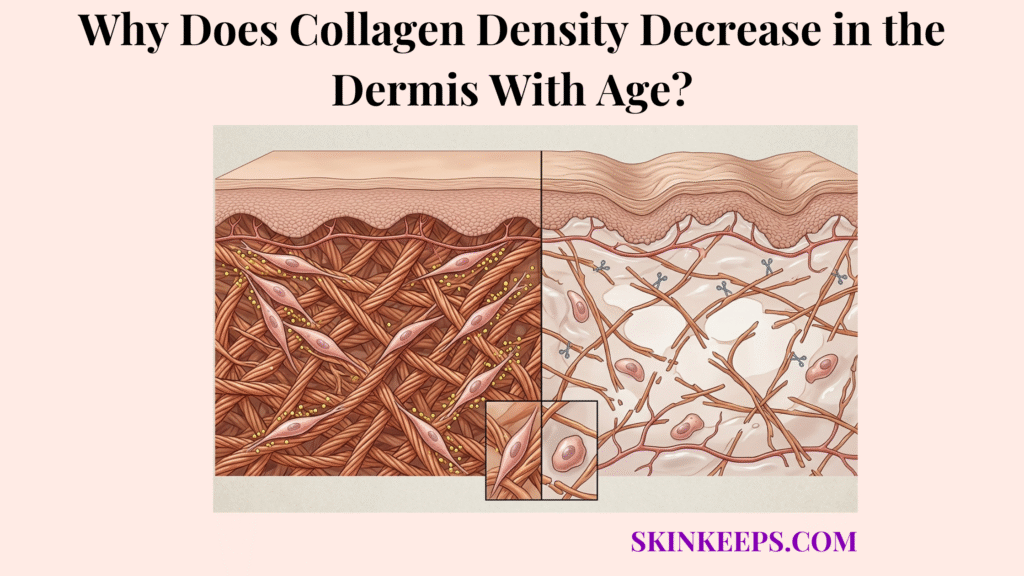
Youthful dermal collagen density is higher and more supportive, while the decrease in dermal collagen density with age reduces the matrix fullness that helps the skin stay firm and resilient.
Youthful dermis maintains stronger matrix fullness, more efficient collagen renewal, and better structural support because fibroblasts are active, securely attached, and well-fueled.
Aging shifts the dermis toward lower density, weaker support, and less resilient mechanical behavior as the continuous loss of material outpaces the body’s repair systems.
| Collagen Density State | Fibroblast Activity | Matrix Fullness | Visible Skin Quality |
|---|---|---|---|
| Youthful dermis | Active and securely attached | High (Dense support) | Firm, compact, and resilient |
| Aging dermis | Weaker and detaching | Lower (Gaps and fragmentation) | Less springy, prone to laxity |
What factors make the decrease in dermal collagen density with age worse?
The decrease in dermal collagen density with age becomes worse when cumulative damage and chronic stress reduce collagen integrity faster than the dermis can maintain it.
Chronic UV exposure, smoking, oxidative stress, ongoing inflammation, poor long-term photoprotection, and repeated skin stress all deepen the loss, acting as aggressive accelerators to intrinsic aging.
These factors do not only damage collagen directly; they also weaken the systems that preserve collagen density over time, damaging the very fibroblasts needed for future repair.
What habits and ingredients help support skin affected by the decrease in dermal collagen density with age?
The best support for skin affected by the decrease in dermal collagen density with age focuses on preservation, lower chronic stress, and long-term structural protection rather than quick-fix claims.
When considering which treatments stimulate collagen production in the dermis, the clinical goal is to preserve remaining dermal support and carefully reduce future loss, not to promise instant collagen rebuilding or overnight reversal of deep structural decay.
This transition points to three proven pillars of long-term dermal care below.
How do retinoids help support skin affected by the decrease in dermal collagen density with age?
Retinoids help support skin affected by the decrease in dermal collagen density with age by improving longer-term matrix-related skin behavior over time.
Retinoids are often used when the goal is to support firmer-feeling skin over time, especially when integrated gently into a routine to avoid unnecessary barrier inflammation.
Mukherjee et al., 2006 summarized that after 10 to 12 months of topical tretinoin treatment, an 80% increase in collagen-I formation was observed in treated photoaged skin, while vehicle-treated skin showed a 14% decrease, which supports retinoids as a long-term structural-support strategy rather than a quick fix (PMC, 2006).
How does sun protection help support skin affected by the decrease in dermal collagen density with age?
Sun protection helps support skin affected by the decrease in dermal collagen density with age because UV exposure is one of the strongest external drivers of collagen loss.
Daily SPF reduces cumulative structural damage and helps preserve the collagen density that remains by blocking the enzymes that break the matrix apart.
Protection works best as a preservation habit, not as a corrective shortcut after years of photodamage have already occurred.
How does lower chronic inflammation help support skin affected by the decrease in dermal collagen density with age?
Lower chronic inflammation helps support skin affected by the decrease in dermal collagen density with age because calmer tissue environments reduce ongoing structural burden.
Chronic inflammation adds stress to connective tissue quality and makes long-term preservation harder by keeping the skin in a continuous state of defensive alarm.
Calmer skin environments are more supportive of dermal integrity over time, ensuring metabolic energy is spent on maintenance rather than emergency repair.
Problem: decrease in dermal collagen density with age
Implication: skin is losing its deep structural support and resilience
Solution: utilize retinoids, strict SPF, and lower-stress care to preserve matrix integrity
What are the key takeaways about the decrease in dermal collagen density with age?
The decrease in dermal collagen density with age happens because collagen production, maintenance, and preservation all become less efficient over time.
Preserving structure requires a unified approach to protection and gentle stimulation.
Summary Points
- The decrease in dermal collagen density with age happens because collagen production, maintenance, and preservation all become less efficient over time
- Weaker fibroblast activity, slower matrix repair, and increased fragmentation all contribute
- UV exposure and chronic stress accelerate the process
- Lower collagen density weakens firmness, support, and visible resilience
- The best preservation strategy focuses on sun protection, lower chronic stress, and consistent long-term support
What daily steps help reduce the impact of the decrease in dermal collagen density with age?
Daily steps help reduce the impact of the decrease in dermal collagen density with age by preserving deeper structure and reducing cumulative damage over time.
Long-term consistency works better than aggressive short-term correction when the goal is dermal preservation and sustained mechanical resilience.
Daily Structural Preservation Checklist
Collagen density does not usually become lower all at once. It decreases gradually as production slows and damage accumulates.
Build your routine around long-term structural preservation if your goal is firmer, more resilient skin over time.