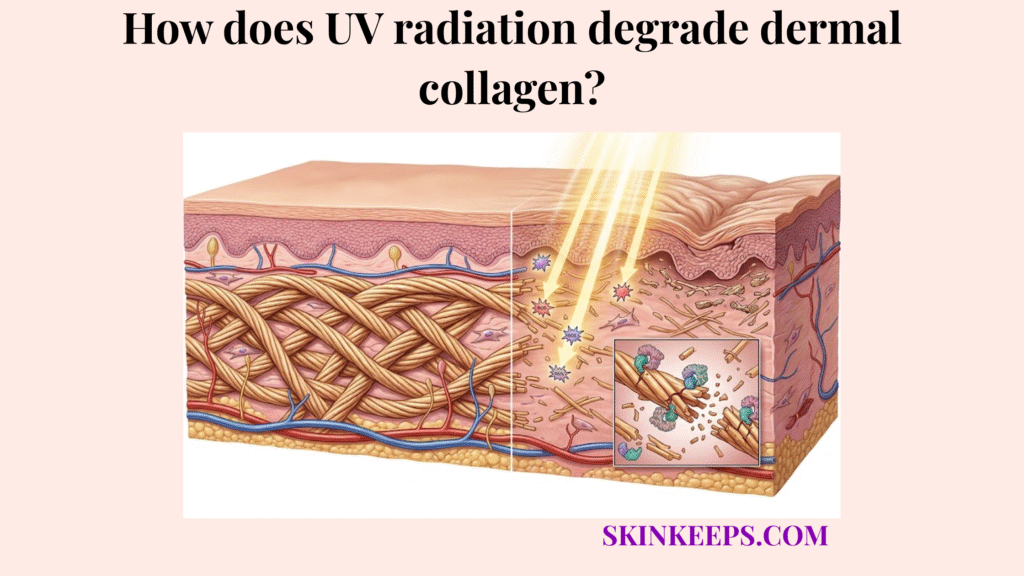
UV radiation degrades dermal collagen by triggering destructive enzymes, increasing oxidative stress, and weakening the fibroblast activity needed to replace damaged collagen.
This is a chronic molecular breakdown cascade, not just casual “sun damage.” It dismantles the skin’s structural foundation hour by hour, operating quietly beneath the surface long before the first deep line ever appears. When ultraviolet light penetrates the tissue, it forces the skin to actively destroy its own support network.
Understanding how UV radiation degrades dermal collagen requires defining the biological baseline, isolating the distinct roles of UVA and UVB, mapping the destruction by Matrix Metalloproteinases, tracking the oxidative stress from Reactive Oxygen Species, examining severe fibroblast suppression, contrasting intrinsic aging with photoaging, and deploying precise prevention strategies.
What is the biological baseline for how UV radiation degrades dermal collagen?
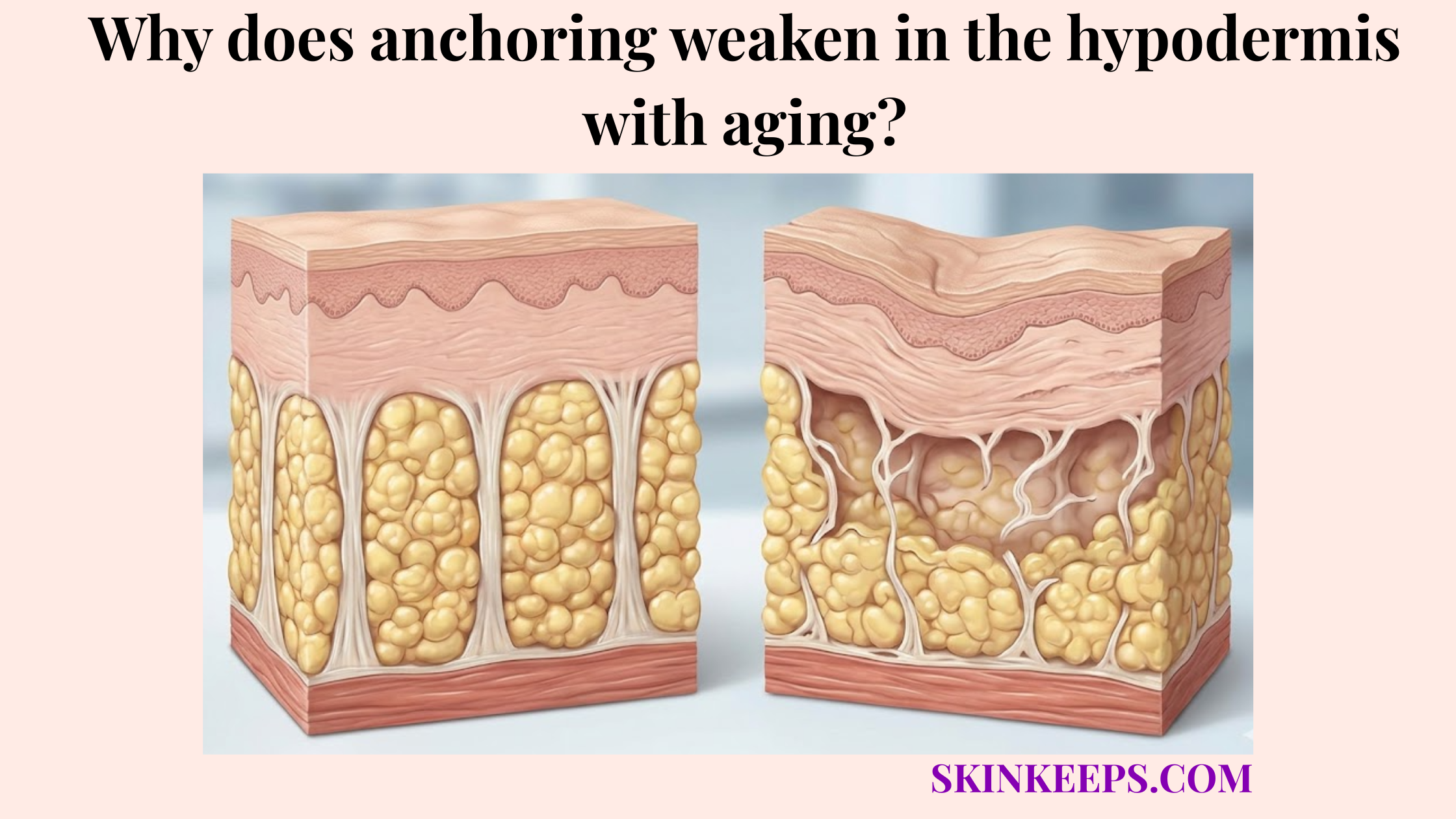
The biological baseline for how UV radiation degrades dermal collagen is that the dermis depends heavily on Type I collagen and Type III collagen for tensile support, and chronic UV exposure turns that supportive matrix into a site of repeated fragmentation, disorganization, and reduced renewal. Photoexposed skin accumulates collagen fragmentation and irregular dermal architecture rather than maintaining the intact collagen grid seen in younger or better-protected skin.
The dermal collagen matrix acts as the physical scaffolding that holds the skin taut against gravity. It requires constant, stable maintenance to resist the mechanical forces of daily movement.
The core issue driving photoaging is both relentless destruction and failed maintenance. The skin is trapped in a biological deficit where the tearing down of tissue drastically outpaces the rebuilding process.
Biskanaki et al. (2023) notes that collagen levels in the body decrease by about 1.5% per year from around age 25 in intrinsic aging, but also emphasizes that UV-driven photoaging degrades dermal collagen more rapidly than biological aging and produces more irregular dermal fragmentation. This makes the comparison useful: intrinsic decline is gradual, while photoaging is more aggressive and disorganized [MDPI].
How do UVA and UVB exposure patterns influence how UV radiation degrades dermal collagen?
UVA and UVB exposure patterns influence how UV radiation degrades dermal collagen because UVA contributes strongly to deeper photoaging-related collagen damage, while UVB adds epidermal injury and inflammatory signaling that feeds matrix breakdown. Together they sustain overlapping pathways that weaken dermal structure over time.
Understanding how UVA rays penetrate into the dermis explains why it acts as the primary instigator of deep structural photoaging by directly striking fibroblasts and collagen bundles.
UVB is not “only surface” damage; while it predominantly strikes the epidermis, the massive inflammatory and oxidative distress it triggers cascades rapidly downward, feeding downstream degradative signaling that ultimately attacks the dermal matrix.
Biskanaki et al. (2023) states that about 20% of UVA that penetrates the skin is associated with destruction of fibroblasts and related dermal damage, anchoring the reality that significant radiation actively reaches and dismantles the deep tissue [MDPI]. Brar et al. (2025) confirm this depth-dependent degradation [PMC].
How do Matrix Metalloproteinases ensure UV radiation degrades dermal collagen?
Matrix Metalloproteinases ensure UV radiation degrades dermal collagen by enzymatically cutting intact collagen fibers into unstable fragments that no longer support normal dermal structure. In photoaged skin, MMP-1 is the key initiator of fibrillar collagen cleavage, while MMP-3 and MMP-9 help extend the degradative cascade.
Think of MMPs as biological “enzymatic scissors” that the skin deploys under stress. When asking what enzymes break down collagen fibers in the dermis, MMP-1, MMP-3, and MMP-9 are the primary destructive agents. While normally used in tiny amounts for healthy tissue remodeling, UV exposure forces their massive overproduction.
The sequence is ruthless: MMP-1 serves as the primary enzyme that makes the first structural cut into intact collagen. Once the bundle is severed, MMP-3 and MMP-9 aggressively dismantle the remaining fragments, entirely destabilizing the extracellular matrix.
Feng et al. (2024) describe MMP-1 as the primary enzyme responsible for collagen damage in human skin during photoaging [PMC], while Quan et al. (2009) specifically identify the triad of MMP-1, MMP-3, and MMP-9 as the major UV-induced metalloproteinases driving dermal matrix breakdown [PMC].
How does oxidative stress contribute to why UV radiation degrades dermal collagen?
Oxidative stress contributes to why UV radiation degrades dermal collagen because UV exposure generates Reactive Oxygen Species (ROS) that amplify pro-degradation signaling and make the dermal environment less able to maintain or rebuild collagen efficiently.
ROS function as biological amplifiers rather than mere side-effects. They relentlessly sustain the intracellular panic signaling that commands the skin to keep producing more collagen-destroying MMPs.
This persistent oxidative storm creates a deeply hostile environment where structural loss heavily and continuously exceeds any weak attempts at collagen replacement.
Gromkowska-Kępka et al. (2021) consistently identify ROS as a core mediator of UV-induced photoaging [PMC], and Biskanaki et al. (2023) explicitly link UV-triggered oxidative stress to inflammatory activation, macrophage signaling, ROS release, and chronic dermal damage [MDPI]. Pullar et al. (2017) reaffirm this pro-degradation signaling network [PMC].
How does fibroblast suppression help explain how UV radiation degrades dermal collagen?
Fibroblast dysfunction (or suppression) helps explain how UV radiation degrades dermal collagen because photoaging is driven not only by greater collagen destruction but also by weaker fibroblast-driven collagen synthesis. UV-driven oxidative and inflammatory stress reduces procollagen signaling and weakens the dermis’s ability to rebuild what has already been cut apart.
Fibroblasts are the master dermal cells entirely responsible for producing and maintaining the collagen matrix. Under severe UV burden, these cells physically detach from the shattered matrix and biologically shut down.
This creates the ultimate structural crisis: the enzymatic scissors are cutting the scaffolding apart faster than ever, while the cellular builders tasked with replacing it are fundamentally suppressed.
Griffiths et al. (1993) reported in their classic trial that collagen I formation was 56% lower in photodamaged skin than in sun-protected skin. Crucially, topical tretinoin treatment produced an 80% increase in collagen I formation compared with a 14% decrease with the vehicle alone. Those figures make the replacement-side of the photoaging problem concrete: fibroblast collagen output is significantly impaired in photo-exposed skin [PubMed].
How does intrinsic aging compare to photoaging in how UV radiation degrades dermal collagen?
Intrinsic aging (or chronological aging) and photoaging compare differently because chronological aging reduces collagen more gradually and uniformly, while UV photoaging drives faster, more chaotic, enzyme-amplified fragmentation with more visible textural and structural distortion.
While intrinsic aging causes a slow, predictable thinning of the collagen network over decades, photoaging behaves like a chemical wrecking ball. It aggressively cleaves fibers and leaves the tissue visibly leathery, deeply wrinkled, and chronically inflamed. This severe structural distortion often leads to solar elastosis in dermal tissue, an accumulation of abnormal elastic fibers that is a hallmark of severe photoaging.
The 2023 Cosmetics paper notes that intrinsic aging is associated with a more gradual collagen decline, while photoexposed skin shows fragmented collagen accumulation, irregular dermal distribution, increased MMP activity, and reduced new-collagen synthesis. This confirms that photoaging is a faster and far more disorganized collagen-loss pattern than intrinsic aging alone [MDPI] [PMC].
| Feature | Chronological aging | UV photoaging | Visible result |
|---|---|---|---|
| Collagen change | Gradual, more uniform thinning | Faster, more chaotic fragmentation | Deeper wrinkles and rougher texture |
| Damage pattern | Slower structural decline | Enzyme-driven and ROS-amplified destruction | More uneven sagging and leathery change |
| Repair balance | Moderately reduced over time | Aggressively impaired by UV-triggered pathways | More pronounced visible aging |
What specific skincare interventions stop how UV radiation degrades dermal collagen?
The most effective skincare interventions stop how UV radiation degrades dermal collagen by blocking the UV trigger, reducing oxidative amplification, and supporting collagen-repair signaling rather than by relying on one product category alone. Daily broad-spectrum photoprotection is the preventive foundation, while retinoids and antioxidants serve as adjunctive anti-photoaging strategies.
These clinical interventions must be deployed logically. Reversing structural collapse is biologically impossible if the skin is still being bombarded daily by unprotected ultraviolet radiation.
How does broad-spectrum SPF stop how UV radiation degrades dermal collagen?
Broad-spectrum sunscreen (specifically SPF 30+) stops how UV radiation degrades dermal collagen best because it reduces the photon exposure that initiates the entire degradation cascade. Without reducing daily UVA and UVB burden, every downstream repair-supportive strategy remains fundamentally limited.
The 2013 randomized Nambour trial found that daily sunscreen use produced 24% less skin aging than discretionary use over 4.5 years. Later review literature also cites a 52-week SPF 30 prospective study in 32 subjects showing significant improvement in photoaging parameters with daily broad-spectrum sunscreen use. These are incredibly strong anchors for the preventive role of daily sunscreen [PubMed] [PMC].
How do topical retinoids stop how UV radiation degrades dermal collagen?
Topical retinoids help stop how UV radiation degrades dermal collagen by supporting collagen-related repair signaling and partially countering the suppression of collagen formation seen in photodamaged skin. Knowing how retinoids influence dermal fibroblast activity clarifies why their role is highly supportive and restorative rather than instant or complete.
Tretinoin actively communicates with fibroblasts to upregulate procollagen production and interfere with MMP expression. Griffiths et al. (1993) reported that tretinoin produced an 80% increase in collagen I formation [PubMed]. Systematic reviews further support topical tretinoin as highly effective for improving clinical signs of photoaging such as severe wrinkling [PMC].
How do antioxidants stop how UV radiation degrades dermal collagen?
Antioxidants help stop how UV radiation degrades dermal collagen by reducing part of the ROS burden that amplifies photoaging signaling, especially when used as adjuncts to photoprotection rather than as replacements for sunscreen. Vitamin C and vitamin E are the most established topical antioxidant examples in this targeted context.
Review literature describes vitamin C as a primary replenisher of vitamin E and notes that topical vitamins C and E work synergistically against UV-related oxidative damage. Human photoprotection studies strongly support combination topical antioxidants as vital UV-protective adjuncts [PMC] [PMC] [JAAD].
Anti-Photoaging Action Pathway
- Problem → UV continuously activates collagen-degrading pathways.
- Implication → collagen fragments accumulate while replacement weakens.
- Solution → block UV exposure, reduce oxidative amplification, and support repair-oriented dermal signaling.
What are the key summary facts for how UV radiation degrades dermal collagen?
The key summary facts are that UV radiation degrades dermal collagen by activating Matrix Metalloproteinases, generating Reactive Oxygen Species, and weakening fibroblast-driven collagen replacement, which together produce a faster and more disorganized form of aging than intrinsic aging alone.
Summary Checklist
What daily steps can you take to prevent how UV radiation degrades dermal collagen?
Daily prevention works best when UV radiation degrades dermal collagen is treated as a cumulative molecular process that must be interrupted consistently, not as a one-time visible event. Regular broad-spectrum sunscreen use, antioxidant support where appropriate, and retinoid-based nighttime repair support are the main long-term collagen-preserving skincare strategies.
Final Execution Checklist
Quick Answers About How UV Radiation Degrades Dermal Collagen
How does UV radiation degrade dermal collagen?
UV radiation degrades dermal collagen by triggering the release of destructive enzymes (MMPs) that cut collagen fibers, generating oxidative stress, and suppressing the fibroblasts responsible for producing new procollagen.
Does UVA damage collagen more than UVB?
UVA penetrates deeper into the dermis, making it a primary driver of deep collagen fragmentation and fibroblast damage, while UVB causes more superficial epidermal injury that also cascades into inflammatory dermal destruction.
What do MMPs do to dermal collagen?
Matrix Metalloproteinases (MMPs) act as biological scissors. MMP-1 initiates the cleavage of intact Type I and Type III collagen fibers, while MMP-3 and MMP-9 further degrade these fragments, destabilizing the entire dermal matrix.
How does oxidative stress contribute to photoaging?
Oxidative stress contributes to photoaging because UV-induced Reactive Oxygen Species (ROS) persistently amplify pro-degradation signaling pathways. This accelerates collagen breakdown while simultaneously weakening the cellular capacity for repair.
Why is photoaging worse than intrinsic aging for collagen structure?
Intrinsic aging thins collagen slowly and uniformly. Photoaging is worse because UV radiation drives aggressive, enzyme-amplified fragmentation, resulting in a chaotic, disorganized matrix that manifests as deep wrinkles and leathery skin.
Can sunscreen really prevent collagen loss?
Yes. Daily broad-spectrum sunscreen prevents collagen loss by physically blocking the initial photon exposure that triggers MMP activation and ROS generation, thereby cutting off the degradation cascade at its absolute source.
Do retinoids help rebuild photodamaged collagen?
Yes. Topical retinoids like tretinoin partially counter fibroblast suppression by upregulating procollagen synthesis and improving repair signaling, providing vital structural support to the compromised extracellular matrix.
Do antioxidants replace sunscreen in photoaging prevention?
No. Antioxidants such as vitamin C and vitamin E neutralize ROS to reduce oxidative amplification, acting as a secondary defense layer. They complement broad-spectrum sunscreen but cannot replace its essential primary shielding function.