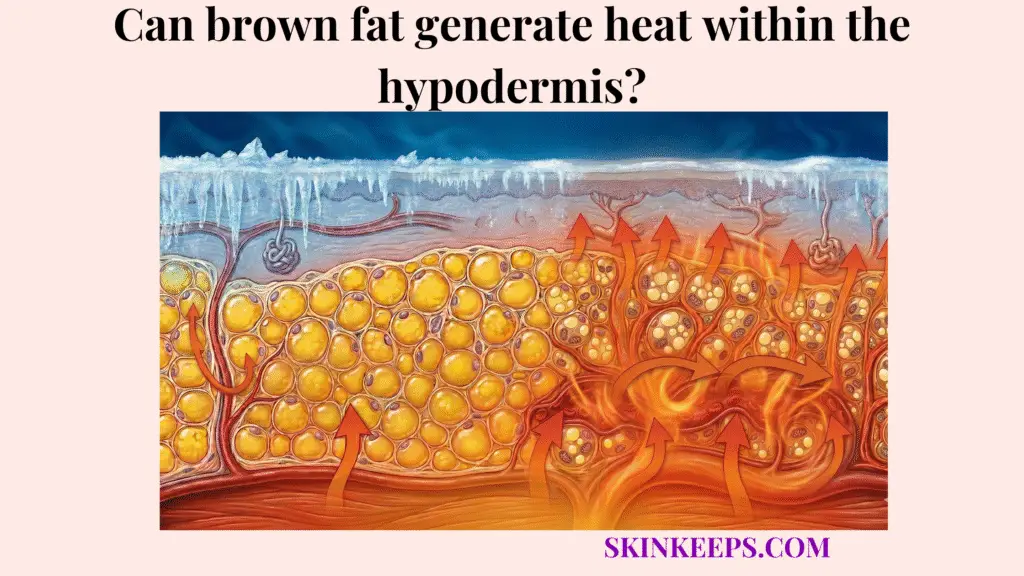
Yes, brown fat can generate heat within hypodermal or subcutaneous fat-associated tissue when thermogenic brown or beige adipocytes are present and activated, providing deep thermal support beneath the epidermis.
This process differs fundamentally from ordinary white fat, as most hypodermal fat mainly insulates and stores energy, while brown fat possesses the unique biological machinery to actively generate heat.
This article will explain why this matters, what the phrase means, how the mechanism works, where it occurs, when it increases, what activates it, how it differs from white fat and shivering, and when it is limited.
Why Brown Fat Heat Generation Within the Hypodermis Matters
Brown fat heat generation within the hypodermis matters because it adds active heat production to local thermal support rather than only helping reduce heat loss.
While most people think of fat under the skin mainly as passive insulation, brown fat introduces an active, dynamic heat-generating function that actively contributes to bodily warmth.
The importance of brown fat ultimately comes from both its active heat production and its fundamental functional difference from standard white-fat insulation.
Why Brown Fat Adds Active Heat Production to Hypodermal Thermal Protection
Brown fat adds active heat production to hypodermal thermal protection because it can generate new heat locally rather than only slowing existing heat loss.
This active heat production means new thermal energy is continuously being generated within the adipose tissue itself.
This unique biological capability makes brown fat functionally different from passive padding or inert storage fat, and active heat production is the main reason brown fat matters thermally. Kajimura, Spiegelman, and Seale (2015) emphasize that this active heat production gives brown fat a profound physiological role beyond simple insulation [PMC].
Why Brown Fat Matters Beyond Simple Fat Insulation
Brown fat matters beyond simple fat insulation because insulation only slows heat loss, while brown fat can actively add heat to the system.
Insulation acts strictly as a passive barrier, preserving the existing warmth produced by other deep-tissue organs.
Thermogenesis acts as active heat generation, proving that the distinction between preservation and production is central to how the body survives cold stress.
What Brown Fat Heat Generation Within the Hypodermis Means
Brown fat heat generation within the hypodermis means that thermogenic brown or beige adipocytes within subcutaneous or hypodermal-associated tissue can convert stored chemical energy into heat.
This does not imply that every single pocket of hypodermal fat is burning fuel for heat; rather, it refers strictly to the localized regions where these specialized adipocytes exist.
The next distinctions clarify the exact differences between ordinary white fat and thermogenic fat, and between actively generated heat and merely conserved heat.
What Makes Brown Fat Different From Ordinary Hypodermal Fat
Brown fat differs from ordinary hypodermal fat because it is specialized for thermogenesis rather than mainly for long-term energy storage and passive insulation.
Ordinary hypodermal fat is almost entirely composed of white adipose tissue, which acts as a dense, lipid-rich reserve designed to hoard energy for times of famine.
Brown fat, however, is packed with thermogenic machinery that white fat completely lacks, confirming that its defining biological difference is its heat-generating function. Sidossis and Kajimura (2015) confirm that brown and beige adipocytes possess specialized thermogenic machinery that white fat completely lacks [PMC].
What It Means for Heat To Be Generated Within Hypodermal Tissue
For heat to be generated within hypodermal tissue means that adipocytes in that region are actively dissipating metabolic energy as heat.
This local heat generation refers explicitly to the fierce metabolic activity happening inside the mitochondria of the adipocytes themselves, distinguishing it from processes inside superficial keratinocytes.
This is fundamentally different from heat merely arriving from other internal tissues via blood flow, which is exactly why “generate heat” and “reduce heat loss” are not interchangeable phrases.
How Brown Fat Heat Generation Within the Hypodermis Works
Brown fat heat generation within the hypodermis works through mitochondria-rich thermogenic adipocytes that use UCP1-linked uncoupling to release energy as heat.
The central process driving this localized warmth is mitochondrial thermogenesis, a specialized cellular reaction.
Mitochondrial density, uncoupling, and fuel oxidation are the three core functional parts of this extraordinary heating mechanism.
How Brown Fat Uses Mitochondria To Generate Heat
Brown fat uses mitochondria to generate heat because thermogenic adipocytes are densely packed with mitochondria that support rapid oxidative heat production.
Brown fat contains vastly more mitochondria than ordinary white fat, giving the tissue its characteristic dark, iron-rich coloration.
This incredible abundance is absolutely vital because mitochondria are the exact cellular locations where thermogenic uncoupling occurs, making mitochondrial richness one of the defining structural features of thermogenic adipose tissue.
How Brown Fat Converts Stored Energy Into Heat Instead of ATP Storage
Brown fat converts stored energy into heat instead of efficient ATP capture by using UCP1 to uncouple oxidative phosphorylation.
Inside the cell, fuel oxidation still occurs aggressively, but the resulting energy is deliberately not captured with normal, standard ATP efficiency.
UCP1 (Uncoupling Protein 1) is the molecular short-circuit that forces this energy to be released safely as heat into the surrounding tissue. Kissig, Shapira, and Seale (2016) describe UCP1 as the essential molecular short-circuit that uncouples oxidative phosphorylation to release energy safely as heat [PMC]. This intentional uncoupling is what makes brown fat explicitly thermogenic rather than storage-focused.
How Thermogenesis Makes Brown Fat Different From Passive Insulation
Thermogenesis makes brown fat different from passive insulation because thermogenesis adds heat, while insulation only slows heat loss.
Passive insulation functions simply by trapping and preserving the body’s pre-existing warmth under a blanket of lipid tissue.
Thermogenesis functions by actively increasing local heat availability through cellular combustion. Brown fat is biologically essential precisely because it can do something passive insulation cannot: generate new heat.
How Brown Fat Heat Generation Within the Hypodermis Works
| Thermogenic feature | What happens biologically | Effect on heat generation | Why it matters in the hypodermis |
|---|---|---|---|
| High mitochondrial density | Brown fat contains many mitochondria | Supports strong thermogenic capacity | Makes local adipose tissue metabolically heat-producing |
| UCP1 activity | Oxidative phosphorylation is uncoupled | Energy is released as heat | Defines true brown-fat thermogenesis |
| Fuel oxidation | Fatty acids and other fuels are oxidized | Provides thermogenic energy | Sustains active heat production |
| Heat dissipation | Energy is not captured efficiently as ATP | Local heat rises | Distinguishes brown fat from white fat |
| Local thermal support | Heat is generated within adipose-associated tissue | Adds active warmth | Goes beyond passive insulation |
Where Brown Fat Heat Generation Within the Hypodermis Occurs
Brown fat heat generation within the hypodermis occurs where thermogenic brown or beige adipocytes are present within subcutaneous or hypodermal-associated fat depots.
Thermogenic adipose tissue is strictly localized and not evenly present throughout all areas of hypodermal fat.
Location and regional cellular abundance both dictate whether a specific patch of subcutaneous fat can produce heat.
Where Thermogenic Adipocytes Can Appear in Subcutaneous or Hypodermal Tissue
Thermogenic adipocytes can appear in subcutaneous or hypodermal tissue when brown or beige fat cells are present within those depots.
Classical brown fat in humans is often localized to highly specific deep anatomical depots, while beige adipocytes can temporarily emerge within standard white-fat depots under the right environmental stress.
Local cellular identity, rather than just the anatomical label of “hypodermis,” rigidly determines the local thermogenic potential of the tissue.
Where Brown Fat Presence Is Stronger or Weaker Depending on the Body Region
Brown fat presence is stronger or weaker depending on the body region because thermogenic adipose depots are region-specific rather than uniformly distributed throughout subcutaneous fat.
Certain regions, particularly the supraclavicular (above the collarbone) and neck areas, are much more heavily associated with active brown adipose tissue than the fat found on the abdomen or thighs.
Consequently, not all subcutaneous fat-associated tissue possesses equal thermogenic significance; anatomical location heavily restricts how strong the heating mechanism can be.
When Brown Fat Heat Generation Within the Hypodermis Increases
Brown fat heat generation within the hypodermis increases when thermogenic adipocytes are activated, especially during cold exposure and sympathetic stimulation.
Brown fat thermogenesis is completely inactive in neutral environments; it requires powerful physiological triggers to increase its output.
Cold exposure, sympathetic nervous signaling, and severe physiologic demand dictate when this tissue actually becomes relevant to thermal defense.
When Cold Exposure Activates Brown Fat Heat Generation Within the Hypodermis
Cold exposure activates brown fat heat generation within the hypodermis when thermogenic adipocytes are recruited to produce heat in response to falling thermal conditions.
Cold exposure acts as the classic, defining environmental trigger that forces brown fat into high gear.
Cold is the clearest condition under which local adipose thermogenesis switches on to defend core temperature. Betz and Enerbäck (2011) note that active BAT was observed in 23 of 24 subjects (96%) after cold exposure in one classic adult cohort, establishing how reliably cold triggers the system [PMC].
When Sympathetic Stimulation Increases Thermogenic Activity
Sympathetic stimulation increases thermogenic activity when neural signaling drives brown and beige adipocytes into a heat-producing state.
The sympathetic nervous system is the main biological highway that connects external environmental cold to deep cellular thermogenesis.
This confirms that brown fat is a heavily regulated, brain-controlled heat-producing tissue, not an automatically burning furnace.
When Brown Fat Heat Generation Becomes More Physiologically Important
Brown fat heat generation becomes more physiologically important when cold challenge or cold adaptation increases the need for non-shivering thermogenesis.
BAT matters most when the body urgently needs extra heat but cannot rely entirely on exhaustive muscle shivering.
Physiologic importance depends on repeated activation over time. Blondin et al. (2014) reported that in one human cold-acclimation study, exposure to 10°C for 2 hours per day for 4 weeks increased total BAT volume of activity by an impressive 45% [PMC].
Which Signals Activate Brown Fat Heat Generation Within the Hypodermis
Neural, hormonal, and metabolic signals activate brown fat heat generation within the hypodermis by pushing thermogenic adipocytes toward an energy-dissipating state.
Neural signaling from the brain acts as the main, instantaneous direct trigger for heat production.
Hormonal and metabolic influences continuously shape the overall strength and biological ceiling of that activation behind the scenes.
Which Neural Signals Activate Brown Fat Heat Generation Within the Hypodermis
Neural signals activate brown fat heat generation within the hypodermis primarily through sympathetic stimulation of thermogenic adipocytes.
Brown fat is wired tightly to sympathetic nervous system control, relying on norepinephrine release to initiate the heating sequence.
Neural activation remains the absolute clearest and most direct control route for initiating BAT thermogenesis.
Which Hormonal and Metabolic Signals Influence Brown Fat Heat Generation Within the Hypodermis
Hormonal and metabolic signals influence brown fat heat generation within the hypodermis by changing how thermogenic adipocytes respond to activation and fuel availability.
Endocrine factors, like thyroid hormones, and overall metabolic health significantly alter how powerfully the tissue can respond to a cold signal.
BAT activity ultimately depends on both immediate neural triggers and the background physiologic context supporting the cell.
How Brown Fat Heat Generation Within the Hypodermis Differs From White Fat Insulation
Brown fat heat generation within the hypodermis differs from white fat insulation because brown fat adds heat actively, while white fat mainly slows heat loss passively.
Both types of adipose tissue support survival in freezing environments, but they do so through fundamentally opposed biological methods.
The core comparison lies perfectly between cellular biology and practical thermal outcome: active fuel burning versus passive thermal blocking.
How Brown Fat Generates Heat While White Fat Mainly Reduces Heat Loss
Brown fat generates heat while white fat mainly reduces heat loss because brown adipocytes are thermogenic, whereas white adipocytes are primarily storage-oriented and insulating.
Brown fat utilizes massive mitochondrial networks to physically burn fatty acids and emit the resultant energy directly as heat.
White fat lacks these dense mitochondrial networks and therefore supports warmth without actually producing any new heat of its own.
How Active Thermogenesis Differs From Passive Insulation
Active thermogenesis differs from passive insulation because thermogenesis increases heat supply, while insulation mainly decreases heat loss.
Active thermogenesis acts like a radiator, actively forcing new thermal energy into the surrounding biological environment.
The difference between actively adding heat and simply retaining heat remains one of the most important physiological distinctions in human biology.
Comparison: Brown Fat vs White Fat in Hypodermal Thermal Function
| Feature | Brown fat | White fat | Main thermal effect |
|---|---|---|---|
| Main role | Thermogenesis | Energy storage / insulation | Active heat vs passive heat conservation |
| Cellular activity | High | Lower | Brown fat is metabolically more active |
| Mitochondria | Abundant | Fewer | Brown fat supports thermogenesis |
| Heat generation | Yes | Minimal | Brown fat actively warms |
| Insulation | Limited compared with white fat | Stronger passive role | White fat mainly slows heat loss |
| Response to cold | Activates thermogenesis | Mainly conserves existing heat | Different cold-defense strategy |
How Brown Fat Heat Generation Within the Hypodermis Compares With Shivering Thermogenesis
Brown fat heat generation within the hypodermis compares with shivering thermogenesis in that both generate heat, but they do so through different tissues and different mechanisms.
Both systems actively produce thermal energy to defend the body’s core temperature during severe cold stress.
However, the tissues utilized and the molecular mechanisms engaged differ radically, distinguishing smooth metabolic heat from violent physical heat.
How Brown Fat Heat Generation Differs From Shivering in Mechanism
Brown fat heat generation differs from shivering in mechanism because brown fat produces heat through mitochondrial thermogenesis, while shivering produces heat through repeated muscle contraction.
BAT thermogenesis relies entirely on the UCP1 protein short-circuiting the mitochondrial battery to emit heat.
Both mechanisms defend body warmth against hypothermia, but they operate through fundamentally different tissues (adipose versus skeletal muscle).
How Brown Fat Heat Generation Differs From Shivering in Efficiency and Body Response
Brown fat heat generation differs from shivering in efficiency and body response because BAT can produce heat without overt body movement, while shivering requires repeated visible muscle contractions.
Shivering is biologically exhausting, mechanically clumsy, and visibly disruptive because it depends on rapid, uncoordinated muscular spasms to generate friction heat.
BAT is incredibly important physiologically because it offers a silent, non-muscular heat-producing option that saves mechanical energy.
Comparison: Brown Fat Thermogenesis vs Shivering Thermogenesis
| Feature | Brown fat thermogenesis | Shivering thermogenesis | Main physiological difference |
|---|---|---|---|
| Tissue involved | Brown / beige adipocytes | Skeletal muscle | Different heat-producing tissue |
| Trigger | Cold, sympathetic activation | Cold, motor activation | Different activation route |
| Heat source | Mitochondrial thermogenesis | Repeated muscle contraction | Different mechanism |
| Movement requirement | No major movement needed | Requires muscular movement | BAT is non-shivering |
| Functional purpose | Non-shivering heat production | Rapid emergency heat generation | Different response style |
Which Factors Affect Brown Fat Heat Generation Within the Hypodermis
Several factors affect brown fat heat generation within the hypodermis, especially age, metabolic state, adipose composition, cold adaptation, sympathetic tone, body region, and adipocyte type.
Age, underlying metabolic state, and adipose composition dictate the foundational baseline capacity for heat production.
Cold adaptation, sympathetic tone, and precise anatomical body region modify exactly how much of that capacity is actually utilized.
Which Roles Age, Metabolic State, and Adipose Composition Play in Brown Fat Heat Generation Within the Hypodermis
Age, metabolic state, and adipose composition affect brown fat heat generation within the hypodermis because they influence how many thermogenic adipocytes are present and how responsive they are.
Advancing age drastically reduces both the sheer volume of detectable active BAT and its thermogenic responsiveness. Betz and Enerbäck (2011) reported active BAT in 17 of 32 younger adults but only 2 of 24 older adults after cold exposure in one age-comparison study, highlighting a steep age-related drop off [PMC].
Overall adipose composition ultimately determines whether a local depot behaves dynamically like a furnace or simply sits statically like a blanket.
Which Roles Cold Adaptation and Sympathetic Activity Play in Brown Fat Heat Generation Within the Hypodermis
Cold adaptation and sympathetic activity affect brown fat heat generation within the hypodermis because they increase the likelihood and strength of thermogenic activation.
Repeated, disciplined cold exposure recruits vastly stronger and more prolonged BAT responses.
Thermogenic strength depends completely on a person’s recent cold activation history and the integrity of their neural drive.
Which Roles Body Region and Adipocyte Type Play in Brown Fat Heat Generation Within the Hypodermis
Body region and adipocyte type affect brown fat heat generation within the hypodermis because local depots differ in their abundance of brown or beige adipocytes.
Only specific anatomical locations, predominantly around the upper torso, chest, and neck, are heavily associated with classical brown fat.
Anatomical location and highly specific cell types jointly dictate the true local thermogenic capacity of the tissue.
When Brown Fat Heat Generation Within the Hypodermis Is Limited
Brown fat heat generation within the hypodermis is limited when thermogenic adipocytes are sparse, inactive, weakly stimulated, or anatomically minor in that tissue region.
Active thermogenesis is real and verified, but it is not a universal phenomenon equally strong across every inch of the human body.
When activation is low or cells are sparse, passive insulation effortlessly overtakes thermogenesis as the primary thermal defense.
When Brown Fat Cells Are Sparse or Inactive in the Hypodermis
Brown fat cells are limited in the hypodermis when thermogenic adipocytes are sparse, quiescent, or not strongly activated.
The mere presence of a beige or brown fat cell is metabolically meaningless if the sympathetic nervous system fails to activate it.
Abundance without activation, or activation without abundance, both lead to severely restricted heat generation.
When Insulation Matters More Than Brown Fat Heat Generation
Insulation matters more than brown fat heat generation when the local adipose tissue behaves mainly like ordinary white fat rather than active thermogenic tissue.
In the vast majority of normal subcutaneous depots across the human body, passive white-fat insulation absolutely dictates thermal defense over active heating.
The tissue’s dominant, everyday thermal role heavily depends on its white-to-brown adipocyte composition.
When Brown Fat Heat Generation Alone Is Not Enough for Thermal Protection
Brown fat heat generation alone is not enough for thermal protection when cold stress exceeds what local thermogenesis can supply and the body still needs circulation, insulation, and other thermoregulatory responses.
Brown adipose tissue is merely one highly specialized, supportive mechanism, not an impenetrable biological heater that solves all extreme cold threats.
Peripheral circulation, autonomic vasomotor control, white-fat insulation, and emergency shivering still bear the heavy burden of survival.
How Brown Fat Heat Generation Within the Hypodermis Supports Overall Thermal Balance
Brown fat heat generation within the hypodermis supports overall thermal balance by adding local non-shivering heat production to a broader system that also includes circulation, insulation, and whole-body thermoregulation.
BAT does not magically replace circulation or the physical need for insulation; it elegantly supplements them.
The physiological significance of brown fat is realized completely only when integrated into the entire organism’s whole-body heat balance strategy.
How Local Brown Fat Thermogenesis Supports Body Warmth
Local brown fat thermogenesis supports body warmth by adding metabolically generated heat to adipose-associated regions during thermogenic activation.
This biological spark allows adipose-associated tissue to transition dynamically from a static thermal barrier into an active thermal engine.
Local heat generation holds major physiological value when the body is forced to defend its core temperature against falling ambient temperatures.
How Brown Fat Heat Generation Works Alongside Circulation and Insulation
Brown fat heat generation works alongside circulation and insulation because local heat must still be distributed, conserved, or lost within a larger thermal system.
Once generated within the adipocyte, this heat still exists inside a physical body heavily dictated by vascular blood flow and lipid insulation.
BAT thermogenesis is incredibly fascinating, but it is deeply meaningless if the circulatory system fails to distribute that heat where it is needed.
Which Key Takeaways Define Brown Fat Heat Generation Within the Hypodermis
The key takeaways are that brown fat can generate heat within hypodermal or subcutaneous fat-associated tissue when thermogenic adipocytes are present, that this process depends on UCP1-linked thermogenesis, and that it differs fundamentally from ordinary white-fat insulation.
Brown fat provides the body with a dynamic metabolic heater, operating through specialized mitochondrial uncoupling that cleanly sidesteps the violent physical shaking required by shivering.
However, this thermal superpower is limited rigidly by body location, cellular abundance, age, and the immediate strength of sympathetic activation, proving it works best as merely one piece of a vast biological thermal-support puzzle.
Final Checklist
Quick Answers About Brown Fat Heat Generation Within the Hypodermis
Is all hypodermal fat brown fat?
No. The vast majority of hypodermal fat is ordinary white adipose tissue, which specializes in energy storage and passive insulation rather than active heat production.
Can beige fat also generate heat?
Yes. Beige adipocytes are thermogenic cells that can emerge within standard white fat depots under specific conditions, allowing them to burn fuel and release heat similarly to classical brown fat.
What activates brown fat most strongly?
Cold exposure activates brown fat most strongly. When environmental temperatures drop, sympathetic nerves release signals that trigger the thermogenic adipocytes to begin actively generating heat.
Is brown fat the same as insulation?
No. Insulation passively prevents existing body heat from escaping. Brown fat thermogenesis actively creates new heat by uncoupling mitochondrial fuel oxidation.
Does brown fat replace shivering?
No. Brown fat provides non-shivering thermogenesis, which acts as a foundational, steady source of heat. Shivering remains a crucial emergency response when non-shivering heat production is insufficient.
Does adult human brown fat still work?
Yes. While much more abundant in infants, active brown fat is still present and functional in many human adults, particularly around the neck and clavicle regions, and it responds directly to cold exposure.
Why is UCP1 so important?
UCP1 (Uncoupling Protein 1) is the essential molecular switch that prevents mitochondria from capturing energy efficiently as ATP, forcing that energy to safely dissipate into the tissue as pure heat.
Can brown fat heat generation be weak or absent in some people?
Yes. The presence and activity of brown fat decline significantly with age and metabolic dysfunction, making local heat generation much weaker or entirely absent in some individuals.
Conclusion
Brown fat can generate heat within hypodermal or subcutaneous fat-associated tissue when thermogenic adipocytes are present and activated, allowing adipose tissue to contribute active non-shivering thermogenesis rather than only passive insulation.
This remarkable ability depends fundamentally on dense mitochondrial networks, UCP1-mediated uncoupling, and precise sympathetic activation rather than generic cellular fat storage.
While brown fat thermogenesis is a powerful and scientifically verified physiological mechanism, its true biological value is most fully realized when it operates as an active heater working smoothly alongside the body’s vast circulatory and insulating defense systems.