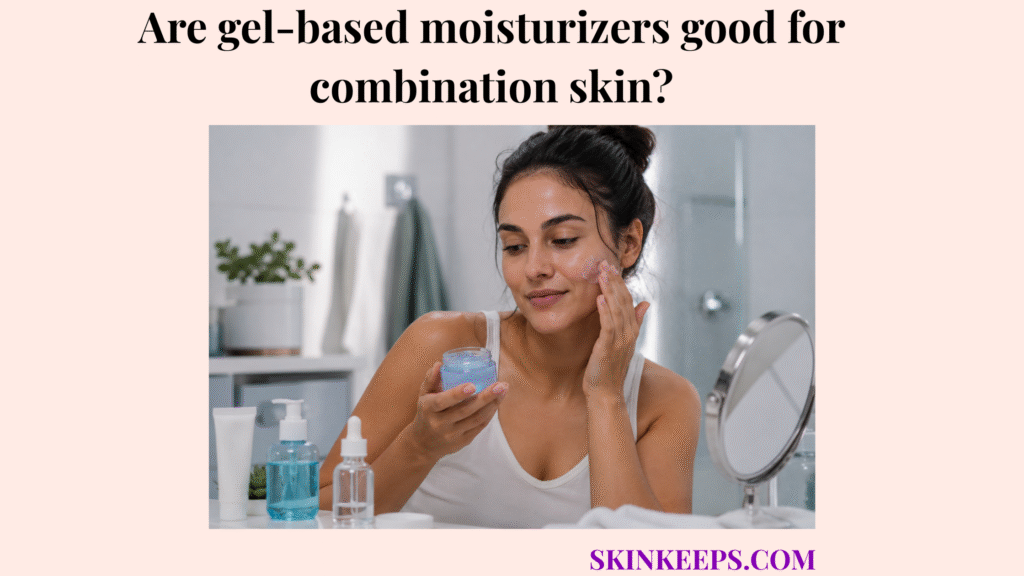
Yes, gel-based moisturizers can be good for combination skin, especially when the T-zone gets oily, shiny, or easily clogged.
Gel-based moisturizers usually have a lightweight texture, so combination skin may use them on the forehead, nose, and chin without the heavy feel that richer creams can leave behind. That can make gel texture helpful when the T-zone looks shiny, sunscreen feels heavy, or makeup slides over oily areas.
Gel moisturizers are not always enough for every area of combination skin. Dry cheeks, peeling around the mouth, low-humidity dryness, or barrier irritation may need a gel-cream, lotion, cream, or an extra support layer placed only where those dry or irritated zones need it.
Are gel-based moisturizers good for combination skin?
Gel-based moisturizers can be good for combination skin when the skin needs lightweight hydration without a greasy or heavy finish.
They can work well on the forehead, nose, and chin because those areas often dislike thick residue. The same gel may be too light for cheeks, mouth-area dryness, or dry-weather barrier support, so the answer depends on zone behavior.
Readers comparing gel texture with cream texture should first understand their different skin types, because combination skin is defined by mixed facial-zone needs rather than one uniform face-wide pattern.
| Combination skin pattern | Are gel-based moisturizers a good fit? | Why |
|---|---|---|
| Oily T-zone, normal cheeks | Often yes | Lightweight hydration without heavy shine |
| Oily T-zone, dry cheeks | Partly | Good for T-zone, may be too light for cheeks |
| Acne-prone combination skin | Often useful if noncomedogenic | Less heavy than rich creams |
| Oily but tight combination skin | Can help if hydrating enough | Needs water support without stripping |
| Flaky cheeks | Usually not enough alone | Dry zones may need richer support |
| Humid-weather combination skin | Often yes | Lighter texture feels more comfortable |
| Cold-weather combination skin | Sometimes | May need layering on dry zones |
| Sensitive combination skin | Depends on formula | Fragrance, alcohol, or actives may irritate |
Gel moisturizer can be a good tool for combination skin, but it should match the zone and season.
Gel Moisturizer Zone Fit Model
This visual shows why gel moisturizer often fits oily zones first while dry areas may need a gel-cream, lotion, or cream layer.
Figure 1. Gel moisturizers often match oily T-zone comfort, while dry cheeks may need extra local support.
Why can gel-based moisturizers suit oily zones in combination skin?
Gel-based moisturizers can suit oily zones in combination skin because they hydrate the T-zone without the heavy feel that some creams leave behind.
Oily zones still need comfort after cleansing, active ingredients, sunscreen removal, or dry weather. A light gel can add water-supporting comfort while reducing the chance that the forehead, nose, or chin feels coated.
How gel moisturizers feel lighter on oily combination skin zones
Gel moisturizers feel lighter on oily combination skin zones because they often absorb quickly and feel less greasy on the forehead, nose, and chin.
That light feel can make combination skin more comfortable under sunscreen or makeup, especially when rich creams leave the T-zone shiny. Formula still matters, because not every gel feels weightless or non-greasy.
How gel moisturizers can support oily but tight combination skin
Gel moisturizers can support oily but tight combination skin by adding lightweight hydration to shiny areas that still feel stripped or uncomfortable.
Oiliness does not prove that the T-zone has enough water comfort. If combination skin feels shiny but tight after washing, the issue may connect with dehydrated combination skin rather than a need for stronger oil removal.
How gel moisturizers may work under sunscreen or makeup on combination skin
Gel moisturizers may work under sunscreen or makeup on combination skin because lighter layers can reduce slipping, shine, or heaviness on oily zones.
A thin gel layer may help the T-zone feel prepared without creating a heavy base. Dry cheeks still need enough comfort underneath sunscreen or makeup so the face does not look smooth in one zone and tight in another.
Oily-Zone Gel Fit Checklist
- The T-zone gets shiny quickly.
- Cream moisturizers feel heavy on the nose or forehead.
- Makeup separates on oily areas.
- Sunscreen feels greasy over rich moisturizer.
- The skin feels oily but tight after cleansing.
- Breakouts happen where heavy products are applied.
- Humid weather makes creams uncomfortable.
- A lightweight layer keeps skin comfortable without coating it.
When are gel-based moisturizers too light for combination skin?
Gel-based moisturizers are too light for combination skin when dry zones stay tight, flaky, rough, stingy, or uncomfortable after application.
A gel can feel refreshing at first and still fail to seal enough comfort for cheeks, around-mouth skin, or dry patches. The fix is not to abandon moisturizer; it is to add support where the gel does not last.
Gel moisturizers may be too light for dry cheeks in combination skin
Gel moisturizers may be too light for dry cheeks in combination skin when cheeks still feel tight, rough, flaky, or under-supported after use.
Cheeks may need lotion, cream, or gel-cream support because hydration and moisture sealing are not the same thing. A gel can be a first layer, but it may not be the complete support dry cheeks need.
Gel moisturizers may be too light around the mouth in combination skin
Gel moisturizers may be too light around the mouth in combination skin when peeling, stinging, cracking, or irritation needs more protective support.
Around-mouth skin can become irritated from actives, weather, friction, or product mismatch. If peeling or stinging persists, combination skin should use gentler local support and avoid strong products in that area.
Gel moisturizers may be too light in cold or dry climates for combination skin
Gel moisturizers may be too light in cold or dry climates for combination skin because low humidity, wind, heating, and air conditioning can increase dry-zone support needs.
In humid weather, gel may feel enough across more areas. In cold or dry conditions, cheeks and around-mouth areas may need a gel-cream, lotion, or cream layer while the T-zone stays lighter.
| Sign in combination skin | What it may mean | Better move |
|---|---|---|
| Cheeks feel tight after gel | Not enough moisture support | Add lotion or cream on cheeks |
| Around-mouth flakes continue | Barrier needs more protection | Use richer support locally |
| Skin feels hydrated for only one hour | Formula may not last | Layer or switch texture |
| Moisturizer absorbs but tightness returns | Not enough sealing | Use gel-cream or cream in dry zones |
| Makeup clings to cheeks | Dry areas are under-supported | Moisturize dry zones more |
| Products sting after gel | Barrier may be irritated | Simplify and choose gentler support |
| Dry patches stay rough | Hydration alone may not be enough | Add barrier-support formula |
If a gel moisturizer feels good at first but dry zones keep asking for rescue, it is probably too light for those zones.
How do gel, gel-cream, lotion, and cream moisturizers compare for combination skin?
Gel, gel-cream, lotion, and cream moisturizers compare for combination skin by texture weight, comfort, oil-zone feel, and dry-zone support.
Texture choice should follow the zone. Gel often fits oilier areas, gel-cream can bridge oily and dry needs, lotion may work across many balanced patterns, and cream is usually better reserved for dry cheeks or rough patches.
| Moisturizer texture | Best fit in combination skin | Main limitation |
|---|---|---|
| Gel | Oily T-zone, humid weather, lightweight layering | May be too light for dry cheeks |
| Gel-cream | Mixed oily and dry zones needing more comfort | May still be too light for severe dryness |
| Lotion | Balanced daily use across many combination patterns | May feel too much on very oily zones |
| Cream | Dry cheeks, cold weather, barrier support | May clog or feel heavy on T-zone |
| Balm/ointment | Very dry spots only | Usually too heavy for oily zones |
| Mattifying moisturizer | Very shiny T-zone | May dry or dull cheeks |
| Hydrating serum plus moisturizer | Oily but tight areas | Serum alone may not seal moisture |
For combination skin, gel is not automatically better than cream. The best texture depends on the zone.
Gel Moisturizer Texture Decision Path
Use this path to decide whether gel, gel-cream, lotion, cream, or a local layer makes more sense for combination skin.
Figure 2. The best moisturizer texture depends on whether oiliness, tightness, and climate stress happen in the same areas.
Which areas of combination skin benefit most from gel-based moisturizers?
The areas of combination skin that benefit most from gel-based moisturizers are usually oily or normal zones such as the forehead, nose, chin, and sometimes normal cheeks.
Gel texture is usually most useful where combination skin wants hydration without weight. It is less reliable where the skin is flaky, peeling, cold-weather dry, or already irritated.
| Facial area in combination skin | Gel moisturizer suitability | How to apply |
|---|---|---|
| Forehead | Often good | Thin layer |
| Nose | Often good | Very thin layer |
| Chin | Often good if acne-prone or oily | Thin layer, avoid heavy buildup |
| Cheeks | Depends | Use gel if normal; add richer layer if dry |
| Around mouth | Often too light if peeling | Use more protective support if needed |
| Jawline | Depends on acne or dryness | Adjust by pattern |
| Eye-adjacent area | Depends on sensitivity | Avoid irritating formulas |
| Dry patches | Usually not enough alone | Layer or switch to cream locally |
Gel moisturizer is often best for the oily half of combination skin, not automatically the whole face.
Which ingredients make gel-based moisturizers better for combination skin?
Ingredients that make gel-based moisturizers better for combination skin include lightweight humectants, barrier-support ingredients, and low-irritation formula choices.
A useful gel moisturizer should not rely on texture alone. Combination skin still needs a formula that hydrates oily zones, avoids obvious greasiness, and does not leave cheeks tight or stinging.
| Ingredient or formula direction | Why it may help combination skin | Caution |
|---|---|---|
| Glycerin | Hydration support without heavy feel | Needs full formula comfort |
| Hyaluronic acid | Helps lightweight hydration | May not be enough alone in dry air |
| Panthenol | Comfort and soothing support | Formula still matters |
| Niacinamide | May support barrier and oil balance | Can sting for some reactive skin |
| Ceramides | Barrier support | Gel formulas may contain less richness |
| Squalane in light amount | Adds softness without heavy feel for some | May be too rich for very oily zones |
| Fragrance-free | Better for reactive dry zones | Especially useful if cheeks sting |
| Alcohol-free | Helps avoid tightness | Check full ingredient context |
| Noncomedogenic | Useful for oily or acne-prone zones | Does not guarantee no breakouts |
| Mattifying agents | May reduce shine | Can feel drying on cheeks |
A good gel moisturizer for combination skin should hydrate without leaving the T-zone greasy or the cheeks tight.
How should combination skin use gel moisturizer by zone?
Combination skin should use gel moisturizer by zone by applying thin layers on oily areas and adding extra support only where dry areas need it.
Gel can be used across the whole face only if every zone stays comfortable. If the cheeks, around mouth, or dry patches feel under-supported, a zone strategy is safer than forcing the gel to do everything.
Use gel moisturizer lightly on oily zones in combination skin
Gel moisturizer should be used lightly on oily zones in combination skin because the forehead, nose, and chin often need comfort without heavy buildup.
A thin layer can sit better under sunscreen and makeup than a thick cream. This is the same placement logic used in area-based product use for combination skin, where the zone decides the amount.
Layer gel moisturizer under cream on dry zones in combination skin
Gel moisturizer can be layered under cream on dry zones in combination skin when cheeks or around-mouth areas need more lasting support than gel alone provides.
The gel can provide a light hydration step, while lotion or cream can seal comfort where dryness is strongest. This does not mean the T-zone needs the same extra layer.
Adjust gel moisturizer amount by season in combination skin
Gel moisturizer amount should change by season in combination skin because humid weather may need less product while cold or dry weather may need more dry-zone support.
Seasonal adjustment can be small: use gel more lightly on oily zones in humid weather, then add local cream or gel-cream to dry zones when wind, heating, or air conditioning increases tightness.
| Combination skin zone | Gel-only use | Gel plus extra support |
|---|---|---|
| Forehead | Usually enough if comfortable | Rarely needed unless tight |
| Nose | Usually enough in very thin layer | Avoid heavy layering if clog-prone |
| Chin | Often enough if oily | Add support if acne treatment dries skin |
| Cheeks | Enough if normal | Add lotion/cream if tight or flaky |
| Around mouth | Often not enough if peeling | Add barrier-support cream |
| Jawline | Depends on acne or dryness | Adjust by pattern |
| Dry patches | Usually not enough | Use richer local support |
Can gel-based moisturizers help acne-prone combination skin?
Gel-based moisturizers can help acne-prone combination skin when they provide lightweight, noncomedogenic comfort without replacing acne treatment.
Gel moisturizers can feel lighter than creams on acne-prone T-zone areas, but they do not clear acne by themselves. The formula still needs to be gentle, compatible with acne treatment, and comfortable around dry or peeling zones.
If breakouts stay local to the forehead, nose, chin, or jawline, the moisturizer should be chosen with area-limited breakouts in combination skin in mind rather than spread as a heavy layer everywhere.
| Acne-prone combination skin issue | How gel moisturizer may help | What to watch |
|---|---|---|
| Heavy creams clog T-zone | Gel may feel lighter | Still check for breakouts |
| Acne treatment causes dryness | Gel may add light comfort | May not be enough for peeling |
| Chin breakouts | Thin gel layer may reduce heavy buildup | Avoid irritating formulas |
| Nose congestion | Lightweight texture may help | Removal and sunscreen texture still matter |
| Breakouts plus flakes | Gel alone may not repair barrier | Add targeted barrier support |
| Sensitive acne-prone skin | Fragrance-free gel may help | Stop if burning or stinging persists |
Gel moisturizer can support acne-prone combination skin, but it is not an acne treatment by itself.
Can gel-based moisturizers work for dry-cheek combination skin?
Gel-based moisturizers can work for dry-cheek combination skin only when cheek dryness is mild or when gel is layered with more supportive moisturizer where needed.
Dry-cheek combination skin often needs more than a weightless texture. If the T-zone does well with gel but cheeks remain tight, the better answer is zone layering, not forcing the same gel across every area.
| Dry-cheek pattern | Gel moisturizer alone? | Better approach |
|---|---|---|
| Mild cheek tightness | Maybe | Try gel-cream or add more gel |
| Cheeks dry only in winter | Sometimes not enough | Add cream in cold/dry weather |
| Flaky cheeks | Usually not enough | Use barrier-support moisturizer |
| Around-mouth peeling | Usually not enough | Avoid actives and add protective layer |
| Cheeks sting after products | Depends on formula | Use fragrance-free gentle support |
| Makeup clings to cheeks | Often too light | Moisturize cheeks more before makeup |
| Cheeks normal but T-zone oily | Yes, often | Gel may work full-face |
If cheeks are truly dry, gel moisturizer may be a first layer, not the whole answer.
How can combination skin tell if a gel moisturizer is working?
Combination skin can tell a gel moisturizer is working when oily zones feel comfortable, dry zones do not tighten, and the skin stays calm for several hours.
The goal is not a matte face with no oil. The goal is comfort: the T-zone should not feel greasy or coated, and the cheeks should not ask for rescue soon after application.
Gel Moisturizer Fit Checklist
- The T-zone feels comfortable, not greasy.
- Cheeks do not feel tight after application.
- Skin stays comfortable for several hours.
- Sunscreen layers well over it.
- Makeup does not slide on the T-zone or cling to cheeks.
- Breakouts do not increase where gel is applied.
- Dry zones do not become rough or flaky.
- Moisturizer does not sting or burn.
- The skin feels hydrated, not coated.
- The routine becomes simpler, not more confusing.
A gel moisturizer should improve comfort in both oily and dry-prone zones, even if the amount differs by area.
Working vs Not Enough Gel Moisturizer Signals
Gel moisturizer should feel light and comfortable. If dry zones keep tightening, the formula or texture may need adjustment.
Figure 3. Lightweight texture should still give lasting comfort; tightness and flakes mean the gel may need help.
How can combination skin tell if a gel moisturizer is not enough?
Combination skin can tell a gel moisturizer is not enough when tightness, flakes, stinging, dullness, clinging makeup, or quick-returning dryness continues after use.
A lightweight finish should still feel comfortable. If combination skin feels like nothing helped, the gel may need a creamier texture, a local second layer, or a less irritating formula.
| After gel moisturizer | Good lightweight result | Too light for combination skin |
|---|---|---|
| T-zone | Comfortable, less greasy | Tight but still shiny |
| Cheeks | Smooth and calm | Tight, dull, rough, or flaky |
| Around mouth | Comfortable | Peeling or stinging continues |
| Makeup | Layers evenly | Clings to dry zones |
| Sunscreen | Applies smoothly | Pills over dry patches |
| After a few hours | Still comfortable | Dryness returns quickly |
| Product feel | Hydrated, not coated | Feels like nothing helped |
Lightweight should mean comfortable, not under-treated.
How should combination skin choose between gel moisturizer and gel-cream?
Combination skin should choose gel moisturizer when oiliness and heavy feel are the main issues, and choose gel-cream when gel feels too light but cream feels too heavy.
Gel-cream can be the middle step for combination skin that wants a light finish on the T-zone but more cushion on cheeks. It is not automatically better; it is useful when gel comfort does not last.
| Combination skin situation | Choose gel moisturizer when | Choose gel-cream when |
|---|---|---|
| T-zone oiliness | Shine and heavy feel are main issues | T-zone oily but skin also feels tight |
| Cheek comfort | Cheeks are normal or only mildly dry | Cheeks feel dry or rough |
| Climate | Hot or humid weather | Dry, cold, windy, or air-conditioned spaces |
| Makeup wear | Creams cause sliding | Gel alone causes clinging |
| Acne treatments | Need light support | Need more comfort around treated areas |
| Sunscreen layering | Sunscreen already feels rich | Sunscreen feels drying |
| Overall feel | Gel keeps skin comfortable | Gel comfort does not last |
Gel-cream is often the bridge when gel is too light and cream is too heavy.
What mistakes happen when combination skin uses gel-based moisturizers?
Mistakes happen when combination skin uses gel-based moisturizers as if they suit every zone, every season, and every dryness level.
The most common problem is letting the T-zone choose the product for the whole face. Gel may be correct for the nose and forehead while still being too light for cheeks, mouth corners, or winter dryness.
Avoid assuming gel moisturizer is enough for every combination skin zone
Gel moisturizer is not enough for every combination skin zone when dry cheeks, around-mouth peeling, or rough patches need more support.
Oily zones may like gel, but dry zones may need gel-cream, lotion, or cream. The point is local adjustment, not buying a separate product for every tiny area.
Avoid choosing gel moisturizer only because combination skin has an oily T-zone
Choosing gel moisturizer only because combination skin has an oily T-zone can ignore dry-zone needs, climate, cleanser strength, and active-ingredient irritation.
Moisturizer texture should follow the whole pattern. A gel may be enough in humid weather but not enough after drying cleansers, exfoliants, benzoyl peroxide, retinoids, or cold air.
Avoid using drying gel formulas on combination skin
Drying gel formulas can irritate combination skin when fragrance, alcohol, mattifying agents, or actives make cheeks sting or the T-zone feel tight.
Gel texture does not guarantee gentleness. If a gel burns, pills, tightens, or makes flakes worse, the formula may be wrong even if the texture feels lightweight.
Avoid skipping moisturizer if gel feels too light on combination skin
Skipping moisturizer when gel feels too light can leave combination skin tighter, flakier, or more uncomfortable instead of fixing the texture mismatch.
The better move is texture adjustment, local layering, or gel-cream. For broader placement and amount decisions, use the same logic as care tips that balance oily and dry zones in combination skin.
| Mistake | Why it hurts combination skin | Better move |
|---|---|---|
| Gel-only on flaky cheeks | Dry zones stay under-supported | Add cream or gel-cream locally |
| Heavy cream after gel on T-zone | T-zone may clog or shine | Keep oily zones light |
| Choosing alcohol-heavy gel | Tightness and stinging may worsen | Choose gentler formula |
| Using gel to replace sunscreen | Moisturizer does not replace SPF | Use sunscreen separately |
| Ignoring stinging | Formula may irritate | Stop or simplify |
| Applying too much gel | Sticky or pilling feel | Use thin layers |
| Assuming noncomedogenic means perfect | Breakouts can still happen | Track zone response |
| Changing many products together | Cannot tell if gel helped | Test one change at a time |
When should gel moisturizer problems in combination skin need a dermatologist?
Gel moisturizer problems in combination skin need a dermatologist when burning, swelling, cracking, bleeding, painful acne, rash-like irritation, or repeated reactions appear.
A moisturizer should make combination skin more comfortable. If even gentle formulas repeatedly sting, burn, swell, or trigger rash-like changes, the issue may be product intolerance, irritation, acne, dermatitis, allergy, or another concern that needs evaluation.
See a Dermatologist If
- Moisturizer repeatedly stings, burns, or causes swelling.
- Dry patches crack, bleed, burn, or spread.
- Breakouts become painful, deep, cystic, or scarring.
- Peeling continues after reducing strong actives.
- Redness, warmth, or rash-like patches appear.
- Skin reacts to many gentle moisturizers.
- Around-mouth irritation keeps returning.
- Oily and dry zones worsen together despite routine simplification.
- The reader suspects acne, eczema, dermatitis, rosacea, allergy, or infection.
A gel moisturizer should make combination skin more comfortable. If it repeatedly creates burning, rash-like irritation, or worsening acne, the issue needs closer review.
What should you remember about gel-based moisturizers for combination skin?
The key point is that gel-based moisturizers can be good for combination skin, especially oily zones, but dry zones may need richer or more supportive care.
- Gel-based moisturizers can be good for combination skin.
- They are often useful for oily T-zone areas.
- They may work well in humid weather.
- They can feel lighter under sunscreen or makeup.
- They may be too light for dry cheeks.
- They may not be enough for flaky or peeling areas.
- Gel-cream can be a good middle option.
- Use gel lightly on oily zones.
- Add richer support only where dry.
- Choose fragrance-free, non-irritating formulas when sensitive.
- Watch for tightness, stinging, flakes, pilling, or breakouts.
- Do not treat gel moisturizer as an acne cure.
- Do not skip moisturizer if gel is too light; adjust texture instead.
- Seek help for burning, swelling, cracking, bleeding, rash-like irritation, or painful acne.
Frequently Asked Questions About Gel-Based Moisturizers and Combination Skin
Is gel moisturizer enough for combination skin?
Gel moisturizer can be enough for combination skin if the T-zone is oily and the cheeks are normal or only mildly dry. If cheeks stay tight or flaky, use gel-cream, lotion, cream, or extra support on dry zones.
Is gel moisturizer better than cream for combination skin?
Gel moisturizer is not always better than cream for combination skin. Gel can suit oily zones, while cream may suit dry cheeks, cold-weather dryness, or rough patches.
Can gel moisturizer help oily but tight combination skin?
Yes. Gel moisturizer can help oily but tight combination skin if the formula hydrates without feeling heavy. If tightness returns quickly, gel-cream or stronger dry-zone support may be needed.
Can gel moisturizer clog combination skin?
Gel moisturizer can clog combination skin depending on the formula and the person’s skin. Gel textures are often lighter, but noncomedogenic labeling and zone tracking still matter.
Should combination skin use gel moisturizer at night?
Combination skin can use gel moisturizer at night, especially if the T-zone feels oily or heavy creams clog. Dry zones may need a richer layer at night if gel alone does not keep them comfortable.
Conclusion About Gel-Based Moisturizers and Combination Skin
Gel-based moisturizers can be a smart texture choice for combination skin when oily zones need hydration without heaviness. They are especially useful on the forehead, nose, and chin when rich creams feel greasy, clog-prone, or hard to layer under sunscreen and makeup.
The limit is dry-zone support. If cheeks, around-mouth skin, or dry patches keep feeling tight, flaky, stingy, or under-supported, combination skin should not force gel everywhere. Use gel where it fits, then add gel-cream, lotion, cream, or local barrier support where the skin asks for more.
Sources & Evidence for Gel-Based Moisturizers and Combination Skin
Cleveland Clinic — skin-type guidance: Used for the facial-zone distinction in combination skin, including oilier T-zone behavior and drier cheek or eye-area patterns.
SourceAmerican Academy of Dermatology — oily skin guidance: Used for oil-free or noncomedogenic product selection and the point that oily skin can still need moisturizer after cleansing.
SourceAmerican Academy of Dermatology — choosing a moisturizer: Used for moisturizer texture and skin-type matching boundaries without claiming one texture works for everyone.
SourceAmerican Academy of Dermatology — acne and moisturizer: Used for acne-prone moisturizer support, noncomedogenic logic, and moisturizing after washing when skin feels dry.
SourceDermNet — emollients and moisturizers: Used for moisturizer ingredient categories, frequency depending on dryness severity, occlusive caution, and contact allergy boundaries.
SourceDermNet — topical acne treatment: Used for acne active formulation context and irritation-risk boundaries around gels, creams, and topical acne products.
SourceAmerican Academy of Dermatology — acne diagnosis and treatment: Used for referral boundaries when acne is persistent, painful, treatment-resistant, or likely to scar.
SourceEducational Disclaimer: This article is for general skin education only and does not diagnose, treat, or replace professional medical advice. If gel moisturizer causes burning, swelling, cracked or bleeding patches, painful acne, scarring, rash-like irritation, or persistent product reactions, consult a qualified dermatologist.