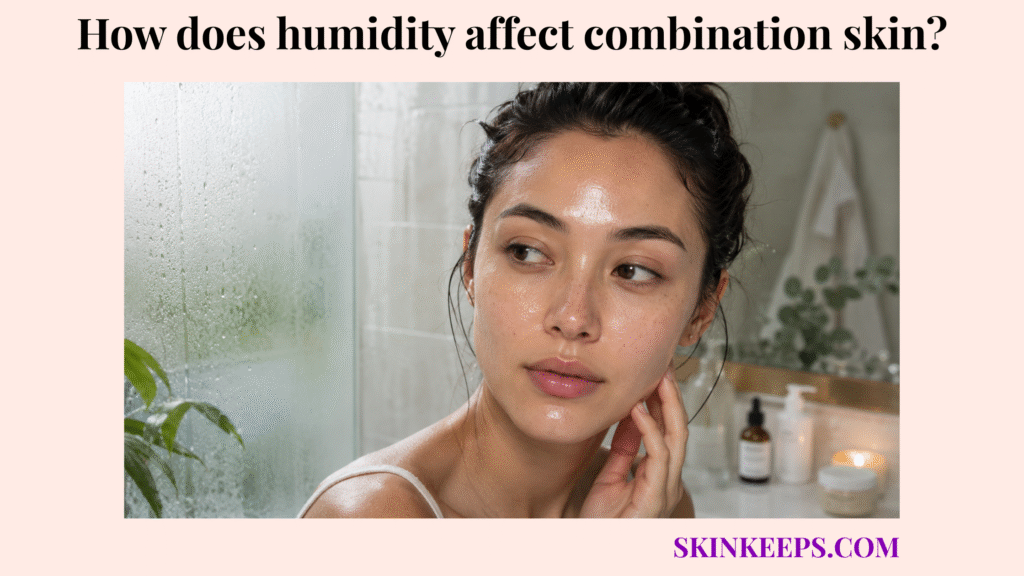
Humidity affects combination skin by changing how oily, dry, sticky, tight, or reactive different facial zones feel.
In combination skin, high humidity can make the T-zone look shinier, sweatier, heavier, and more congested, while low humidity can make the cheeks, around the mouth, or outer face feel tighter, rougher, flaky, or less comfortable. The useful response is not to treat the entire face as oily or dry, but to adjust texture, amount, and placement by zone.
How does humidity affect combination skin overall?
Humidity affects combination skin overall by changing the balance between oil, sweat, water loss, product feel, and barrier comfort across different facial zones.
In humid conditions, oily zones may feel greasy, sticky, or congested. In low-humidity conditions, dry or normal zones may lose comfort and become tight, rough, or flaky. This is why external factors that affect combination skin should be judged by where they show up on the face.
| Humidity condition | Effect on oily zones in combination skin | Effect on dry or normal zones in combination skin | Main routine concern |
|---|---|---|---|
| High humidity | More shine, sweat, sticky feel, clogged pores | May still feel hydrated or may feel sticky and irritated | Keep layers light without stripping |
| Low humidity | Oil may still appear, but skin can feel tight | More dryness, flakes, roughness, barrier discomfort | Add hydration and barrier support |
| Indoor air conditioning | T-zone may still get oily | Cheeks may feel dry or tight | Balance light hydration with comfort |
| Indoor heating | Oil may feel reduced temporarily | Dryness and tightness may worsen | Prevent moisture loss |
| Humid plus sweat | T-zone congestion may increase | Friction and irritation may rise | Cleanse gently after sweating |
| Dry air plus actives | Oil zones may tolerate treatment | Dry zones may peel faster | Reduce irritation risk |
Practical rule: Humidity does not change combination skin into one skin type. It exaggerates the facial-zone differences that already exist.
High and Low Humidity Change Different Zones
This visual shows why humidity does not affect combination skin as one uniform skin type.
Figure 1. Humidity can exaggerate existing facial-zone differences in combination skin.
How does high humidity affect combination skin?
High humidity affects combination skin by making oily zones feel shinier, sweatier, stickier, heavier, and more congestion-prone while dry zones may still become irritated.
This high-humidity pattern often feels confusing because the skin may seem more moisturized at first, yet sweat, sunscreen, makeup, and friction can still make selected areas uncomfortable. The baseline oil-and-dryness patterns in combination skin usually become more visible in humid air.
How high humidity can make the T-zone oilier in combination skin
High humidity can make the T-zone oilier in combination skin when sweat, oil, and product layers sit more heavily on the forehead, nose, and chin.
The forehead, nose, and chin may look shinier, feel stickier, or show more surface buildup. This does not mean humidity has permanently changed the skin type; it means the T-zone is responding to humid conditions more visibly than other zones.
How high humidity can increase clogged pores in combination skin
High humidity can increase clogged pores in combination skin when sunscreen, makeup, sweat, oil, and environmental buildup feel heavier on pore-prone zones.
Blackheads, small bumps, or congestion may become more noticeable on the nose, chin, or forehead. The cause is usually a combination of oil, sweat, product texture, and buildup, not dirty skin.
How high humidity can still irritate dry zones in combination skin
High humidity can still irritate dry zones in combination skin when sweat, friction, sticky products, or occlusive layers bother the cheeks, around-mouth area, or jawline.
Dry zones may feel less tight in humid air, but they can still sting, rub, or feel overloaded if sunscreen, makeup, masks, or sweat stay trapped on the skin.
| Facial zone in combination skin | High-humidity effect | What to watch |
|---|---|---|
| Forehead | Shine, sweat, small bumps | Oil buildup or hat/hairline congestion |
| Nose | Greasy feel, blackheads look more visible | Heavy sunscreen or makeup buildup |
| Chin | Sweat, congestion, breakout risk | Mask or hand-contact irritation |
| Cheeks | Sticky feel, irritation, product heaviness | Friction or sunscreen discomfort |
| Around mouth | Sweat irritation, peeling if over-treated | Acne actives plus humidity friction |
| Jawline | Breakouts from sweat, masks, collars | Contact and friction patterns |
Facial-Zone Humidity Response Map
Use the zone pattern to decide whether humidity is affecting oil, dryness, product feel, or irritation.
Figure 2. Humidity response should be read by facial zone, not by the whole face at once.
How does low humidity affect combination skin?
Low humidity affects combination skin by making dry or normal zones lose comfort faster while oily zones may still produce shine.
Dry air can make combination skin feel contradictory: the nose or forehead may still look oily, yet the cheeks or mouth area may feel tight. This is why low humidity can expose oily T-zone with normal cheeks patterns or make normal cheek areas feel temporarily drier.
How low humidity can make dry zones in combination skin tighter
Low humidity can make dry zones in combination skin tighter when cheeks, the mouth area, and outer face lose comfort in dry air.
The cheeks may look dull, feel rough, flake, or need more barrier support. The mouth area may sting faster if it is already exposed to wind, indoor heating, or active ingredients.
How low humidity can make combination skin feel oily but dehydrated
Low humidity can make combination skin feel oily but dehydrated when the T-zone still produces oil while other areas feel tight, dull, or uncomfortable.
Oiliness and hydration are not the same thing. Washing more often to chase shine can worsen tightness, especially when the cheeks or outer face are already stressed by dry air.
How low humidity can reduce tolerance for strong products in combination skin
Low humidity can reduce tolerance for strong products in combination skin when dry zones are already stressed and more likely to sting, peel, or burn.
Exfoliants, retinoids, benzoyl peroxide, drying acne products, and harsh cleansers may feel stronger in low-humidity conditions. If a product is prescribed, changes should follow clinician guidance.
| Facial zone in combination skin | Low-humidity effect | What to watch |
|---|---|---|
| Forehead | May still shine but feel tight after cleansing | Oily-but-tight feeling |
| Nose | Oil may remain visible | Avoid stripping to chase shine |
| Chin | May peel if acne products are used | Treatment-related dryness |
| Cheeks | Tightness, roughness, dullness | Barrier support needs |
| Around mouth | Flaking, stinging, cracking | Dry-air sensitivity |
| Outer face | Dry texture or irritation | Moisturizer may need strengthening |
How can combination skin tell whether humidity is causing oiliness, dryness, or irritation?
Combination skin can tell whether humidity is causing oiliness, dryness, or irritation by matching symptoms to high-humidity heaviness or low-humidity tightness.
Location matters. T-zone shine after humid weather points in a different direction than cheek tightness after air conditioning, and sunscreen stinging after sweat may behave differently from dry-air peeling.
| Symptom in combination skin | More likely high humidity | More likely low humidity | What it suggests |
|---|---|---|---|
| T-zone shine | Yes | Sometimes | Oil-prone zones are active |
| Sticky face feel | Yes | Rare | Product layers may be too heavy |
| Sweat pimples | Yes | Rare | Sweat, oil, heat, and friction may be involved |
| Cheek tightness | Sometimes after cleansing | Yes | Barrier support may be needed |
| Makeup separation | Yes | Sometimes | T-zone prep may need adjusting |
| Makeup clinging | Sometimes | Yes | Dry zones need hydration |
| Stinging after products | Sometimes from sweat/friction | Yes from barrier stress | Reduce irritation triggers |
| Oily but tight skin | Sometimes | Yes | Do not skip hydration |
Practical rule: High humidity usually creates heaviness and buildup. Low humidity usually creates tightness and barrier discomfort.
How does humidity affect sunscreen and makeup on combination skin?
Humidity affects sunscreen and makeup on combination skin by changing how daily product layers sit, separate, cling, sting, or feel heavy across facial zones.
Oily zones may break down sunscreen, primer, foundation, or powder faster in humidity, while dry zones may still cling, sting, or look uneven. If the same product behaves differently by area, it may help to review product reactions by facial area in combination skin instead of changing every product at once.
| Product issue in combination skin | High-humidity pattern | Low-humidity pattern | Better adjustment |
|---|---|---|---|
| Sunscreen feels heavy | T-zone looks greasy | Less common, but formula may still sting | Try lighter texture |
| Foundation separates | Nose and forehead break down | May still separate over oil | Prep T-zone lightly |
| Makeup clings | Less common unless skin is irritated | Cheeks and mouth area look flaky | Hydrate dry zones first |
| Powder gets cakey | Sweat and oil mix with powder | Dry patches look heavier | Use selectively |
| Primer feels uneven | Mattifies T-zone but dries cheeks | Can increase cheek tightness | Apply by zone |
| Moisturizer feels sticky | Too much for humid T-zone | May still be needed for dry zones | Adjust amount, not whole routine |
Practical rule: In humidity, product texture matters more than product category. A good product can still be wrong for one facial zone.
How should combination skin adjust care in high humidity?
Combination skin should adjust care in high humidity by keeping layers lighter, cleansing gently after sweat, targeting oily zones, and still hydrating dry or normal zones.
Humid-weather care should reduce heaviness without stripping the skin. This matters most when high humidity creates shine in the T-zone while the cheeks or mouth area still need comfort support.
Cleanse combination skin gently after sweat in high humidity
Combination skin should be cleansed gently after sweat in high humidity because removing buildup helps, but repeated harsh washing can irritate dry or normal zones.
Sweat, sunscreen, makeup, and outdoor buildup should be removed without scrubbing. Repeated stripping washes can make cheeks feel tight while the T-zone still becomes oily again.
Use lighter layers on oily zones of combination skin in high humidity
Oily zones of combination skin often need lighter layers in high humidity because thick textures can feel sticky, greasy, or congesting on the T-zone.
Gel, lotion, lightweight, oil-free, or non-comedogenic textures may feel more comfortable on the forehead, nose, and chin. Dry zones should not be skipped if they still need support.
Keep dry zones of combination skin hydrated even in high humidity
Dry zones of combination skin still need hydration in high humidity because sweat and oil do not replace barrier support.
Cheeks, around-mouth areas, or reactive zones may need a lighter moisturizer amount rather than no moisturizer. The goal is comfort without creating a sticky full-face layer.
Adjust sunscreen and makeup for combination skin in high humidity
Sunscreen and makeup for combination skin should be adjusted in high humidity so the T-zone does not become heavy while dry zones stay comfortable.
Lightweight sunscreen, selective primer, lighter makeup prep, and careful powder use may help. Sunscreen should be adjusted for texture, not skipped because the T-zone gets shiny.
| High-humidity issue in combination skin | Better adjustment | What to avoid |
|---|---|---|
| Shiny T-zone | Lightweight moisturizer and sunscreen | Heavy full-face creams |
| Sweat buildup | Gentle cleanse after sweating | Repeated stripping washes |
| Clogged nose or chin | Targeted pore care | Strong exfoliation everywhere |
| Sticky cheeks | Use thinner layers | Skipping all hydration |
| Makeup separation | Light T-zone prep | Powder overload |
| Mask-related sweat | Reduce friction and cleanse gently | Picking bumps |
Humidity Care Decision Flow
The safest adjustment is usually texture, amount, and placement by zone rather than replacing every product.
Figure 3. Humidity care works best when adjustments follow the observed zone pattern.
How should combination skin adjust care in low humidity?
Combination skin should adjust care in low humidity by strengthening dry-zone support, cleansing gently, and reducing irritation from strong actives where tightness or peeling appears.
Dry-air care should not become heavy full-face care. The dry zones may need more support, while the T-zone may still need lighter products.
Strengthen dry-zone support in combination skin during low humidity
Dry-zone support should be strengthened in combination skin during low humidity because cheeks, the mouth area, and outer face may lose comfort faster.
Moisturizers with humectant or barrier-support categories can be useful where dry zones need them. Richer support can stay local instead of being spread over the whole T-zone.
Avoid stripping oily zones of combination skin during low humidity
Oily zones of combination skin should not be stripped during low humidity because the T-zone may still shine while the face feels tighter overall.
A gentle cleanser and light hydration usually make more sense than repeated washing. Stripping can make the skin feel oily and tight at the same time.
Reduce strong actives on dry areas of combination skin during low humidity
Strong actives should be reduced on dry areas of combination skin during low humidity if exfoliants, retinoids, benzoyl peroxide, or drying treatments cause peeling or stinging.
Around-mouth flaking and cheek stinging are signs that dry zones may need less exposure. Prescription treatments should be adjusted only with professional guidance.
Use indoor humidity support for combination skin when dry air worsens tightness
Indoor humidity support may help combination skin when dry air, heating, or air conditioning makes cheeks, the mouth area, or outer face feel tighter.
Environmental support can work alongside moisturizer, but it should not be treated as a cure-all for every form of dryness, irritation, or rash-like change.
| Low-humidity issue in combination skin | Better adjustment | What to avoid |
|---|---|---|
| Cheek tightness | Add barrier-support moisturizer | Treating cheeks like oily zones |
| Around-mouth flaking | Reduce drying actives nearby | Applying acne treatment over peeling skin |
| Oily but tight T-zone | Gentle cleanse plus light hydration | Washing more often |
| Product stinging | Pause or reduce irritating steps | Adding more exfoliation |
| Makeup clinging | Hydrate and smooth dry zones first | Powdering dry patches |
| Indoor dry air | Consider humidity support | Ignoring environment |
Which product textures work better for combination skin in humidity?
Product textures work better for combination skin in humidity when they match both the humidity level and the facial zone that needs support.
Season alone is not enough. A gel may suit the humid T-zone, while a lightweight lotion may still be needed on cheeks; a richer cream may help low-humidity dry patches but feel too heavy on the nose.
| Product texture | Better in high humidity? | Better in low humidity? | Combination skin caution |
|---|---|---|---|
| Gel cleanser | Often useful if gentle | Can be drying if too strong | Avoid tight after-feel |
| Cream cleanser | May feel heavy for oily zones | Often useful for dry zones | Watch T-zone residue |
| Gel moisturizer | Often good for T-zone | May not be enough for dry patches | Layer only where needed |
| Lightweight lotion | Often balanced | Often balanced | Choose non-comedogenic |
| Rich cream | Usually too heavy for T-zone | Useful for dry zones | Apply selectively |
| Mattifying sunscreen | Useful for humid T-zone | May dry cheeks | Use by zone if needed |
| Hydrating sunscreen | May feel heavy in humidity | Useful in low humidity | Watch shine on nose/forehead |
| Clay mask | T-zone only if needed | Usually less needed | Avoid dry zones |
Practical rule: Combination skin should not choose products only by season. It should choose by season plus facial zone.
What mistakes make humidity-related combination skin problems worse?
Humidity-related combination skin problems get worse when the routine skips moisturizer, over-cleanses after sweat, uses heavy products everywhere, ignores low-humidity dryness, or changes too much at once.
These mistakes often show up as mixed symptoms: shine with tightness, bumps with flakes, or makeup separation with cheek dryness. When breakouts and peeling appear together, breakouts and dry patches in combination skin need balanced care rather than aggressive full-face correction.
Avoid skipping moisturizer on combination skin in high humidity
Skipping moisturizer on combination skin in high humidity can leave dry or reactive zones unsupported because oil and sweat do not replace hydration.
A lighter moisturizer amount may be enough in humid weather, but the cheeks and around-mouth area may still need comfort support.
Avoid over-cleansing combination skin after humidity and sweat
Over-cleansing combination skin after humidity and sweat can strip cheeks, irritate sensitive zones, and make the face feel oily but tight.
Sweat should be removed gently after heavy sweating, but aggressive washing can worsen low-comfort zones while failing to stop the T-zone from becoming oily again.
Avoid using the same heavy product everywhere on combination skin in humidity
Using the same heavy product everywhere on combination skin in humidity can clog or weigh down the T-zone while only some dry zones actually need richer support.
Thick creams, heavy sunscreen, and occlusive layers may be better reserved for areas that feel dry or rough rather than applied across the entire face.
Avoid ignoring low-humidity dryness because the T-zone is oily
Ignoring low-humidity dryness because the T-zone is oily can leave cheeks, the mouth area, and outer face tight, flaky, or more reactive.
The oily T-zone does not cancel dry-zone moisture loss. Combination skin needs a response that protects dry zones without overloading oily zones.
| Mistake | Why it hurts combination skin | Better move |
|---|---|---|
| Skipping moisturizer in humidity | Dry zones may still need support | Use lighter hydration |
| Washing repeatedly after sweat | Can strip cheeks and irritate skin | Cleanse gently |
| Using thick cream everywhere | T-zone may clog or feel greasy | Apply rich texture only to dry zones |
| Over-powdering shine | Can make texture cakey | Blot or use selective powder |
| Exfoliating more in humid breakouts | Can irritate dry zones | Target congested areas carefully |
| Ignoring dry indoor air | Cheeks may worsen | Add barrier and humidity support |
| Changing the whole routine | Hides the real trigger | Adjust one step at a time |
When should humidity-related combination skin changes need a dermatologist?
Humidity-related combination skin changes need a dermatologist when breakouts, dryness, irritation, peeling, or rash-like symptoms become painful, persistent, spreading, bleeding, scarring, or resistant to gentle adjustments.
Humidity can worsen symptoms, but persistent or severe symptoms may involve acne, dermatitis, eczema, rosacea, allergy, infection, or another issue that needs professional evaluation.
- Humidity-related breakouts become painful, deep, cystic, or scarring.
- Dry patches crack, bleed, burn, or spread.
- Sweat-related bumps keep returning or become inflamed.
- Skin reacts to many gentle products.
- Peeling continues after reducing strong actives.
- A rash-like reaction appears in humid or dry conditions.
- Combination skin does not improve after simple humidity-based routine adjustments.
- The pattern suggests acne, dermatitis, eczema, rosacea, allergy, or infection may be involved.
What should you remember about humidity and combination skin?
The key point is that humidity can affect combination skin strongly because high humidity and low humidity stress oily and dry zones in different ways.
Final Humidity Checklist
Frequently Asked Questions About Humidity and Combination Skin
Does humidity make combination skin oilier?
Yes. High humidity can make combination skin oilier, especially across the forehead, nose, and chin, where shine, sweat, stickiness, and congestion may become more noticeable.
Can low humidity make combination skin dry?
Yes. Low humidity can make combination skin dry by making cheeks, around the mouth, and outer-face areas feel tighter, rougher, flaky, or more sensitive.
Should combination skin skip moisturizer in humid weather?
No. Combination skin should not skip moisturizer just because the weather is humid. The T-zone may need lighter layers, but dry or normal zones can still need hydration and barrier support.
Why does combination skin feel oily but tight in dry air?
Combination skin can feel oily but tight in dry air because the T-zone may still produce oil while dry or barrier-stressed zones lose comfort. Oiliness and hydration are not the same thing.
Should combination skin change its whole routine when humidity changes?
No. Combination skin should usually adjust texture, amount, and application zones when humidity changes instead of replacing the entire routine at once.
Conclusion: How should humidity and combination skin be managed?
Humidity affects combination skin by pushing different zones in different directions. High humidity often makes the T-zone heavier, shinier, sweatier, or more congested, while low humidity often makes cheeks, the mouth area, and outer facial zones tighter, rougher, or less tolerant.
The safest response is to adjust by zone. Use lighter layers where humidity makes the T-zone heavy, add barrier support where low humidity makes dry zones uncomfortable, cleanse gently after sweat, and change one variable at a time.
Sources & Evidence
Cleveland Clinic skin-type guidance supports the article’s explanation that combination skin can show different behavior in the T-zone and cheeks.
Cleveland Clinic — Understanding Skin TypesThe American Academy of Dermatology explains that low humidity and indoor heating can contribute to dry, chapped skin, supporting the low-humidity sections.
AAD — Dry Skin OverviewAAD cold-weather guidance links low humidity with moisture loss, itchy dry skin, and cracked lips, supporting dry-air barrier comfort advice.
AAD — Cold Weather and Your SkinAAD oily-skin guidance supports cleansing after sweating, avoiding harsh scrubbing, and using oil-free or non-comedogenic products when appropriate.
AAD — How to Control Oily SkinAAD face-washing guidance supports gentle cleansing, lukewarm water, and avoiding scrubbing when managing sweat, makeup, and buildup.
AAD — Face Washing 101AAD acne-care guidance supports gentle, non-abrasive washing after sweating and avoiding irritation from aggressive cleansing.
AAD — Acne Care TipsAAD dry-skin moisturizer guidance supports fragrance-free moisturizing and indoor humidity support when dry conditions make skin uncomfortable.
AAD — Tips for Relieving Dry SkinEducational Disclaimer: This article is for general skin education only and does not diagnose, treat, or replace professional medical advice. If humidity-related combination skin changes become painful, persistent, spreading, scarring, cracked, bleeding, burning, swollen, rash-like, or resistant to gentle routine changes, consult a qualified dermatologist.