
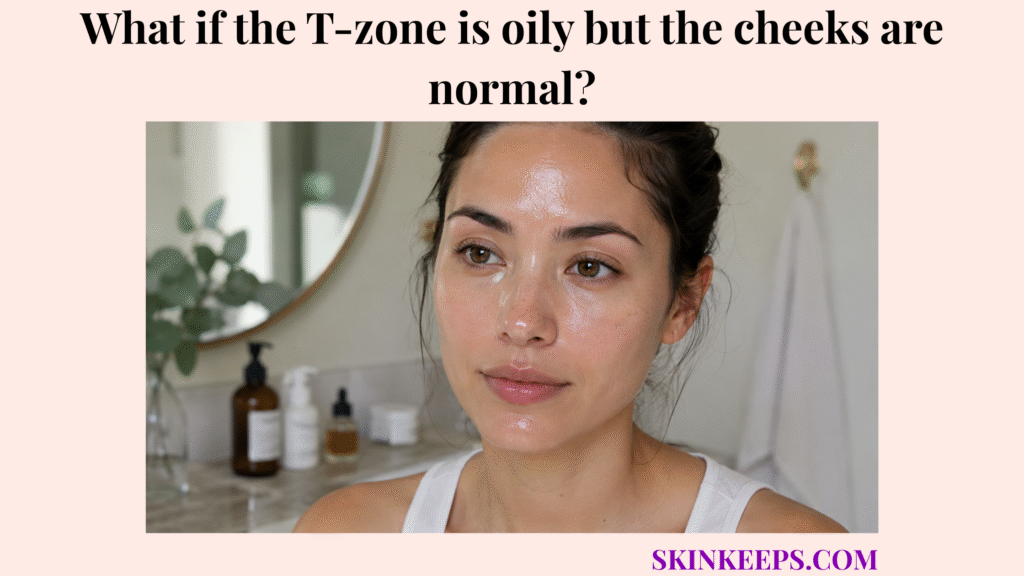
If the T-zone is oily but the cheeks are normal, this can still fit a mild or T-zone-dominant form of combination skin. In this pattern, the forehead, nose, and chin may produce more oil, show more shine, or develop visible pores or clogged pores while the cheeks feel balanced, comfortable, and neither dry nor greasy.
This combination skin pattern is different from classic combination skin where the T-zone is oily and the cheeks are dry. The practical goal is to control oil where it appears without over-treating normal cheek areas that are already behaving well.
What does oily T-zone with normal cheeks mean in combination skin?
Oily T-zone with normal cheeks in combination skin means the forehead, nose, and chin produce more visible oil while the cheeks stay balanced and comfortable. The face is not fully oily, because the cheeks do not become greasy quickly, but it is not fully balanced either because the center face still shows more shine.
This can fit combination skin because different facial zones behave differently. The key distinction is that the cheeks are normal rather than dry, flaky, tight, or reactive at baseline.
Key Signs of This Combination Skin Pattern
- Forehead, nose, or chin becomes shiny during the day.
- Nose may show visible pores or blackheads.
- Chin may become slightly congested.
- Cheeks feel comfortable after cleansing.
- Cheeks do not usually flake, sting, or feel tight.
- Moisturizer may feel necessary on the cheeks but too heavy on the T-zone.
Oily T-Zone With Normal Cheeks Map
This visual shows the mild combination-skin pattern: oil activity in the forehead, nose, and chin while the cheeks stay balanced.
Figure 1. Mild combination skin can show an oily center face while the cheeks remain comfortable and balanced.
Why can combination skin have an oily T-zone but normal cheeks?
Combination skin can have an oily T-zone but normal cheeks because oil production and facial-zone comfort are not always equal across the whole face. The T-zone can show more visible oil activity while the cheeks keep enough comfort to feel balanced.
How the T-zone in combination skin can produce more oil
The T-zone in combination skin can produce more visible oil because the forehead, nose, and chin often show stronger shine, pore visibility, and congestion than the cheeks. This is why an oily T-zone in combination skin can appear even when the side areas of the face do not feel greasy.
How normal cheeks in combination skin can stay balanced
Normal cheeks in combination skin can stay balanced when they have enough oil and hydration to feel comfortable without becoming greasy, flaky, or tight. Balanced cheeks may still need moisturizer, but they do not usually need the same oil-control pressure as the forehead, nose, and chin.
How combination skin can be mild instead of extreme
Combination skin can be mild instead of extreme because the contrast may be oily plus normal rather than oily plus very dry. This T-zone-dominant combination skin pattern can be subtle, so repeated observation matters more than one shiny day.
How can you tell oily T-zone and normal cheeks are combination skin, not oily skin?
You can tell oily T-zone and normal cheeks are combination skin rather than oily skin by checking whether oiliness stays mainly in the forehead, nose, and chin instead of spreading across most of the face. Oily skin usually affects the cheeks more broadly, while this pattern keeps the cheek area comfortable.
This comparison is easier when the pattern is placed beside different skin types instead of judged from one area alone.
| Skin pattern | T-zone | Cheeks | What it suggests |
|---|---|---|---|
| Combination skin with normal cheeks | Oily, shiny, or congested | Balanced and comfortable | Zone-specific oil pattern |
| Classic combination skin | Oily | Dry, tight, or flaky | Stronger mixed-zone pattern |
| Oily skin | Oily | Also oily or greasy | Oiliness across most of face |
| Normal skin | Balanced | Balanced | Little zone difference |
| Dehydrated oily skin | Oily but tight | Tight or dull | Water loss, not just oil |
Practical Rule
If only the T-zone gets oily while the cheeks stay comfortable and balanced, the pattern is closer to combination skin than full-face oily skin.
Pattern Classification Flow
This visual separates oily T-zone with normal cheeks from oily skin, normal skin, and classic oily-plus-dry combination skin.
Figure 2. Oily T-zone with normal cheeks points toward a zone-specific combination-skin pattern, not full-face oily skin.
What signs show the cheeks are truly normal in combination skin?
Normal cheeks in combination skin usually feel comfortable, balanced, smooth, and stable after gentle cleansing and basic moisturizing. This means the cheeks are not being read as normal just because the T-zone is oilier; they should actually feel comfortable on their own.
Normal Cheek Signs
- Cheeks do not feel tight after a gentle cleanse.
- Cheeks do not become greasy quickly.
- Cheeks do not usually flake.
- Cheeks tolerate basic moisturizer comfortably.
- Cheeks do not sting often after simple products.
- Makeup does not cling heavily or slide off quickly.
- Texture feels mostly smooth or balanced.
Important Distinction
Normal cheeks are not problem-free forever. They can still react to harsh cleansers, strong exfoliants, weather shifts, or aggressive oil-control products, but at baseline they feel balanced.
How should combination skin care for an oily T-zone without disrupting normal cheeks?
Combination skin should care for an oily T-zone without disrupting normal cheeks by using gentle full-face basics and targeted oil control only where shine or congestion appears. This approach protects cheek comfort while allowing the T-zone to receive lighter, more oil-aware care.
Cleanse combination skin gently instead of stripping the whole face
Combination skin should be cleansed gently because stripping the whole face to control T-zone oil can make normal cheeks tight, dull, or irritated. Washing more aggressively is not better oil control when only the center face is oily.
Moisturize combination skin lightly on the T-zone and normally on the cheeks
Combination skin can use a thinner moisturizer layer on the oily T-zone and a comfortable layer on normal cheeks. This is especially useful when combination skin product reactions show that one amount or texture does not behave the same way across every facial area.
Apply oil-control products to the T-zone in combination skin
Oil-control products in combination skin should usually be applied to the T-zone rather than automatically spread across normal cheeks. Mattifying primer, clay masks, exfoliants, or pore-focused products are better interpreted as targeted tools, not full-face requirements.
| Routine step | T-zone move | Normal cheek move | What to avoid |
|---|---|---|---|
| Cleanser | Remove oil gently | Do not strip | Harsh foaming cleanse |
| Moisturizer | Use thin layer | Use comfortable layer | Skipping cheeks entirely |
| Sunscreen | Choose non-greasy texture | Keep daily coverage | Avoiding sunscreen due to shine |
| Exfoliant | Target oily or congested areas | Use less often or avoid if unnecessary | Full-face over-exfoliation |
| Clay mask | Apply only to oily T-zone | Usually skip cheeks | Drying the whole face |
Zone-Aware Oil Control
This visual shows the safe care logic: gentle basics everywhere, oil control on the T-zone, and balanced support on normal cheeks.
Figure 3. The safest routine logic is local oil control with normal-cheek preservation.
Which products should combination skin choose for oily T-zone and normal cheeks?
Combination skin with an oily T-zone and normal cheeks should choose lightweight, non-stripping, zone-friendly products that control shine without drying balanced cheek areas. The whole face does not always need the same product strength because only one zone may be showing oil.
| Product type | Better choice for this combination skin pattern | Why it helps |
|---|---|---|
| Cleanser | Gentle gel or mild foaming cleanser | Cleans oil without drying cheeks |
| Moisturizer | Lightweight lotion or gel-cream | Supports cheeks without overloading T-zone |
| Sunscreen | Lightweight, non-greasy sunscreen | Protects skin without heavy shine |
| Exfoliant | Mild salicylic acid or gentle exfoliant used selectively | Helps oily or clogged T-zone |
| Mask | Clay only on T-zone when needed | Controls oil without drying normal cheeks |
| Makeup primer | Mattifying only on T-zone | Keeps cheeks natural and comfortable |
Product Rule
Choose products for the whole face only when the whole face needs them. Choose targeted products when only the T-zone is oily.
What mistakes make oily T-zone and normal cheeks worse in combination skin?
Oily T-zone and normal cheeks can get worse in combination skin when the routine treats the whole face as oily, strips balanced cheeks, skips moisturizer, or overuses drying products. These mistakes often happen because the T-zone looks more demanding than the cheeks.
Avoid treating combination skin as fully oily skin
Treating combination skin as fully oily skin can make normal cheeks tight, dull, or irritated while chasing oil that mainly appears in the T-zone. Strong cleansers, drying toners, and full-face mattifying products should be used cautiously when cheek comfort is already normal.
Avoid using drying products on normal cheeks in combination skin
Using drying products on normal cheeks in combination skin can disrupt areas that were already balanced. This matters because the difference between the cheek area and the T-zone is exactly what makes the pattern zone-specific.
Avoid skipping moisturizer because the T-zone is oily
Skipping moisturizer because the T-zone is oily can leave normal cheeks less comfortable and may make active products harder to tolerate. Lightweight moisturizer can preserve balance without forcing a heavy cream across the nose or forehead.
Avoid overusing clay masks across combination skin
Overusing clay masks across combination skin can dry normal cheeks even when the T-zone benefits from occasional oil control. If cheeks are already normal, they usually do not need the same drying step used on an oilier center face.
How can combination skin adjust when the T-zone gets oilier during the day?
Combination skin can adjust when the T-zone gets oilier during the day by controlling shine locally instead of rewashing or drying the whole face. This keeps normal cheeks from being over-treated just because the forehead, nose, or chin becomes shiny.
Daytime Adjustments
- Blot the T-zone instead of washing the whole face again.
- Use a lightweight moisturizer in the morning.
- Apply mattifying primer only on the forehead, nose, or chin.
- Keep sunscreen light but consistent.
- Avoid powder buildup that makes texture look heavier.
- Reassess whether the cleanser is too harsh if cheeks start feeling tight.
Practical Rule
Control shine locally. Do not punish the whole face for T-zone oil.
When should oily T-zone and normal cheeks in combination skin be reassessed?
Oily T-zone and normal cheeks in combination skin should be reassessed when the cheeks become tight, flaky, irritated, or oily, or when the T-zone develops frequent breakouts or persistent congestion. Skin patterns can change with weather, products, hormones, stress, or over-treatment.
This reassessment is especially useful if visible pores, congestion, or bumpy texture starts changing the pattern, because visible T-zone pores in combination skin can be a clue but not the only sign that the routine needs review.
Reassess If
- Cheeks start feeling tight, flaky, or irritated.
- T-zone oiliness becomes paired with frequent breakouts.
- Nose or chin congestion worsens.
- Products that once worked start burning or stinging.
- Skin becomes oily everywhere, not just the T-zone.
- Skin feels both oily and tight, suggesting possible dehydration.
- A simple routine does not keep the skin comfortable.
What should you remember about oily T-zone and normal cheeks in combination skin?
The key point is that oily T-zone with normal cheeks can fit combination skin, but the routine should treat only the oily zone as oily.
Final Checklist
- Oily T-zone with normal cheeks can fit combination skin.
- This pattern is not the same as full-face oily skin.
- This pattern is also not the same as oily T-zone plus dry cheeks.
- Treat the T-zone for oil only where needed.
- Keep normal cheeks balanced, not over-treated.
- Use gentle cleansing.
- Use lightweight moisturizer.
- Apply clay masks, exfoliants, or mattifying products selectively.
- Watch for changes in cheek comfort.
- Reassess if oiliness spreads, breakouts worsen, or irritation appears.
Frequently Asked Questions About Oily T-Zone and Normal Cheeks in Combination Skin
Is oily T-zone with normal cheeks still combination skin?
Yes. Oily T-zone with normal cheeks can be a mild form of combination skin because the forehead, nose, and chin behave differently from the cheeks.
Does combination skin always mean oily T-zone and dry cheeks?
No. Combination skin does not always mean oily T-zone and dry cheeks. It can also mean oily T-zone with normal cheeks when the cheeks stay balanced and comfortable.
Should I use oily-skin products if only my T-zone is oily?
Use oily-skin products carefully and mainly where oiliness appears. Applying strong oil-control products everywhere may disrupt normal cheeks and create unnecessary tightness or irritation.
Do normal cheeks still need moisturizer in combination skin?
Yes. Normal cheeks in combination skin usually still benefit from lightweight moisturizer to stay balanced, comfortable, and less affected by cleansing or weather changes.
Should I exfoliate my whole face if only my T-zone is oily?
Not necessarily. If only the T-zone is oily or congested, targeted exfoliation is usually safer than treating normal cheeks with the same strength and frequency.
Conclusion About Oily T-Zone and Normal Cheeks in Combination Skin
Oily T-zone with normal cheeks can fit combination skin because the forehead, nose, and chin may show more oil activity while the cheeks remain balanced and comfortable. This pattern is milder than classic oily-plus-dry combination skin, but it still needs zone-aware care because the whole face is not behaving the same way.
The safest approach is to cleanse gently, control shine locally, keep normal cheeks supported, and avoid applying drying oil-control products everywhere. If the cheeks stop feeling normal, oiliness spreads across the whole face, or breakouts, irritation, burning, cracking, bleeding, swelling, or sudden changes appear, the pattern should be reassessed rather than forced into one skin-type label.
Sources & Evidence for Combination Skin
Cleveland Clinic — Understanding Skin Types
Supports combination skin as zone-based behavior involving an oilier T-zone and different cheek behavior.
[Cleveland Clinic]American Academy of Dermatology — How to Control Oily Skin
Supports oil-control guidance such as oil-free, non-comedogenic products and blotting instead of aggressive washing.
[AAD]American Academy of Dermatology — Face Washing 101
Supports gentle cleansing, lukewarm water, avoiding scrubbing, and using moisturizer when needed.
[AAD]American Academy of Dermatology — How to Safely Exfoliate at Home
Supports caution around exfoliation and avoiding irritation, especially when skin is dry, sensitive, or already affected by stronger products.
[AAD]DermNet — Comedonal Acne
Supports blackheads and clogged-pore context without turning T-zone oiliness into an acne diagnosis.
[DermNet]American Academy of Dermatology — Acne Scars Overview
Supports escalation when acne is deep, painful, or likely to scar.
[AAD]Educational Disclaimer: This article is for general skin education only and does not diagnose, treat, or replace professional medical care. If oiliness is paired with painful acne, persistent irritation, burning, cracking, bleeding, sudden skin changes, swelling, or spreading rash-like symptoms, consult a qualified dermatologist.