
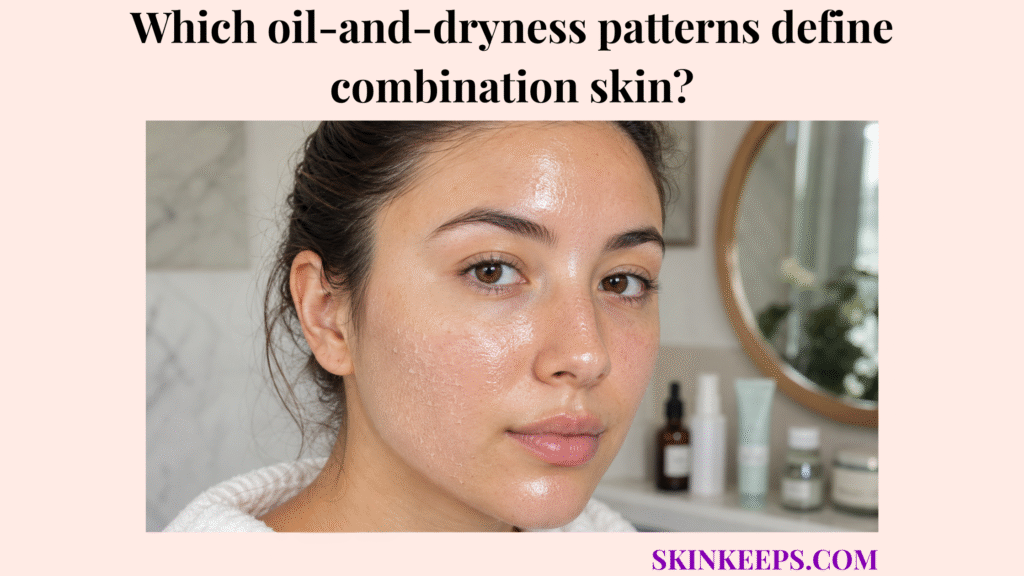
Combination skin is usually defined by uneven oil and dryness patterns across the face. The most common combination skin pattern is an oily T-zone with drier cheeks, but the same skin type can also appear as an oily T-zone with normal cheeks, an oily nose with a balanced outer face, or shifting zones that become oily, dry, or tight under different conditions.
Combination skin is defined by different facial areas behaving differently at the same time or under the same routine. That location-based contrast matters more than one oily moment, one dry patch, or one tight-feeling day.
What oil-and-dryness patterns define combination skin?
Oil-and-dryness patterns define combination skin when one facial zone is oilier while another zone is dry, normal, tight, flaky, or less oily. This means combination skin is best understood as mixed facial-zone behavior rather than one uniform skin label.
Because the pattern is mixed, combination skin does not require every person to have dry cheeks. Some people have a classic oily-and-dry pattern, while others have a milder pattern where the T-zone is oily and the cheeks stay balanced.
| Combination skin pattern | Oily area | Dry or normal area | What it means |
|---|---|---|---|
| Classic combination skin | Forehead, nose, chin | Cheeks feel dry or tight | Strong oil-and-dryness contrast |
| Mild combination skin | T-zone | Cheeks feel normal | Oil is concentrated, but cheeks stay balanced |
| Nose-dominant combination skin | Nose mostly | Cheeks and forehead may feel normal or dry | Oil is localized around the nose |
| Chin-and-nose combination skin | Chin and nose | Cheeks may feel normal or dry | Congestion may cluster in lower T-zone |
| Seasonal combination skin | T-zone remains oily | Cheeks become drier in cold or dry weather | Pattern changes with environment |
| Treatment-affected combination skin | Breakout zones may stay oily | Treated areas may peel or dry | Products may exaggerate mixed behavior |
Practical rule: If the face does not behave as one uniform skin type, and oiliness is clearly stronger in some zones than others, the pattern may fit combination skin.
Oil-and-Dryness Pattern Map
This visual shows how combination skin is identified by comparing oily zones with dry, normal, or less oily zones.
Figure 1. Combination skin is identified by location-based contrast, not by oiliness or dryness alone.
Why do oil-and-dryness patterns happen in combination skin?
Oil-and-dryness patterns happen in combination skin because oil production, moisture retention, product tolerance, and environmental response can vary by facial zone. That is why the forehead, nose, and chin may show shine while the cheeks or around-mouth area stay normal, tight, or flaky.
How combination skin creates more oil in the T-zone
Combination skin creates more oil in the T-zone when the forehead, nose, and chin show stronger shine, visible pores, blackheads, or congestion than the cheeks. This T-zone pattern is easier to understand after reading why an oily T-zone with normal cheeks can still fit a mild combination-skin pattern.
How combination skin creates dryness or balance on the cheeks
Combination skin creates dryness or balance on the cheeks when cheek areas produce less visible oil, lose moisture more easily, or stay comfortable while the T-zone becomes oily. The cheeks may be dry and tight, or they may be normal and comfortable.
How combination skin patterns can shift with routine, weather, and hormones
Combination skin patterns can shift with routine, weather, and hormones because cleansing, acne products, dry air, humidity, stress, and hormonal changes can alter oiliness and dryness. These changes can make seasonal or treatment-affected patterns look stronger for a short period.
Which facial zones show oil-and-dryness differences in combination skin?
Facial zones show oil-and-dryness differences in combination skin most clearly across the forehead, nose, chin, cheeks, around-mouth area, and jawline. Instead of labeling the whole face too quickly, it helps to observe how each zone behaves under the same products and conditions.
| Facial zone in combination skin | Common oil sign | Common dryness sign | What to observe |
|---|---|---|---|
| Forehead | Shine, bumps, clogged pores | Tightness if over-cleansed | Does it get oily faster than cheeks? |
| Nose | Shine, visible pores, blackheads | Rare dryness unless irritated | Is oil mostly concentrated here? |
| Chin | Shine, clogged pores, breakouts | Peeling from acne products | Does congestion appear here often? |
| Cheeks | Usually less oily | Tightness, flakes, roughness, or normal comfort | Are cheeks dry, normal, or occasionally reactive? |
| Around mouth | Less oil | Peeling, tightness, stinging | Is dryness product-related? |
| Jawline | Breakouts or mixed texture | Dryness from actives | Is the pattern acne-related or dryness-related? |
How does classic combination skin differ from mild combination skin?
Classic combination skin differs from mild combination skin because classic patterns show oily T-zone plus dry cheeks, while mild patterns show oily T-zone plus normal cheeks or localized oil. Both patterns can count as combination skin when zone contrast repeats.
Identify classic combination skin with oily T-zone and dry cheeks
Classic combination skin is the recognizable pattern where the T-zone becomes oily or congested while the cheeks feel dry, tight, flaky, rough, or under-moisturized. This strong mixed-zone contrast is also why breakouts and dry patches in combination skin can sometimes appear together.
Identify mild combination skin with oily T-zone and normal cheeks
Mild combination skin can show an oily T-zone with normal cheeks because the T-zone still behaves differently from the rest of the face. Normal cheeks do not disqualify combination skin when the center of the face repeatedly becomes shinier or more congested.
Identify borderline combination skin when only one area is oily
Borderline combination skin may appear when only the nose, chin, or a small part of the T-zone is oilier than the rest of the face. This pattern should be observed over time before it is treated like full-face oily skin.
| Pattern | T-zone | Cheeks | Best description |
|---|---|---|---|
| Classic combination skin | Oily or congested | Dry, tight, flaky, or rough | Strong mixed-zone contrast |
| Mild combination skin | Oily or shiny | Normal and comfortable | T-zone-dominant pattern |
| Borderline combination skin | Nose or chin oily | Mostly balanced | Localized oil difference |
| Not typical combination skin | Whole face oily | Cheeks also greasy | More likely oily skin |
| Not typical combination skin | Whole face dry | T-zone also tight or flaky | More likely dry skin |
Classic, Mild, and Borderline Combination Skin
This visual separates the main pattern types so mild combination skin is not missed just because the cheeks are normal.
Figure 2. Combination skin can be classic, mild, or localized as long as the same zone contrast repeats.
How can combination skin be confused with oily skin, dry skin, or dehydrated skin?
Combination skin can be confused with oily skin, dry skin, or dehydrated skin when the reader notices oil, tightness, or flakes without checking where each symptom appears. Comparing different skin types is useful because combination skin is about location-based contrast, while oily and dry skin are usually more widespread.
| Skin pattern | Oil behavior | Dryness behavior | Main clue |
|---|---|---|---|
| Combination skin | Oilier in selected zones | Dry, normal, or less oily in other zones | Uneven facial-zone behavior |
| Oily skin | Oil across most of the face | Usually not zone-specific dryness | Shine is widespread |
| Dry skin | Low oil across most of the face | Tightness or flakes across many areas | Dryness is widespread |
| Normal skin | Balanced oil across most zones | Little tightness or shine | Minimal zone contrast |
| Dehydrated skin | May feel oily and tight | Water loss, tightness, dullness | Skin can feel oily but still tight |
| Sensitive skin overlap | May be oily or dry | Stinging, burning, redness | Reactivity is the main clue |
Practical rule: Combination skin is about location-based contrast. Dehydration is about water loss and tightness, even if oil is still present.
What signs confirm oil-and-dryness patterns in combination skin?
Oil-and-dryness patterns in combination skin are confirmed by observing where shine, tightness, flakes, clogged pores, and product comfort appear over several hours. One moment after cleansing is not enough because oil and tightness can change as the day progresses.
Facial-Zone Observation Checklist
- After cleansing, check whether cheeks feel tight but the T-zone becomes oily later.
- Watch whether shine appears first on the forehead, nose, or chin.
- Notice whether cheeks stay normal while the T-zone becomes greasy.
- Check whether flakes appear only on cheeks, around the mouth, or near treated breakout zones.
- Observe whether blackheads or clogged pores appear mainly on the nose or chin.
- Look at how moisturizer behaves: too heavy on the T-zone but comfortable on cheeks.
- Look at how makeup behaves: separates on oily zones but clings to dry patches.
- Track whether the pattern changes with weather, stress, hormones, or new products.
Practical test: Observe skin at three points: after cleansing, mid-day, and before bed. Combination skin patterns often become clearer over several hours.
How should combination skin care change based on oil-and-dryness patterns?
Combination skin care should change based on oil-and-dryness patterns by treating oily zones lightly while giving dry or normal zones only the support they need. The goal is direction, not a complicated full routine.
Adjust combination skin care when the T-zone is oily and cheeks are dry
Combination skin care should balance oil control and barrier support when the T-zone is oily and the cheeks are dry. If bumps, visible pores, flakes, or roughness appear together, the article on uneven skin texture across the face in combination skin explains how those clues can overlap.
Adjust combination skin care when the T-zone is oily and cheeks are normal
Combination skin care should use local oil control when the T-zone is oily and the cheeks are normal. Normal cheeks do not need aggressive oil-control products just because the center of the face becomes shiny.
Adjust combination skin care when oiliness and dryness shift by season
Combination skin care should adjust gently when oiliness and dryness shift by season rather than changing the whole routine at once. Lighter textures may feel better in humid weather, while dry or cold weather may require more barrier support on dry zones.
| Combination skin pattern | Main routine focus | Best adjustment | Avoid |
|---|---|---|---|
| Oily T-zone + dry cheeks | Balance oil control with barrier support | Treat T-zone lightly, moisturize cheeks well | Drying the whole face |
| Oily T-zone + normal cheeks | Local oil control | Use lighter T-zone layers | Turning normal cheeks dry |
| Oily nose only | Localized pore care | Apply treatment only on nose if needed | Full-face acne routine |
| Dry cheeks after acne treatment | Barrier recovery | Reduce active frequency on dry zones | Adding more actives |
| Seasonal mixed pattern | Flexible routine | Adjust moisturizer texture by weather | Changing everything at once |
Observation-to-Care Decision Flow
This visual shows how pattern recognition should guide gentle, zone-aware routine direction without overcorrecting the whole face.
Figure 3. Combination skin care should respond to repeated zone behavior rather than one temporary oily or dry symptom.
What mistakes hide or worsen oil-and-dryness patterns in combination skin?
Mistakes hide or worsen oil-and-dryness patterns in combination skin when the routine treats the whole face as one skin type before identifying where oil, dryness, or tightness appears. These mistakes can make the true pattern harder to see.
Avoid treating combination skin as oily skin everywhere
Treating combination skin as oily skin everywhere can make normal or dry areas tighter, duller, rougher, or more irritated. Oil-control products should go where oil actually appears, not automatically across the whole face.
Avoid assuming combination skin always has dry cheeks
Assuming combination skin always has dry cheeks can cause readers to miss mild patterns such as oily T-zone with normal cheeks. Dry cheeks are common, but they are not mandatory for combination skin.
Avoid confusing dehydrated skin with combination skin
Confusing dehydrated skin with combination skin can happen when skin feels oily and tight but the tightness reflects water loss rather than a true oily-and-dry zone pattern. If the pattern appears after product changes, it may help to review product reactions by facial area in combination skin before changing the whole routine.
Avoid changing too many products before identifying the combination skin pattern
Changing too many products before identifying the combination skin pattern can blur whether the issue is oil distribution, dryness, irritation, or product reaction. Observing first makes the next routine adjustment safer and clearer.
When should oil-and-dryness patterns in combination skin be reassessed?
Oil-and-dryness patterns in combination skin should be reassessed when symptoms become painful, spreading, full-face, product-triggered, or paired with persistent acne or irritation. Reassessment does not always mean an emergency, but it means the pattern should not be treated as ordinary skin-type variation without closer review.
Reassess If
- Dryness becomes painful, cracked, bleeding, or spreading.
- Oiliness becomes full-face rather than zone-specific.
- Cheeks suddenly become irritated after new products.
- The T-zone becomes oily but also tight, dull, or flaky.
- Breakouts become painful, deep, or scarring.
- Flaking appears mainly where acne products are applied.
- Skin reacts to many gentle products.
- A simple routine does not improve comfort.
What should you remember about oil-and-dryness patterns in combination skin?
The key point is that combination skin is defined by uneven facial-zone behavior, not by oiliness or dryness alone.
Final Identification Checklist
- Combination skin is defined by uneven facial-zone behavior.
- The classic pattern is oily T-zone with dry cheeks.
- A mild pattern is oily T-zone with normal cheeks.
- Oil may also concentrate around the nose, chin, or forehead.
- Dryness may appear on cheeks, around the mouth, or where strong products are used.
- Combination skin is not the same as full-face oily skin.
- Combination skin is not the same as full-face dry skin.
- Dehydrated skin can feel oily and tight, so do not misread it.
- Identify the pattern before choosing products.
- Treat oily zones without damaging normal or dry zones.
Frequently Asked Questions About Oil-and-Dryness Patterns in Combination Skin
What is the most common oil-and-dryness pattern in combination skin?
The most common oil-and-dryness pattern in combination skin is an oily T-zone with drier cheeks, but this is not the only valid combination-skin pattern.
Can combination skin have oily T-zone and normal cheeks?
Yes. Combination skin can have an oily T-zone and normal cheeks because the T-zone still behaves differently from the cheeks, even when the cheeks are balanced.
Can combination skin be oily only around the nose?
Yes. Combination skin can sometimes look oily mainly around the nose if that area is much shinier, more pore-visible, or more congested than the rest of the face.
Is oily but tight skin always combination skin?
No. Oily but tight skin is not always combination skin. It may reflect dehydration, irritation, over-cleansing, or treatment-related dryness unless the pattern clearly differs by facial zone.
Does combination skin always include dry patches?
No. Combination skin does not always include dry patches. Some patterns include oily zones with normal, balanced cheeks rather than visibly dry or flaky areas.
Conclusion About Oil-and-Dryness Patterns in Combination Skin
Oil-and-dryness patterns define combination skin when different facial zones behave differently under the same routine. The most recognizable pattern is an oily T-zone with dry cheeks, but mild combination skin can also show an oily T-zone with normal cheeks or localized oil around the nose or chin.
The safest approach is to identify the repeated pattern before changing products. If dryness becomes painful, cracked, bleeding, spreading, or paired with severe irritation, painful acne, scarring, swelling, sudden skin changes, or persistent product reactions, professional guidance is safer than guessing from skin type alone.
Sources & Evidence for Combination Skin
Cleveland Clinic — Understanding Skin Types
Supports combination-skin zone differences and T-zone/cheek behavior.
[Cleveland Clinic]American Academy of Dermatology — Oily Skin Care
Supports cleansing, oil-free products, non-comedogenic products, and shine-control context.
[AAD]American Academy of Dermatology — Face Washing Guidance
Supports gentle cleansing, lukewarm water, and avoiding scrubbing.
[AAD]American Academy of Dermatology — Dry Skin Care
Supports roughness, irritation risk, and moisturizer direction for dry zones.
[AAD]American Academy of Dermatology — Exfoliation Safety
Supports avoiding irritation and over-exfoliation, especially when the skin is dry or sensitive.
[AAD]DermNet — Comedonal Acne
Supports blackheads, whiteheads, mild cleansing, and oil-free cosmetic context without overdiagnosing combination skin.
[DermNet]American Academy of Dermatology — Acne Scars
Supports reassessment when breakouts are deep or scarring.
[AAD]Educational Disclaimer: This article is for general skin education only and does not diagnose, treat, or replace professional medical care. If dryness becomes painful, cracked, bleeding, spreading, or paired with severe irritation, painful acne, scarring, swelling, sudden skin changes, or persistent product reactions, consult a qualified dermatologist.