
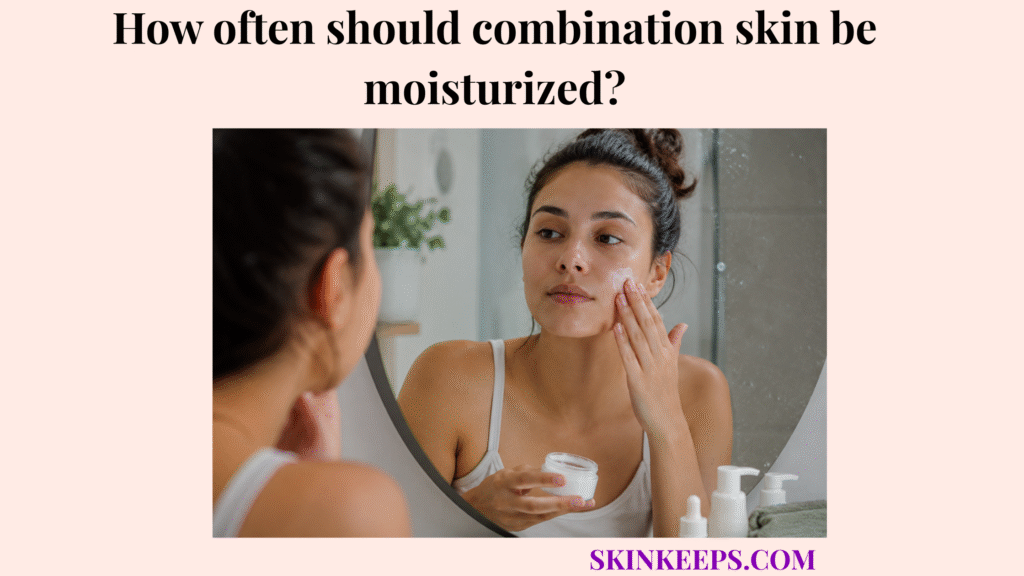
Combination skin should usually be moisturized at least once daily, and many people do best moisturizing twice daily: once in the morning and once at night after cleansing.
The key for combination skin is not applying the same amount everywhere. Oily zones may need a thin, lightweight layer, while cheeks, around the mouth, or the outer face may need a more generous or supportive layer when they feel tight, flaky, or uncomfortable.
If the T-zone becomes greasy, combination skin usually needs less product or a lighter texture there, not a complete break from moisturizer. The goal is steady comfort: oilier areas stay lightly supported, and dry zones receive enough barrier support without clogging oily areas.
How often should combination skin be moisturized?
Combination skin should usually be moisturized daily, and many people do well with a light morning layer plus evening support after cleansing.
Daily moisturizing helps combination skin stay comfortable because the oily and dry zones do not lose comfort at the same pace. The T-zone may need a thinner, noncomedogenic layer, while dry cheeks may need more consistent support.
People comparing different skin types should remember that combination skin is not managed like one uniform oily or dry pattern. Frequency, amount, texture, and placement all matter.
| Combination skin situation | Moisturizing frequency | Product amount |
|---|---|---|
| Mild oily T-zone, normal cheeks | Once or twice daily | Thin layer all over or lighter on T-zone |
| Oily T-zone, dry cheeks | Morning and evening | Light T-zone layer, more on cheeks |
| Dry cheeks after cleansing | After each cleanse | Extra support on dry zones |
| Acne-prone T-zone | Daily, with noncomedogenic texture | Thin layer near oily areas |
| Oily but tight skin | Daily, often twice daily | Lightweight hydration, not heavy grease |
| Low humidity or cold weather | More consistent support | Extra dry-zone layer |
| After strong actives | Moisturize after use or as directed | Protect dry or peeling zones |
| Greasy buildup | Keep moisturizing but reduce amount | Use lighter texture |
Combination skin should be moisturized by need and zone, not by one fixed full-face amount.
Should combination skin be moisturized in the morning?
Combination skin should often be moisturized in the morning because light support can reduce tightness, prepare dry zones, and help sunscreen or makeup sit more evenly.
Morning moisturizer can make combination skin easier to manage through the day. It does not have to be rich or heavy; many people need a light layer on the forehead, nose, and chin, with more support where cheeks or the outer face feel dry.
Why morning moisturizer helps combination skin
Morning moisturizer helps combination skin by supporting dry zones, reducing tightness, and creating a smoother base before sunscreen or makeup.
Cheeks, around-mouth skin, and the outer face may look smoother when they are supported before sunscreen or makeup. This can reduce patchiness without making the T-zone greasy.
How oily zones in combination skin should be moisturized in the morning
Oily zones in combination skin should be moisturized in the morning with a thin, lightweight layer so the T-zone does not feel greasy under sunscreen or makeup.
For the forehead, nose, and chin, less product is different from no product. A thin layer can help comfort after cleansing while still respecting shine-prone zones.
How dry zones in combination skin should be moisturized in the morning
Dry zones in combination skin should be moisturized more generously in the morning when cheeks, around-mouth skin, or outer-face areas feel tight or look patchy.
Dry zones often need more support than the T-zone, especially before sunscreen or makeup. This does not mean rich cream belongs everywhere.
| Morning condition in combination skin | Better moisturizer move | Avoid |
|---|---|---|
| T-zone gets shiny quickly | Use a thin lightweight layer | Skipping all moisturizer |
| Cheeks feel tight | Add more moisturizer to cheeks | Treating cheeks like oily zones |
| Sunscreen feels greasy | Use less moisturizer under T-zone | Skipping sunscreen |
| Makeup clings to cheeks | Hydrate dry zones first | Powdering over flakes |
| Oily but tight skin | Use lightweight hydration | Washing again and again |
| Normal cheeks | Use a balanced thin layer | Overloading with rich cream |
Should combination skin be moisturized at night?
Combination skin should often be moisturized at night because cleansing, sunscreen removal, makeup removal, sweat, and actives can leave some zones needing comfort.
Evening moisturizing is often where combination skin gets the most benefit. The skin has usually been cleansed, and dry or treated areas may need comfort before the next day.
Why night moisturizer matters for combination skin
Night moisturizer matters for combination skin because it restores comfort after cleansing and supports zones affected by sunscreen, makeup, sweat, or active ingredients.
This is comfort support, not a promise of full barrier repair. It helps reduce the tight feeling that can appear after residue removal or active use.
How combination skin should moisturize after evening cleansing
Combination skin should moisturize after evening cleansing with less product on oily zones and more product on dry or tight zones.
The T-zone may only need a light layer. Cheeks, around the mouth, or the outer face may need a normal or more supportive layer if cleansing leaves them tight.
How combination skin should moisturize after acne products or exfoliants
Combination skin should moisturize more carefully after acne products or exfoliants because treated areas can peel, sting, or become tight.
When acne treatments or exfoliating acids affect the chin, jawline, or T-zone, moisturizing around treated areas can reduce discomfort. If irritation keeps recurring, the active step may be too strong or too frequent.
| Evening situation in combination skin | Moisturizer direction | Watch out for |
|---|---|---|
| After gentle cleansing | Moisturize all needed zones | Leaving cheeks tight |
| After makeup removal | Rebalance dry areas | Over-cleansing |
| After sunscreen removal | Restore comfort | Heavy cream on clogged T-zone |
| After salicylic acid | Moisturize to reduce dryness | Peeling on cheeks |
| After benzoyl peroxide | Support treated areas | Spreading dryness |
| After retinoid | Buffer or moisturize as tolerated | Irritation around mouth |
| After humid sweaty day | Light layer on T-zone, normal layer on cheeks | Skipping moisture due to oil |
Zone-Based Moisturizing Frequency Map
This visual shows why combination skin usually needs daily moisturizer, but not the same amount in every facial zone.
Figure 1. Zone-based moisturizing frequency works best when oily areas receive lighter layers and dry areas receive more consistent support.
How often should oily zones in combination skin be moisturized?
Oily zones in combination skin should usually be moisturized daily with a thin, lightweight layer instead of being skipped completely.
Oily zones often need less moisturizer, not zero moisturizer. This is especially true when a cleanser, acne treatment, exfoliant, or dry weather leaves the forehead, nose, or chin tight.
People using care tips that balance oily and dry zones in combination skin should treat moisturizer amount as a control knob. A thin layer can support comfort without creating greasy buildup.
| Oily zone in combination skin | How often to moisturize | How much to use |
|---|---|---|
| Forehead | Daily or after cleansing | Thin layer |
| Nose | Daily if tight or treated; very light if greasy | Very thin layer |
| Chin | Daily, especially with acne care | Thin noncomedogenic layer |
| Oily but tight T-zone | Morning and evening may help | Lightweight hydration |
| Oily and clogged T-zone | Daily but lighter texture | Avoid heavy residue |
| T-zone under sunscreen | Adjust based on sunscreen texture | Reduce moisturizer amount if greasy |
Oily zones usually need less moisturizer, not zero moisturizer.
How often should dry zones in combination skin be moisturized?
Dry zones in combination skin should usually be moisturized morning and evening, with extra support when they feel tight, flaky, rough, or uncomfortable.
Dry zones often guide the real moisturizing frequency because cheeks, around-mouth skin, and the outer face can lose comfort faster than the T-zone. These areas may need more consistent support even when the center of the face is shiny.
For readers managing using different products by area for combination skin, the dry-zone question may be solved by applying more of the same moisturizer first. Separate textures are only needed if amount changes do not work.
| Dry zone in combination skin | How often to moisturize | Product direction |
|---|---|---|
| Cheeks | Morning and evening if dry | More supportive layer |
| Around mouth | Morning and evening; extra if peeling | Barrier-support texture |
| Outer face | Daily; more in dry weather | Lotion or cream depending on dryness |
| Jawline | Adjust by dryness or breakouts | Light or supportive texture |
| Flaky patches | More consistent support | Avoid exfoliating first |
| Burning or stinging zones | Simplify and moisturize gently | Avoid strong actives |
Dry zones should guide moisturizing frequency more than the oily T-zone does.
Should combination skin moisturize after every cleanse?
Combination skin should usually moisturize after cleansing when any zone feels tight, dry, exposed, flaky, or uncomfortable.
After evening cleansing, moisturizer is especially useful because sunscreen, makeup, sweat, and oil removal can leave combination skin needing support. The layer can still be light where the T-zone is oily.
If skin stays shiny but tight after washing, the issue may overlap with dehydrated-feeling combination skin. In that case, more washing usually makes the pattern harder to manage.
| After-cleansing feeling in combination skin | What it suggests | Moisturizer move |
|---|---|---|
| Comfortable everywhere | Light layer may be enough | Keep routine simple |
| T-zone oily but cheeks tight | Cleanser may be too strong for cheeks | Moisturize cheeks more |
| Whole face tight | Cleanser may be stripping | Moisturize and review cleanser |
| Nose shiny but tight | Oily-dehydrated pattern possible | Lightweight hydration |
| Moisturizer stings | Barrier may be irritated | Use gentler formula |
| Flakes after washing | Dry zones need support | Apply moisturizer consistently |
| Greasy after moisturizer | Amount or texture too heavy | Use less or lighter texture |
Cleanser and moisturizer work together. If cleansing always creates tightness, fix both frequency and cleanser strength.
Morning and Evening Moisturizer Timing Flow
This visual separates morning texture control from evening comfort support so combination skin does not get the same amount everywhere.
Figure 2. Combination skin often uses moisturizer in both morning and evening, but the amount changes by zone and by what came before it.
How should combination skin adjust moisturizing frequency in different climates?
Combination skin should moisturize more consistently in cold, dry, windy, heated, or air-conditioned conditions and use lighter oily-zone layers in humid weather.
Climate can change how often dry zones ask for support. Cold air, wind, indoor heating, and air conditioning often make cheeks and around-mouth areas feel tighter, while humid weather may make the T-zone feel overloaded if the same amount is applied.
Moisturize combination skin more consistently in dry or cold weather
Combination skin should be moisturized more consistently in dry or cold weather when cheeks, around-mouth skin, or outer-face areas become tight or flaky.
Dry-zone support can increase without making the whole face heavier. A more supportive layer on cheeks may be enough while the T-zone stays light.
Moisturize combination skin lightly in humid weather
Combination skin should be moisturized lightly in humid weather when the T-zone feels greasy but dry zones still need basic support.
In humid conditions, reduce the amount on the forehead, nose, and chin rather than stopping moisturizer everywhere. Dry zones can still need a normal layer.
Moisturize combination skin by zone during travel or seasonal changes
Combination skin should be moisturized by zone during travel or seasonal changes because different areas may need more or less support than usual.
When climate and combination skin patterns change, adjust one moisturizer variable at a time. This keeps the skin response easier to read.
| Climate condition | Oily-zone frequency | Dry-zone frequency |
|---|---|---|
| Hot and humid | Daily, light layer | Daily, normal layer |
| Cold and dry | Daily, light but consistent | Morning, evening, and as needed |
| Windy weather | Avoid stripping | Add barrier support |
| Indoor heating | Keep T-zone light | Increase cheek support |
| Air conditioning | Light hydration | Moisturize tight areas |
| Travel climate shift | Keep routine stable | Adjust only where symptoms appear |
How often should combination skin moisturize when using acne treatments or exfoliants?
Combination skin should moisturize more carefully when using acne treatments or exfoliants because actives can dry treated zones and irritate dry or sensitive areas.
Actives can change moisturizer needs. A chin or T-zone treatment may create peeling near the mouth or cheeks if placement is too broad or frequency is too aggressive.
Moisturize combination skin more carefully when using acne treatments
Combination skin should be moisturized more carefully with acne treatments because treated chin, jawline, or T-zone areas can peel, sting, or dry out.
Salicylic acid, benzoyl peroxide, and retinoids may be useful for acne-prone zones, but combination skin often needs moisturizer support around treated areas. This is especially important where area-limited breakouts in combination skin overlap with dryness.
Moisturize combination skin after exfoliation if the skin feels tight
Combination skin should be moisturized after exfoliation when any zone feels tight, dry, stingy, or more sensitive than usual.
Exfoliation should not spread over fragile zones just because the T-zone is clogged. Dry or peeling areas usually need support before more exfoliation.
Reduce active frequency if combination skin needs more moisturizer every time
Combination skin may need less active frequency if every use causes stinging, peeling, burning, or a need for rescue moisturizer.
Repeated rescue moisturizing is a sign to reassess strength, placement, or timing. Do not stop prescribed treatments without clinician guidance.
| Active-use situation in combination skin | Moisturizer frequency | Caution |
|---|---|---|
| Salicylic acid on T-zone | Moisturize after or around use as tolerated | Avoid dry cheeks |
| Benzoyl peroxide on pimples | Moisturize treated area carefully | Watch peeling |
| Retinoid use | Moisturize consistently | Protect mouth and eye-adjacent zones |
| Exfoliating acids | Moisturize after use | Reduce if stinging appears |
| Clay mask on T-zone | Moisturize after if tight | Do not apply to dry cheeks |
| Breakouts plus peeling | Moisturize and reduce irritation | Do not add more actives |
How can combination skin tell if it is moisturizing too little?
Combination skin may be moisturizing too little when dry zones stay tight, flaky, dull, stingy, or uncomfortable after cleansing or by the end of the day.
Too little moisturizer in combination skin usually shows first on the cheeks, around the mouth, or outer face. It can also show as oily-but-tight skin when the T-zone has shine but poor comfort.
- Cheeks feel tight after cleansing.
- Around-mouth skin flakes or peels.
- Makeup clings to dry patches.
- Oily areas feel shiny but tight.
- Moisturizer absorbs quickly but discomfort returns.
- Acne treatments cause repeated peeling.
- Products sting more than usual.
- Skin looks dull or rough in dry zones.
- Dry zones feel worse in cold, wind, or air conditioning.
- The face feels uncomfortable by evening.
If dry zones keep asking for rescue, the moisturizing frequency or texture is probably too weak.
How can combination skin tell if it is moisturizing too much?
Combination skin may be moisturizing too much when the T-zone feels greasy, coated, congested, or makeup slides soon after application.
Too much moisturizer in one zone does not mean the whole face needs less. It may mean the T-zone needs a lighter layer while cheeks still need steady support.
- T-zone feels greasy soon after application.
- Nose or chin becomes more congested.
- Makeup slides off the forehead, nose, or chin.
- Skin feels coated instead of comfortable.
- Breakouts appear where heavy product is applied.
- Sunscreen layers pill or feel thick.
- Cheeks feel fine but the T-zone feels overloaded.
- Rich cream is being applied everywhere out of habit.
| Pattern in combination skin | Too little moisturizer | Too much or too heavy |
|---|---|---|
| T-zone | Shiny but tight | Greasy, coated, congested |
| Cheeks | Tight, flaky, dull | Usually less common unless texture is too rich |
| Makeup | Clings to dry patches | Slides or separates on oily zones |
| After cleansing | Tightness persists | Product sits on top |
| Breakouts | Treatment peeling may worsen | Clogged zones may worsen |
| Best fix | Add moisture where dry | Reduce amount or lighten texture |
Too much moisturizer in one zone does not mean the whole face needs less. It may mean the T-zone needs a lighter layer.
Too Little vs Too Much Moisturizer Balance Scale
This visual shows how combination skin can be under-supported in dry areas and overloaded in oily areas at the same time.
Figure 3. Combination skin can need more moisturizer on dry zones and less moisturizer on oily zones during the same routine.
How much moisturizer should combination skin use each time?
Combination skin should use different moisturizer amounts by facial zone, with thinner layers on oily areas and more support on dry or tight areas.
Amount often matters more than strict timing. The same moisturizer may work across the face when it is applied thinly to the T-zone and more generously to the cheeks.
| Combination skin area | Amount direction | Texture direction |
|---|---|---|
| Forehead | Thin layer | Lightweight lotion or gel-cream |
| Nose | Very thin layer | Non-heavy, noncomedogenic |
| Chin | Thin layer | Light but supportive if using acne care |
| Cheeks | Normal to generous layer | Lotion, cream, or barrier-support texture |
| Around mouth | Extra support if dry | Gentle, protective texture |
| Jawline | Adjust by acne or dryness | Avoid heavy product over clogged areas |
For combination skin, the question is not only “how often?” It is also “how much, where, and with what texture?”
What mistakes make moisturizing frequency worse for combination skin?
Moisturizing frequency gets worse for combination skin when moisturizer is skipped because of oil, applied heavily everywhere, used only after flakes appear, or changed alongside too many actives.
These mistakes make combination skin harder to read. The same face can become greasy in the T-zone and uncomfortable on the cheeks when frequency and amount are not adjusted by zone.
Avoid skipping moisturizer on combination skin because the T-zone is oily
Skipping moisturizer on combination skin because the T-zone is oily can leave oily areas tight and dry zones uncomfortable.
Use a lighter texture or smaller amount instead of skipping moisturizer completely. This is especially useful after cleansing, exfoliants, or acne products.
Avoid applying heavy moisturizer everywhere on combination skin
Applying heavy moisturizer everywhere on combination skin can help dry cheeks but overload the forehead, nose, or chin.
Rich moisturizer can be useful on dry patches, but it should not automatically cover oily zones that clog or feel coated.
Avoid moisturizing combination skin only when flakes appear
Moisturizing combination skin only when flakes appear can let dry zones become rough, tight, sensitive, or harder to calm.
Dry cheeks and around-mouth skin usually respond better to consistent support than emergency support after visible flakes appear.
Avoid changing moisturizer frequency and active products at the same time
Changing moisturizer frequency and active products at the same time makes it harder to know what improved or irritated combination skin.
Adjust one variable at a time. This helps separate moisturizer texture, active strength, climate changes, and cleanser effects.
| Mistake | Why it hurts combination skin | Better move |
|---|---|---|
| Skipping moisturizer due to oil | Dry zones lose comfort | Use light T-zone layer |
| Heavy cream everywhere | T-zone may clog | Apply richness only where dry |
| Moisturizing only once despite tight cheeks | Dryness persists | Add evening or dry-zone support |
| Moisturizing too often with wrong texture | Greasy buildup | Use lighter formula |
| Ignoring post-cleanse tightness | Barrier stress continues | Moisturize after cleansing |
| Using actives without moisturizer | Peeling increases | Support treated zones |
| Changing many products | Pattern becomes unclear | Adjust one variable at a time |
| Assuming oil means hydration | Oily zones can still feel tight | Use lightweight hydration |
When should moisturizing problems in combination skin need a dermatologist?
Moisturizing problems in combination skin need a dermatologist when moisturizer causes burning, swelling, rash-like irritation, cracked patches, bleeding, painful acne, or repeated reactions.
Moisturizer should improve comfort. If it repeatedly causes burning, rash-like irritation, or worsening acne, the issue may be more than timing or product amount.
- Dry patches crack, bleed, burn, or spread.
- Moisturizer repeatedly stings or burns.
- Skin reacts to many gentle moisturizers.
- Breakouts are painful, deep, cystic, or scarring.
- Peeling continues after reducing strong actives.
- Redness, swelling, warmth, or rash-like patches appear.
- Oily and dry zones worsen together despite routine simplification.
- Around-mouth irritation keeps returning.
- A simple moisturizing routine does not improve comfort.
- The reader suspects acne, eczema, dermatitis, rosacea, allergy, or infection.
Moisturizer should improve comfort. If it repeatedly causes burning, rash-like irritation, or worsening acne, the issue needs closer evaluation.
What should you remember about how often combination skin should be moisturized?
The key point is that combination skin usually needs moisturizer daily, often morning and evening, but the amount should change by zone.
Final Checklist
- Combination skin usually needs moisturizer daily.
- Many people with combination skin do well moisturizing morning and evening.
- Oily zones usually need a lighter layer.
- Dry zones may need more frequent or richer support.
- Moisturize after cleansing if the skin feels tight or dry.
- Do not skip moisturizer just because the T-zone is oily.
- Do not apply heavy cream everywhere by default.
- Adjust frequency during cold, dry, windy, heated, or air-conditioned conditions.
- Moisturize more carefully when using acne treatments or exfoliants.
- Watch for too little moisturizer: tightness, flakes, stinging, or dullness.
- Watch for too much moisturizer: greasiness, congestion, or sliding makeup.
- Change amount, texture, and placement before adding many new products.
- Seek help for burning, cracking, bleeding, rash-like irritation, or painful acne.
Frequently Asked Questions About Moisturizing Combination Skin
Should combination skin moisturize every day?
Yes. Combination skin usually benefits from daily moisturizer, with a lighter amount on oily areas and more supportive moisturizer on dry areas.
Should combination skin moisturize twice a day?
Many people with combination skin do well moisturizing morning and evening, especially after cleansing. Oily zones may need only a thin layer, while dry zones may need more.
Should oily areas in combination skin be moisturized?
Yes. Oily areas in combination skin may still need lightweight moisturizer, especially after cleansing, acne treatments, or exfoliants. The key is using less product, not skipping it completely.
Should dry cheeks in combination skin be moisturized more often?
Yes. Dry cheeks in combination skin may need moisturizer morning and evening, plus extra support in cold, dry, windy, heated, or air-conditioned environments.
How do I know if I am using too much moisturizer on combination skin?
You may be using too much moisturizer on combination skin if the T-zone feels greasy, the nose or chin clogs, makeup slides, or product feels coated on the skin.
Conclusion About Moisturizing Frequency for Combination Skin
Combination skin usually does best with daily moisturizer, and many people benefit from morning and evening use. The safe adjustment is not one fixed amount across the whole face; it is a lighter layer on oily zones and more consistent support where dry zones feel tight, flaky, or uncomfortable.
Moisturizing frequency should change when cleansing, weather, acne treatments, exfoliants, or sunscreen layering changes the skin’s comfort. If moisturizer causes burning, swelling, rash-like irritation, painful acne, cracking, bleeding, or repeated product reactions, the problem should be evaluated instead of managed by product switching alone.
Sources & Evidence for Moisturizing Frequency in Combination Skin
Cleveland Clinic explains that combination skin can show oily and dry-feeling areas in different facial zones, supporting the zone-based framing used in this article.
Cleveland Clinic skin type guidanceThe American Academy of Dermatology advises oil-free and noncomedogenic products for oily skin, and notes that irritated skin may need less frequent use of potentially harsh oil-control ingredients.
AAD oily skin guidanceThe American Academy of Dermatology recommends moisturizer support for dry skin, especially after washing and when skin feels dry, and encourages gentle, fragrance-free care for dry or sensitive skin.
AAD dry skin relief guidanceThe American Academy of Dermatology face-washing guidance supports lukewarm water, fingertips, avoiding scrubbing, and applying moisturizer when skin feels dry or itchy after washing.
AAD face washing guidanceThe American Academy of Dermatology notes that acne-prone skin can still need moisturizer, especially after washing, and recommends noncomedogenic support when skin feels dry.
AAD acne moisturizer guidanceAAD acne treatment guidance and acne guideline pages support the article’s cautious framing around salicylic acid, benzoyl peroxide, retinoids, and professional evaluation for persistent or severe acne.
AAD acne treatment guidanceDermNet lists low humidity, air conditioning, heat, excessive bathing, soaps, and friction as dryness contributors and identifies moisturizers or emollients as core dry-skin support.
DermNet dry skin guidanceDermNet’s moisturizer and emollient guidance supports the article’s explanation that moisturizers can reduce dryness, scaling, transepidermal water loss, and support skin integrity.
DermNet emollients and moisturizersEducational Disclaimer for Combination Skin
This article is for general skin education only and does not diagnose, treat, or replace professional medical advice. If moisturizing causes burning, swelling, cracked or bleeding patches, painful acne, scarring, rash-like irritation, or persistent product reactions, consult a qualified dermatologist.