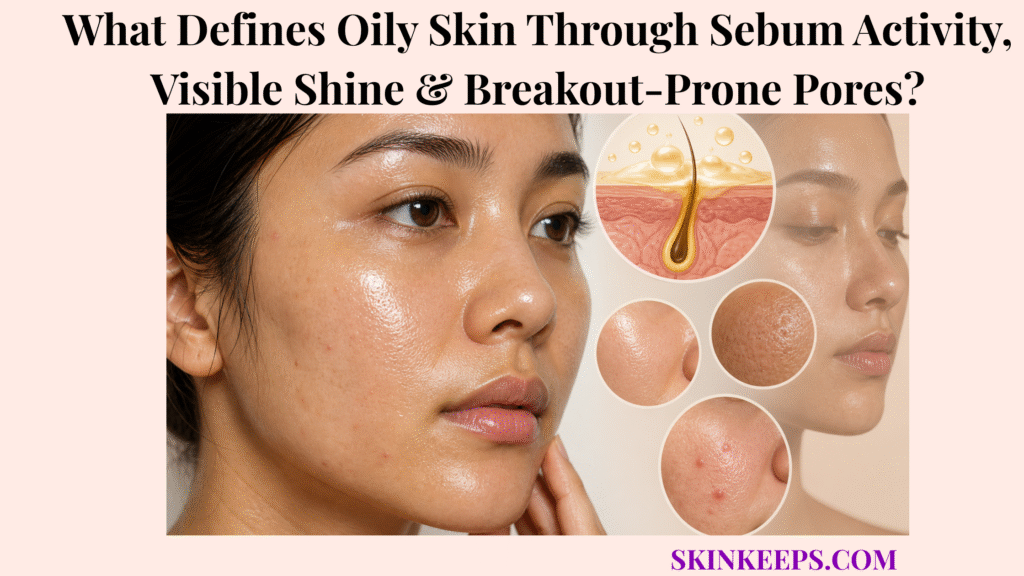
Oily skin is defined by overactive sebaceous glands that produce excess sebum, creating persistent facial shine, larger-looking pores, and a higher tendency for comedones, blackheads, and breakouts. This internal sebaceous-gland pattern continually pushes lipids to the surface to support lubrication and barrier comfort. However, oily skin becomes difficult to manage when this excess sebum mixes with dead cells inside follicles, demonstrating that the condition is a biological reality rather than poor hygiene.
This guide explores how this hyperactive sebum activity biologically defines the profile and why it makes pores appear enlarged. We also review the hormonal and environmental factors that trigger visible shine, the unique benefits of a sebaceous barrier, and how to build a gentle routine using targeted ingredients.
How does hyperactive sebum activity biologically define the oily skin profile?
Hyperactive sebum activity biologically defines the oily skin profile through increased sebaceous gland output that continuously deposits surface lipids onto the stratum corneum. This process begins deep inside the sebaceous glands attached to the pilosebaceous follicles, which constantly produce sebum—a lipid-rich secretion rather than mere dirt. Within the broader guide to different skin types, oily skin is the type most strongly defined by this glandular activity.
In fact, dermatological measurements show that the sebum excretion rate in an oily skin profile may exceed 1.5 mg/10 cm² every three hours. Surface cleansing removes the current oil but does not stop the glandular production underneath. [JCAD]
The supporting guide on oily skin sebum production explains how glandular output creates the oily skin baseline. This constant flow maintains barrier lubrication but also contributes to the signature surface shine.
The Sebaceous Gland Overdrive
The sebaceous gland overdrive occurs because glands inside the pilosebaceous follicles produce a higher volume of lipids than the skin surface can comfortably balance. Fundamentally, oily skin is an internal glandular condition rather than a surface defect. Because sebaceous glands continue producing sebum after cleansing, the skin quickly replenishes its lipid film.
For example, a person may cleanse their face in the morning and still see shine a few hours later because the internal glandular output remains high.
The Composition of Sebum
The composition of sebum includes triglycerides, wax esters, squalene, cholesterol-related lipids, and free fatty acids that lubricate and protect the skin surface. This complex biochemical lipid mixture spreads across the stratum corneum to support skin flexibility and hydration. While normal sebum output supports a healthy barrier, excess sebum output can mix with sweat, shed cells, and environmental particles to contribute to congestion. [Karger]
Why are enlarged, breakout-prone pores a primary structural characteristic of an oily complexion?
Enlarged, breakout-prone pores are a primary structural characteristic of an oily complexion because excess sebum accumulates inside follicles and makes pore openings appear wider and more congested. It is a myth that pores open and close like doors; rather, their pore visibility increases as sebum accumulation fills the follicular canal.
Studies confirm that increased sebum output is strongly associated with enlarged facial pore size, making these openings more prominent to the naked eye. [PubMed]
The guide on oily skin enlarged pores explains why pore visibility increases when sebum output remains high.
The Physics of Pore Stretching
The physics of pore stretching means that pores appear larger when repeated sebum accumulation and follicular congestion make the pore opening more visible. Because pores do not contain muscles, they cannot physically shrink on command once filled with debris. Instead, they become larger-looking pores as a result of constant sebum output, age, skin elasticity, follicle size, and sex-related differences.
The Comedogenic Cascade: Blackheads to Breakouts
The comedogenic cascade begins when excess sebum mixes with dead skin cells inside the follicle and forms a blockage that can develop into blackheads, whiteheads, or inflamed acne lesions. Acne pathophysiology involves this excess sebum combining with follicular hyperkeratinization, allowing C. acnes to thrive and trigger inflammation.
It is important to clarify that C. acnes is a normal part of the skin microbiome, meaning oil alone does not cause acne without these co-occurring factors. [PMC]
The related article on oily skin blackheads and breakouts explains how follicular congestion turns oily skin into acne-prone skin.
| Stage | Biological Action | Clinical Result |
|---|---|---|
| Hyperseborrhea | Excess sebum fills the follicular canal | Visible shine and pore congestion increase |
| Hyperkeratinization | Dead skin cells stick inside the follicle | A comedone begins to form |
| C. acnes activity | C. acnes activity increases in the blocked follicle | Local inflammatory signaling rises |
| Inflammation | Immune cells respond to follicular irritation | Papules, pustules, nodules, or cyst-like lesions may appear |
Which hormonal and environmental factors trigger extreme visible shine on the epidermal surface?
Hormonal shifts and environmental heat trigger extreme visible shine by increasing sebaceous activity, sweat mixing, and the surface spread of sebum across the epidermis. Internally, genetics, puberty, androgens, and hormonal fluctuations directly stimulate the glands to produce more oil. Externally, heat, humidity, sweat, and occlusive conditions compound the issue by making the existing oil more fluid and widespread.
For example, local temperature variation changed sebum excretion by about 10% per 1°C in older physiology work, highlighting how climate impacts surface shine. [PubMed]
Androgen Receptors and Hormonal Spikes
Androgen receptors increase oily skin symptoms because sebaceous glands are sensitive to androgenic hormones such as testosterone and dihydrotestosterone. While androgens are present in all sexes, their levels can shift dramatically during puberty, menstrual cycle fluctuations, or stress-related endocrine changes.
High DHT sensitivity triggers the glands to expand and produce more oil, though this does not imply that oily skin always means a hormone disorder. The supporting article on oily skin hormones explains how androgen response changes sebaceous gland activity.
Humidity and Heat Responses
Humidity and heat responses amplify oily skin shine when sweat mixes with sebum and spreads the lipid film more evenly across the face. Environmental heat influences sebum excretion measurements by lowering the viscosity of the oil, allowing it to flow more freely out of the pores. High humidity also slows sweat evaporation, making the mixture feel heavier and worsening the appearance of oiliness even if the baseline skin type has not changed.
The article on oily skin climate and humidity explains why hot, humid environments can make facial shine more visible.
What are the unique evolutionary and anti-aging benefits of a highly sebaceous skin barrier?
A highly sebaceous skin barrier can benefit the skin by supporting surface lubrication, reducing dryness, and delivering antioxidant lipids that help protect the upper skin surface. Reframing oily skin as biologically useful reveals that its constant lipid coating provides robust dryness resistance.
Sebaceous gland secretion is actually a physiologic route for delivering vitamin E to the upper facial skin, offering essential antioxidant delivery. [PubMed]
The full guide on oily skin benefits explains why this sebum supports skin softness and comfort.
The Built-In Occlusive Shield
The built-in occlusive shield of oily skin helps limit surface dryness by coating the stratum corneum with a lipid-rich film. While this barrier naturally limits trans-epidermal water loss (TEWL), it is crucial to recognize the difference between oil and true hydration. Oily skin can still be severely dehydrated, but its native lipids consistently support surface barrier function and overall skin softness.
Natural Vitamin E and Antioxidant Delivery
Natural vitamin E delivery is one advantage of oily skin because sebaceous secretion can transport alpha-tocopherol to the upper facial skin surface. Alpha-tocopherol, a potent form of vitamin E, helps protect the skin’s surface lipids from everyday oxidative stress. Although this natural defense mechanism may make fine lines appear less visible over time, it does not replace sunscreen.
Oily skin still requires daily photoprotection because UV exposure, collagen loss, and genetics ultimately govern skin aging.
What are the most common cleansing myths that accidentally worsen breakout-prone sebaceous skin?
The most common cleansing myths that worsen breakout-prone sebaceous skin involve stripping away surface lipids, over-washing the face, and skipping lightweight hydration. Oily skin desperately needs balanced cleansing, not aggressive stripping with a harsh cleanser or alkaline soap. Such harsh cleansing disrupts barrier comfort, leaving the skin feeling tight, irritated, and functionally unstable.
| Myth | Reality |
|---|---|
| Oily skin does not need moisturizer | Oily skin can still lack water, so lightweight hydration supports comfort |
| Strong soaps control oil better | Harsh alkaline cleansing can strip the barrier and increase irritation |
| Scrubbing removes pores | Scrubbing cannot remove pores and may worsen redness |
| Sunscreen makes oily skin worse | Oily skin still needs sunscreen in a lightweight, non-comedogenic formula |
| More washing means less oil | Frequent washing removes surface oil temporarily but does not stop sebaceous gland activity |
The “Squeaky Clean” Stripping Fallacy
The “squeaky clean” stripping fallacy harms oily skin because removing too much surface lipid can leave the barrier tight, irritated, and more difficult to regulate. The fundamental rule is to cleanse oily skin gently, because harsh washing removes essential barrier lipids alongside the excess oil. Experiencing tight, squeaky skin after washing is actually a sign of barrier disruption, not a sign of successful oil control.
The Fear of Moisturizers
The fear of moisturizers worsens oily skin routines because avoiding hydration can leave the skin water-depleted while sebum remains high. Because oil and hydration are entirely different biological properties, oily skin easily suffers from dehydration if humectants are skipped. Instead of avoiding moisture, experts recommend using a lightweight, oil-free, non-comedogenic moisturizer to restore water balance without relying on heavy occlusive creams.
Which specific cosmetic ingredients clinically balance an overactive lipid-producing skin type?
Specific cosmetic ingredients balance an overactive lipid-producing skin type by clearing follicular oil, supporting barrier hydration, and reducing the conditions that lead to clogged pores. Selecting ingredients by their function helps regulate oily skin behavior without pushing the barrier into irritation.
The guide on oily skin active ingredients explains which actives target excess sebum, clogged pores, and oily-skin texture. This targeted approach ensures that the skin receives hydration without heavy lipids while safely promoting cellular turnover.
Salicylic Acid (BHA) for Pore Clearing
Salicylic acid supports pore clearing in oily skin because its oil-soluble BHA structure allows it to work inside sebum-rich follicles. Salicylic acid (BHA) is particularly useful for dissolving the debris that forms clogged pores and comedones. While many over-the-counter products use concentrations around 0.5% to 2%, overuse can cause dryness, stinging, or barrier stress.
Therefore, gradual application based on personal tolerance is recommended for safe, effective exfoliation.
Niacinamide and Retinoids for Sebum Regulation
Niacinamide and retinoids support long-term oily skin regulation by reducing excess surface oil appearance and preventing dead cells from accumulating inside pores. Clinical studies demonstrate that a 2% niacinamide formulation can significantly lower facial sebum production rates. [PubMed]
While cosmetic formulas may use 2% to 5% niacinamide, retinoids function differently by acting as turnover-supporting ingredients to prevent follicular plugging. However, retinoids must be used cautiously, as they can irritate sensitive or over-exfoliated skin barriers.
| Ingredient | Primary Target | Mechanism of Action | When to Use |
|---|---|---|---|
| Salicylic acid / BHA | Congested pores | Works inside oily follicles to reduce buildup | PM, 2–3x weekly if tolerated |
| Niacinamide / B3 | Surface oil appearance | Supports sebum regulation and barrier comfort | AM or PM |
| Retinoids | Comedones and uneven texture | Supports turnover to reduce follicular buildup | PM only |
| Hyaluronic acid | Dehydration | Binds water without adding heavy lipids | AM or PM |
| Lightweight sunscreen | UV protection | Protects skin without heavy occlusion when non-comedogenic | AM daily |
What is the ultimate daily checklist to manage shine and clear pores for an oily skin matrix?
The ultimate daily checklist to manage shine and clear pores for an oily skin matrix relies on gentle cleansing, lightweight hydration, daily sunscreen, and controlled chemical exfoliation. This consistent routine stabilizes oily skin management by addressing morning oil control and evening pore clearing separately. Oily skin should never be scrubbed aggressively, and persistent painful acne, cystic lesions, scarring, or sudden severe oiliness always requires a dermatologist referral.
Morning Oil Control
Morning oil control focuses on removing overnight sebum buildup while protecting the skin with lightweight hydration and non-comedogenic sunscreen.
Morning Checklist
Evening Purification and Regulation
Evening purification and regulation focuses on removing sunscreen, makeup, sweat, and daytime sebum before applying targeted treatments that reduce follicular congestion.
Evening Checklist
Key Takeaways
The key takeaways about oily skin are that sebum defines the skin type, pore congestion explains its breakout tendency, and gentle regulation works better than aggressive stripping.
Key Takeaways
- Oily skin is defined by higher sebaceous gland activity and increased sebum on the skin surface.
- Visible shine occurs when sebum spreads across the epidermal surface.
- Larger-looking pores are associated with sebum output, follicular filling, age, and skin elasticity.
- Breakouts form when sebum combines with dead cells, follicular plugging, C. acnes activity, and inflammation.
- Oily skin can support surface lubrication and may make dryness less visible.
- Harsh cleansing can irritate oily skin and destabilize barrier comfort.
- Salicylic acid, niacinamide, retinoids, lightweight moisturizers, and non-comedogenic sunscreen are useful routine categories.
- A dermatologist is needed when oily skin includes painful cysts, scarring, sudden severe acne, or persistent inflammation.
FAQs
What defines oily skin?
Oily skin is defined by increased sebaceous gland activity that produces excess sebum on the skin surface. This oil creates visible shine, a greasy feel, larger-looking pores, and a higher tendency for clogged follicles, blackheads, whiteheads, and breakouts.
Is oily skin caused by poor hygiene?
Oily skin is not caused by poor hygiene. It is mainly driven by sebaceous gland activity, genetics, hormones, age, and environmental factors. Cleansing removes surface oil temporarily, but it does not stop sebaceous glands from producing more sebum.
Why does oily skin have enlarged pores?
Oily skin often has larger-looking pores because high sebum output and follicular congestion make pore openings more visible. Pore appearance is also influenced by age, skin elasticity, hair follicle size, and sex-related differences.
Why does oily skin break out more easily?
Oily skin breaks out more easily when excess sebum mixes with dead skin cells inside follicles. This blockage can form comedones and create conditions that support C. acnes activity and inflammation.
Does oily skin need moisturizer?
Yes, oily skin still needs moisturizer because oiliness and hydration are different. Sebum is lipid-rich, while hydration depends on water. A lightweight, oil-free, non-comedogenic moisturizer can support comfort without adding heavy grease.
Is salicylic acid good for oily skin?
Salicylic acid is useful for oily skin because it is oil-soluble and can work inside sebum-rich pores. It is especially helpful for clogged pores and comedones, but overuse can cause dryness, stinging, or irritation.
Is oily skin better for aging?
Oily skin may show dryness and fine surface lines less easily because sebum lubricates the skin surface. It should not be described as preventing aging, because UV exposure, collagen loss, genetics, and lifestyle still affect skin aging.
When should oily skin need a dermatologist?
Oily skin needs a dermatologist when breakouts are painful, cystic, persistent, scarring, suddenly severe, or unresponsive to a consistent routine. A dermatologist can check for acne severity, hormonal triggers, medication effects, or other skin conditions.
Conclusion
Oily skin is best understood as a sebaceous-gland-driven skin type that needs regulation, not punishment. Oily skin is defined by active sebaceous glands, excess surface sebum, visible shine, larger-looking pores, and a higher tendency toward follicular congestion. The goal is not to eliminate sebum, because sebum supports lubrication and barrier comfort.
The best oily-skin routine controls shine with gentle cleansing, lightweight hydration, non-comedogenic sunscreen, and targeted ingredients such as salicylic acid, niacinamide, and retinoids when tolerated. At SkinKeeps, we explain oily skin as a biological pattern that becomes easier to manage when the routine respects the barrier instead of stripping it. When sebum is treated as a regulated skin function rather than an enemy, oily skin becomes clearer, calmer, and easier to understand.