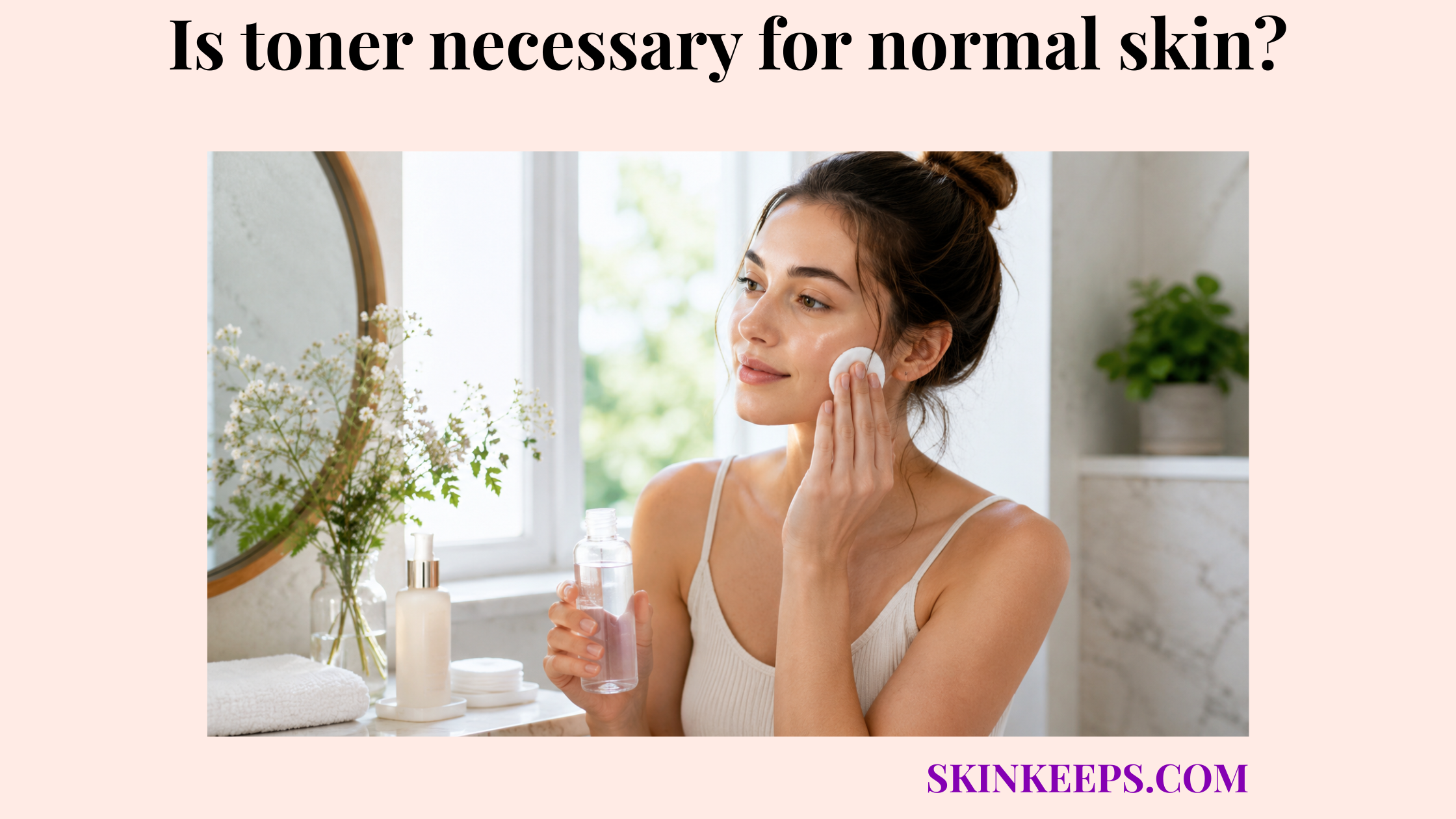
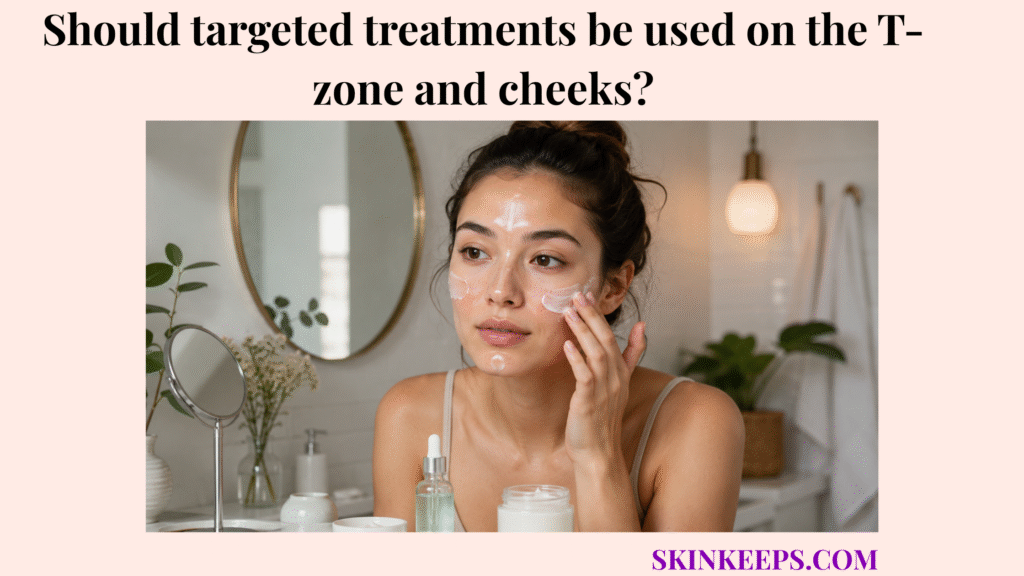
Yes, targeted treatments can be used on the T-zone and cheeks when those areas show different problems.
In combination skin, the T-zone may need support for oiliness, clogged pores, blackheads, or breakouts, while the cheeks may need hydration, barrier support, calming care, or less exposure to strong actives. Targeted treatments are not always necessary; if one gentle routine keeps both the T-zone and cheeks comfortable, combination skin does not need separate treatment steps just for the sake of separation.
Combination skin responds best when targeted care is used only for repeated zone-specific needs. That means the forehead, nose, chin, cheeks, around-mouth area, and jawline are treated according to their actual pattern, not because one area is oily or dry on a single day.
Why does combination skin need zone-based treatment logic first?
Combination skin needs zone-based treatment logic first because the T-zone and cheeks often have different problems and should not automatically receive the same treatment.
The forehead, nose, and chin may become oily, congested, or breakout-prone, while the cheeks may be normal, dry, tight, or reactive. Treating both zones the same way can create new problems, especially when acne products spread into dry areas or rich cheek creams overload the nose.
This is why different skin types should not be managed as if every face has one uniform pattern. Combination skin needs a map before it needs stronger products.
| Facial zone in combination skin | Common concern | Treatment logic |
|---|---|---|
| Forehead | Shine, sweat, bumps, congestion | Use light or targeted oil/congestion support |
| Nose | Blackheads, visible pores, oil | Use targeted pore care if tolerated |
| Chin | Breakouts, oil, treatment dryness | Use spot or acne support carefully |
| Cheeks | Dryness, tightness, irritation | Use hydration and barrier support |
| Around mouth | Peeling, stinging, irritation | Avoid strong actives and protect barrier |
| Jawline | Breakouts, dryness, friction | Track pattern before treating aggressively |
Practical Rule: In combination skin, treatment should follow the zone problem. Do not let the oiliest area decide the treatment for the whole face.
When should combination skin use targeted treatments by area?
Combination skin should use targeted treatments by area when one facial zone needs help and another zone would be dried, clogged, or irritated by the same treatment.
Targeted treatment makes sense when the same product creates opposite outcomes. A pore product may help the nose but sting the cheeks. A barrier cream may help flaky cheeks but make the forehead feel coated. When the whole face feels comfortable, targeted treatment is not necessary.
The decision is similar to using different products by area for combination skin: the skin should show a repeated reason before the routine becomes more divided.
| Combination skin signal | Does targeted treatment make sense? | Better direction |
|---|---|---|
| T-zone is oily but cheeks are comfortable | Maybe | Light oil-control support only where oily |
| Nose has blackheads | Yes, if persistent | Targeted pore care on nose |
| Chin breaks out but cheeks are dry | Yes | Acne treatment only on breakout zone |
| Cheeks are tight or flaky | Yes | Barrier support on cheeks |
| Cheeks sting after acne products | Yes | Keep strong actives away from cheeks |
| Whole face feels comfortable | Not necessary | Keep routine simple |
| Breakouts and dryness happen together | Yes, carefully | Treat acne and barrier separately |
| Products irritate multiple zones | Maybe, but simplify first | Reduce actives before adding more |
Practical Rule: Targeted treatment is useful when one area needs help and another area would be harmed by the same product.
Which targeted treatments suit the T-zone in combination skin?
Targeted treatments that suit the T-zone in combination skin are usually oil, pore, congestion, breakout, or lightweight hydration treatments used only where needed.
The T-zone does not automatically need acne treatment. It may need a lighter moisturizer, better sunscreen removal, careful pore support, or less harsh cleansing. The correct treatment depends on whether the repeated concern is blackheads, bumps, inflamed pimples, shine, or oily-but-tight discomfort.
Use salicylic acid carefully for clogged T-zone areas in combination skin
Salicylic acid can be used carefully on clogged T-zone areas in combination skin when the nose, forehead, or chin repeatedly shows blackheads, bumps, or congestion. It should stay targeted because overuse can dry or irritate nearby normal or dry zones.
Use benzoyl peroxide only where combination skin has inflamed breakouts
Benzoyl peroxide should be used only where combination skin has inflamed breakouts because it can dry or irritate surrounding normal or dry zones. For many people, this means a spot or zone approach rather than automatic full-face coverage.
Use clay masks selectively on oily T-zone areas in combination skin
Clay masks should be used selectively on oily T-zone areas in combination skin because they can feel drying on cheeks or around-mouth skin. A T-zone-only approach is safer when cheeks are tight, flaky, or easily irritated.
Use lightweight hydration on oily-but-tight T-zone areas in combination skin
Lightweight hydration can suit oily-but-tight T-zone areas in combination skin when shine appears with tightness, stripping, or discomfort. A hydrating gel, light lotion, or humectant-based product may help comfort better than stronger oil removal.
| T-zone concern in combination skin | Possible targeted treatment | Main caution |
|---|---|---|
| Nose blackheads | Salicylic acid if tolerated | Avoid overuse |
| Forehead bumps | Salicylic acid or product-contact review | Check hair products and sweat |
| Chin pimples | Spot treatment or acne active | Protect surrounding dry skin |
| Shiny forehead | Lightweight moisturizer, oil-free texture, blotting | Do not over-cleanse |
| Oily but tight T-zone | Hydrating gel or light lotion | Do not use stronger drying products |
| Congestion after sunscreen | Better removal and lighter formula | Do not scrub |
| Temporary oiliness | Clay mask on T-zone only | Avoid dry cheeks |
Which targeted treatments suit the cheeks in combination skin?
Targeted treatments that suit the cheeks in combination skin are often hydration, barrier-support, and calming treatments rather than strong oil-control products.
Cheeks in combination skin can be normal, dry, or reactive while the T-zone is oily. That makes cheek treatment different: the goal is often comfort, tolerance, and barrier support, not stronger pore clearing.
Use barrier-support ingredients on dry cheeks in combination skin
Barrier-support ingredients can help dry cheeks in combination skin when cheeks feel tight, rough, flaky, or under-supported. Ceramides, glycerin, panthenol, and supportive moisturizers may help when placed on the cheeks instead of spread heavily over oily zones.
Use calming formulas on reactive cheeks in combination skin
Calming formulas can help reactive cheeks in combination skin when cheeks sting, burn, redden, or react faster than oily zones. Fragrance-free, simple, gentle formulas are usually safer than adding more actives to skin that already feels irritated.
Avoid treating cheek dryness in combination skin like T-zone oiliness
Cheek dryness in combination skin should not be treated like T-zone oiliness because salicylic acid, clay masks, harsh cleansers, or acne products can worsen dry cheeks. Cheeks often need support before they need correction.
| Cheek concern in combination skin | Better targeted treatment | Avoid |
|---|---|---|
| Tight cheeks | Hydrating moisturizer | Oil-control products |
| Flaky cheeks | Barrier-support cream | Scrubbing flakes |
| Cheek redness | Gentle fragrance-free formula | Fragrance or harsh actives |
| Cheeks sting after products | Simplify and protect barrier | Adding more actives |
| Makeup clings to cheeks | Moisturizer before makeup | Powdering dry patches |
| Cheek bumps after makeup | Review product clogging or irritation | Assuming all bumps are oily acne |
| Dry cheeks with oily T-zone | Richer layer only on cheeks | Heavy cream everywhere |
Should the same targeted treatment be used on both T-zone and cheeks in combination skin?
The same targeted treatment should be used on both the T-zone and cheeks in combination skin only when both zones have the same problem and tolerate the product well.
If the T-zone is oily and the cheeks are dry, strong acne or oil-control treatments should not automatically go on both areas. If both zones feel mildly dehydrated and tolerate the same lightweight moisturizer, one treatment may be enough.
| Situation in combination skin | Same treatment may work | Separate treatment is safer |
|---|---|---|
| Whole face feels mildly dehydrated | Lightweight moisturizer | Add richer layer to dry cheeks if needed |
| T-zone oily, cheeks dry | No | Oil-control on T-zone, barrier support on cheeks |
| Breakouts only on chin | No | Spot or zone treatment only |
| Cheeks and T-zone both tolerate niacinamide | Maybe | Stop if cheeks sting |
| Dry patches only on cheeks | No | Rich support only on dry zones |
| Blackheads only on nose | No | Salicylic acid only on nose/T-zone |
| Irritation on cheeks | No | Gentle repair on cheeks, reduce actives |
Practical Rule: Same product everywhere works only when the whole face shares the same need.
How should combination skin use acne treatments on the T-zone without harming cheeks?
Combination skin should use acne treatments on the T-zone without harming cheeks by applying actives only where breakouts or clogged pores actually repeat.
This matters because area-limited breakouts in combination skin can make a small zone look like a full-face problem. The safer response is to treat the repeated breakout area while protecting dry or normal skin nearby.
Keep acne treatment on combination skin where breakouts actually occur
Acne treatment should stay where combination skin actually breaks out or clogs, such as the nose, chin, forehead, or jawline. Salicylic acid, benzoyl peroxide, retinoids, and spot treatments should follow the recurring breakout zone rather than the whole face by default.
Buffer dry zones in combination skin before acne treatment spreads
Dry zones in combination skin may need buffering when acne treatments migrate toward the mouth corners, nose corners, or dry cheeks. A small amount of moisturizer around these sensitive borders can reduce accidental spread and irritation.
Reduce frequency when combination skin shows peeling or stinging
Combination skin may need reduced active frequency when acne treatment causes peeling, stinging, burning, or tightness. More frequent use is not automatically better if the treatment is destabilizing the surrounding skin.
| Acne treatment type | Better placement in combination skin | Caution |
|---|---|---|
| Salicylic acid | Nose, forehead, chin congestion | Avoid flaky cheeks |
| Benzoyl peroxide | Inflamed pimples or acne-prone zones | Can dry and irritate |
| Retinoid | Acne-prone or texture-prone areas if tolerated | Introduce slowly |
| Spot treatment | Individual pimples | Do not spread like moisturizer |
| Acne cleanser | Short-contact use if tolerated | Can dry whole face |
| Clay mask | Oily T-zone only | Avoid cheeks and mouth area |
Practical Rule: Acne treatment should not punish the parts of combination skin that are not breaking out.
How should combination skin protect cheeks while treating the T-zone?
Combination skin should protect cheeks while treating the T-zone by keeping strong actives away from dry areas and giving cheeks enough moisturizer or barrier support.
Cheek protection is part of treatment, not a separate luxury step. It keeps targeted T-zone care from turning into full-face irritation, especially when acids, acne cleansers, or clay masks are used.
| Cheek risk during T-zone treatment | Protective move | Why it helps |
|---|---|---|
| Cheeks become tight | Apply moisturizer before or after treatment routine | Supports comfort |
| Around-mouth peeling | Keep acne actives away from mouth corners | Reduces irritation |
| Cheeks sting after acids | Reduce acid spread and frequency | Protects barrier |
| Makeup clings to cheeks | Hydrate before makeup | Smooths dry texture |
| Cheeks redden easily | Use fragrance-free formulas | Reduces avoidable irritation |
| Dry patches worsen | Pause exfoliation on cheeks | Prevents further stripping |
| Treatment migrates | Apply carefully and wash hands | Limits accidental spread |
Practical Rule: Cheek protection is not optional if T-zone treatment repeatedly causes tightness, flakes, or stinging.
How should combination skin layer targeted treatments with moisturizer and sunscreen?
Combination skin should layer targeted treatments with moisturizer and sunscreen by treating only the problem zone, moisturizing by zone, and keeping daily protection comfortable.
Layering does not need to become complicated. The treatment goes where the repeated problem is, moisturizer changes by amount and zone, and sunscreen remains consistent enough that the skin is protected each day. These decisions are part of the same care tips that balance oily and dry zones in combination skin.
| Routine moment | T-zone in combination skin | Cheeks in combination skin |
|---|---|---|
| After cleansing | Keep skin comfortable, not squeaky | Check for tightness |
| Treatment step | Apply active only where needed | Avoid strong actives if dry or reactive |
| Moisturizer step | Thin lightweight layer | More supportive layer if dry |
| Sunscreen step | Comfortable non-heavy texture | Add moisturizer underneath if sunscreen dries |
| Makeup prep | Mattify only oily zones | Hydrate dry zones |
| Night routine | Target congestion or pimples | Repair barrier and reduce irritation |
Practical Rule: In combination skin, layering should be lighter where oily and more protective where dry.
How can combination skin test targeted treatments safely?
Combination skin can test targeted treatments safely by adding one treatment at a time, applying it only to the intended zone, and watching both the T-zone and cheeks.
Testing is especially important because the T-zone may improve while cheeks become irritated, or cheeks may calm while the nose becomes clogged. The goal is a clearer pattern, not a longer list of products.
- Add one targeted treatment at a time.
- Apply it only to the intended zone.
- Start with lower frequency.
- Keep cleanser, moisturizer, and sunscreen stable.
- Watch T-zone shine, blackheads, bumps, and peeling.
- Watch cheeks for tightness, stinging, redness, or flakes.
- Avoid combining multiple acids, retinoids, acne cleansers, and spot treatments at once.
- Stop or reduce use if burning, swelling, rash-like redness, or persistent peeling appears.
- Track results for several weeks when the treatment is tolerated.
- Do not add another active to fix irritation caused by the first active.
Practical Rule: Targeted treatment should make the pattern clearer, not create new confusion.
What mistakes happen when combination skin targets the T-zone and cheeks?
Mistakes happen when combination skin targets the T-zone and cheeks by spreading strong T-zone treatments onto dry cheeks or rich cheek products onto oily areas.
These mistakes usually happen when the routine follows product category instead of zone behavior. Ingredient placement matters because ingredients that support combination skin balance can help one zone while irritating or overloading another zone.
Avoid using T-zone treatments on dry cheeks in combination skin
T-zone treatments can worsen dry cheeks in combination skin when salicylic acid, clay masks, acne products, or harsh cleansers are spread too widely. Oil-control products should stay where oil, congestion, or breakouts repeat.
Avoid using cheek creams across oily T-zone areas in combination skin
Cheek creams can overload oily T-zone areas in combination skin when rich barrier products are spread over the forehead, nose, or chin. Rich products can still be useful; the problem is placing them where the skin repeatedly clogs or shines.
Avoid treating every bump on combination skin as acne
Every bump on combination skin should not be treated as acne because cheek bumps can come from irritation, contact triggers, makeup, sunscreen, or friction. Acne products can worsen irritation if the bump is not behaving like acne.
Avoid changing too many targeted treatments at once on combination skin
Changing too many targeted treatments at once on combination skin makes it hard to know which product helped or harmed each zone. Acids, acne treatments, masks, moisturizers, and cleansers should be changed one at a time whenever possible.
| Mistake | Why it hurts combination skin | Better move |
|---|---|---|
| Salicylic acid on dry cheeks | Peeling and tightness worsen | Use on clogged zones only |
| Clay mask full-face | Cheeks may become dry or irritated | Apply to T-zone only |
| Benzoyl peroxide everywhere | Dryness and irritation increase | Spot or zone use |
| Heavy cream on T-zone | Greasy feel or congestion | Use rich texture only where dry |
| Treating cheek irritation as acne | Can worsen barrier damage | Simplify and calm cheeks |
| Stacking actives | Burning and peeling increase | Add one active at a time |
| Skipping moisturizer | Treatments become harder to tolerate | Use noncomedogenic support |
| Ignoring sunscreen discomfort | Protection becomes inconsistent | Adjust texture or layering |
When should targeted treatment problems in combination skin need a dermatologist?
Targeted treatment problems in combination skin need a dermatologist when acne is painful, irritation spreads, dry patches crack or bleed, or products repeatedly burn or sting.
Targeted care is meant for manageable zone differences. If symptoms are deep, painful, spreading, warm, rash-like, bleeding, or scarring, the issue may need medical evaluation rather than more product adjustment.
- Breakouts are painful, deep, cystic, or scarring.
- T-zone acne does not improve with gentle targeted care.
- Cheek bumps are red, spreading, itchy, burning, or rash-like.
- Dry patches crack, bleed, burn, or spread.
- Skin reacts to many gentle products.
- Peeling continues after reducing active treatments.
- Around-mouth irritation keeps returning.
- Treatments repeatedly cause swelling, warmth, or severe redness.
- The reader suspects acne, dermatitis, eczema, rosacea, allergy, folliculitis, or infection.
- A simple zone-aware routine does not improve comfort.
Practical Rule: Targeted treatments are for manageable zone differences. Painful, spreading, bleeding, burning, scarring, or rash-like symptoms need professional evaluation.
What should you remember about targeted treatments in combination skin?
The key point is that targeted treatments can help combination skin when they treat the repeated zone problem without harming nearby normal, dry, or reactive areas.
- Targeted treatments can help combination skin.
- They are not always necessary.
- Treat the zone with the repeated problem.
- Use oil and pore support mainly on the T-zone.
- Use acne treatment only where breakouts occur.
- Use barrier support on dry cheeks.
- Use calming formulas on reactive cheek areas.
- Do not apply clay masks full-face if cheeks are dry.
- Do not spread strong acne products across normal or dry zones.
- One product is enough when both zones tolerate it.
- Separate products help when one product creates opposite problems.
- Test one treatment at a time.
- Protect cheeks while treating T-zone congestion.
- Seek help for painful acne, cracking, bleeding, burning, swelling, spreading redness, rash-like irritation, or scarring.
Frequently Asked Questions About Targeted Treatments in Combination Skin
Should combination skin use acne treatment only on the T-zone?
Often, yes. If breakouts or clogged pores are mainly on the T-zone, acne treatment should follow that breakout zone instead of automatically covering the whole face.
Should combination skin use different treatments on cheeks?
Sometimes. Cheeks in combination skin may need hydration, barrier support, or calming care instead of acne or oil-control products.
Can combination skin use salicylic acid on cheeks?
Combination skin can use salicylic acid on cheeks only if the cheeks are clogged and tolerate it. If cheeks are dry, tight, flaky, or stinging, salicylic acid may make them worse.
Can combination skin use clay masks on the whole face?
Usually not if the cheeks are dry or sensitive. Clay masks are often better limited to the oily T-zone instead of being applied across the whole face.
What if both the T-zone and cheeks break out?
If both the T-zone and cheeks break out, combination skin may need broader acne care, but dryness, irritation, product reactions, and rash-like conditions should be considered if symptoms burn, spread, or persist.
Conclusion About Targeted Treatments in Combination Skin
Targeted treatments can be useful for combination skin when the T-zone and cheeks repeatedly behave differently. The T-zone may need careful support for oil, congestion, blackheads, or breakouts, while the cheeks may need hydration, barrier support, or calmer formulas.
The safest approach is to treat the zone with the repeated problem and protect the zones that do not need the same strength. If a targeted treatment causes burning, spreading irritation, cracking, bleeding, painful acne, or scarring, the next step is professional evaluation rather than more product stacking.
Sources & Evidence for Targeted Treatments in Combination Skin
Cleveland Clinic: Skin-type guidance describing combination skin as zone-specific, often with oilier T-zone behavior and drier cheek or eye-adjacent areas. Cleveland Clinic skin type guidance.
American Academy of Dermatology: Acne guideline and public guidance on topical acne treatments including benzoyl peroxide, topical retinoids, salicylic acid, gentle cleansing, and irritation reduction. AAD acne clinical guideline and AAD acne treatment guidance.
American Academy of Dermatology: Oily-skin guidance supporting oil-free and noncomedogenic products, careful use of salicylic, glycolic, or lactic acids, and stopping or reducing use if irritation appears. AAD oily skin guidance.
American Academy of Dermatology: Face-washing guidance for lukewarm water, fingertips, avoiding scrubbing, and applying moisturizer when skin feels dry or itchy. AAD Face washing 101.
American Academy of Dermatology: Dry-skin guidance for gentle cleansing, fragrance-free moisturizer, and avoiding harsh drying habits. AAD dry-skin relief guidance.
American Academy of Dermatology: Skin-care guidance noting that benzoyl peroxide and salicylic acid can cause dry skin or irritation and that moisturizer support helps reduce treatment dryness. AAD dermatologist skincare guidance.
Educational Disclaimer About Targeted Treatments in Combination Skin
Educational Disclaimer: This article is for general skin education only and does not diagnose, treat, or replace professional medical advice. If targeted treatments cause burning, swelling, cracked or bleeding patches, painful acne, scarring, spreading redness, rash-like irritation, or persistent product reactions, consult a qualified dermatologist.