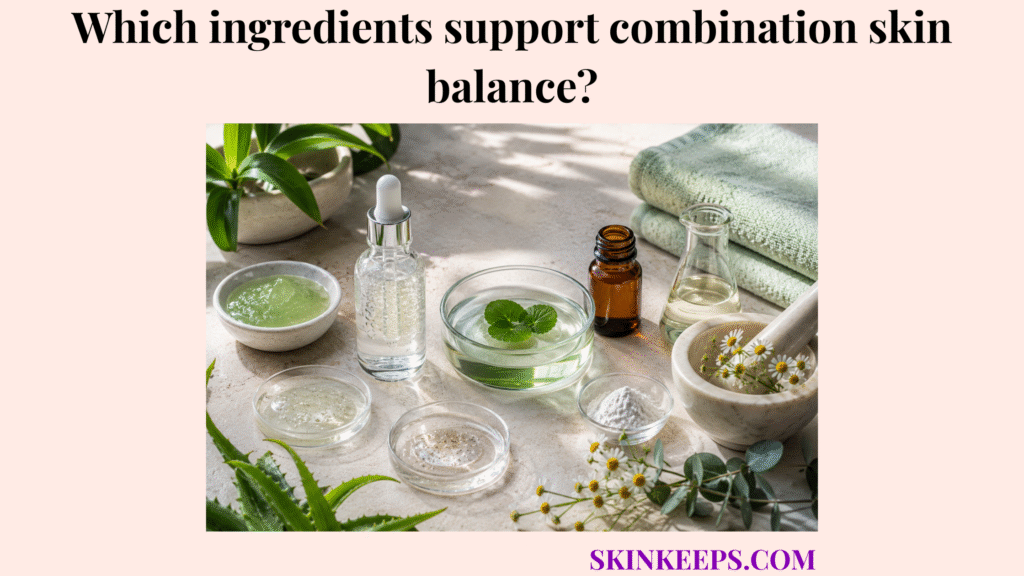
Ingredients that support combination skin balance usually fall into five groups: lightweight hydrators, barrier-support ingredients, noncomedogenic moisturizers, gentle oil-and-pore support ingredients, and low-irritation formulas.
For combination skin, helpful examples include glycerin, hyaluronic acid, panthenol, ceramides, niacinamide, light amounts of squalane, salicylic acid for clogged oily zones, and fragrance-free formulas for sensitive or dry areas. Oily areas often need lightweight support, while dry areas may need more barrier-focused ingredients; the goal is not to layer every active everywhere.
Which ingredients support combination skin balance best?
Ingredients that support combination skin balance best are ingredients that hydrate without heaviness, support dry zones, reduce clogging risk, and calm irritation without overloading the face.
Combination skin balance is best supported by ingredient roles, not by one miracle ingredient. The T-zone may need light hydration and pore-conscious formulas, while cheeks or around-mouth areas may need comfort, barrier support, and fewer irritating ingredients.
| Ingredient category | Examples | How it supports combination skin |
|---|---|---|
| Lightweight hydrators | Glycerin, hyaluronic acid, panthenol, aloe-style humectants | Help tight or dehydrated-feeling zones without heavy grease |
| Barrier-support ingredients | Ceramides, cholesterol, fatty acids | Support dry or easily irritated zones |
| Light emollients | Squalane, lightweight oils in small amounts | Add softness without heavy coating for some users |
| Noncomedogenic formulas | Oil-free, noncomedogenic, won’t-clog-pores directions | Help oily and breakout-prone zones tolerate moisture |
| Oil-support ingredients | Niacinamide, salicylic acid when tolerated | May help shine, congestion, and pore-prone areas |
| Gentle exfoliants | Lactic acid, glycolic acid, salicylic acid | May improve texture if used carefully |
| Calming ingredients | Colloidal oatmeal, panthenol, green tea-style antioxidants | May support irritation-prone dry zones |
| Irritation-avoidance labels | Fragrance-free, alcohol-free, non-abrasive | Reduce unnecessary stinging and dryness risk |
Practical Rule: The strongest ingredient strategy for combination skin is not “more actives.” It is right ingredient, right zone, right frequency.
Ingredient Role Framework for Combination Skin
A balanced ingredient plan separates hydration, barrier support, oil-zone care, texture support, and irritation reduction instead of treating every facial area the same way.
Figure 1. Combination skin balance works best when ingredients are grouped by role instead of copied across the whole face.
How do hydrating ingredients support combination skin balance?
Hydrating ingredients support combination skin balance by improving water comfort in tight, dull, or oily-but-dehydrated zones without automatically adding heavy grease.
Hydrating ingredients are useful because combination skin can feel oily and tight at the same time. They help water comfort, but they do not replace moisturizer or barrier support when cheeks are rough, flaky, or irritated.
How glycerin supports combination skin hydration
Glycerin supports combination skin hydration by helping tight or dry-feeling zones feel more comfortable without requiring a heavy finish.
Glycerin is a humectant, so it fits both oily-but-tight areas and dry zones when the full formula feels comfortable. In combination skin, the vehicle matters as much as the single ingredient.
How hyaluronic acid supports combination skin hydration
Hyaluronic acid supports combination skin hydration by adding lightweight water comfort, especially in serums, gels, or lotions for oily-but-tight areas.
Hyaluronic acid can feel light under moisturizer or sunscreen, but it may not be enough alone in dry air. Dry cheeks often need a moisturizing layer that helps reduce water loss.
How panthenol supports combination skin comfort
Panthenol supports combination skin comfort by softening tight-feeling zones and helping irritated areas feel calmer when the formula is tolerated.
Panthenol can be useful around mild tightness or irritation, but it works best inside a simple product that does not clog the T-zone or sting dry areas.
| Hydrating ingredient | Best use in combination skin | Watch out for |
|---|---|---|
| Glycerin | Broad hydration across oily and dry zones | Needs a complete formula, not just one ingredient |
| Hyaluronic acid | Lightweight hydration for oily-but-tight skin | May not be enough alone in dry air |
| Panthenol | Comfort for tight or mildly irritated zones | Formula must still suit oily areas |
| Aloe-style humectants | Light comfort in oily or humid conditions | Can irritate some sensitive users depending on formula |
| Water-gel bases | Lightweight feel on T-zone | May be too light for dry cheeks |
| Hydrating toner or essence | Extra hydration layer if tolerated | Too many layers can pill or irritate |
Practical Rule: Hydrating ingredients help combination skin feel less tight, but dry zones may still need barrier-support ingredients on top.
How do barrier-support ingredients help combination skin dry zones?
Barrier-support ingredients help combination skin dry zones by supporting cheeks, around-mouth skin, and outer-face areas that feel tight, rough, flaky, or easily irritated.
Dry-zone support matters because combination skin can have a shiny T-zone while cheeks still need more comfort. Readers comparing ingredient options may also benefit from the broader care tips that balance oily and dry zones in combination skin.
How ceramides support combination skin dry areas
Ceramides support combination skin dry areas by helping dry cheeks, around-mouth skin, or outer-face zones feel more comfortable and less rough.
Ceramides are most useful when placed where dryness is repeated. A ceramide-rich cream may help cheeks but feel too heavy if spread thickly over a clog-prone nose.
How cholesterol and fatty acids support combination skin comfort
Cholesterol and fatty acids support combination skin comfort when dry or irritated zones need lipid-rich support without overloading oily areas.
These barrier-lipid directions often appear together in moisturizers. They should follow dry-zone need rather than become a full-face heavy layer by default.
How petrolatum-style occlusives fit combination skin only in dry spots
Petrolatum-style occlusives fit combination skin best as small dry-spot support rather than full-face layers over oily or clog-prone zones.
A small occlusive layer may help a rough patch near the mouth, but the same heavy layer may feel greasy or clog-prone on the forehead, nose, or chin.
| Dry-zone concern in combination skin | Helpful ingredient direction | Placement caution |
|---|---|---|
| Tight cheeks | Ceramides, glycerin, panthenol | Keep T-zone lighter |
| Rough dry patches | Ceramides, fatty acids, richer cream | Avoid heavy layer on nose |
| Around-mouth peeling | Barrier-support cream, petrolatum spot layer | Avoid strong actives nearby |
| Low-humidity dryness | Creamier moisturizer with humectants and lipids | Do not overload oily zones |
| Irritation from actives | Barrier-support formula | Reduce active frequency too |
| Makeup clinging to cheeks | Hydration plus barrier support | Do not powder flakes heavily |
Practical Rule: Barrier ingredients belong where combination skin is dry, tight, rough, peeling, or easily irritated — not automatically across the whole face in the same amount.
Which ingredients help oily zones in combination skin without over-drying?
Ingredients that help oily zones in combination skin without over-drying include lightweight hydrators, noncomedogenic formulas, niacinamide, and salicylic acid used only where tolerated.
Oily-zone ingredients should reduce heaviness, shine, or congestion without turning the T-zone tight or making dry cheeks peel. For readers who break out in repeat zones, area-limited breakouts in combination skin explains why targeted placement matters.
How niacinamide may support oily zones in combination skin
Niacinamide may support oily zones in combination skin by helping some skin look calmer and less shiny while also supporting barrier comfort.
Niacinamide is not automatically tolerated by everyone. If cheeks or around-mouth skin are reactive, introduce it slowly and watch for stinging or redness.
How salicylic acid may support clogged oily zones in combination skin
Salicylic acid may support clogged oily zones in combination skin when blackheads, congestion, or bumps repeat on the nose, chin, or forehead.
Salicylic acid should follow the clogged zone. If it is applied too often or spread across dry cheeks, it can create tightness, peeling, or stinging.
How noncomedogenic formulas support oily combination skin zones
Noncomedogenic formulas support oily combination skin zones by lowering the chance that moisturizers, sunscreen, or makeup feel heavy or clog-prone.
Noncomedogenic labeling is useful but not perfect. Combination skin still needs zone tracking because one formula can be fine on the cheeks and too heavy for the nose or chin.
| Oily-zone concern in combination skin | Ingredient direction | Caution |
|---|---|---|
| T-zone shine | Niacinamide, lightweight moisturizer | Avoid drying formulas |
| Nose blackheads | Salicylic acid if tolerated | Avoid daily overuse if tight |
| Forehead bumps | Noncomedogenic formulas, gentle cleansing | Check hair products too |
| Chin breakouts | Targeted acne ingredients | Do not spread over dry cheeks |
| Oily but tight skin | Glycerin, hyaluronic acid, light moisturizer | Do not cleanse harder |
| Heavy sunscreen feel | Oil-free or lightweight textures | Do not skip sunscreen |
| Makeup sliding | Lightweight prep, selective mattifying | Avoid full-face drying primer |
Practical Rule: Oily-zone ingredients should reduce clogging or heaviness without creating tightness, flakes, or stinging.
Which exfoliating ingredients can support combination skin texture?
Exfoliating ingredients can support combination skin texture when they are used selectively on clogged or rough areas and kept away from dry, burning, or peeling zones.
Exfoliating ingredients can be useful in combination skin, but they carry more risk when the face has both clogged pores and dry patches. A rough cheek is not always dead skin; it may be dryness or irritation.
| Exfoliating ingredient | Possible role in combination skin | Main caution |
|---|---|---|
| Salicylic acid | Oily-zone congestion, blackheads, clogged pores | Can dry or irritate if overused |
| Lactic acid | Mild texture and hydration-supporting exfoliation | Can still sting sensitive zones |
| Glycolic acid | Uneven texture or dullness | May be too strong for dry cheeks |
| Mandelic acid | Gentler-feeling exfoliation for some users | Still needs slow testing |
| PHA-style exfoliants | Gentler texture support for some | Not irritation-proof |
| Enzyme exfoliants | Light surface smoothing | Can irritate depending on formula |
| Scrub particles | Usually not ideal | Friction can worsen redness and barrier stress |
Practical Rule: For combination skin, exfoliating ingredients should be selective and limited, not a daily full-face punishment.
Which calming ingredients can support sensitive combination skin?
Calming ingredients can support sensitive combination skin by reducing avoidable irritation and helping reactive dry zones stay more comfortable.
Sensitive combination skin should prioritize formulas that the skin tolerates. A product can be marketed as soothing and still sting if fragrance, essential oils, acids, or texture are wrong for the zone.
| Calming ingredient direction | How it may help combination skin | Caution |
|---|---|---|
| Fragrance-free formulas | Reduce avoidable irritation risk | Unscented is not always fragrance-free |
| Colloidal oatmeal | May soothe dry or irritated zones | Formula texture must suit the face |
| Panthenol | Helps comfort and softness | Still patch test if reactive |
| Green tea-style antioxidants | May support calm-looking skin | Botanical ingredients can still irritate |
| Simple moisturizers | Reduce ingredient overload | May lack enough support for severe dryness |
| Barrier-support creams | Help dry or reactive zones | Use selectively if T-zone clogs |
| Alcohol-free formulas | Reduce drying or stinging risk | Full formula still matters |
Practical Rule: Sensitive combination skin should prioritize tolerance before chasing oil control or texture correction.
How should combination skin choose ingredients by facial zone?
Combination skin should choose ingredients by facial zone because the T-zone, cheeks, mouth area, jawline, and dry patches often need different ingredient roles.
Zone placement is often more important than product count. The broader using different products by area for combination skin page explains when separate products are justified and when changing amount or placement is enough.
| Facial zone in combination skin | Common need | Ingredient direction |
|---|---|---|
| Forehead | Oil, sweat, bumps | Lightweight hydration, noncomedogenic formulas, salicylic acid if clogged |
| Nose | Shine, visible pores, blackheads | Lightweight moisturizer, salicylic acid if tolerated |
| Chin | Breakouts, oil, treatment dryness | Targeted acne support plus moisturizer |
| Cheeks | Dryness, normal comfort, sensitivity | Glycerin, ceramides, panthenol, fragrance-free moisturizer |
| Around mouth | Peeling, irritation, actives sensitivity | Barrier-support cream, avoid strong acids nearby |
| Jawline | Acne, friction, dryness | Track pattern before choosing actives |
| Eye-adjacent area | Thin, sensitive skin | Avoid harsh actives and fragrance |
| Dry patches | Roughness or flakes | Barrier support, richer local layer |
Practical Rule: Combination skin ingredients should be placed where they solve a repeated zone problem.
Facial-Zone Ingredient Placement Map
Oily zones often need lightweight, noncomedogenic support, while dry or reactive zones usually need hydration, barrier support, and low-irritation formulas.
Figure 2. Ingredient placement should follow repeated zone behavior, not random face division.
Which ingredients should combination skin avoid or limit?
Combination skin should avoid or limit ingredients that repeatedly cause stinging, dryness, clogged oily zones, abrasion, peeling, or unclear reactions.
Avoidance is not about fear of ingredients. It is about pattern recognition: if a formula repeatedly causes burning, tightness, flakes, or congestion in one zone, it does not support balance.
Limit harsh alcohols in combination skin products
Harsh alcohol-heavy formulas can be a poor fit for combination skin when they make oily zones feel stripped and dry zones feel tighter or stingy.
Not every alcohol ingredient has the same role, but formulas that leave a sharp, stripped, tight finish are poor matches for mixed facial zones.
Avoid fragrance-heavy products on reactive combination skin
Fragrance-heavy products should be avoided on reactive combination skin when cheeks, around-mouth skin, or dry zones sting, burn, or redden easily.
Unscented products are not always fragrance-free. If combination skin reacts easily, low-irritation labeling and simple formulas are safer starting points.
Limit heavy occlusives on oily combination skin zones
Heavy occlusives should be limited on oily combination skin zones because balms, rich creams, or heavy oils can feel greasy or clog-prone on the T-zone.
Heavy occlusives may still fit small dry patches. The issue is full-face placement, not the ingredient category itself.
Avoid too many acids at once on combination skin
Too many acids at once can disrupt combination skin when exfoliating acids, retinoids, acne treatments, and active cleansers create peeling, burning, or breakouts plus dryness.
One active at a time makes it easier to see whether the T-zone is improving or whether dry zones are becoming irritated.
| Ingredient or formula type | Why it may be a problem for combination skin | Safer approach |
|---|---|---|
| Fragrance | May irritate dry or sensitive zones | Choose fragrance-free |
| Essential oils | Can irritate or trigger reactions | Patch test or avoid if reactive |
| Rubbing alcohol / harsh alcohol-heavy formulas | Can dry and sting | Choose alcohol-free when sensitive |
| Abrasive scrubs | Add friction and redness | Use gentle chemical exfoliation if tolerated |
| Strong acids used too often | Peeling and barrier stress | Use slowly and selectively |
| Heavy oils/butters over T-zone | May feel greasy or clog-prone | Use rich ingredients only on dry zones |
| Multiple actives at once | Hard to identify irritation | Add one ingredient at a time |
| Harsh astringents | Can strip oily and dry zones | Use gentle oil-control strategies |
Practical Rule: Combination skin balance often improves by removing irritants before adding stronger ingredients.
How should combination skin combine ingredients without overloading the routine?
Combination skin should combine ingredients by pairing hydration, barrier support, and targeted actives carefully instead of stacking every “balancing” ingredient together.
Ingredient pairing should solve one clear problem at a time. For example, gel-based moisturizers for combination skin can be useful for lightweight hydration, but dry cheeks may still need a more supportive layer.
| Combination skin goal | Useful pairing | Avoid pairing mistake |
|---|---|---|
| Oily but tight T-zone | Hyaluronic acid or glycerin + light moisturizer | Salicylic acid without moisturizer |
| Dry cheeks | Humectant + ceramide moisturizer | Gel hydration alone if flakes persist |
| Clogged nose | Salicylic acid + noncomedogenic moisturizer | Scrub plus acid plus acne cleanser |
| Breakouts plus peeling | Gentle moisturizer + reduced active frequency | Adding stronger acne actives |
| Sensitive cheeks | Fragrance-free moisturizer + calming ingredients | Fragrance, acids, and retinoid together |
| Humid-weather shine | Lightweight hydration + oil-free sunscreen | Skipping moisturizer entirely |
| Cold-weather dryness | Humectant + richer dry-zone support | Heavy cream over clogged T-zone |
Practical Rule: Combination skin needs ingredient balance, not ingredient stacking.
How can combination skin test balancing ingredients safely?
Combination skin can test balancing ingredients safely by adding one new ingredient at a time and applying actives only to the zone they are meant to help.
Testing slowly keeps the pattern readable. If an active is meant for the nose, chin, or forehead, there is no reason to expose dry cheeks or around-mouth skin before tolerance is known.
- Add one new ingredient or product at a time.
- Keep cleanser, moisturizer, and sunscreen stable.
- Test actives on the intended zone first.
- Use exfoliating acids less often at the start.
- Avoid applying new acids to dry or peeling zones.
- Watch for T-zone clogging after richer ingredients.
- Watch for cheek stinging after actives or fragrance.
- Track shine, tightness, flakes, breakouts, and burning.
- Stop if swelling, rash-like redness, burning, or persistent peeling appears.
- Do not add another active to fix irritation from the first active.
Practical Rule: A good ingredient should make combination skin easier to read, not more reactive.
Safe Ingredient Introduction Ladder
Combination skin usually stays easier to read when low-irritation basics are stable before stronger pore or exfoliating ingredients are added.
Figure 3. Ingredient balance is safer when each new ingredient has one purpose and one intended zone.
Which ingredients support combination skin in different climates?
Ingredients that support combination skin in different climates should shift toward lighter textures in humidity and stronger dry-zone support in cold, dry, heated, or air-conditioned conditions.
Ingredient needs can change with weather, but changes should stay small. For oily-but-tight patterns, dehydrated combination skin explains why shine does not always mean enough water comfort.
| Climate condition | Ingredient direction for oily zones | Ingredient direction for dry zones |
|---|---|---|
| Hot and humid | Lightweight hydrators, oil-free textures | Light moisturizer, avoid stripping |
| Cold and dry | Gentle cleanser, light T-zone moisturizer | Ceramides, glycerin, richer support |
| Windy weather | Avoid strong acids if irritated | Barrier-support ingredients |
| Air conditioning | Lightweight hydration | Extra moisture support on cheeks |
| Indoor heating | Avoid over-cleansing | Humectants plus barrier support |
| Travel climate shifts | Keep actives stable | Adjust moisturizer texture by zone |
Practical Rule: Combination skin ingredients should shift with the environment, but one step at a time.
What mistakes happen when choosing ingredients for combination skin?
Ingredient mistakes happen in combination skin when oily-zone ingredients are used everywhere, dry-zone ingredients overload the T-zone, or too many actives are copied at once.
Most ingredient mistakes come from treating combination skin as if one facial zone represents the whole face. This is why ingredient choice should begin with different skin types and then narrow into zone behavior.
Avoid choosing ingredients only for oily zones in combination skin
Choosing ingredients only for oily zones in combination skin can make cheeks or around-mouth areas peel, sting, or feel under-supported.
Salicylic acid, mattifying ingredients, and drying formulas may belong on clogged zones, but they do not belong automatically on dry cheeks.
Avoid choosing ingredients only for dry zones in combination skin
Choosing ingredients only for dry zones in combination skin can overload the nose, forehead, or chin when heavy creams, oils, or occlusives are used everywhere.
Rich ingredients can help dry patches, but oily zones usually need a lighter amount or a different texture.
Avoid copying active-heavy routines for combination skin
Copying active-heavy routines for combination skin can create irritation that looks like worsening oiliness, dryness, breakouts, or sensitivity.
Acids, retinoids, exfoliants, and acne treatments should be introduced slowly and selectively, especially if the cheeks or mouth area are reactive.
Avoid assuming natural ingredients are always safer for combination skin
Natural ingredients are not always safer for combination skin because essential oils, fragrance, and botanical extracts can still irritate sensitive or dry zones.
A formula should be judged by tolerance, texture, and zone response, not by whether an ingredient sounds natural or synthetic.
| Mistake | Why it hurts combination skin | Better move |
|---|---|---|
| Using salicylic acid everywhere | Dry zones may peel or sting | Use only clogged zones |
| Heavy cream across T-zone | T-zone may feel greasy or clog | Apply richness to dry zones |
| Hyaluronic acid alone in dry weather | Hydration may not last | Pair with moisturizer |
| Too many actives | Barrier stress increases | Add one active at a time |
| Fragrance-heavy products | Cheeks may sting or redden | Choose fragrance-free |
| Scrubs for texture | Friction worsens irritation | Use gentle, limited exfoliation |
| Skipping moisturizer with acne ingredients | Peeling and tightness increase | Use noncomedogenic support |
| Ignoring formula texture | Ingredient may be good but formula too heavy | Judge by zone response |
When should ingredient problems in combination skin need a dermatologist?
Ingredient problems in combination skin need a dermatologist when products repeatedly cause burning, swelling, cracked patches, bleeding, painful acne, scarring, or rash-like reactions.
Ingredient selection can help mild balancing problems, but it should not be used to explain away severe or persistent symptoms. Pain, spreading irritation, swelling, or scarring needs proper evaluation.
- Products repeatedly sting, burn, or cause swelling.
- Dry patches crack, bleed, burn, or spread.
- Breakouts become painful, deep, cystic, or scarring.
- Redness, warmth, or rash-like patches appear.
- Peeling continues after stopping strong actives.
- Skin reacts to many gentle products.
- Around-mouth irritation keeps returning.
- Oily and dry zones worsen together despite routine simplification.
- The reader suspects acne, eczema, dermatitis, rosacea, allergy, or infection.
Practical Rule: Ingredient selection can help mild balance problems, but persistent burning, bleeding, scarring, or rash-like reactions need professional evaluation.
What should you remember about ingredients for combination skin balance?
The key point is that combination skin balance needs ingredient roles, zone placement, and tolerance testing — not one magic ingredient.
- Combination skin balance needs ingredient roles, not one magic ingredient.
- Glycerin and hyaluronic acid can support lightweight hydration.
- Ceramides and barrier ingredients can support dry zones.
- Niacinamide may help some oily or uneven zones.
- Salicylic acid may help clogged oily zones if tolerated.
- Lactic or glycolic acid may help texture but can irritate.
- Fragrance-free formulas are safer for reactive or dry zones.
- Noncomedogenic formulas matter for oily and acne-prone areas.
- Heavy occlusives may belong only on dry patches.
- Avoid harsh alcohols, abrasive scrubs, and too many actives.
- Use ingredients by facial zone.
- Add one new ingredient at a time.
- Stop or reduce products that cause burning, peeling, or rash-like redness.
- Seek help for painful acne, cracking, bleeding, swelling, persistent irritation, or scarring.
Frequently Asked Questions About Ingredients for Combination Skin Balance
Is hyaluronic acid good for combination skin?
Yes. Hyaluronic acid can be good for combination skin because it offers lightweight hydration. It may work well on oily-but-tight zones, but dry areas may still need moisturizer on top.
Is niacinamide good for combination skin?
Niacinamide can be useful for some combination skin because it may support barrier comfort and help oily-looking areas appear more balanced. It should still be introduced slowly if the skin is reactive.
Are ceramides good for combination skin?
Yes. Ceramides can support dry, tight, or irritated zones in combination skin. Use richer ceramide products mainly where dryness appears if the T-zone clogs easily.
Is salicylic acid good for combination skin?
Salicylic acid can help clogged oily zones such as the nose, chin, or forehead, but it can dry or irritate dry cheeks if used too often or applied everywhere.
Which ingredients should combination skin avoid?
Combination skin should be cautious with fragrance, essential oils, harsh alcohols, abrasive scrubs, too many acids, and heavy occlusives applied over oily or clog-prone zones.
Conclusion About Ingredients for Combination Skin Balance
Combination skin balance depends on matching ingredients to the zone that actually needs them. Lightweight hydrators, noncomedogenic textures, niacinamide, salicylic acid, ceramides, and fragrance-free formulas can all help, but they do different jobs.
The safest ingredient plan keeps oily zones light, dry zones supported, reactive zones simple, and active ingredients selective. If a product causes burning, swelling, cracked patches, bleeding, painful acne, scarring, or rash-like reactions, stop treating it as a normal balancing problem and seek professional care.
Sources & Evidence for Ingredients and Combination Skin
Cleveland Clinic: Skin-type guidance describing combination skin as zone-based, often with oilier T-zone areas and drier cheek or eye-area zones.
SourceAmerican Academy of Dermatology: Oily-skin guidance supporting oil-free and noncomedogenic product choices, gentle care, and caution when acids irritate skin.
SourceAmerican Academy of Dermatology: Dry-skin guidance supporting fragrance-free product choices, moisturizer use, and avoidance of harsh drying habits.
SourceAmerican Academy of Dermatology: Acne-care guidance supporting gentle cleansing, noncomedogenic products, and moisturizer support when acne-prone skin feels dry.
SourceDermNet: Moisturizer guidance describing moisturizers, emollients, gels, creams, and ointments, including occlusive caution for acne-prone areas.
SourceDermNet: Salicylic acid guidance supporting its keratolytic role and the need for caution with irritation or overuse.
SourceDermNet: Acne topical treatment guidance describing common topical acne ingredients and dryness or peeling risks.
SourcePeer-reviewed review: A moisturizer review describing humectants, emollients, and occlusives as functional categories that support skin barrier and moisture comfort.
SourceEducational Disclaimer: This article is for general skin education only and does not diagnose, treat, or replace professional medical advice. If ingredients or skincare products cause burning, swelling, cracked or bleeding patches, painful acne, scarring, rash-like irritation, or persistent product reactions, consult a qualified dermatologist.