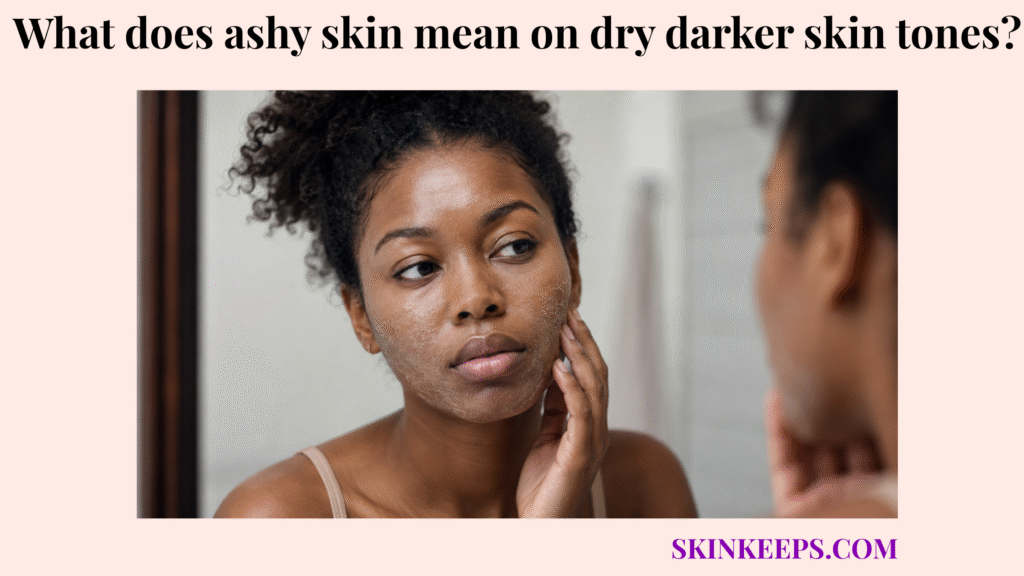
Ashy skin on dry darker skin tones usually means the outer surface is dry enough to create a gray, white, chalky, or dusty cast over melanin-rich skin. This cast appears because dry cells and flakes sit on top of the skin, making the surface look paler, rougher, and less even.
This guideline explains what ashiness means, why it is more visible on darker skin tones, where it commonly appears, how to separate ashy dryness from hyperpigmentation, what worsens it, how to care for it gently, and when persistent ashiness may need professional evaluation.
What does ashy skin mean on darker skin tones?
Ashy skin on darker skin tones means visible surface dryness is creating a pale gray, white, or chalky layer over the natural skin color. This ashiness usually sits on top of the skin rather than appearing as a deeper brown or purple color change. The key visual clue is a powdery or dusty finish that follows dry texture.
Ashiness is often easiest to recognize when the skin looks dull, rough, or flaky in addition to looking grayish. This combination points toward surface dryness rather than pigment alone. Readers who need the broader dry-skin context can compare this page with the main dry skin guide.
Why ashiness usually signals surface dryness
Ashiness usually signals surface dryness because loose dry cells scatter across the skin and create a pale cast over the outer layer. This makes the skin look powdery, chalky, or gray rather than smooth and even. The appearance should not be described as dirt or poor hygiene because the visible change is usually dryness on the surface.
Why ashy skin often looks gray, white, or chalky
Ashy skin often looks gray, white, or chalky because dry flakes contrast strongly against the deeper color of melanin-rich skin. The contrast makes pale dry cells easier to see. This is why ashiness may look obvious on elbows, knees, shins, hands, or other dry areas even when the underlying skin tone has not changed.
Why does dry skin look ashy on darker skin?
Dry skin looks ashy on darker skin because flakes, roughness, and scaling create a lighter surface layer that contrasts with the natural skin tone. This contrast makes dryness more visible than it might be on lighter skin. The ashiness is not the skin changing identity; it is the dry surface layer becoming easier to see.
The visual mechanism is mostly surface texture. Loose dry cells sit unevenly, catch light differently, and create a gray or chalky finish. Readers who see flakes or layered dry patches can connect this pattern to the page on flaking and scaling in dry skin.
How dry flakes create a pale surface cast
Dry flakes create a pale surface cast by sitting loosely on top of the skin and making the surface look powdery. These flakes reflect light differently from the smoother surrounding skin. When enough flakes collect, the surface can look gray, white, or chalky from a distance.
Why rough texture reflects light differently on darker skin
Rough texture reflects light differently on darker skin because uneven dry cells interrupt the smooth appearance of the skin surface. Instead of a continuous tone, the skin shows small dry edges, flakes, and matte patches. The result is a visible ashy finish that follows texture more than deep pigment.
| Visible Change | What Happens | What It Looks Like |
|---|---|---|
| Dry flakes | Loose surface cells collect | White or gray cast |
| Rough texture | Surface becomes uneven | Dull, chalky finish |
| Low surface moisture | Skin loses smoothness | Less rich, less even tone |
| Scaling | Dry patches become thicker | More obvious ashiness |
| Frequent friction | Dry areas rub against clothing or surfaces | Ashiness appears faster on elbows, knees, or shins |
Where does ashiness usually show up on dry darker skin?
Ashiness usually shows up on dry darker skin in areas where the surface is thicker, exposed, frequently washed, or exposed to friction. Elbows, knees, shins, ankles, feet, and hands commonly show ashiness because these areas lose smoothness quickly. The mouth area can also look ashy when dryness, saliva, weather, or repeated wiping irritates the surface.
Location matters because ashiness is often not evenly spread across the whole body. It may cluster where skin bends, rubs, or faces cold air. When ashiness appears as isolated rough patches on the body, the guide on dry patches on legs or elbows can help explain why certain areas show dryness more clearly.
| Location | Why Ashiness May Appear There |
|---|---|
| Elbows | Thicker skin and frequent friction |
| Knees | Friction, bending, and rougher surface texture |
| Shins | Common dry-skin zone, especially in cold or dry weather |
| Ankles | Friction from socks and shoes |
| Feet | Thicker skin and dryness-prone surface |
| Hands | Frequent washing and environmental exposure |
| Around the mouth | Wiping, saliva, weather, or surface irritation |
| Exposed areas | Cold, wind, or dry air can increase visible dryness |
How is ashy dryness different from hyperpigmentation or dark patches?
Ashy dryness is different from hyperpigmentation because ashiness usually looks gray, white, chalky, or powdery on the surface, while hyperpigmentation appears as deeper brown, purple-brown, or dark patches. This distinction matters because ashiness is often a surface texture problem, while hyperpigmentation involves color change within the skin. A quick visual clue is whether the area looks dusty and flaky or deeply discolored.
Moisturizer response can also help separate the two patterns, but it should not be used as a diagnosis. Ashiness often looks less obvious after the dry surface is moisturized, while pigment changes usually remain visible. If the area stays dark, thick, itchy, or inflamed after dryness improves, it should be evaluated rather than treated as simple ashiness.
| Feature | Ashy Dryness | Hyperpigmentation or Dark Patches |
|---|---|---|
| Color | White, gray, chalky, dusty | Brown, dark brown, purple-brown, or black |
| Texture | Often rough, flaky, or scaly | May be smooth, thickened, or uneven |
| Surface look | Powdery or dry-looking | Deeper color change |
| Response to moisturizer | Often looks better when dryness improves | Usually does not disappear quickly |
| Common cause | Surface dryness or flaking | Pigment change after inflammation, acne, eczema, friction, or other causes |
| Main clue | Looks like dry surface ash | Looks like deeper discoloration |
What can make ashiness worse on darker skin tones?
Ashiness can look worse on darker skin tones when cold weather, dry air, harsh soaps, hot showers, fragrance, alcohol-heavy products, or frequent washing strip surface comfort. These triggers make the outer layer rougher and less smooth. When the dry surface becomes more uneven, the gray or chalky cast becomes more visible.
Scrubbing ashiness can also backfire because the problem is dryness, not dirt. Hard rubbing may temporarily remove loose flakes, but it can irritate the surface and make the area look rougher later. The safer direction is gentler barrier support rather than aggressive exfoliation.
How cold or dry weather increases ashiness
Cold or dry weather increases ashiness by pulling moisture from the surface and making dry flakes more visible. The surface can become tighter, rougher, and less reflective. On darker skin tones, that roughness may quickly show as a gray or chalky cast.
How harsh soaps and hot showers worsen dry-looking skin
Harsh soaps and hot showers worsen dry-looking skin by removing surface lipids that help the outer layer stay smooth and comfortable. When those surface lipids are stripped too often, dry cells lift more easily. That lifted texture makes ashiness more obvious.
Why fragrance or alcohol-heavy products can irritate dry skin
Fragrance or alcohol-heavy products can irritate dry skin because they may increase stinging, tightness, and roughness on an already dry surface. Irritation can make ashiness look more inflamed or uneven. This is why sensitive or visibly ashy areas usually need simpler, gentler product choices.
| Trigger | What It Does | Visible Result |
|---|---|---|
| Cold weather | Challenges surface moisture balance | More gray or chalky cast |
| Dry indoor air | Makes surface dryness more visible | Ashiness returns faster |
| Hot showers | Removes surface comfort | Tight, dry-looking skin |
| Harsh soaps | Strip surface lipids | Roughness and flaking |
| Fragrance-heavy products | Can irritate dry skin | Stinging or visible irritation |
| Alcohol-heavy products | Can dry the surface | More tightness and ashiness |
| Aggressive scrubbing | Irritates the surface | Rougher-looking ashiness |
How should ashy dry skin be cared for without irritating darker skin?
Ashy dry skin should be cared for with gentle cleansing, consistent moisturizing, and barrier-supportive products instead of aggressive scrubbing or harsh brightening attempts. This care direction works because ashiness is usually a surface dryness sign, not a stain that needs to be rubbed away. The goal is to smooth and hydrate the dry outer layer.
Creams, ointments, and ceramide-supportive moisturizers may be more useful when ashiness is obvious, especially on elbows, knees, shins, or hands. Lightweight lotions may not be enough for visibly chalky areas. Readers who want ingredient-level support can review dry skin moisturizer ingredients after understanding what ashiness means visually.
Why gentle cleansing matters for ashy dry skin
Gentle cleansing matters for ashy dry skin because harsh cleansing can make the surface rougher, tighter, and more visibly chalky. The cleanser should remove buildup without leaving the skin squeaky or uncomfortable. When cleansing is too aggressive, ashiness often returns faster.
Why moisturizer should be applied before ashiness fully returns
Moisturizer should be applied before ashiness fully returns because consistent surface hydration helps keep dry cells smoother and less visible. Waiting until the skin looks very chalky allows dryness to become obvious again. Regular application is more useful than trying to fix advanced ashiness after it becomes thick and rough.
Why scrubbing ashiness is the wrong approach
Scrubbing ashiness is the wrong approach because ashiness is usually surface dryness, and aggressive friction can increase irritation instead of solving the cause. The skin may look smoother for a short time after rubbing, but the barrier can feel more sensitive later. Gentle moisture support is safer than treating ashiness as something to scrape away.
| Care Direction | Why It Helps Ashiness |
|---|---|
| Use a mild cleanser | Reduces stripping and surface roughness |
| Choose fragrance-free moisturizer | Lowers irritation risk on dry skin |
| Apply moisturizer after bathing | Helps reduce visible dryness before it returns |
| Use cream or ointment on obvious ashiness | Gives stronger surface support than light lotion |
| Consider ceramide-supportive formulas | Supports barrier comfort |
| Reapply to very dry areas | Helps high-friction zones stay smoother |
| Avoid aggressive scrubbing | Prevents irritation and roughness |
| Avoid harsh brightening attempts | Prevents mistaking ashiness for pigment alone |
When is ashy skin more than ordinary dryness?
Ashy skin may be more than ordinary dryness when it persists despite consistent moisturizing or appears with severe itching, cracks, bleeding, thick scaling, swelling, oozing, crusting, or discoloration that does not fade. These signs suggest the issue may involve inflammation, irritation, or another skin condition. Professional evaluation is safer than stronger scrubbing or repeated product switching.
Persistent ashiness also deserves attention when the same patches keep returning. Recurring dry, itchy, darkened, or thickened areas may overlap with eczema, dermatitis, psoriasis, or other conditions that need diagnosis. This page should not name a condition as certain, but persistent or inflamed ashiness is not just a cosmetic concern.
When ashiness does not improve with moisturizer
Ashiness that does not improve with moisturizer may need evaluation because the visible cast may not be caused by simple surface dryness alone. If moisturizer softens the skin but the color or thickness stays unchanged, the issue may need a closer look. That does not prove a diagnosis, but it does argue against treating the area as ordinary ashiness only.
When itching, cracking, scaling, or oozing appears with ashiness
Itching, cracking, scaling, or oozing with ashiness is more concerning because it suggests irritation or inflammation beyond ordinary dry texture. Cracks and oozing are especially important because the surface may be injured or infection-looking. These signs deserve professional evaluation rather than aggressive home correction.
When ashy-looking patches keep returning in the same areas
Ashy-looking patches that keep returning in the same areas may need professional review because repeated patches can reflect an underlying skin condition. Recurrence matters because simple dry surface cast usually improves when the surface is supported consistently. Repeated return in one area should be documented rather than ignored.
Dermatologist-Level Signs Checklist
What should you remember about ashy skin on dry darker skin tones?
The main point to remember is that ashy skin on darker skin tones usually reflects visible surface dryness, not dirt, poor hygiene, or automatic hyperpigmentation. Ashiness often looks white, gray, chalky, dusty, or powdery because dry flakes contrast against melanin-rich skin. The safest goal is to reduce surface dryness gently, not scrub the skin into irritation.
Final Takeaways
- Ashy skin on darker skin tones usually means visible surface dryness.
- Ashiness often looks white, gray, chalky, dusty, or powdery.
- Ashiness is more visible on melanin-rich skin because dry flakes contrast against the natural skin tone.
- Ashy dryness is not the same as hyperpigmentation or dark patches.
- Moisturizer often improves ashiness faster than it improves true pigment change.
- Cold weather, dry air, hot showers, harsh soaps, fragrance, alcohol-heavy products, and scrubbing can make ashiness worse.
- Persistent, itchy, cracked, painful, oozing, thick, or recurring ashiness should be professionally evaluated.
- The safest goal is to reduce surface dryness gently, not scrub the skin into irritation.
FAQs
What does ashy skin mean on darker skin?
Ashy skin on darker skin usually means visible surface dryness is creating a gray, white, chalky, or dusty cast over the natural skin tone.
Is ashy skin the same as dirty skin?
No, ashy skin is not dirty skin. It usually comes from dry flakes, rough texture, or scaling on the surface.
Why does dry skin look ashy on Black or brown skin?
Dry skin looks ashy on Black or brown skin because pale dry flakes contrast more clearly against melanin-rich skin.
Is ashy skin the same as hyperpigmentation?
No, ashy skin usually looks pale, gray, or chalky on the surface, while hyperpigmentation usually appears as deeper brown, purple-brown, or dark patches.
Can moisturizer make ashy skin look better?
Yes, moisturizer can often make ashy skin look better when the ashiness is caused by surface dryness.
Should ashy skin be scrubbed off?
No, ashy skin should not be aggressively scrubbed because friction can irritate dry skin and make roughness worse.
When should ashy skin need a dermatologist?
Ashy skin should be evaluated when it is persistent, itchy, cracked, bleeding, oozing, swollen, painful, thickened, or recurring in the same areas.
Conclusion
Ashy skin on darker skin tones is usually a visible surface-dryness sign, but it should be judged by texture, persistence, discomfort, and whether the color change fades when dryness improves. A gray, white, chalky, or dusty cast often points to flakes, roughness, or scaling on the surface.
If ashiness becomes painful, itchy, cracked, oozing, thick, recurrent, or unchanged after moisturizing, it deserves professional evaluation rather than more scrubbing. The strongest interpretation is practical: ashiness is usually a surface dryness signal, but persistent or inflamed patches need a safer medical review.