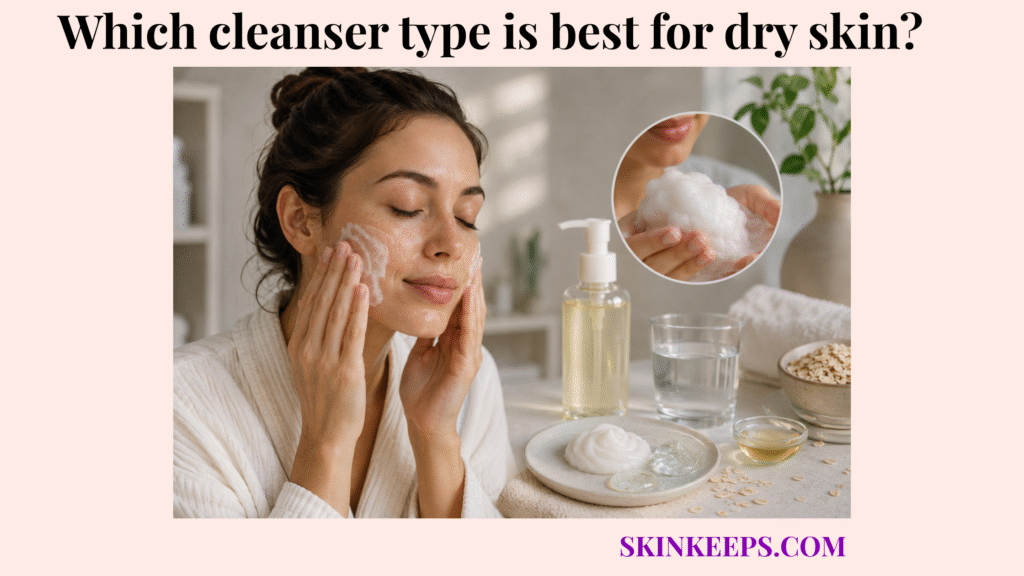
The best cleanser type for dry skin is usually a gentle, fragrance-free, non-stripping cleanser with a cream, lotion, milk, balm, or hydrating gel texture. A good dry-skin cleanser should remove dirt, sweat, sunscreen, or makeup without leaving the skin tight, squeaky, rough, itchy, or stinging after washing.
This article explains why cleanser texture, formula style, and after-feel matter for dry skin. It compares cream, lotion, milk, balm, gel, foam, and soap cleansers, then shows which ingredients to look for, which cleanser types to avoid, how to match cleanser texture to dryness pattern, and how to cleanse without worsening barrier discomfort.
What Cleanser Type Is Usually Best for Dry Skin?
The cleanser type usually best for dry skin is a gentle, fragrance-free, non-stripping cleanser that leaves the skin clean but comfortable instead of tight or squeaky. Cleanser choice should match the broader needs of dry skin, where barrier comfort matters more than a squeaky-clean finish. Cream, lotion, milk, balm, or hydrating gel textures are common dry-skin fits when the after-feel stays calm.
A cleanser should remove sweat, sunscreen, makeup, dirt, or residue without removing too much surface comfort. Texture label matters, but the skin’s after-feel matters more. If the skin feels tight, rough, itchy, or stinging after washing, the cleanser may be too stripping even if the label sounds gentle.
Why Cream, Lotion, or Milk Cleansers Often Suit Dry Skin
Cream, lotion, or milk cleansers often suit dry skin because they usually cleanse with a softer after-feel than harsh soaps or aggressive foaming cleansers. A cream cleanser, lotion cleanser, or milk cleanser can be useful when dry skin feels tight after washing. These textures are common starting points, but they are not automatically suitable for every person.
Why the Best Cleanser Should Leave Skin Comfortable, Not Squeaky
The best cleanser for dry skin should leave the skin comfortable, not squeaky, because a squeaky-clean feeling often signals that too much surface comfort has been removed. Tightness, roughness, stinging, or itching after washing are after-feel problems, not signs of better cleansing. The goal is clean but calm skin.
| Cleanser Type | Fit for Dry Skin | Why |
|---|---|---|
| Cream cleanser | Strong fit | Cleans with a softer after-feel |
| Lotion cleanser | Strong fit | Gentle and low-stripping |
| Milk cleanser | Strong fit | Lightweight but comforting |
| Balm cleanser | Useful for makeup/SPF removal | Needs gentle removal without rubbing |
| Hydrating gel cleanser | Good if non-stripping | Lighter option for dry facial skin |
| Strong foaming cleanser | Often risky | Can leave dry skin tight |
| Harsh bar soap | Usually poor fit | Can strip natural lipids |
Why Do Cream and Lotion Cleansers Work Well for Dry Skin?
Cream and lotion cleansers work well for dry skin because they are usually designed to clean with less of the tight, stripped after-feel that dry skin often gets from harsher cleansers. Texture is part of comfort, not a guarantee. Cream or lotion cleanser textures may fit the face, neck, and dry body areas depending on the formula.
Cream, lotion, milk, balm, gel, and foam all behave differently because they remove residue with different textures and surfactant systems. A cleanser that leaves the skin stripped can overlap with the way harsh soaps can remove natural lipids in dry skin. That is why the after-feel should decide whether the cleanser really fits.
How Creamy Cleansers Reduce the Stripped Feeling
Creamy cleansers reduce the stripped feeling by cleaning the surface while helping dry skin avoid the harsh tightness that can follow stronger soap-like cleansing. The stripped feeling usually means tight, stretched, rough, or uncomfortable skin after rinsing. Cream cleansers can support surface comfort, but they do not replace moisturizer.
Why Dry Skin Often Needs Cleansing With Barrier Comfort
Dry skin often needs cleansing with barrier comfort because the goal is to remove residue without pushing the outer layer into tightness, stinging, or roughness. Dry skin still needs cleansing when sweat, dirt, makeup, sunscreen, or residue is present. The selection test remains the same: clean skin should feel calm after rinsing.
| Texture Type | Potential Benefit | Dry-Skin Risk |
|---|---|---|
| Cream cleanser | Soft, comforting after-feel | May not remove heavy makeup/SPF alone |
| Lotion cleanser | Gentle everyday feel | May feel too light for heavy residue |
| Milk cleanser | Light but soft cleansing | May need a second gentle step for heavy sunscreen |
| Balm cleanser | Helps dissolve makeup or sunscreen | Rough removal can irritate dry skin |
| Hydrating gel cleanser | Lightweight and clean-feeling | Must not leave tightness |
| Foaming cleanser | Rinses easily and feels fresh | Strong foam may over-strip dry skin |
Can Dry Skin Use Gel or Foaming Cleansers?
Dry skin can use gel or foaming cleansers only if they are gentle, hydrating, fragrance-free, and do not leave the skin tight, squeaky, or stinging after washing. The word “foam” alone is not the problem. The problem is a formula that removes too much surface comfort.
A hydrating gel cleanser can be a lighter option for some dry facial skin when cream cleansers feel too heavy. A foaming cleanser can still work if the lather is mild and the after-feel is calm. If the skin feels squeaky, tight, or burning afterward, the cleanser is not behaving like a dry-skin fit.
| Skin Response After Cleansing | What It Means |
|---|---|
| Skin feels soft and calm | Cleanser may be suitable |
| Skin feels tight | Cleanser may be too stripping |
| Skin stings or burns | Barrier may be irritated |
| Skin flakes more after washing | Cleanser or water temperature may be worsening dryness |
| Skin feels squeaky clean | Usually too aggressive for dry skin |
Which Cleanser Ingredients Help Dry Skin Feel Comfortable?
Cleanser ingredients that help dry skin feel comfortable usually support mild cleansing, reduce a stripped after-feel, or lower the chance of fragrance-related irritation. Ingredient guidance should stay cleanser-specific because rinse-off ingredients have less contact time than leave-on moisturizers. Formula direction matters more than treating cleanser ingredients like medical treatments.
Dry skin often does better with mild surfactants, fragrance-free formulas, and a non-drying cleansing base. Glycerin, panthenol, ceramides, colloidal oatmeal, and aloe if tolerated can support a calmer cleanser feel. A pH-balanced formula may help some dry or sensitive skin, but the label does not guarantee tolerance for every person.
Ingredient Selection Guide
- Glycerin.
- Panthenol.
- Ceramides.
- Colloidal oatmeal.
- Aloe if tolerated.
- Mild surfactants.
- Fragrance-free formula.
- pH-balanced formula.
- Non-drying cleansing base.
Which Cleanser Types Should Dry Skin Avoid?
Dry skin should avoid or limit cleanser types that leave the skin tight, squeaky, stinging, rough, itchy, or more flaky after washing. Dry skin does not need aggressive cleansing to be clean. Stronger cleansing is not better if the skin feels stripped afterward.
Harsh bar soaps, deodorant soaps, unnecessary strong antibacterial soaps, high-foam tight-feel cleansers, fragrance-heavy cleansers, alcohol-heavy cleansers, and rough scrub cleansers are common problem patterns. The after-feel test matters because dry skin can feel tight after washing when the cleanser removes too much surface comfort. The point is practical caution, not fear.
Avoid or Limit
- Harsh bar soaps.
- Deodorant soaps.
- Strong antibacterial soaps used unnecessarily.
- High-foam cleansers that leave tightness.
- Fragrance-heavy cleansers.
- Alcohol-heavy cleansers.
- Scrub cleansers with rough particles.
- Cleansers that make skin feel squeaky or stretched.
How Should Dry Skin Choose Between Cleanser Textures?
Dry skin should choose between cleanser textures by matching the formula to dryness severity, sensitivity, makeup or sunscreen use, acne tendency, flaking, and stinging after washing. The best cleanser depends on pattern and after-feel, not the name alone. Acne-prone dry skin may need a lighter gentle cleanser, but this page is not a full acne-cleanser guide.
Very dry and tight skin often starts with a cream or lotion cleanser. Dry skin with makeup or sunscreen may need a balm or gentle first cleanse followed by mild cleansing only if needed. Dry and stinging skin usually needs a minimal, fragrance-free cleanser without harsh actives.
| Dry-Skin Condition | Better Cleanser Direction |
|---|---|
| Very dry and tight | Cream or lotion cleanser |
| Dry and sensitive | Fragrance-free creamy cleanser |
| Dry with makeup or sunscreen | Balm or gentle first cleanse, then mild cleanser if needed |
| Dry but acne-prone | Gentle hydrating gel or non-comedogenic cream cleanser |
| Dry and flaky | Non-stripping cleanser plus moisturizer after washing |
| Dry and stinging | Minimal, fragrance-free cleanser; avoid actives |
How Can Dry Skin Tell If a Cleanser Is Too Harsh?
Dry skin can tell a cleanser is too harsh when the skin feels tight, squeaky, stinging, burning, itchy, rough, or more flaky after cleansing. After-feel is the simplest cleanser test because it checks what the cleanser does after it rinses away. Needing moisturizer immediately just to stop discomfort suggests the cleanser may be too stripping.
This is a practical assessment, not a medical diagnosis. A cleanser can be poorly matched without proving eczema, dermatitis, allergy, infection, or rosacea. The stronger concern is persistent or worsening irritation that does not settle after switching to gentler cleansing.
After-Cleansing Warning Signs
- Tightness.
- Squeaky-clean feeling.
- Stinging.
- Burning.
- Itching.
- More flaking.
- Redness or darker irritation.
- Roughness after washing.
- Skin needing moisturizer immediately just to stop discomfort.
How Should Dry Skin Cleanse Without Worsening Dryness?
Dry skin should cleanse without worsening dryness by using lukewarm water, applying a gentle cleanser with minimal friction, rinsing well, patting dry, and moisturizing while the skin is still slightly damp. Water temperature matters because hot showers can worsen dryness even when the cleanser itself is gentle. Fingers are safer than rough cloths, brushes, or scrub tools when the goal is low-friction cleansing.
Very dry body areas may not need cleanser everywhere every time, especially when no sweat, sunscreen, makeup, or residue is present. Cleansing should end with moisture support because moisturizer should be applied to dry skin before post-wash tightness fully returns. This keeps the section practical without turning it into a full routine article.
Dry-Skin Cleansing Checklist
- Use lukewarm water.
- Use a gentle cleanser only where needed.
- Avoid scrubbing with rough cloths or brushes.
- Keep cleansing short.
- Pat dry instead of rubbing.
- Leave skin slightly damp.
- Apply moisturizer soon after cleansing.
- Use a richer moisturizer if skin still feels tight.
When Should Cleanser-Related Dryness Be Checked Professionally?
Cleanser-related dryness should be checked professionally when burning, swelling, oozing, crusting, bleeding, severe itching, recurring patches, or persistent irritation continues despite switching to gentle cleansing. Professional evaluation helps distinguish ordinary cleanser irritation from skin conditions, allergic reactions, or infection-looking changes. Professional review becomes important when persistent dry skin needs a dermatologist instead of stronger cleanser changes.
The warning boundary should stay calm and non-diagnostic. A cleanser reaction does not prove eczema, dermatitis, allergy, infection, psoriasis, or rosacea. It does mean persistent or severe symptoms should not be handled by repeatedly testing stronger products at home.
Warning Signs
- Burning continues after washing.
- Skin swells, oozes, crusts, or bleeds.
- Severe itching appears.
- Dry patches keep returning in the same places.
- Redness, darkening, or irritation worsens.
- Skin stings with many gentle products.
- Symptoms disrupt sleep or daily life.
- You suspect eczema, dermatitis, allergy, infection, rosacea, or another condition.
What Should You Remember About Cleanser Types for Dry Skin?
Dry skin usually does best with a gentle, fragrance-free, non-stripping cleanser that cleans without leaving tightness, squeakiness, stinging, or roughness behind. Cleanser selection works best inside broader dry skin care tips that reduce stripping, friction, and irritation. The cleanser name matters less than the after-feel, and a cleanser that works should remove residue while still leaving the skin calm.
Final Takeaways
- Dry skin usually does best with cream, lotion, milk, balm, or hydrating gentle cleansers.
- The best cleanser cleans without tightness.
- Squeaky clean is usually a warning sign for dry skin.
- Fragrance-free and non-stripping formulas are safer starting points.
- Foaming or gel cleansers can work only if they are gentle and comfortable.
- Harsh soap, rough scrubs, and drying cleansers usually make dry skin worse.
Frequently Asked Questions
Is a Cream Cleanser Better for Dry Skin Than Foam?
A cream cleanser is often better for dry skin than a strong foaming cleanser when foam leaves the skin tight, squeaky, or uncomfortable. Foam is not automatically bad, but dry skin should judge by after-feel, not lather level alone.
Can Dry Skin Use a Gel Cleanser?
Dry skin can use a gel cleanser if it is gentle, hydrating, fragrance-free, and does not leave the skin tight or stinging. Hydrating gel cleansers may suit some dry facial skin, especially when cream cleansers feel too heavy.
Is Bar Soap Bad for Dry Skin?
Bar soap can be a poor fit for dry skin when it is alkaline, deodorizing, heavily fragranced, or leaves the skin squeaky and tight. Traditional harsh soaps are often more stripping, while some syndet or moisturizing bars may be gentler if the after-feel is comfortable.
Should Dry Skin Feel Squeaky Clean After Washing?
Dry skin should not usually feel squeaky clean after washing because that feeling often means too much surface comfort has been removed. Dry skin should feel clean, soft, and calm after cleansing rather than tight, stretched, rough, or itchy.
Should Dry Skin Cleanse Every Morning?
Dry skin does not always need a full cleanser every morning if it feels tight or easily stripped. Some people may rinse with lukewarm water in the morning, while sunscreen, sweat, makeup, or residue may still require gentle cleansing.
Conclusion
The best cleanser type for dry skin is usually gentle, fragrance-free, non-stripping, and comfortable after rinsing. Cream, lotion, milk, balm, and hydrating gel cleansers can all work when they remove residue without leaving tightness, squeakiness, roughness, itching, or stinging.
The real test is after-feel, not the cleanser name alone. Dry skin usually needs cleansing that is effective but low-friction, with lukewarm water, no scrubbing, gentle patting dry, and moisturizer soon after washing so the barrier stays comfortable.