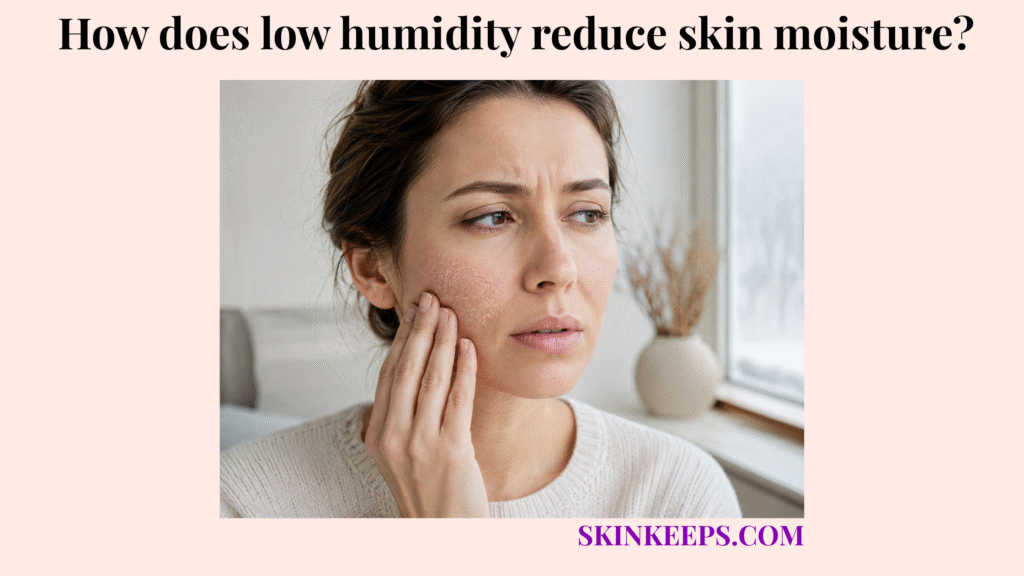
Low humidity reduces skin moisture by making the surrounding air drier than the outer skin layer, which encourages water to evaporate from the stratum corneum. This evaporation reduces surface flexibility and can make the skin feel tight, rough, flaky, itchy, or more reactive.
This guideline explains how low humidity creates a moisture-loss gradient, how that gradient increases transepidermal water loss, why indoor heating worsens dry-air exposure, what low-humidity dryness looks and feels like, and how to reduce the problem with humidity support, short warm bathing, and immediate moisturizing.
Why does low humidity pull moisture from the skin?
Low humidity pulls moisture from the skin because dry air creates a moisture gradient that encourages water to move away from the stratum corneum. This gradient forms when the air around the skin has less moisture support than the outer skin layer. As water leaves, the surface becomes less smooth, less flexible, and more likely to feel tight.
Low humidity is one specific trigger within the broader group of environmental factors that worsen dry skin, but this page focuses only on the moisture-loss mechanism. That focus matters because the same dry-air exposure can make early roughness appear before flakes become visible.
How dry air creates a moisture gradient away from the skin
Dry air creates a moisture gradient away from the skin by surrounding the stratum corneum with an environment that encourages surface water to evaporate. This gradient does not act like a vacuum; it simply means water moves more readily from the moister skin surface into drier surrounding air. As evaporation increases, the outer layer has less water support for comfort and flexibility.
Why the stratum corneum loses flexibility when water leaves
The stratum corneum loses flexibility when water leaves because its surface cells become less pliable and less able to maintain a smooth, comfortable texture. This flexibility loss is why low-humidity dryness can feel tight or coarse before obvious flakes appear. If low humidity creates texture before flakes appear, the article on dry skin can feel rough before visible flaking can clarify that early stage.
| Low-Humidity Effect | What Happens | Skin Result |
|---|---|---|
| Dry air surrounds the skin | Water evaporates more easily. | Moisture loss. |
| Stratum corneum loses water | Outer layer becomes less flexible. | Tightness. |
| Barrier comfort drops | Skin surface becomes less smooth. | Roughness. |
| Moisture loss continues | Dry cells shed unevenly. | Flaking or scaling. |
| Irritation increases | Dry skin becomes more reactive. | Itching, stinging, or redness. |
How does low humidity increase transepidermal water loss?
Low humidity increases transepidermal water loss by making it easier for water to leave the epidermis and pass through the stratum corneum into the surrounding air. TEWL describes this movement of water across the outer skin barrier. When the surrounding air is dry, the barrier has to work harder to maintain moisture stability.
Increased TEWL matters because moisture loss changes how the skin feels before it always changes how it looks. The skin may feel tight, less elastic, or more sensitive even before visible cracking or flaking appears. When moisture loss progresses into visible shedding, the guide on dry skin flaking and scaling can explain the later surface changes.
What TEWL means in low-humidity conditions
TEWL in low-humidity conditions means water is escaping from the epidermis through the stratum corneum into dry surrounding air. This process is useful to understand because it explains why skin can become dry even without visible peeling at first. The problem is not only a surface look; it is a moisture-stability change in the outer barrier.
Why dry air makes the skin barrier work harder
Dry air makes the skin barrier work harder because the outer layer must retain water while the surrounding environment continuously encourages evaporation. When that demand continues, the barrier may feel tighter, rougher, and more reactive. This is why low-humidity dryness can create discomfort before the skin looks severely dry.
| TEWL-Related Change | What It Means | Common Skin Effect |
|---|---|---|
| More water leaves the epidermis | Surface hydration drops. | Tightness. |
| Stratum corneum becomes less flexible | Outer layer stiffens. | Roughness. |
| Barrier comfort decreases | Skin becomes more reactive. | Itching or stinging. |
| Dryness persists | Surface cells shed unevenly. | Flaking or scaling. |
| Barrier stress increases | Skin tolerates products less easily. | Irritation. |
Why does indoor heating make low-humidity dryness worse?
Indoor heating makes low-humidity dryness worse by keeping the air around the skin dry for long periods, especially during colder seasons. This means the skin can keep losing comfort even after a person leaves cold outdoor air. Bedrooms, offices, and heated indoor spaces can all extend low-humidity exposure.
Indoor heating matters because exposure time changes the dryness pattern. A person may protect the skin outdoors, then still wake up with tightness, roughness, or flaking because heated indoor air kept the room dry overnight. The key is to treat indoor air as part of the environment, not as a separate skin problem.
How heated indoor air lowers moisture around the skin
Heated indoor air lowers moisture around the skin by creating a dry room environment that gives the stratum corneum less humidity support. This lower support makes evaporation from the skin surface easier. When heated rooms are used every day, the moisture-loss cycle can repeat for hours.
Why winter dryness can continue even indoors
Winter dryness can continue even indoors because heated rooms may keep the skin exposed to low-moisture air for many hours. This indoor exposure can explain overnight tightness, morning roughness, or repeated dryness in bedrooms and offices. The pattern is environmental even when the person is not standing outside in cold air.
| Environment | Main Moisture-Loss Pattern |
|---|---|
| Cold outdoor air | Low surrounding moisture and exposure stress. |
| Heated indoor room | Dry indoor air and long exposure time. |
| Bedroom air | Overnight tightness or morning roughness. |
| Office air | Repeated exposure during the day. |
| Air-conditioned space | Dry circulating air. |
| Dry climate | Year-round low-moisture exposure. |
What does low-humidity moisture loss feel or look like?
Low-humidity moisture loss can feel or look like tightness, roughness, itching, flaking, fine surface lines, stinging, irritation, or cracking. These signs appear because the outer skin layer becomes less flexible as water content drops. Mild moisture loss may only feel tight, while stronger dryness may become visibly flaky or cracked.
Low humidity can also make existing dry skin symptoms more noticeable. A person may first notice tightness after washing, then roughness, then visible flaking if the dry-air exposure continues. When dry-air exposure creates sharp discomfort, the page on dry skin stinging or burning can help separate dryness from stronger irritation.
Why tightness and roughness appear early in low humidity
Tightness and roughness appear early in low humidity because the stratum corneum becomes less hydrated, less flexible, and less smooth. These early clues can be felt before the skin visibly peels. If the dryness also appears after cleansing, the guide on dry skin feels tight after washing can explain the washing-related part of that discomfort.
Why flaking, itching, and cracking can appear as moisture loss progresses
Flaking, itching, and cracking can appear as moisture loss progresses because dry surface cells become less stable and the barrier becomes more irritated. Flaking means dry cells are now shedding visibly, while cracking suggests the surface has become stiff enough to split. These later signs deserve stronger attention than mild tightness alone.
| Sign | Why It Happens |
|---|---|
| Tightness | Outer layer loses water and flexibility. |
| Roughness | Surface cells become uneven. |
| Flaking | Dry cells shed visibly. |
| Itching | Dryness irritates the barrier. |
| Fine lines | Surface dryness makes shallow lines clearer. |
| Stinging | Dry barrier becomes more reactive. |
| Cracking | Severe dryness makes skin stiff and split. |
Which areas lose moisture fastest in low humidity?
Areas that often lose moisture fastest in low humidity include the hands, lips, cheeks, around the mouth, elbows, knees, shins, and feet. These areas are frequently exposed to air, washing, friction, pressure, or naturally lower surface comfort. The result is that low-humidity dryness may appear in patches rather than evenly across the whole body.
Location helps explain the trigger pattern. Hands may react first because of washing, lips because of constant exposure, and cheeks because of wind, dry air, or cleanser contact. When vulnerable areas start changing, the broader guide to dry skin can help place the pattern within the full skin-type context.
Why hands, lips, and cheeks often react quickly to low humidity
Hands, lips, and cheeks often react quickly to low humidity because they are exposed repeatedly to air, cleansing, friction, and weather. These areas also tend to be noticed quickly because they feel tight, chapped, or rough during daily movement. Early support matters because the same surfaces can progress into irritation when dry air continues.
Why elbows, knees, shins, and feet can become rough in dry air
Elbows, knees, shins, and feet can become rough in dry air because friction, pressure, and lower surface comfort make texture changes more obvious. These areas may not always feel painful at first, but they can become coarse or patchy. Consistent moisturizer and friction reduction are usually more useful than aggressive scrubbing.
| Area | Why Low Humidity May Affect It |
|---|---|
| Hands | Frequent washing and exposure. |
| Lips | Thin surface and constant environmental contact. |
| Cheeks | Wind, dry air, and cleanser exposure. |
| Around mouth | Friction, washing, saliva exposure, or dryness. |
| Elbows | Pressure and rough surface buildup. |
| Knees | Friction and dryness. |
| Shins | Cold air and low surface oiliness. |
| Feet | Pressure, friction, and dryness. |
How can low-humidity skin moisture loss be reduced?
Low-humidity skin moisture loss can be reduced by supporting indoor humidity, moisturizing immediately after washing, limiting hot-water exposure, choosing gentle cleansers, and protecting exposed skin from cold air and wind. These steps reduce the conditions that encourage evaporation and barrier stress. The goal is prevention support, not a quick cure.
Humidifier support can be useful when indoor air is dry. Harvard Health recommends setting a winter humidifier to around 60% to help replenish the top layer of the epidermis. [Harvard Health]
Why humidifier support helps low-humidity dryness
Humidifier support helps low-humidity dryness because adding moisture to indoor air reduces the dry-air pressure that encourages evaporation from the stratum corneum. This does not replace moisturizer, but it can make the room environment less drying. The benefit is most relevant when heated indoor air or winter air keeps skin tight and rough.
Why moisturizer should be applied immediately after washing
Moisturizer should be applied immediately after washing because the outer layer needs support before water exposure turns into tightness. Applying moisturizer while the surface is still slightly damp helps support comfort after washing. This is especially important when low humidity is already encouraging moisture loss.
Why short warm showers are safer than long hot showers
Short warm showers are safer than long hot showers because hot water and long bathing can remove surface comfort from already dry skin. The American Academy of Dermatology recommends limiting baths and showers to five to ten minutes when relieving dry skin. [American Academy of Dermatology]
Humidity-Support Checklist
When does low-humidity dryness need professional evaluation?
Low-humidity dryness needs professional evaluation when it cracks, bleeds, becomes painful, burns, stings, swells, oozes, crusts, persists, or disrupts sleep and daily life. These patterns suggest the problem may be more than ordinary dry-air exposure. The article should recommend evaluation without diagnosing the reader.
Professional care is also appropriate when dryness keeps returning in the same area despite indoor humidity support, immediate moisturizing, and gentler washing. A clinician can check whether the issue is severe dryness, dermatitis, eczema, psoriasis, allergy, infection, or another concern. When low-humidity dryness does not improve despite prevention, the article on persistent dry skin needs a dermatologist can guide escalation.
Why cracking, bleeding, or oozing changes the concern level
Cracking, bleeding, or oozing changes the concern level because those signs suggest stronger barrier damage or inflammation. Low humidity may contribute to the dryness, but these signs are no longer simple moisture-loss clues. They should be evaluated more carefully, especially when pain or spreading inflammation is present.
Why persistent low-humidity dryness should be checked
Persistent low-humidity dryness should be checked because ongoing symptoms may reflect an environmental trigger plus an underlying skin condition. A dry room can worsen the pattern, but it may not be the only cause. Evaluation helps separate ordinary low-humidity dryness from conditions that need targeted care.
Warning-Sign Checklist
What should you remember about low humidity and skin moisture?
The main point to remember is that low humidity reduces skin moisture by encouraging water to evaporate from the stratum corneum into dry surrounding air. This moisture loss can make the outer layer less flexible and more reactive. The practical response is to reduce dry-air exposure, support moisture after washing, and watch for warning signs when dryness persists.
Final Takeaways
- Low humidity reduces skin moisture by increasing evaporation from the outer skin layer.
- The stratum corneum becomes less flexible when water content drops.
- Transepidermal water loss explains how water can leave the skin through the outer barrier.
- Indoor heating can worsen low-humidity dryness by keeping the surrounding air dry for long periods.
- Tightness, roughness, itching, flaking, stinging, and cracking can appear when moisture loss progresses.
- Humidifier support, immediate moisturizing, short warm showers, and gentle cleansing can help reduce low-humidity moisture loss.
- Severe, painful, bleeding, oozing, crusted, infection-looking, or persistent dryness needs professional evaluation.
FAQs
How does low humidity reduce skin moisture?
Low humidity reduces skin moisture by creating dry surrounding air that encourages water to evaporate from the stratum corneum.
What does low humidity do to the stratum corneum?
Low humidity makes the stratum corneum lose water, which can reduce flexibility and make the skin feel tight, rough, itchy, or flaky.
Does low humidity increase TEWL?
Yes, low humidity can increase transepidermal water loss by making it easier for water to leave the epidermis through the outer skin barrier.
Why does indoor heating worsen low-humidity dryness?
Indoor heating worsens low-humidity dryness by keeping indoor air dry, which exposes the skin to moisture-loss conditions for longer periods.
What humidity level helps winter dry skin?
Harvard Health recommends setting a winter humidifier to around 60% to help replenish the top layer of the epidermis. [Harvard Health]
How long should showers be when skin is dry?
The American Academy of Dermatology recommends limiting baths and showers to five to ten minutes when relieving dry skin. [American Academy of Dermatology]
When should low-humidity dryness need professional care?
Low-humidity dryness needs professional care when it cracks, bleeds, becomes painful, burns, stings, swells, oozes, crusts, persists, or disrupts sleep and daily life.
Conclusion
Low humidity reduces skin moisture by encouraging water to evaporate from the stratum corneum into dry surrounding air. This moisture loss makes the outer skin layer less flexible, which can lead to tightness, roughness, itching, flaking, stinging, or cracking. The best prevention is to reduce dry-air exposure, support indoor moisture when needed, moisturize after washing, use short warm showers, and seek care if dryness becomes painful, bleeding, oozing, crusted, or persistent.