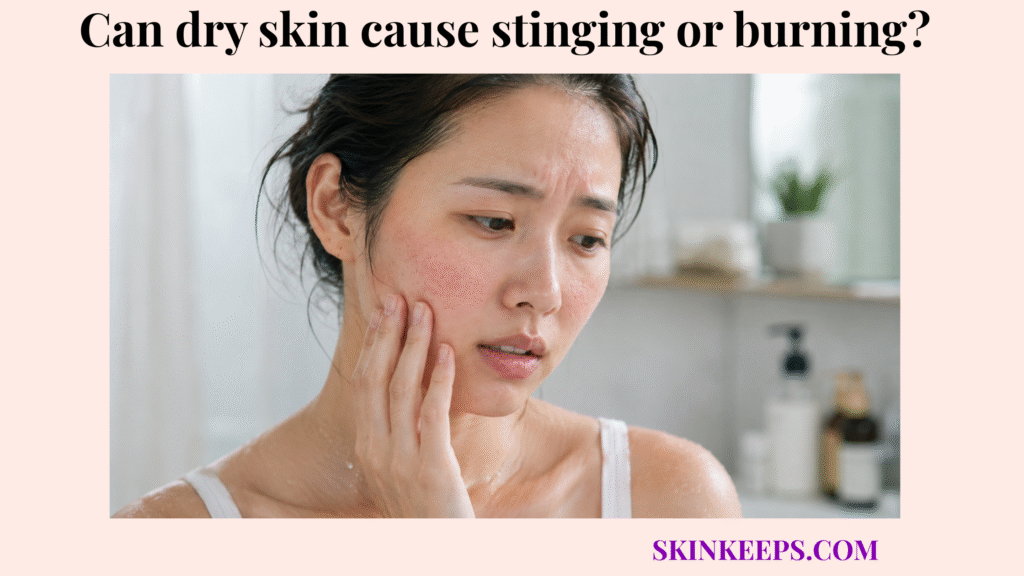
Yes, dry skin can cause stinging or burning when the outer barrier becomes cracked, raw, irritated, or severely moisture-depleted. This stronger discomfort usually means the skin surface is more reactive than simple dryness alone.
This guideline explains why dry skin can sting or burn, which triggers commonly cause the sensation, how burning differs from tightness, how dry-skin irritation differs from contact dermatitis, which care steps calm the barrier, and when symptoms need professional evaluation.
Why can dry skin sting or burn?
Dry skin can sting or burn because a weakened barrier exposes sensitive surface tissue to water, cleanser, sweat, cold air, and skincare ingredients more easily. This exposed feeling is stronger than ordinary dryness because the skin is no longer tolerating everyday contact comfortably. The result may be a sharp sting, a warm burning sensation, or soreness after washing or product use.
Stinging and burning should be interpreted by pattern and severity. A brief sting after applying a product may suggest barrier sensitivity, while repeated burning with swelling, oozing, blistering, or pain is more concerning. If the broader pattern includes tightness, itching, and soreness, the guide on dry skin barrier discomfort can help frame the full sensation profile.
How a weakened skin barrier exposes sensitive surface tissue
A weakened skin barrier exposes sensitive surface tissue by losing the outer comfort layer that normally buffers water, cleanser, friction, and product contact. This barrier loss does not mean the skin is destroyed, but it does mean the surface is less protected from ordinary touch and ingredients. When that buffering layer is reduced, a mild product or rinse can feel sharper than expected.
Why cracked or raw dry skin reacts strongly to water and products
Cracked or raw dry skin reacts strongly to water and products because small openings and irritated areas allow contact triggers to reach more sensitive surface layers. Water, moisturizer, cleanser, sweat, and cold air can then feel stingy or warm instead of soothing. If visible splitting is part of the pattern, the guide on dry skin cracked appearance can help explain why cracks change comfort.
| Sensation | What It May Suggest |
|---|---|
| Mild stinging | Barrier dryness or product sensitivity. |
| Burning after washing | Harsh cleanser, hot water, or irritated skin. |
| Burning after moisturizer | Damaged barrier or unsuitable formula. |
| Stinging with cracks | More advanced dry-skin barrier damage. |
| Painful burning | Possible dermatitis, infection, or stronger irritation that needs review. |
| Burning with swelling | A stronger inflammatory reaction may be present. |
| Burning with oozing or crusting | Professional evaluation is safer. |
What makes dry skin sting after washing or applying products?
Dry skin stings after washing or applying products when water, cleanser, fragrance, preservatives, acids, sweat, or moisturizer contact an already irritated barrier. The sting does not always mean the product is dangerous, but it does mean the skin is currently less tolerant. Repeated stinging should change the routine.
The trigger tells the reader what to adjust first. Burning after hot water points toward washing conditions, while burning after a specific cream may point toward product intolerance or barrier weakness. If washing mainly causes tightness without burning, the page on dry skin feels tight after washing is the better internal link.
Why water can sting damaged dry skin
Water can sting damaged dry skin when the barrier is cracked, raw, or irritated enough that simple contact feels sharp instead of neutral. This does not mean water itself is harmful; it means the skin surface is temporarily too exposed to tolerate contact comfortably. The stronger the sting after washing, the more carefully the routine should be simplified.
Why harsh cleansers and fragrance can worsen burning
Harsh cleansers and fragrance can worsen burning because they add chemical irritation to a barrier that is already dry, reactive, or poorly protected. A cleanser that leaves burning, squeaky tightness, or redness after repeated use is not matching the current skin state. Fragrance can be especially unhelpful when the goal is to reduce avoidable irritation.
Why even moisturizer can sting when the barrier is compromised
Even moisturizer can sting when the barrier is compromised because humectants, preservatives, fragrance, or active ingredients may contact irritated surface tissue before the skin has calmed. This does not automatically mean every moisturizer is wrong. It means the formula and barrier condition should be judged together, especially when stinging repeats.
| Trigger | Why It May Sting or Burn |
|---|---|
| Water | Can sting cracked or raw patches. |
| Hot water | Increases dryness and irritation. |
| Harsh soap | Strips and irritates the barrier. |
| Fragrance | Can irritate sensitive dry skin. |
| Alcohol-heavy products | Can sting on compromised skin. |
| Strong acids or retinoids | Can exceed current tolerance. |
| Sweat | Can irritate cracked or raw patches. |
| Cold, dry air | Worsens barrier dryness. |
How are stinging and burning different from simple tightness?
Stinging and burning are different from simple tightness because they usually suggest stronger barrier sensitivity, irritation, or inflammation rather than ordinary moisture loss alone. Tightness often means the skin lacks comfort and flexibility, while burning means the surface is reacting more intensely. The stronger the sensation, the more carefully the routine should be simplified.
The difference matters because mild tightness and repeated burning should not be handled the same way. Tightness may improve with moisturizing after washing, while burning may require stopping irritating products and watching for redness, swelling, or rash. When burning appears with visible inflammation, the guide on dry skin redness and irritation can help connect sensation to appearance.
Why tightness is usually milder than stinging or burning
Tightness is usually milder than stinging or burning because it often reflects reduced flexibility, while stinging and burning suggest stronger nerve-level irritation. A tight feeling can happen when the surface is dry but still mostly intact. Stinging or burning deserves more attention because it suggests the barrier is reacting more strongly to contact.
Why burning deserves closer attention than ordinary dryness
Burning deserves closer attention than ordinary dryness because it can signal a more irritated barrier, product reaction, dermatitis-like inflammation, or painful cracking. The important clues are persistence, intensity, and whether visible changes appear. Burning that repeats with basic products should not be brushed off as normal dryness.
| Sensation | Common Meaning | Concern Level |
|---|---|---|
| Tightness | Moisture loss or dryness. | Usually mild to moderate. |
| Itching | Dryness or irritation. | Depends on severity. |
| Stinging | Barrier sensitivity or irritation. | Moderate warning. |
| Burning | Stronger irritation or inflammation. | Higher concern. |
| Pain | Cracks, rawness, dermatitis, or infection risk. | Needs attention. |
How is dry-skin burning different from contact dermatitis?
Dry-skin burning is different from contact dermatitis because dryness-related burning often follows barrier cracking or moisture loss, while contact dermatitis follows irritant or allergen exposure and may cause rash, swelling, blistering, oozing, or crusting. The symptoms can overlap, so the trigger and appearance matter. Burning alone should not be used to self-diagnose.
Dry-skin burning may improve when harsh triggers stop and the barrier is supported. Contact dermatitis-like symptoms may persist, spread, or worsen after exposure to a product, plant, chemical, fragrance, metal, or other trigger. If burning keeps returning with rash-like changes, the safest next step is professional evaluation.
Why dryness-related burning often follows washing, weather, or cracking
Dryness-related burning often follows washing, weather, or cracking because those triggers reduce barrier comfort and make the surface more reactive to ordinary contact. The burning may be strongest after a shower, cleanser use, cold exposure, or contact with sweat. This pattern should improve as avoidable triggers are reduced and the barrier is supported.
Why dermatitis-like burning often includes rash, swelling, oozing, or blistering
Dermatitis-like burning often includes rash, swelling, oozing, crusting, or blistering because inflammation is affecting the skin beyond ordinary dryness alone. These signs do not prove one specific diagnosis, but they do raise the level of concern. Burning with spreading rash, swelling, or fluid should be reviewed more carefully than simple dryness.
| Feature | Dry-Skin Stinging or Burning | Contact Dermatitis |
|---|---|---|
| Main trigger | Dryness, cracks, harsh washing, or cold air. | Irritant or allergen exposure. |
| Common feel | Tight, stingy, sore, or dry. | Burning, stinging, intense itching, or pain. |
| Appearance | Rough, flaky, cracked, or raw. | Rash, swelling, blisters, oozing, or crusting. |
| Timing | Often after washing or dryness exposure. | Can appear after exposure or within a delayed window. |
| Action | Gentle care may help. | Persistent or severe cases need medical advice. |
What commonly triggers stinging or burning in dry skin?
Common triggers for stinging or burning in dry skin include hot water, harsh soap, fragrance, alcohol-heavy products, over-exfoliation, sweat, cold dry air, and friction. These triggers either dry the barrier further or irritate already sensitive tissue. Removing the trigger is often the first step before adding more products.
The same trigger can feel different depending on barrier condition. A cleanser may feel normal on healthy skin but burn when the barrier is dry and cracked. Repeated exposure to the same trigger makes the pattern easier to identify.
Why hot water and harsh soap can make burning worse
Hot water and harsh soap can make burning worse because they remove surface comfort and increase irritation in skin that is already dry or reactive. The heat can make the skin feel more exposed after washing, while harsh soap can leave the surface strained. When burning follows the same wash routine repeatedly, the wash method should be softened first.
Why sweat, cold air, and friction can sting damaged dry skin
Sweat, cold air, and friction can sting damaged dry skin because they repeatedly contact or rub a weakened surface that has reduced tolerance. Sweat may sting cracked or raw areas, cold air can intensify dryness, and rough fabric can add mechanical irritation. These triggers matter most when the same sensation appears again and again.
| Trigger | Why It Stings or Burns |
|---|---|
| Hot water | Increases dryness and irritation. |
| Harsh soap | Strips and irritates the barrier. |
| Fragrance | Can irritate sensitive dry skin. |
| Alcohol-heavy products | Can sting on compromised skin. |
| Over-exfoliation | Leaves the surface more reactive. |
| Sweat | Can irritate cracked or raw patches. |
| Cold, dry air | Worsens barrier dryness. |
| Rough fabric or towel friction | Adds mechanical irritation. |
How should dry skin stinging or burning be calmed?
Dry skin stinging or burning should be calmed by stopping repeated triggers, switching to gentle fragrance-free care, moisturizing after washing, and pausing irritating actives until the barrier feels stable. The goal is to reduce contact stress while the skin becomes less reactive. Adding more strong products usually makes burning harder to interpret.
Care should match the severity of the sensation. Mild stinging may improve with simpler products, while burning with cracks may need thicker barrier support and more protection from friction. If ingredient selection is the issue, the page on moisturizer ingredients for dry skin can help guide gentler choices.
Why repeated burning products should be stopped first
Repeated burning products should be stopped first because continued exposure can keep the dry barrier irritated and make recovery slower. This is a practical safety step, not a diagnosis of allergy. If one product repeatedly creates burning, the routine becomes clearer when that product is paused.
Why fragrance-free moisturizer and gentle cleansing are safer first steps
Fragrance-free moisturizer and gentle cleansing are safer first steps because they reduce avoidable irritation while supporting dry skin comfort. The goal is to keep the routine boring enough for the skin to settle. Once the burning pattern calms, products can be judged more accurately.
Why acids, retinoids, scrubs, and fragrance should pause during burning episodes
Acids, retinoids, scrubs, and fragrance should pause during burning episodes because reactive dry skin often needs stability before stronger ingredients are reintroduced. These products may be useful for some routines, but they can be poorly tolerated during active barrier irritation. Reintroduction should be slow and based on comfort.
Barrier-Calming Checklist
When does dry-skin stinging or burning need medical care?
Dry-skin stinging or burning needs medical care when the sensation is severe, persistent, painful, spreading, sleep-disrupting, or appears with swelling, oozing, crusting, blistering, bleeding, or infection-looking changes. These patterns suggest the problem may be more than ordinary dryness. Evaluation should be recommended without naming a diagnosis.
Professional evaluation is also appropriate when many basic products suddenly sting or when the same rash-like area keeps returning. A clinician can assess whether the problem is severe dryness, dermatitis, eczema, allergy, infection, psoriasis, or another concern. If symptoms persist despite gentle care, the guide on persistent dry skin needs a dermatologist can help explain when review is safer.
Why swelling, oozing, crusting, or blistering should not be treated as simple dryness
Swelling, oozing, crusting, or blistering should not be treated as simple dryness because these signs can indicate stronger inflammation or another skin condition. Ordinary dryness can feel uncomfortable, but fluid, swelling, or blistering changes the risk pattern. These signs should move the reader away from self-management alone.
Why persistent burning after basic products needs evaluation
Persistent burning after basic products needs evaluation because repeated intolerance may signal that the barrier is highly irritated or reacting to an ingredient or condition. When water, plain moisturizer, or gentle cleansers keep burning, the issue may need more careful assessment. The key concern is not one brief sting, but repeated intolerance that does not improve.
Professional-Care Warning Checklist
What should you remember about dry skin stinging or burning?
The main point to remember is that dry skin can sting or burn when the barrier becomes cracked, raw, irritated, or too moisture-depleted to tolerate normal contact. This means the surface is reacting more strongly than simple tightness. Care should focus on removing repeated triggers, supporting comfort, and watching for escalation signs.
Final Takeaways
- Dry skin can sting or burn when the barrier is cracked, raw, irritated, or severely moisture-depleted.
- Water, cleansers, sweat, cold air, fragrance, and skincare products can sting damaged dry skin.
- Tightness is usually milder than stinging or burning.
- Burning suggests stronger irritation and should be watched more carefully than ordinary dryness.
- Repeated burning after products may mean the formula is unsuitable or the barrier is compromised.
- Swelling, oozing, blistering, bleeding, severe pain, or persistent rash should be checked professionally.
- Gentle, fragrance-free care and immediate moisturizing are safer first steps than adding stronger products.
FAQs
Can dry skin cause stinging?
Yes, dry skin can cause stinging when the barrier becomes cracked, raw, irritated, or sensitive to water, cleanser, sweat, or products.
Can dry skin cause burning?
Yes, dry skin can cause burning when the barrier is more severely irritated or compromised, especially after washing or applying products.
Why does dry skin burn after moisturizer?
Dry skin can burn after moisturizer when the barrier is already irritated or when the formula contains ingredients the skin cannot currently tolerate.
Why does dry skin sting after washing?
Dry skin can sting after washing when water, hot temperature, cleanser, or friction contacts a barrier that is cracked, raw, or moisture-depleted.
Is burning dry skin the same as contact dermatitis?
No, burning dry skin is not always contact dermatitis, but burning with rash, swelling, blistering, oozing, or persistent symptoms may need professional evaluation.
What should I stop using if dry skin burns?
Stop products that repeatedly burn, especially fragrance, strong acids, retinoids, scrubs, harsh cleansers, or alcohol-heavy formulas until the skin feels calmer.
When should burning dry skin need a dermatologist?
Burning dry skin should be evaluated when it is severe, persistent, painful, spreading, sleep-disrupting, or appears with swelling, oozing, crusting, blistering, bleeding, or infection-looking changes.
Conclusion
Dry skin can sting or burn when the barrier becomes cracked, raw, irritated, or too moisture-depleted to tolerate normal contact from water, cleanser, sweat, cold air, or skincare products. Mild stinging may improve with gentle fragrance-free care, but repeated burning means the routine should be simplified and monitored closely. Severe burning, pain, swelling, oozing, crusting, blistering, bleeding, or persistent rash-like symptoms should be evaluated professionally.