
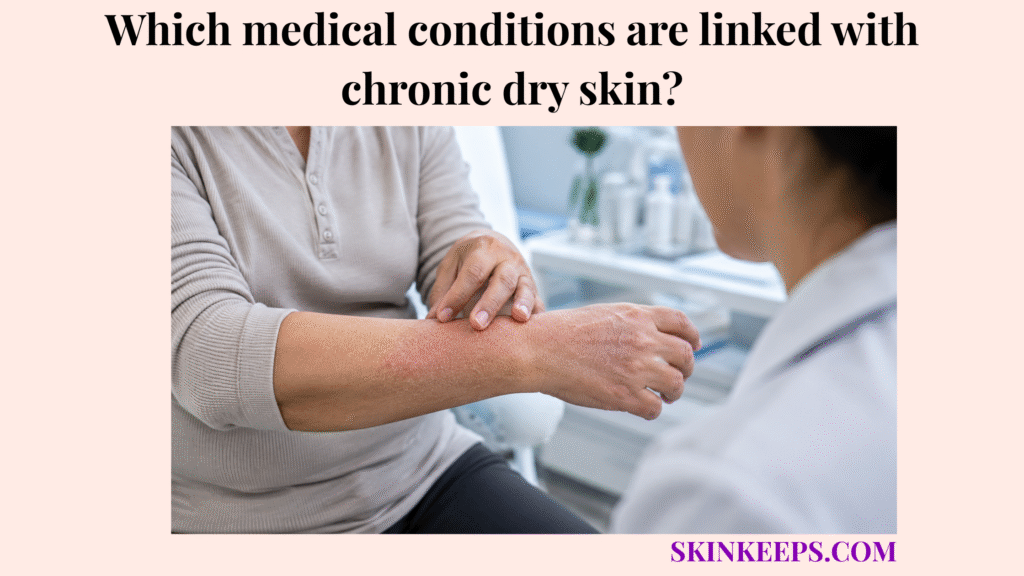
Medical conditions linked with chronic dry skin include eczema, dermatitis, psoriasis, ichthyosis, thyroid disease, diabetes, kidney disease, liver disease, autoimmune dryness disorders, and nutritional deficiency patterns. Dry skin alone does not diagnose any condition, but dryness that is persistent, severe, widespread, intensely itchy, painful, cracking, bleeding, or treatment-resistant should be evaluated rather than dismissed as ordinary dryness.
This article explains when chronic dry skin may suggest a medical condition, which skin diseases and systemic conditions can be linked with dryness or itching, how medical dryness differs from environmental dryness, and how to prepare for a doctor or dermatologist visit if symptoms persist or escalate.
When does chronic dry skin suggest a medical condition?
Chronic dry skin may suggest a medical condition when it persists despite consistent care, becomes severe or widespread, or appears with intense itching, cracking, bleeding, swelling, pain, or other body symptoms. This pattern is different from mild seasonal dryness that improves with moisturizer and trigger control. Chronic medical dryness is one pathway within dry skin, but this page focuses on disease-linked patterns rather than ordinary surface dryness.
Medical-pattern dryness deserves closer attention when the skin changes are persistent, recurrent, symmetrical, resistant to care, or paired with fatigue, weight changes, excessive thirst, frequent urination, jaundice, or severe nighttime itching. The safest lesson is pattern recognition without claiming that one symptom proves a disease.
Why dryness that does not improve deserves closer attention
Dryness that does not improve deserves closer attention because treatment-resistant dryness may reflect a skin condition, systemic condition, medication effect, or inflammatory process rather than ordinary seasonal dryness. Moisturizer failure does not automatically mean disease, but it changes the pattern from simple surface dryness to something worth reviewing. Evaluation is the next step when dryness persists despite consistent gentle care.
Why chronic itching, cracking, or scaling changes the concern level
Chronic itching, cracking, or scaling changes the concern level because these symptoms can indicate deeper barrier disruption, inflammation, infection risk, or a recurring skin disease pattern. The concern increases when itch interrupts sleep, cracks bleed, or scale becomes thick and recurrent. These signs point toward evaluation rather than stronger over-the-counter experimentation.
| Pattern | More Likely Ordinary Dryness | More Concerning Medical Pattern |
|---|---|---|
| Duration | Short-term or seasonal | Persistent or recurring |
| Response to care | Improves with moisturizer | Does not improve enough |
| Symptoms | Mild tightness or roughness | Severe itch, pain, bleeding, swelling |
| Distribution | Exposed or washed areas | Widespread, symmetrical, or recurring patches |
| Skin changes | Light flaking | Thick scaling, plaques, oozing, cracks |
Which skin diseases are commonly linked with chronic dry skin?
Skin diseases commonly linked with chronic dry skin include eczema, atopic dermatitis, contact dermatitis, psoriasis, ichthyosis, and seborrheic dermatitis. These conditions can create recurring dryness by disrupting the barrier, changing skin-cell turnover, or increasing inflammation. Thick scale or recurring peeling may overlap visually with dry skin flaking and scaling, especially when patches return in the same areas.
Dryness alone should not be used to diagnose these diseases. Eczema-prone dryness often involves itching and recurring inflamed patches, psoriasis often creates thicker scaly plaques, and ichthyosis can create persistent scale-like dryness. Mayo Clinic notes that dry skin may be caused by a medical condition and may also be a symptom of dermatitis or psoriasis. Mayo Clinic
How eczema can cause chronic dry, itchy, inflamed skin
Eczema can cause chronic dry, itchy, inflamed skin by weakening the barrier and creating recurring patches that flare with triggers, irritation, or immune reactivity. This pattern is more than temporary roughness because itching and inflammation often return in the same vulnerable areas. A clinician can separate eczema from contact irritation, infection, or other rashes when symptoms persist.
How psoriasis can create dry, scaly plaques
Psoriasis can create dry, scaly plaques because abnormal skin-cell turnover and inflammation produce thicker patches that may look dry, flaky, or silvery. These plaques can be mistaken for ordinary dryness if the reader focuses only on scaling. Persistent thick plaques deserve professional evaluation because the care pathway differs from simple moisturizer use.
How ichthyosis can cause persistent dry, thickened, scale-like skin
Ichthyosis can cause persistent dry, thickened, scale-like skin because the outer layer sheds and organizes differently, producing long-term roughness and scaling. This pattern often looks more continuous than short seasonal dryness. Evaluation is useful when scale-like dryness is longstanding, widespread, or present from childhood.
| Skin Condition | Dry-Skin Pattern |
|---|---|
| Eczema / atopic dermatitis | Dry, itchy, inflamed, recurring patches |
| Contact dermatitis | Dryness with irritation after exposure to a trigger |
| Psoriasis | Thick, dry, scaly plaques |
| Ichthyosis | Persistent dry, rough, scale-like skin |
| Seborrheic dermatitis | Flaky, scaly patches, often in oilier areas |
Which thyroid conditions can be linked with chronic dry skin?
Thyroid conditions can be linked with chronic dry skin when thyroid imbalance slows skin renewal, changes surface texture, or appears with broader body symptoms such as fatigue, cold sensitivity, weight change, or hair changes. Underactive thyroid is one context where dry or coarse skin may appear. Dry skin alone should never be used to diagnose thyroid disease.
The useful clue is dryness with broader body symptoms, not dryness by itself. A person with persistent dryness plus fatigue, cold sensitivity, constipation, weight change, or hair thinning should discuss the pattern with a healthcare professional. Mayo Clinic lists dry skin among hypothyroidism symptoms and explains that hypothyroidism symptoms can develop slowly. Mayo Clinic
Why underactive thyroid can make skin dry, rough, or coarse
Underactive thyroid can make skin dry, rough, or coarse because slower metabolic activity may affect skin renewal, surface texture, and moisture comfort. This pattern is more meaningful when it appears with fatigue, cold sensitivity, constipation, or hair changes. The right next step is medical evaluation, not self-diagnosis from skin texture alone.
Why thyroid-related dryness often appears with other body symptoms
Thyroid-related dryness often appears with other body symptoms because thyroid hormones influence multiple body systems, not only the skin. The skin clue becomes more relevant when it sits inside a wider symptom pattern. That wider pattern helps a clinician decide whether testing is appropriate.
Thyroid Clue Guide
How are diabetes and kidney disease linked with chronic dry skin?
Diabetes and kidney disease can be linked with chronic dry skin because they may affect hydration comfort, itching, healing, circulation, nerve function, infection risk, or systemic waste and mineral balance. Diabetes-related dryness can become especially concerning when cracks, slow healing, foot changes, or infection-looking areas appear. Kidney-related itching may be intense, persistent, or widespread, especially in advanced disease contexts.
A person should not assume they have diabetes or kidney disease because of dryness alone. Dryness becomes more medically relevant when it appears with excessive thirst, frequent urination, slow wound healing, swelling, fatigue, severe itching, or known kidney or diabetes history. AAD notes that diabetes can cause extremely dry skin that may itch, crack, bleed, heal slowly, or become infected. American Academy of Dermatology
| Medical Condition | Possible Dry-Skin Link |
|---|---|
| Diabetes | Dryness, itching, slower healing, infection risk |
| Kidney disease | Dry skin and intense itching can occur, especially in advanced disease |
| Dialysis-related dryness | Skin may become very dry or itchy |
| Poor circulation or nerve changes | Can worsen dryness risk in feet or lower legs |
Can liver disease, blood disease, or infection be linked with itchy dry-feeling skin?
Liver disease, blood disease, infection, or other systemic illness can be linked with itchy dry-feeling skin when the main symptom is persistent or widespread itch rather than simple surface dryness. In these cases, the skin may feel dry because scratching and irritation damage the surface. The underlying issue may be itch signaling rather than ordinary lack of moisture.
Widespread itching without a clear rash, severe nighttime itching, yellowing of the eyes or skin, unexplained fatigue, weight loss, or persistent itch without a skincare trigger should be treated as a reason for medical evaluation, not proof of one disease. Mayo Clinic lists internal diseases such as liver disease, kidney disease, anemia, diabetes, thyroid problems, and certain cancers among possible causes of itchy skin, while AAD notes long-standing itch can be a warning sign of internal disease. Mayo Clinic AAD
Systemic Warning Patterns
Which autoimmune or inherited conditions can involve chronic dry skin?
Autoimmune or inherited conditions can involve chronic dry skin when they affect moisture-producing surfaces, barrier strength, inflammation, or long-term skin scaling patterns. Autoimmune dryness may appear with dry eyes or dry mouth, while inherited skin conditions may create long-term dry, rough, or scale-like skin. Family-linked eczema risk may overlap with genetic predisposition to dry skin, especially when relatives share atopy, allergies, or sensitive skin.
This section should stay pattern-based rather than become a rare-disease list. Persistent dryness, unusual scale, childhood onset, family history, dry mouth or dry eyes, recurrent inflammation, or symptoms that do not match ordinary weather-related dryness all deserve careful evaluation.
| Condition Type | Dryness Pattern |
|---|---|
| Autoimmune dryness disorders | Dry skin may appear with dry eyes or dry mouth |
| Atopic tendency | Dry, itchy, reactive skin from childhood or family history |
| Ichthyosis-related disorders | Long-term scale-like dryness |
| Chronic inflammatory skin disease | Recurring patches, itching, scaling, or cracking |
Can nutritional deficiency be linked with chronic dry skin?
Nutritional deficiency can be linked with chronic dry skin when poor intake, malabsorption, or restricted dieting affects barrier repair, wound healing, hair and nail quality, or overall skin comfort. This does not mean supplements automatically fix dry skin. Nutritional deficiency should be considered when dryness appears with broader body signs or a clear dietary risk.
Miracle-food or supplement claims should be avoided. Dry skin with brittle hair or nails, mouth cracks, poor wound healing, unexplained fatigue, restricted dieting, malabsorption history, or symptoms that do not match weather or skincare exposure should be evaluated rather than guessed.
Nutritional Dryness Clues
How can medical dry skin be separated from environmental dry skin?
Medical dry skin can be separated from environmental dry skin by checking whether symptoms persist without clear exposure triggers, resist basic care, recur in patches, or appear with body-wide symptoms. Environmental dryness usually follows triggers such as cold air, dry air, hot showers, or harsh soaps. Medical dryness often looks more persistent, widespread, inflamed, itchy, or resistant to ordinary care.
Environmental triggers still matter because environmental factors that worsen dry skin can intensify a medical dryness pattern. Many people have mixed dryness: a medical or skin-condition tendency may become worse when weather, bathing, or skincare habits add stress.
| Dryness Type | Main Clue | Best Next Step |
|---|---|---|
| Environmental dryness | Worsens with cold, dry air, hot showers, harsh soaps | Adjust exposure and moisturize |
| Skin-condition dryness | Recurring patches, rash, scaling, itching | Dermatology evaluation if persistent |
| Systemic-condition dryness | Dryness with fatigue, thirst, weight change, widespread itch, or other symptoms | Medical evaluation |
| Medication-related dryness | Starts after a new treatment or dose change | Ask clinician before stopping medication |
When should chronic dry skin be checked by a doctor or dermatologist?
Chronic dry skin should be checked by a doctor or dermatologist when it lasts despite consistent gentle care, becomes severe or widespread, or appears with intense itching, cracks, bleeding, oozing, pain, plaques, or body symptoms. These signs may reflect a skin disease, infection, systemic condition, medication effect, or another medical contributor. The safest angle is recognition and referral, not self-diagnosis.
Dryness that persists, bleeds, cracks, or keeps returning may fit the escalation pattern where persistent dry skin needs a dermatologist. Medical evaluation becomes more important when dryness appears with fatigue, weight change, excessive thirst, frequent urination, jaundice, severe nighttime itch, or thick recurring plaques.
Doctor or Dermatologist Warning Signs
How should someone prepare for a visit about chronic dry skin?
Someone should prepare for a chronic dry skin visit by tracking when symptoms started, where they appear, what worsens them, what improves them, and whether body symptoms or medication changes are present. This helps the clinician separate ordinary dryness from skin disease, medication-related dryness, or systemic symptoms. Photos during flare-ups can be especially useful when symptoms change before the appointment.
The most useful visit notes include product names, soaps, bathing habits, medication lists, supplement lists, family history, and symptoms such as itching, pain, cracking, bleeding, scaling, fatigue, weight change, thirst, or urination changes. Bringing patterns is more useful than guessing a diagnosis.
Appointment Preparation Checklist
What should you remember about chronic dry skin and medical conditions?
The main point to remember is that chronic dry skin can be linked with skin diseases, internal medical conditions, medication effects, autoimmune dryness disorders, or nutritional deficiency patterns. The key boundary is that dry skin alone does not diagnose a disease. Persistent, severe, widespread, itchy, painful, bleeding, or treatment-resistant dryness should be professionally evaluated.
Final Takeaways
FAQs
Which medical conditions are linked with chronic dry skin?
Chronic dry skin can be linked with eczema, dermatitis, psoriasis, ichthyosis, thyroid disease, diabetes, kidney disease, liver disease, autoimmune dryness disorders, and nutritional deficiency patterns.
Does dry skin mean I have a medical condition?
No, dry skin alone does not mean you have a medical condition, but persistent, severe, widespread, itchy, painful, or treatment-resistant dryness should be evaluated.
Can eczema cause chronic dry skin?
Yes, eczema can cause chronic dry, itchy, inflamed patches that may recur or flare with triggers.
Can thyroid disease cause dry skin?
Yes, thyroid disease can be associated with dry, rough, or coarse skin, especially when dryness appears with body symptoms such as fatigue, cold sensitivity, weight change, or hair changes.
Can diabetes or kidney disease cause dry skin?
Yes, diabetes and kidney disease can be linked with dry skin, itching, slow healing, circulation changes, or systemic itch patterns.
Can nutritional deficiency cause dry skin?
Nutritional deficiency can be linked with dry skin when poor intake, restricted dieting, or malabsorption affects barrier repair, wound healing, hair, nails, or overall skin comfort.
When should chronic dry skin be checked?
Chronic dry skin should be checked when it persists despite gentle care, becomes severe or widespread, cracks, bleeds, oozes, hurts, itches intensely, or appears with body symptoms.
Conclusion
Chronic dry skin can be linked with skin diseases, internal medical conditions, medication effects, autoimmune dryness disorders, or nutritional deficiency patterns. Eczema, dermatitis, psoriasis, ichthyosis, thyroid disease, diabetes, kidney disease, liver disease, autoimmune dryness, and nutritional problems can all belong in the medical-pattern dryness discussion, but dry skin alone does not diagnose any one condition.
The safest response is to track symptoms, avoid guessing, and seek professional evaluation when dryness becomes persistent, severe, widespread, painful, bleeding, intensely itchy, infection-looking, or resistant to consistent care. That keeps the page focused on recognition and referral rather than fear or self-diagnosis.