
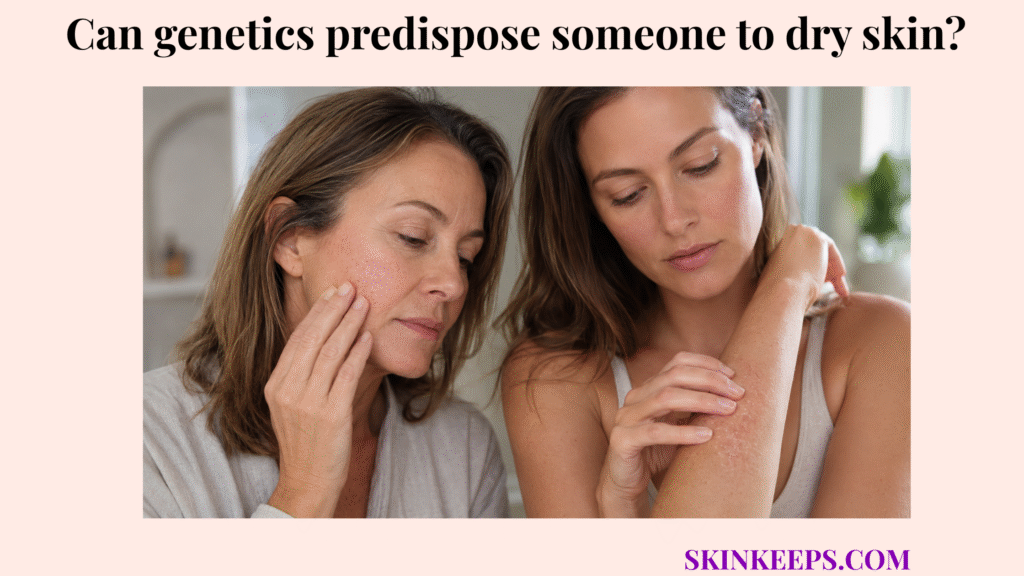
Yes, genetics can predispose someone to dry skin by influencing barrier strength, lipid support, water retention, irritation tendency, and eczema-prone skin patterns. This inherited baseline can make the outer skin layer lose comfort more easily, react more strongly to triggers, or develop recurring dryness in family-linked patterns.
This article explains how inherited barrier weakness increases dryness risk, why family history matters, how genetic dryness overlaps with eczema-prone skin, how genes and environment work together, and how genetically dry skin can be supported without assuming that the condition is fixed or unmanageable.
How can genetics predispose someone to dry skin?
Genetics can predispose someone to dry skin by shaping the skin barrier, natural lipid support, moisture retention, sensitivity, and tendency toward recurring dry patches. This inherited pattern may make skin feel tight, rough, itchy, or reactive even when the person is not doing anything obviously wrong. Genetic predisposition is one pathway within dry skin, but this page focuses specifically on inherited barrier tendency rather than every cause of dryness.
A genetic tendency does not mean the skin must always be severely dry. It means the skin may need more consistent barrier support than skin with stronger natural moisture retention. Genetics should be framed as a baseline influence, not a fixed outcome.
How inherited barrier weakness increases dryness risk
Inherited barrier weakness increases dryness risk by making the outer skin layer less able to hold moisture and protect itself from irritation. This vulnerability can make dry skin feel tight, rough, itchy, stinging, or prone to recurring patches after ordinary triggers. The important point is that inherited weakness can be supported; it should not be treated as untreatable damage.
Why some people naturally hold less moisture in the outer skin layer
Some people naturally hold less moisture in the outer skin layer because inherited differences can affect barrier lipids, water retention, and skin-surface comfort. This can make the skin feel less flexible even when the person uses reasonable skincare habits. It also explains why two people can share the same climate but show different dryness levels.
| Genetic Tendency | What It Affects | Dry-Skin Result |
|---|---|---|
| Weaker skin barrier | Less effective moisture protection | Tightness and roughness |
| Lower lipid support | Less surface comfort | Dry or flaky feel |
| Reduced water retention | Less flexible outer layer | Fine lines and tightness |
| Sensitive-skin tendency | Higher irritation response | Stinging, itching, redness, or discomfort |
| Family eczema pattern | More reactive barrier | Recurring dry patches |
How does inherited barrier weakness make dry skin more likely?
Inherited barrier weakness makes dry skin more likely by reducing the skin’s ability to hold water, resist irritants, and recover after everyday triggers. A stronger barrier holds moisture more efficiently and tolerates routine stress better. A genetically weaker barrier may lose comfort faster and show dryness more often.
This mechanism explains why some people react strongly to soaps, weather, friction, or fragrance while others do not. Inherited dryness can become more obvious when environmental factors that worsen dry skin stress the barrier. The same environment can produce different symptoms depending on the person’s baseline barrier strength.
Why the skin barrier controls moisture retention
The skin barrier controls moisture retention by keeping water inside the outer layer while limiting irritation from soaps, weather, friction, and other triggers. This outer barrier is the reason dry skin can become uncomfortable before a visible rash appears. When the barrier is weaker, water loss and irritation can repeat more easily.
How a weaker inherited barrier loses water more easily
A weaker inherited barrier loses water more easily because its outer layer is less efficient at sealing in moisture and maintaining surface comfort. That water loss can make the skin feel rougher, tighter, and less flexible. It can also make the skin more reactive after triggers that seem mild to other people.
| Barrier Feature | Stronger Barrier | Genetically Weaker Barrier |
|---|---|---|
| Moisture retention | Holds water better | Loses water more easily |
| Irritation tolerance | More stable | More reactive |
| Texture | Smoother | Rougher or tighter |
| Dryness pattern | Less frequent | More recurring |
| Recovery speed | Faster | Slower after triggers |
Can family history increase dry-skin risk?
Family history can increase dry-skin risk when close relatives share patterns of dry skin, eczema, allergies, asthma, sensitive skin, or recurring barrier irritation. These patterns suggest that the skin may have inherited a more reactive or moisture-vulnerable baseline. Genetics belongs near biological and medical factors that contribute to dry skin, but this page isolates inherited barrier weakness and family pattern.
Family history is a clue, not a diagnosis. A person can have relatives with eczema or allergies and only experience mild dryness. Another person can have no obvious family history and still develop dry skin through environment, age, medication, or skincare habits.
Family History Clues
How is genetic dry skin linked with eczema-prone skin?
Genetic dry skin is linked with eczema-prone skin because inherited barrier weakness and atopic tendency can make the skin drier, itchier, more reactive, and more likely to develop recurring patches. Ordinary genetic dryness may mainly cause tightness and roughness. Eczema-prone dryness is more likely to involve inflammation, stronger itching, recurring flares, or visible irritated patches.
Dryness alone should not be used to diagnose eczema. Eczema-prone patterns become more likely when dry patches repeatedly itch, inflame, crack, ooze, or return in the same areas. Inherited dryness may become visible as dry skin flaking and scaling when the outer layer sheds unevenly.
Why eczema-prone skin often has a weaker barrier
Eczema-prone skin often has a weaker barrier because inherited atopic tendency can reduce moisture control and increase irritation sensitivity. This can make the skin more reactive to soaps, fragrance, weather, sweat, or friction. The pattern matters most when dryness is recurrent, itchy, inflamed, or difficult to calm.
Why genetic dryness may come with itching or recurring patches
Genetic dryness may come with itching or recurring patches when inherited barrier weakness allows irritation and moisture loss to repeat in the same vulnerable areas. Repetition is important because ordinary dryness may come and go, while inherited vulnerability can return under similar triggers. Recurring patches should be watched calmly and evaluated when they become severe or inflamed.
| Feature | Genetic Dry-Skin Tendency | Eczema-Prone Dry Skin |
|---|---|---|
| Main pattern | Persistent dryness tendency | Recurring inflamed dry patches |
| Sensation | Tightness, roughness, mild itching | Strong itching, irritation, flare-ups |
| Appearance | Dry, flaky, dull, or rough | Red/dark, inflamed, scaly, cracked, or oozing patches |
| Trigger response | Weather and washing worsen dryness | Triggers may cause flares |
| Care level | Barrier support often helps | May need medical treatment if persistent or severe |
Does genetics mean dry skin is permanent?
Genetics does not mean dry skin is permanently unmanageable because inherited dryness is a tendency that can often be reduced with consistent barrier support. Someone may inherit a drier or weaker barrier, but daily habits still influence how dry the skin feels and looks. The goal is to manage the inherited pattern rather than trying to erase it.
Moisturizer use, cleanser choice, bathing habits, climate protection, trigger tracking, and medical care can all affect severity. Age can add another layer because aging reduces skin moisture retention through a different mechanism than inherited predisposition. Genetics should be explained without promising that it can be cured.
How do genes and environment work together in dry skin?
Genes and environment work together in dry skin because genetics set baseline barrier vulnerability while weather, washing, soaps, friction, and moisturizer habits influence symptom severity. This explains why inherited dry skin may stay mild in one season and worsen sharply in another. The same genetic tendency can look different depending on external stress.
A genetically weaker barrier may react more strongly when harsh soaps remove natural lipids during cleansing. Hot water, cold weather, low humidity, fragrance, wool, and frequent washing can also expose inherited weakness. The point is interaction, not blame or DNA determinism.
| Factor | Role in Dry Skin |
|---|---|
| Genetics | Sets baseline barrier strength and sensitivity |
| Weather | Can worsen an inherited dryness tendency |
| Hot showers | Remove surface oils and expose weakness |
| Harsh soaps | Strip a barrier that may already be vulnerable |
| Moisturizer habits | Help compensate for inherited dryness |
| Medical conditions | Can add another dryness layer |
How should genetically dry skin be supported?
Genetically dry skin should be supported with gentle cleansing, consistent moisturizer, trigger avoidance, barrier-supporting ingredients, and protection from weather or friction. These steps do not change the genetic baseline, but they can reduce how often dryness becomes tight, rough, itchy, or visibly flaky. The routine should focus on stability rather than aggressive correction.
Barrier-supporting ingredients such as ceramides, glycerin, petrolatum, and hyaluronic acid can help compensate for lower comfort or moisture retention. Product texture should match severity: lighter moisturizers may suit mild dryness, while creams or ointments may be needed when dryness is obvious. Over-exfoliating dry or sensitive areas can make inherited barrier weakness more uncomfortable.
Genetic Dry-Skin Care Checklist
When does inherited dry skin need professional evaluation?
Inherited dry skin needs professional evaluation when dryness becomes severe, painful, bleeding, persistently itchy, inflamed, infection-looking, sleep-disrupting, or repeatedly returns in the same areas. These signs may suggest eczema-prone skin, dermatitis, infection, allergy, or another condition rather than simple inherited dryness. Evaluation should be recommended without diagnosing the reader.
Recurring, painful, bleeding, or inflamed inherited dryness may fit the escalation pattern where persistent dry skin needs a dermatologist. A family history of eczema plus frequent flares also deserves more caution. This section should stay calm, direct, and safety-oriented.
Warning-Sign Checklist
What should you remember about genetics and dry skin?
The main point to remember is that genetics can predispose someone to dry skin by shaping barrier strength, moisture retention, lipid support, and irritation tendency. Genetic tendency creates vulnerability, not destiny. Good barrier care can reduce dryness severity even when the inherited pattern remains present.
Final Takeaways
FAQs
Can genetics predispose someone to dry skin?
Yes, genetics can predispose someone to dry skin by influencing barrier strength, lipid support, water retention, irritation tendency, and eczema-prone skin patterns.
How does inherited barrier weakness cause dry skin?
Inherited barrier weakness can cause dry skin by making the outer layer less able to hold moisture and resist irritation from daily triggers.
Can dry skin run in families?
Yes, dry skin can run in families, especially when relatives share dry skin, eczema, allergies, asthma, or sensitive-skin tendencies.
Is genetic dry skin the same as eczema?
No, genetic dry skin is not always eczema, but inherited barrier weakness can overlap with eczema-prone or atopic skin in some people.
Does genetics mean dry skin is permanent?
No, genetics creates a tendency, not a fixed outcome, and consistent barrier support can often reduce dryness severity.
What helps genetically dry skin?
Gentle cleansing, consistent moisturizer, fragrance-free products, barrier-supporting ingredients, trigger tracking, and protection from harsh weather can help genetically dry skin.
When should inherited dry skin be checked?
Inherited dry skin should be checked when it is severe, painful, bleeding, persistently itchy, inflamed, infection-looking, sleep-disrupting, or repeatedly returns in the same areas.
Conclusion
Genetics can predispose someone to dry skin by shaping barrier strength, moisture retention, lipid support, sensitivity, and eczema-prone patterns. This inherited tendency can make skin feel tight, rough, itchy, reactive, or prone to recurring dry patches, but it does not mean dryness is impossible to manage.
The strongest approach is consistent barrier support, gentle cleansing, moisturizer after washing, trigger tracking, and professional evaluation when dryness becomes severe, painful, bleeding, inflamed, or persistent. The goal is not to rewrite DNA, but to reduce the stress placed on an inherited dry-skin tendency.