
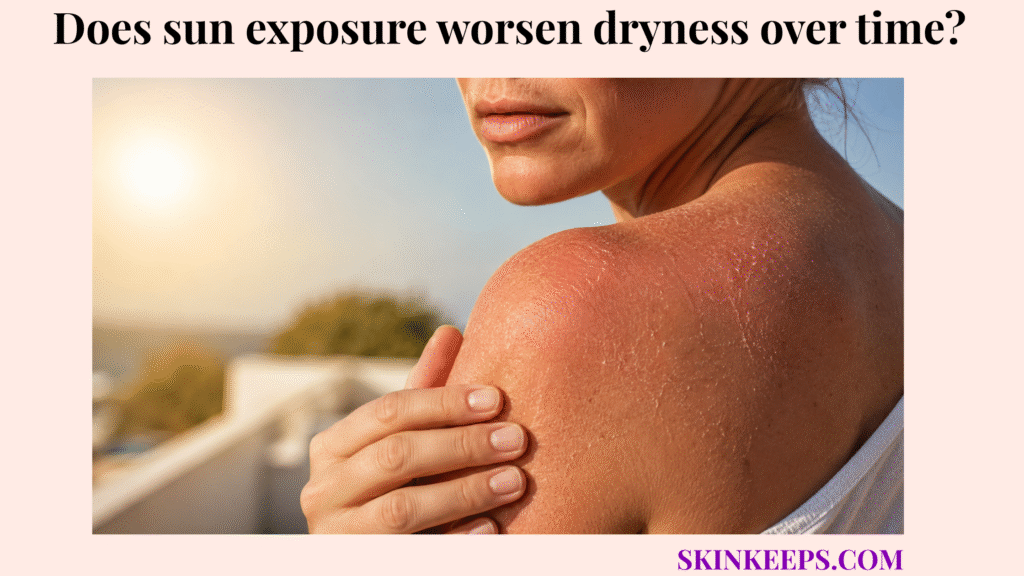
Yes, sun exposure worsen dryness over time by damaging the outer skin surface, increasing moisture loss, and making exposed skin look rougher, flakier, scalier, or less comfortable. This gradual pattern is different from temporary tightness after washing because repeated UV exposure can make dryness more persistent on areas that receive regular sunlight.
This article explains how UV exposure worsens dry skin over time, how sun-related dryness differs from ordinary seasonal dryness, which visible signs can become worse, where dryness often appears, which habits increase the problem, and when a dry sun-exposed patch needs professional evaluation.
How does sun exposure worsen dry skin over time?
Sun exposure worsens dry skin over time by stressing the outer skin surface, weakening comfort, and making exposed areas more prone to roughness, flaking, scaling, and uneven texture. This dryness pattern usually builds with repeated exposure rather than appearing as a one-time reaction. The result is skin that may look less smooth and feel less comfortable on areas frequently exposed to sunlight.
Repeated sun exposure belongs within the broader group of environmental factors that worsen dry skin, but its pattern is usually slower and more cumulative than a single hot shower. That difference matters because sun-related dryness often appears on exposed areas and may overlap with visible photodamage. Mayo Clinic lists sun damage as one factor that can contribute to dry skin. Mayo Clinic
How UV exposure damages the skin surface
UV exposure damages the skin surface by adding repeated stress to the outer layer, making it less smooth, less even, and more likely to show dry texture over time. This is a gradual process rather than a guarantee that every sun exposure causes immediate dryness. Over time, exposed skin can become rougher, scalier, or less comfortable.
Why sun-exposed skin can lose moisture and essential oils
Sun-exposed skin can lose moisture and essential oils because repeated UV exposure weakens surface comfort and makes the outer layer less able to stay smooth and flexible. This loss of comfort can make dry skin feel tighter or rougher after outdoor exposure. It can also make irritation more noticeable when sun stress is combined with wind, heat, or harsh skincare.
| Sun Exposure Effect | What Happens | Dry-Skin Result |
|---|---|---|
| UV exposure | Surface structures are stressed | Roughness and dryness |
| Moisture loss | Outer skin becomes less hydrated | Tightness or flaking |
| Surface oil reduction | Protective comfort decreases | Dry, rough feel |
| Repeated exposure | Damage accumulates gradually | More persistent dryness |
| Barrier stress | Skin tolerates weather and products less easily | More irritation or scaling |
How is sun-related dryness different from ordinary seasonal dryness?
Sun-related dryness is different from ordinary seasonal dryness because it is linked to repeated UV exposure and often appears as persistent roughness, scaling, uneven tone, or dry patches on exposed areas. Seasonal dryness often follows climate patterns such as cold air, low humidity, or indoor heating. Sun-related dryness is more likely to remain noticeable where the skin receives repeated sunlight.
Cold air can also increase dryness, but low humidity reduces skin moisture through a different mechanism than UV exposure. These causes should not be merged into one explanation. Seasonal dryness often responds more predictably to humidity and moisturizer, while rough or scaly sun-exposed patches may need closer observation.
| Feature | Seasonal Dryness | Sun-Related Dryness |
|---|---|---|
| Main trigger | Cold air, low humidity, indoor heating | Repeated UV exposure |
| Pattern | Often seasonal or climate-linked | Often appears on sun-exposed areas |
| Texture | Tight, flaky, rough | Rough, dry, scaly, leathery, or uneven |
| Duration | May improve with humidity and moisturizing | Can persist if photodamage has accumulated |
| Concern level | Usually routine-care level | Higher if scaly patches or changing lesions appear |
Which dry-skin signs can sun exposure make worse?
Sun exposure can make dry-skin signs worse by increasing roughness, flaking, scaling, fine visible lines, uneven tone, tightness, and irritation on exposed areas. These signs matter because sun-related dryness often looks like surface texture change, not just a temporary lack of moisture. A dry patch that becomes visibly flaky can overlap with dry skin flaking and scaling, especially when the same exposed area keeps shedding.
A sun-exposed area that feels sharp, hot, or painful may overlap with dry skin stinging or burning, especially if irritation persists after moisturizing. Ordinary dryness should be separated from more concerning signs such as persistent scaly patches, bleeding, crusting, or changing lesions. AAD describes dry, scaly patches and other signs within sun-damage education, while Cleveland Clinic describes UV exposure as a driver of photoaging and texture change. AAD Cleveland Clinic
| Sign | How Sun Exposure Can Worsen It |
|---|---|
| Roughness | Damaged surface becomes less smooth |
| Flaking | Dry outer cells shed unevenly |
| Scaling | Sun-damaged patches may become rough or scaly |
| Fine lines | Dryness and photoaging make lines more visible |
| Uneven tone | UV exposure can worsen discoloration |
| Tightness | Barrier stress makes skin less comfortable |
| Irritation | Exposed skin may become more reactive |
Where does sun exposure most often worsen dryness?
Sun exposure most often worsens dryness on areas that receive repeated sunlight, including the face, neck, chest, shoulders, forearms, hands, ears, scalp, and lower legs. These areas are more likely to show roughness or dry patches because they are exposed more often. The pattern may be especially noticeable in people who work outdoors or spend long periods outside.
Location helps separate ordinary dryness from sun-related dryness. Dryness on covered areas may be more connected to climate, bathing, or cleanser habits, while persistent roughness on exposed areas deserves closer attention. This does not diagnose the patch, but it does make suspicious, persistent, or changing patches worth checking.
Common Sun-Exposed Areas
What habits make sun-related dryness worse?
Habits that make sun-related dryness worse include skipping sunscreen, staying outside during strong sun, not reapplying protection, tanning, neglecting moisturizer, and combining sun exposure with harsh exfoliation. These habits increase UV exposure or reduce the skin’s ability to stay comfortable afterward. Dry skin becomes harder to manage when sun stress and barrier stress happen together.
Sun-related dryness should not be treated with aggressive scrubbing or harsh exfoliation. Roughness caused by sun exposure is not the same as harmless buildup that needs to be polished away. The safer direction is protection, gentle care, and monitoring persistent patches.
| Habit | Why It Worsens Dryness |
|---|---|
| Skipping sunscreen | Allows repeated UV exposure |
| Staying outside during strong sun | Increases UV stress |
| Not reapplying protection | Leaves skin more exposed during the day |
| Sunbathing or tanning | Adds unnecessary UV damage |
| Not moisturizing after sun exposure | Leaves dryness unsupported |
| Combining sun exposure with harsh exfoliation | Raises irritation and barrier stress |
How can dry skin be protected from sun-related moisture loss?
Dry skin can be protected from sun-related moisture loss by using daily sun protection, covering exposed areas, seeking shade, moisturizing consistently, and keeping post-sun skincare gentle. Sunscreen reduces UV exposure, while moisturizer supports dryness that is already present. Protective clothing and shade reduce the burden on products alone.
Moisturizer can improve comfort, but it does not replace sun protection. Sunscreen helps reduce repeated UV exposure, while moisturizers support dryness after the skin has already become rough or tight. The strongest prevention strategy combines protection, coverage, shade, and gentle barrier support.
Sun-Protection Dry-Skin Checklist
When does dry, sun-exposed skin need professional evaluation?
Dry, sun-exposed skin needs professional evaluation when a rough or scaly patch does not heal, bleeds, crusts, becomes painful, changes, or appears on chronically exposed areas. These signs may still be dryness, but they can also overlap with conditions that need diagnosis. The safest recommendation is evaluation without naming one guaranteed cause.
Persistent dry, scaly areas on the face, ears, scalp, hands, or forearms deserve more caution because those areas receive repeated UV exposure. Dryness that continues despite protection and moisturizer may fit the escalation pattern described in persistent dry skin needs a dermatologist. AAD describes actinic keratosis as a rough or scaly sun-damaged patch that should be evaluated clinically. AAD
Warning-Sign Checklist
What should you remember about sun exposure and dryness?
The main point to remember is that repeated sun exposure can worsen dryness over time by making exposed skin rougher, flakier, scalier, less even, and less comfortable. This pattern is usually gradual and often appears on exposed areas rather than everywhere at once. Persistent scaly or changing patches should not be treated as ordinary dryness indefinitely.
Final Takeaways
- Sun exposure can worsen dryness over time.
- Repeated UV exposure can make exposed skin rough, flaky, scaly, uneven, and less comfortable.
- Sun-related dryness often appears on areas such as the face, neck, chest, forearms, hands, ears, scalp, and shoulders.
- Seasonal dryness is usually climate-linked, while sun-related dryness often follows an exposed-area pattern.
- Moisturizer helps support dry skin, but sunscreen and protective clothing reduce repeated UV exposure.
- Tanning and intentional sun exposure can worsen long-term dryness and texture changes.
- Persistent dry, scaly, bleeding, crusted, painful, or changing patches should be checked professionally.
FAQs
Does sun exposure worsen dryness over time?
Yes, sun exposure can worsen dryness over time by stressing exposed skin and making it rougher, flakier, scalier, or less comfortable.
Why does sun exposure make dry skin rough?
Sun exposure can make dry skin rough because repeated UV exposure stresses the outer skin surface and changes how smooth the exposed area feels.
Can sun exposure make dry skin flaky or scaly?
Yes, repeated sun exposure can make dry skin flaky or scaly, especially on areas that receive frequent sunlight.
Is sun-related dryness the same as seasonal dryness?
No, sun-related dryness is usually linked to repeated UV exposure, while seasonal dryness is more often linked to cold air, low humidity, or indoor heating.
Where does sun-related dryness usually appear?
Sun-related dryness often appears on exposed areas such as the face, neck, chest, shoulders, forearms, hands, ears, scalp, and lower legs.
Can moisturizer fix sun-related dryness?
Moisturizer can improve dry-skin comfort, but sun protection is still needed to reduce repeated UV exposure.
When should dry sun-exposed patches be checked?
Dry sun-exposed patches should be checked when they do not heal, bleed, crust, hurt, change, or remain rough despite basic care.
Conclusion
Sun exposure can worsen dryness over time by making exposed skin rougher, flakier, scalier, less even, and less comfortable. This pattern is usually gradual, so it may be mistaken for ordinary dryness until the same exposed areas keep showing rough texture or persistent dry patches.
The best approach is to protect exposed skin, moisturize consistently, avoid intentional tanning, and seek evaluation when a rough or scaly patch does not heal, bleeds, crusts, hurts, or changes. That balance keeps the page focused on long-term sun-related dryness rather than turning it into a generic sunscreen article.