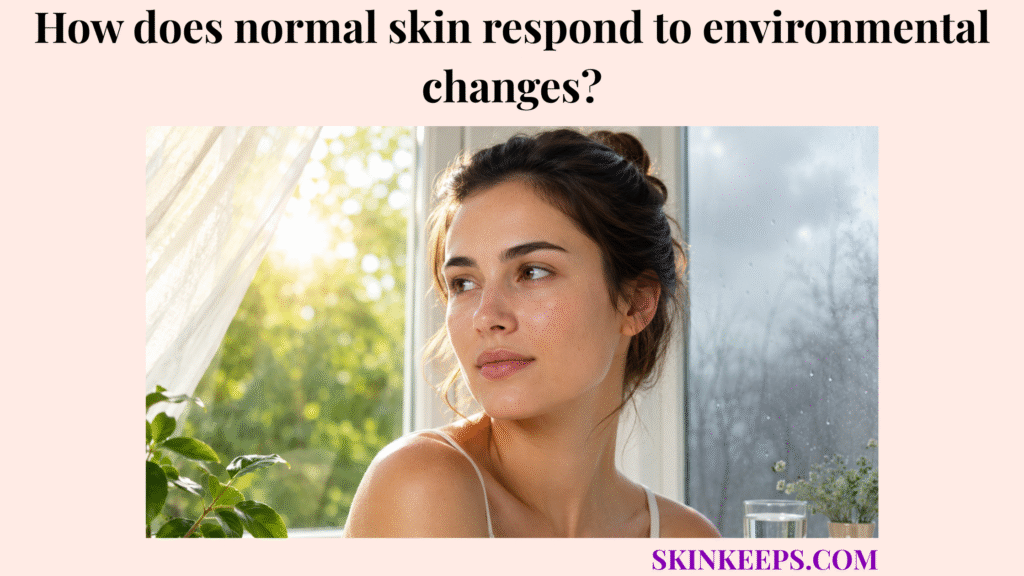
Normal skin can respond to environmental changes by becoming temporarily drier, shinier, duller, tighter, rougher, redder, or more sensitive.
These changes often appear after cold weather, low humidity, heat, sweat, sun exposure, pollution, wind, indoor heating, air conditioning, travel, or seasonal shifts.
Normal skin is usually balanced, but it is not sealed off from the environment. If the skin returns to its usual comfortable pattern after the trigger passes or care is adjusted, the change may be temporary rather than a permanent skin-type shift.
Why can normal skin respond to environmental changes?
Normal skin can respond to environmental changes because temperature, humidity, UV exposure, wind, indoor air, sweat, friction, and pollution can affect surface comfort and visible balance.
Normal skin can respond through moisture loss, oil and sweat changes, friction, irritation, and UV exposure. These responses can show as dryness, tightness, shine, redness, dullness, roughness, or sensitivity.
This does not make normal skin fragile or abnormal. A temporary environmental flare should be compared with the broader pattern of different skin types before the skin type is reclassified.
Normal skin can respond through moisture loss
Normal skin can respond through moisture loss when cold air, low humidity, wind, indoor heating, or air conditioning reduces surface comfort.
Moisture loss may make normal skin feel tight, rough, dull, or mildly flaky. This points to temporary environmental stress rather than automatic dry skin.
Normal skin can respond through oil, sweat, and friction
Normal skin can respond through oil, sweat, and friction when heat, humidity, helmets, masks, or clothing contact makes the surface feel shinier, clogged, irritated, or bump-prone.
Shine in humid weather may reflect sweat and residue, not a permanent oily skin type. Friction can also create localized bumps or redness where pressure repeats.
Normal skin can respond through irritation and UV exposure
Normal skin can respond through irritation and UV exposure when sun, pollution, dust, chlorine, wind, or harsh outdoor contact affects redness, tone, sensitivity, or long-term appearance.
Balanced skin is not UV-proof or pollution-proof. Persistent reactions, blistering, swelling, or changing spots should be evaluated rather than dismissed as weather response.
| Environmental change | Possible response in normal skin |
|---|---|
| Cold weather | Tightness, dryness, roughness |
| Low humidity | Moisture loss, dullness, flaking |
| Wind | Redness, dryness, stinging |
| Indoor heating | Tightness and dry patches |
| Air conditioning | Dry-feeling skin |
| Heat | Sweat, redness, shine |
| Humidity | More shine, clogged feel |
| Sun exposure | Redness, uneven tone, texture change |
| Pollution | Dullness or irritation |
| Travel | Mixed dryness, oiliness, or sensitivity |
Normal skin can stay normal while still reacting to environmental pressure.
How does normal skin respond to cold or dry environments?
Normal skin may respond to cold or dry environments by feeling tighter, rougher, duller, or more easily irritated.
Moisture loss can make skin that is usually comfortable feel temporarily dry. This is often most noticeable on the cheeks, around the mouth, after cleansing, during wind exposure, or after hot showers in winter.
Low humidity, cold-weather travel, indoor heating, and air conditioning can also affect hydration level and normal skin balance.
| Cold/dry trigger | Normal skin response | Meaning |
|---|---|---|
| Cold air | Tightness, dullness | Temporary moisture stress |
| Low humidity | Dry surface feel | Water loss may increase |
| Wind | Redness, stinging | Barrier irritation possible |
| Indoor heating | Roughness, dry patches | Air may be drying |
| Hot showers in winter | More tightness | Cleansing habit may worsen dryness |
| Cold-weather travel | Mixed dryness and sensitivity | Climate shift response |
| Cracked patches | More concerning | Not routine normal variation |
Cold-weather normal skin usually needs comfort support, not aggressive exfoliation.
How does normal skin respond to heat and humidity?
Normal skin may respond to heat and humidity with more shine, sweat, clogged-feeling areas, redness, or occasional bumps.
Heat and humidity do not automatically mean normal skin has become oily. The skin may be reacting to sweat, sunscreen, friction, masks, helmets, outdoor activity, or heavier product layers.
Humidity-related shine should be separated from balanced radiance because normal skin can have a healthy glow without shine when the surface is steady.
| Heat/humidity trigger | Normal skin response | Meaning |
|---|---|---|
| Humid weather | Shinier surface | Sweat and oil feel more noticeable |
| Heat | Redness or flushing | Temperature response |
| Sweat | Clogged-feeling skin | Residue and friction may matter |
| Heavy sunscreen | Greasy feel | Formula may be too rich for conditions |
| Outdoor activity | Bumps or irritation | Sweat and friction trigger |
| Masks or helmets | Contact irritation | Friction and trapped heat |
| Persistent painful bumps | More concerning | Needs evaluation if repeated |
In hot weather, normal skin often needs lighter comfort and gentle cleansing, not harsh oil stripping.
How does normal skin respond to sun exposure?
Normal skin can respond to sun exposure with short-term redness, warmth, dryness, burning, peeling, or sensitivity and long-term tone, texture, and health changes.
Normal skin is balanced, not UV-proof. The response can vary by exposure level, skin tone, protection, time outdoors, and whether sunscreen, shade, hats, or protective clothing are used.
Sun exposure can affect tone and texture across years, so age changes normal skin over time alongside cumulative environmental exposure.
Normal skin can show short-term sun responses
Normal skin can show short-term sun responses when UV exposure causes redness, warmth, burning, dryness, peeling, or temporary sensitivity.
Strong, blistering, painful, or unusual sun reactions should be reviewed rather than treated as ordinary environmental variation.
Normal skin can show long-term sun effects
Normal skin can show long-term sun effects when repeated UV exposure contributes to uneven tone, dark spots, texture changes, premature aging signs, and skin cancer risk.
Sun protection reduces avoidable exposure risk, but it does not make skin invincible. Changing spots or lesions need evaluation.
- Skin feels warm or tender after exposure.
- Redness appears after outdoor time.
- Dark spots or uneven tone become more noticeable.
- Texture looks rougher over time.
- Skin becomes drier after sun exposure.
- Moles, spots, or lesions change.
- Sunburn happens even in cool or cloudy weather.
Normal skin is balanced, not UV-proof.
How does normal skin respond to pollution, dust, and contact exposure?
Normal skin may respond to pollution, dust, and contact exposure with dullness, irritation, clogged-feeling areas, redness, bumps, itching, or dryness.
Pollution, smoke, chlorine, hard water, masks, helmets, rough fabrics, and rubbing are more convincing triggers when the same exposure repeatedly produces the same pattern.
Wind, pollution, sun, chlorine, and harsh contact can temporarily interrupt the usual pattern of normal skin being less sensitive than reactive skin types.
| Exposure | Possible normal skin response |
|---|---|
| Pollution | Dullness, irritation, uneven-looking surface |
| Dust | Itching, clogged feel, irritation |
| Smoke exposure | Dullness, dryness, irritation |
| Chlorine | Tightness, dryness, stinging |
| Hard water | Dryness or residue feel in some people |
| Masks | Friction bumps, redness, sweat buildup |
| Helmets | Forehead bumps, heat, friction |
| Wool or rough fabrics | Itching or redness |
| Repeated rubbing | Marks, irritation, roughness |
Normal skin can react to what repeatedly touches or coats it.
How does normal skin respond to travel and seasonal changes?
Normal skin may respond to travel and seasonal changes by becoming temporarily dull, dry, oily, sensitive, or unpredictable.
Flights, climate shifts, sleep disruption, sunscreen changes, sweat, dehydration, indoor heating, and air conditioning can overlap. This mixed pressure can make normal skin look dull, dry, shiny, or reactive for a short period.
Weather, sun, pollution, travel, and daily habits also overlap with lifestyle and environmental factors that influence normal skin.
Travel can make normal skin temporarily unpredictable
Travel can make normal skin temporarily unpredictable because flights, climate shifts, sleep disruption, sunscreen changes, sweat, dehydration, and routine changes can overlap.
Mixed triggers can make normal skin look dull, dry, oily, or reactive. Short-term observation is safer than changing the whole routine immediately.
Seasonal changes can shift normal skin needs
Seasonal changes can shift normal skin needs because dry seasons may increase moisture stress, while humid seasons may increase shine or clogged-feeling areas.
Seasonal adjustment does not mean the skin type has permanently changed. The cue is whether the skin returns closer to baseline after conditions stabilize.
- Did the change start after moving climates?
- Did humidity or temperature change suddenly?
- Did sunscreen, cleanser, or moisturizer change?
- Did sleep or hydration change?
- Did sweat or friction increase?
- Did indoor heating or air conditioning increase?
- Did the skin return to baseline after adjustment?
Travel and seasons can change normal skin behavior without changing the underlying skin type.
How can normal skin tell if an environmental response is temporary?
Normal skin can tell an environmental response is temporary by checking whether the change follows a clear trigger, improves after adjustment, and returns to the usual baseline.
One environmental flare should not reclassify skin type. Duration, repetition, pain, spreading, bleeding, swelling, scarring, and return to baseline matter more than one dry, shiny, or irritated day.
| Pattern | More likely temporary | More concerning |
|---|---|---|
| Dryness | Appears after cold, wind, or low humidity | Cracks, bleeds, burns, or spreads |
| Shine | Appears in heat or humidity | Persistent greasiness with frequent clogged pores |
| Redness | Fades after heat or wind exposure | Persistent warmth, swelling, rash-like patches |
| Bumps | Appear after sweat or friction | Painful, deep, frequent, or scarring |
| Sensitivity | Starts after sun, wind, or harsh exposure | Repeats with many gentle products |
| Dullness | Appears after travel or pollution | Persistent with other health symptoms |
| Pigmentation | Mild post-sun unevenness | Sudden, spreading, darkening, or changing spots |
Normal skin should be judged by repeated baseline behavior, not one environmental flare.
What mistakes should normal skin avoid during environmental changes?
Normal skin should avoid environmental-change mistakes such as scrubbing dryness, stripping humid shine, skipping sunscreen, overusing strong acids, or treating travel changes as permanent.
Environmental changes usually call for adjustment, not aggressive correction. Scrubbing, over-cleansing, or adding strong acids can worsen tightness, stinging, redness, peeling, or clogged-feeling skin.
| Mistake | Why it can worsen normal skin | Better interpretation |
|---|---|---|
| Scrubbing dry winter skin | Can increase barrier stress | Add moisture support first |
| Over-cleansing humid shine | Can cause tightness and irritation | Cleanse gently |
| Skipping sunscreen in cold weather | UV exposure still matters | Protect exposed skin |
| Using the same rich products in humidity | Can feel greasy or cloggy | Adjust texture if needed |
| Ignoring wind or low humidity dryness | Dryness may build | Support barrier comfort |
| Treating travel changes as permanent skin type | Leads to wrong routine | Wait for baseline return |
| Using strong acids for dullness after travel | Can worsen irritation | Recover first |
| Ignoring persistent rash or swelling | May delay care | Seek professional review |
Environmental changes usually call for adjustment, not aggressive correction.
When should environmental changes in normal skin need professional attention?
Environmental changes in normal skin need professional attention when symptoms are severe, persistent, spreading, bleeding, blistering, painful, swollen, scarring, slow-healing, or linked with changing spots.
Environmental triggers can explain mild changes, but severe signs should not be dismissed as weather, travel, or pollution.
- Dry patches crack, bleed, burn, or spread.
- Redness becomes persistent, warm, swollen, or rash-like.
- Sun exposure causes unusual rash, blistering, or severe burning.
- Breakouts become painful, deep, frequent, cystic, or scarring.
- Itching is persistent or intense.
- Skin reacts to many gentle products.
- Pigmentation appears suddenly, spreads, darkens, or changes.
- A mole, spot, or lesion changes color, shape, size, or behavior.
- Wounds heal slowly or repeatedly reopen.
- Skin changes appear with illness, medication changes, or broader symptoms.
Environmental triggers can explain mild changes, but severe, persistent, spreading, bleeding, blistering, or changing signs need medical review.
What should you remember about normal skin and environmental changes?
The key point is that normal skin can respond to environmental changes without always losing its balanced baseline.
Cold, dry air, heat, humidity, sweat, friction, sun, pollution, travel, and seasons can temporarily shift normal skin. Repeated baseline behavior matters more than one environmental flare.
Frequently Asked Questions About Normal Skin and Environmental Changes
Can cold weather make normal skin dry?
Yes. Cold air, wind, low humidity, and indoor heating can make normal skin feel tight, dry, rough, or dull temporarily.
Can humidity make normal skin oily?
Humidity can make normal skin look shinier or feel more sweaty, but that does not always mean the skin type has become oily.
Can sun exposure affect normal skin?
Yes. Sun exposure can cause redness, burning, dryness, uneven tone, texture changes, premature aging signs, and skin cancer risk.
Can pollution affect normal skin?
Pollution, smoke, dust, and contact exposure may contribute to dullness, irritation, clogged-feeling areas, or redness in some normal skin patterns.
Can normal skin change after travel?
Yes. Travel can affect normal skin through climate shifts, sleep disruption, dehydration, sunscreen changes, sweat, air conditioning, and routine changes.
Sources & Evidence About Normal Skin and Environmental Changes
Cleveland Clinic skin-type guidance was used to ground normal, dry, oily, combination, and sensitive skin distinctions.
American Academy of Dermatology cold-weather guidance was used for cold air, dryness, low comfort, moisturizer timing, and fabric irritation boundaries.
American Academy of Dermatology dry-skin overview was used for low humidity, indoor heating, dry and chapped skin, and moisture-loss context.
American Academy of Dermatology dry-skin relief guidance was used for dry skin, cracking, bleeding, moisturizer support, and gentle care boundaries.
American Academy of Dermatology sunscreen guidance was used for SPF 30+, broad-spectrum sunscreen, shade, premature skin aging, sunburn, and skin cancer risk.
American Academy of Dermatology workout-acne guidance was used for sweat, oil, dirt, bacteria buildup, workout-related acne, and hygiene boundaries.
American Academy of Dermatology sports-equipment acne guidance was used for heat, sweat, rubbing, equipment pressure, friction, and localized breakouts.
Peer-reviewed humidity and temperature review was used for low humidity, low temperature, barrier function, seasonal effects, and mechanical-stress susceptibility.
Peer-reviewed air-pollution and skin-function review from NIH/PMC was used for pollution, oxidative stress, inflammation, and skin-barrier stress boundaries.
American Academy of Dermatology melanoma signs guidance was used for changing mole, changing spot, unusual lesion, and referral boundaries.
Educational Disclaimer: This article is for general skin education only and does not diagnose, treat, or replace professional medical advice. If environmental skin changes include severe sunburn, blistering, painful acne, scarring, cracked or bleeding patches, persistent burning, swelling, spreading redness, rash-like irritation, severe itching, sudden unexplained changes, slow-healing wounds, broader health symptoms, or changing moles or lesions, consult a qualified dermatologist or healthcare professional.