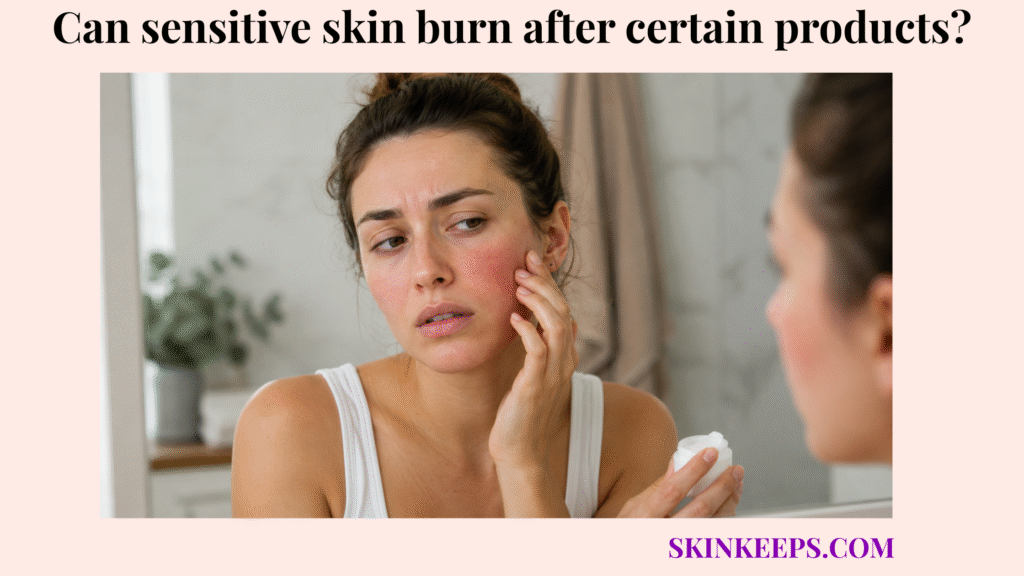
Yes, sensitive skin can burn after certain products, especially when the formula contains strong actives, fragrance, alcohol, exfoliating acids, retinoids, harsh cleansers, benzoyl peroxide, vitamin C, sunscreen filters, preservatives, or ingredients the skin barrier does not tolerate.
Burning is stronger than mild tingling or brief stinging and usually means the skin is irritated, over-treated, barrier-damaged, or reacting poorly to the product. This article explains why product burning happens, which product types commonly trigger it, whether burning is ever normal, how burning differs from tingling and stinging, when burning suggests barrier damage, what to do immediately, which mistakes to avoid, how to reintroduce products, how to track reactions, and when to seek professional evaluation.
Why Can Sensitive Skin Burn After Certain Products?
Sensitive skin can burn after certain products because a reactive or damaged barrier may not tolerate strong formulas, harsh cleansing, fragrance, alcohol-heavy products, or active ingredients. Product burning should be interpreted inside the broader pattern of sensitive skin, where barrier weakness, trigger response, and product intolerance can lower skin tolerance.
Product-induced burning is a stronger sensory reaction than mild tingling. It should be treated as a stop-and-assess signal rather than proof that the formula is working.
How a Reactive Skin Barrier Allows Products to Feel Harsher
A reactive skin barrier allows products to feel harsher because the outer layer may have lower tolerance for contact, acidity, fragrance, alcohol, cleansing agents, or active ingredients. Product burning often begins with barrier behavior, especially when sensitive skin has a compromised barrier that tolerates strong formulas poorly.
Products may burn more when the skin is over-cleansed, over-exfoliated, dry, peeling, or already irritated. Barrier damage is not the only possible cause, but it is one of the most important patterns to check.
Why Burning Suggests Stronger Irritation Than Mild Tingling
Burning suggests stronger irritation than mild tingling because it feels hotter, deeper, more painful, or more persistent. Burning belongs to the wider sensory group of sensitive skin discomfort, but it is usually more concerning than mild tightness or brief tingling.
Mild tingling can sometimes happen with active products, but burning should not be treated as a goal. Burning with swelling, rash, blisters, oozing, crusting, or pain is an escalation sign rather than normal product adjustment.
| Burning Pattern | What It May Suggest |
|---|---|
| Brief warmth from a strong active | Product may be too intense or poorly timed. |
| Burning from basic moisturizer | Barrier may be damaged or formula may not suit skin. |
| Burning after cleanser | Cleanser may be stripping or irritating. |
| Burning with redness or darker irritation | Inflammatory reaction may be present. |
| Burning with swelling or rash | Possible dermatitis or allergy concern. |
| Burning that lasts | Not normal product adjustment. |
Which Product Types Commonly Make Sensitive Skin Burn?
Product types that commonly make sensitive skin burn include harsh cleansers, fragrance-heavy products, alcohol-heavy toners, strong exfoliating acids, retinoids, benzoyl peroxide, vitamin C formulas, sunscreen, and makeup. Product category matters because skincare ingredients can commonly irritate sensitive skin when the formula is too strong, too fragranced, or poorly timed.
The same product category may not burn everyone. Formula strength, barrier condition, individual tolerance, and cumulative irritation from combining actives can change how the skin reacts.
| Product Type | Why It May Burn Sensitive Skin |
|---|---|
| Harsh cleansers | Strip barrier comfort. |
| Fragrance-heavy products | Can irritate reactive skin. |
| Alcohol-heavy toners | Can sting, dry, and inflame. |
| Strong exfoliating acids | Can over-disrupt the surface. |
| Retinoids | Can trigger dryness, peeling, and burning during intolerance. |
| Benzoyl peroxide | Can irritate sensitive or over-dry skin. |
| Vitamin C formulas | Low-pH formulas may burn reactive skin. |
| Sunscreen or makeup | Certain filters, preservatives, or fragrance may sting or burn. |
Is Burning After Skincare Ever Normal?
Burning after skincare is not a goal and should not be ignored, even though mild tingling can sometimes happen with active products. A light, brief sensation is different from heat, pain, swelling, redness, peeling, or lasting discomfort.
If a product causes strong heat, pain, redness, darker irritation, swelling, peeling, or lasting discomfort, the skin may be reacting badly. Burning should be treated as a stop-and-assess signal, not proof that the product is working.
How Is Burning Different From Tingling or Stinging?
Burning is different from tingling or stinging because burning feels hotter, deeper, more painful, and more concerning than a light fizz or sharp prickly sensation. Burning needs a stricter boundary than stinging as a common sensitive-skin sign because burning feels more intense and irritating.
Tingling can be light and brief, stinging is sharper, and burning is usually more intense. Pain, swelling, and lasting burning increase concern and should not be pushed through.
| Sensation | What It Feels Like | Concern Level |
|---|---|---|
| Tingling | Light, brief, fizzy sensation. | Sometimes tolerable if mild. |
| Stinging | Sharp or prickly discomfort. | Common sensitivity signal. |
| Burning | Hot, painful, deeper irritation. | More concerning. |
| Pain | Strong discomfort or soreness. | Stop and assess. |
| Burning with swelling | Strong reaction pattern. | Needs caution. |
When Does Product Burning Suggest Barrier Damage?
Product burning suggests barrier damage when basic products, gentle cleanser, plain moisturizer, or even water begins to burn. This pattern matters because the skin is reacting to low-intensity contact that should normally feel mild.
Barrier damage can follow over-cleansing, over-exfoliation, strong actives, hot water, weather stress, or combining too many products. It is not a diagnosis, but it is a strong practical warning to pause the trigger load.
Barrier-Damage Clues
Can Sensitive Skin Burn From “Gentle” Products Too?
Sensitive skin can burn from “gentle” products when the skin barrier is already damaged or when the formula contains an ingredient the person does not tolerate. “Gentle” reduces risk, but it does not guarantee compatibility for every reactive barrier.
Moisturizer, cleanser, sunscreen, and makeup can all burn if the formula mismatches the skin’s current tolerance. A reaction to a gentle-marketed product is not the reader’s fault; it is a sign to assess the barrier and product pattern.
What Should Someone Do Immediately If a Product Burns Sensitive Skin?
Someone should stop using a product immediately if it causes strong, worsening, painful, or lasting burning on sensitive skin. If the product is still on the skin and burning is strong or worsening, rinsing it off gently is a reasonable first step.
Hot water, scrubbing, and adding more actives can intensify irritation. The immediate response should lower exposure, reduce friction, and support the barrier only with products that are already tolerated.
Immediate Response Checklist
What Mistakes Make Product-Related Burning Worse?
Product-related burning gets worse when the response adds more actives, heat, friction, or repeated exposure before the skin has calmed. The most dangerous assumption is that burning means the product is working.
Calling everything purging can also backfire. Burning is a discomfort signal, so it should be separated from acne-pattern changes and assessed through product timing, sensation intensity, visible signs, and repeat exposure.
| Mistake | Why It Backfires |
|---|---|
| Pushing through burning | Can worsen irritation. |
| Adding another active product | Increases barrier stress. |
| Scrubbing the skin | Adds friction damage. |
| Using hot water | Intensifies burning and dryness. |
| Switching many products at once | Makes the trigger impossible to identify. |
| Treating burning as purging | May miss irritation or dermatitis. |
| Reapplying the same product quickly | Can restart the reaction. |
How Should Sensitive Skin Reintroduce Products After Burning?
Sensitive skin should reintroduce products after burning only after burning, redness, peeling, tightness, and rawness have calmed. Reintroduction should be cautious because sensitive skin should patch test new products when past burning suggests poor tolerance.
Use one product at a time so the trigger remains visible. Cleanser and moisturizer usually come before actives, because adding acids, retinoids, and exfoliants too early can restart burning.
| Reintroduction Step | Purpose |
|---|---|
| Wait until burning, redness, peeling, and tightness calm | Reduces the chance of restarting irritation. |
| Reintroduce one product at a time | Keeps the trigger easier to identify. |
| Start with cleanser and moisturizer before actives | Builds tolerance around basics first. |
| Patch test when the history of burning is strong | Checks tolerance before wider use. |
| Use active products less often at first | Reduces cumulative barrier stress. |
| Avoid combining acids, retinoids, and exfoliants on the same day | Prevents layered irritation. |
| Stop again if burning returns | Treats repeat burning as useful evidence. |
How Should Someone Track Product-Related Burning?
Someone should track product-related burning by recording the product, ingredient type, application area, timing, intensity, duration, visible signs, barrier condition, same-day products, and whether burning returned after reuse. Tracking is pattern recognition, not diagnosis.
Photos are useful if visible changes appear. The most useful record connects the exact product, what else was used that day, how quickly burning started, and whether the same formula caused the same reaction again.
Product-Burning Tracking Checklist
When Does Burning After Products Need Professional Evaluation?
Burning after products needs professional evaluation when it is severe, painful, persistent, spreading, eye-area related, swollen, blistering, oozing, crusted, bleeding, raw, cracked, or infected-looking. These signs deserve evaluation instead of repeated product switching.
Professional review becomes important when sensitive skin needs a dermatologist instead of repeated product guessing. Burning alone does not diagnose dermatitis, allergy, rosacea, eczema, infection, chemical burn, nerve pain, or another condition, but severe patterns should not be ignored.
Professional Evaluation Warning Signs
What Should You Remember About Sensitive Skin Burning After Products?
Sensitive skin can burn after certain products, and burning usually deserves more caution than mild tingling or brief stinging. The pattern matters most when burning follows product strength, formula type, active layering, or a damaged barrier.
Final Takeaways
- Sensitive skin can burn after certain products.
- Burning is stronger and more concerning than mild tingling.
- Common triggers include fragrance, harsh cleansers, alcohol-heavy formulas, acids, retinoids, benzoyl peroxide, vitamin C, and some sunscreens or makeup.
- Burning from basic products can suggest barrier damage.
- The safest first step is to stop the trigger and calm the barrier.
- Severe, persistent, swollen, blistering, spreading, or painful burning needs professional evaluation.
Frequently Asked Questions
Is Burning After Skincare Normal for Sensitive Skin?
Burning after skincare is not a normal goal for sensitive skin, even though mild tingling can sometimes happen with active products. Strong, painful, lasting, swollen, or spreading burning should not be pushed through; stop the product and assess the trigger.
Why Does Moisturizer Burn Sensitive Skin?
Moisturizer may burn sensitive skin when the barrier is damaged, the formula does not suit the skin, or the skin is already irritated from cleansing, actives, weather, or friction. Repeated burning means the product or barrier condition needs reassessment.
Can Vitamin C or Retinoids Burn Sensitive Skin?
Vitamin C or retinoids can burn sensitive skin when the formula is too strong, used too often, layered with other actives, or applied while the barrier is already irritated. Reduce exposure and seek help if burning is severe, persistent, swollen, or painful.
What Should I Do If Sunscreen Burns My Sensitive Skin?
If sunscreen burns sensitive skin, stop using that formula and track whether burning follows the same sunscreen, application area, or ingredient pattern. Sun protection still matters, but the burning formula may not suit the skin.
Is Burning the Same as Purging?
Burning is not the same as purging because burning is a discomfort signal, while purging is usually discussed as an acne-pattern change after certain acne-active products. Burning, swelling, rash, peeling, pain, oozing, or crusting should not be treated as normal purging.
When Should Product Burning Be Checked?
Product burning should be checked when it is severe, persistent, painful, spreading, eye-area related, swollen, blistering, oozing, crusted, bleeding, raw, cracked, or infected-looking. Evaluation helps separate ordinary irritation from dermatitis, allergy, infection, chemical irritation, or another concern.
Conclusion
Sensitive skin can burn after certain products when a formula, ingredient strength, product combination, or damaged barrier exceeds the skin’s tolerance. Harsh cleansers, fragrance-heavy products, alcohol-heavy toners, exfoliating acids, retinoids, benzoyl peroxide, vitamin C formulas, sunscreen, and makeup can all trigger burning in reactive skin.
Burning is a clue, not a diagnosis, but it is more concerning than mild tingling or brief stinging. If burning is severe, persistent, painful, spreading, swollen, blistering, oozing, crusted, bleeding, eye-area related, raw, cracked, or infected-looking, professional evaluation is safer than repeated product guessing.