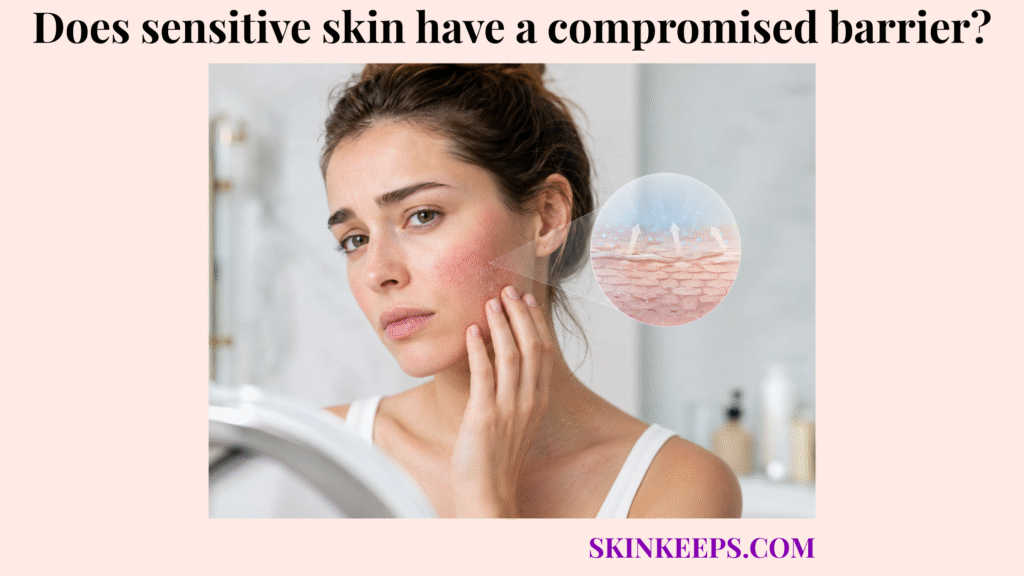
Sensitive skin often involves a weakened, stressed, or easily disrupted skin barrier, but not every case means the barrier is permanently damaged.
A compromised barrier can make skin react more easily to cleansers, fragrance, exfoliants, retinoids, weather, sweat, friction, and hot water. This article explains what a compromised barrier means, why the barrier matters, how barrier weakness increases reactivity, which symptoms suggest barrier stress, whether barrier stress can happen without visible damage, how temporary and recurring barrier stress differ, what triggers weaken barrier comfort, how barrier sensitivity differs from allergy, how to support the barrier, what mistakes to avoid, how to track patterns, and when professional evaluation is safer.
What Does a Compromised Skin Barrier Mean in Sensitive Skin?
A compromised skin barrier means the outer protective layer of the skin is not holding moisture or blocking irritants as effectively as it should. Barrier weakness should be understood inside the broader pattern of sensitive skin, where trigger response and product intolerance often overlap.
When the barrier is stressed, everyday products and environmental exposures may feel stronger, harsher, or more irritating than expected. This can happen temporarily after a clear trigger or recur when the skin is repeatedly exposed to the same stress.
| Barrier Pattern | What It May Mean |
|---|---|
| Skin feels tight after washing | Barrier may be losing comfort after cleansing. |
| Moisturizer stings | Barrier may be irritated or weakened. |
| Products burn more than before | Skin may be over-treated or disrupted. |
| Skin flakes or peels easily | Surface barrier may be stressed. |
| Skin reacts to many products | Barrier may be highly reactive. |
| Redness or darker irritation appears | Inflammation may be involved. |
Why Is the Skin Barrier Important for Sensitive Skin?
The skin barrier is important for sensitive skin because it helps hold moisture, block irritants, protect surface nerves, support recovery, and limit inflammation. A compromised barrier is one part of the wider group of biological factors that increase skin sensitivity, alongside genetics, nerve reactivity, inflammation, hormones, and condition overlap.
When these functions are stressed, the skin may tolerate fewer products and recover more slowly after irritation. Barrier function explains why mild products, water, weather, or friction can suddenly feel uncomfortable.
| Barrier Function | Why It Matters for Sensitive Skin |
|---|---|
| Holds moisture | Helps prevent tightness, roughness, and flaking. |
| Blocks irritants | Reduces product-triggered stinging and burning. |
| Protects surface nerves | Helps reduce discomfort from mild triggers. |
| Supports recovery | Helps skin calm after irritation. |
| Limits inflammation | Reduces visible and sensory reactions. |
| Maintains comfort | Helps skin tolerate normal skincare and weather exposure. |
How Does a Compromised Barrier Make Sensitive Skin More Reactive?
A compromised barrier makes sensitive skin more reactive because irritants can affect the skin more easily and water can escape more quickly. That combination can create both visible and sensory discomfort.
The result may be product reactivity, water stinging, moisturizer stinging, tightness, burning, itching, flaking, tenderness, or rawness. These are barrier clues, not medical diagnoses.
How Barrier Weakness Allows Irritants to Affect Skin More Easily
Barrier weakness allows irritants to affect skin more easily because the outer layer is less effective at reducing contact stress from products, fragrance, sweat, friction, or weather. Barrier stress may explain why stinging becomes a common sensitive-skin sign after products, cleansing, water, or weather exposure.
Cleansers, fragrance, exfoliants, retinoids, and basic products can feel harsher when the surface is already stressed. This does not diagnose dermatitis or allergy.
Why Moisture Loss Can Increase Discomfort and Reactivity
Moisture loss can increase discomfort and reactivity because a dry, stripped, or stressed surface often feels tight, rough, flaky, stingy, itchy, hot, or raw. Stronger product discomfort needs caution because sensitive skin can burn after certain products when formulas exceed barrier tolerance.
Dry-feeling barrier stress can happen in sensitive skin even when the skin type is not purely dry. When the barrier is weakened, irritants can affect the skin more easily and water can escape more quickly, making even mild products or normal weather exposure feel uncomfortable.
What Symptoms Suggest Sensitive Skin Has Barrier Stress?
Symptoms that suggest sensitive skin has barrier stress include stinging, burning, itching, tightness, flaking, redness, darker irritation, shiny tightness, tenderness, or rawness. The barrier lens matters because the same symptom can come from different patterns.
Symptoms are clues, not diagnoses. Tightness matters because sensitive skin can feel tight after irritation when the barrier loses comfort.
| Symptom | How It May Relate to Barrier Stress |
|---|---|
| Stinging | Products or water may affect exposed nerve endings more easily. |
| Burning | Stronger irritation or barrier disruption may be present. |
| Itching | Dryness, irritation, or inflammation may be involved. |
| Tightness | Moisture loss or cleanser stripping may be present. |
| Flaking | Surface barrier may be disrupted. |
| Redness or darker irritation | Inflammation may be active. |
| Shiny tight surface | Over-cleansing or over-exfoliation may have stripped the skin. |
| Tenderness | Skin may feel raw or over-treated. |
Can Sensitive Skin Have a Weak Barrier Even If It Does Not Look Damaged?
Sensitive skin can have barrier stress even if it does not look visibly damaged because sensation can appear before visible irritation. The skin may look normal but still sting, burn, itch, or feel tight after products, cleansing, heat, cold, sweat, or friction.
Visible changes can also be subtle. Barrier stress may show through discomfort first and visible redness, darker irritation, roughness, or flaking later.
Is a Compromised Barrier Always Permanent in Sensitive Skin?
A compromised barrier is not always permanent in sensitive skin because barrier stress can be temporary, recurring, or related to an underlying condition. Temporary stress may follow over-exfoliation, harsh cleansing, strong actives, weather exposure, or product irritation.
Recurring stress needs more caution. It can overlap with genetics, eczema-prone skin, rosacea-prone skin, dermatitis, dryness tendency, or frequent trigger exposure without proving any one diagnosis.
| Pattern | What It May Suggest |
|---|---|
| Appears after one harsh product | Temporary irritation. |
| Appears after over-exfoliation | Treatment-related barrier stress. |
| Returns with many products | Recurring sensitivity pattern. |
| Has existed for years | Possible inherited or condition-linked sensitivity. |
| Appears with eczema-like patches | Barrier condition may need evaluation. |
| Appears with flushing and burning | Rosacea-like pattern may need evaluation. |
Which Triggers Commonly Weaken the Skin Barrier in Sensitive Skin?
Triggers that commonly weaken the skin barrier in sensitive skin include harsh cleansers, hot water, strong exfoliants, retinoids, fragrance, alcohol-rich formulas, wind, cold, sweat, friction, and frequent product switching. Product category matters because skincare ingredients can commonly irritate sensitive skin when the barrier is already stressed.
These triggers can stress barrier comfort, but the page remains about barrier function. The important pattern is whether the same trigger repeatedly causes sting, burn, itch, tightness, flaking, rawness, or product intolerance.
| Trigger | How It May Weaken Barrier Comfort |
|---|---|
| Harsh cleansers | Strip surface lipids and increase tightness. |
| Hot water | Increases dryness and irritation. |
| Strong exfoliants | Can over-disrupt the surface layer. |
| Retinoids | May irritate if introduced too quickly. |
| Fragrance | Can trigger irritation in reactive skin. |
| Alcohol-rich formulas | May dry and irritate the surface. |
| Wind or cold | Increases roughness and moisture loss. |
| Sweat and friction | Can irritate already sensitive areas. |
| Frequent product switching | Makes the barrier harder to stabilize. |
How Is Barrier-Related Sensitivity Different From Allergy?
Barrier-related sensitivity is different from allergy because barrier sensitivity usually reflects a weak, dry, irritated, or stripped surface, while allergy-like reactions may involve a specific ingredient response with stronger rash, swelling, blisters, spread, or recurrence.
This distinction is cautious and non-diagnostic. Professional evaluation is safer when reactions are strong, spreading, recurrent, swollen, blistering, oozing, crusted, or painful.
| Feature | Barrier-Related Sensitivity | Allergy-Like Reaction |
|---|---|---|
| Main issue | Skin barrier is weak, dry, or irritated. | Specific ingredient may trigger immune reaction. |
| Common sensation | Stinging, burning, tightness, itching. | Strong itching, rash, swelling, blisters. |
| Location | Usually where skin is irritated or product touched. | May spread beyond contact area. |
| Timing | Often soon after irritation or product use. | Can be delayed or repeat after exposure. |
| First step | Calm barrier and remove triggers. | Seek evaluation if strong, spreading, or recurrent. |
How Can a Compromised Sensitive-Skin Barrier Be Supported?
A compromised sensitive-skin barrier can be supported by simplifying care, avoiding avoidable irritation, and giving the barrier time to regain comfort. This is a support direction, not a full sensitive-skin routine.
Gentle fragrance-free cleansing, avoiding hot water, pausing strong actives, using a simple moisturizer if tolerated, environmental protection, and routine stability are the main ideas. Repeated stinging, burning, itching, or tightening should be treated as useful feedback.
Barrier-Support Checklist
What Mistakes Make a Compromised Barrier Worse?
Mistakes that make a compromised barrier worse usually add stripping, friction, heat, actives, or repeated exposure before the skin has recovered. The most common mistake is trying to force the skin through discomfort instead of lowering the trigger load.
Over-cleansing, scrubbing, strong actives, ignoring burning or stinging, skipping moisturizer when the skin feels tight, using hot water, switching routines constantly, and treating every reaction as purging can all prolong barrier stress.
| Mistake | Why It May Worsen Sensitive Skin |
|---|---|
| Over-cleansing | Removes protective surface support. |
| Scrubbing irritated skin | Adds friction and inflammation. |
| Using strong actives too often | Increases barrier stress. |
| Ignoring burning or stinging | Allows irritation to continue. |
| Skipping moisturizer when skin feels tight | Leaves barrier comfort unsupported. |
| Using hot water repeatedly | Worsens dryness and tightness. |
| Switching routines constantly | Makes trigger identification difficult. |
| Treating every reaction as purging | May miss irritation or barrier damage. |
How Can Someone Track Whether Their Sensitive Skin Barrier Is Compromised?
Someone can track whether their sensitive skin barrier is compromised by recording which products, water exposure, weather, sweat, friction, or shaving events repeatedly lead to stinging, burning, itching, tightness, flaking, or rawness. Tracking is pattern recognition, not diagnosis.
Photos can help if visible changes appear. The strongest record connects the trigger, sensation, visible sign, duration, and whether the reaction returns with the same product or exposure.
Barrier Tracking Checklist
When Should Barrier-Related Sensitive Skin Be Professionally Evaluated?
Barrier-related sensitive skin should be professionally evaluated when basic products repeatedly sting, burn, or itch, water stings, rawness persists, or reactions include swelling, blisters, oozing, crusting, bleeding, spreading rash, eye-area involvement, pain, or infected-looking skin.
Professional review becomes important when sensitive skin needs a dermatologist instead of repeated product guessing. These signs do not diagnose eczema, dermatitis, allergy, rosacea, infection, or another condition, but they should not be ignored.
Professional Evaluation Warning Signs
What Should You Remember About Sensitive Skin and the Barrier?
Sensitive skin often involves a stressed, weak, or easily disrupted barrier, but barrier compromise is not always permanent. The safest first step is to remove repeat triggers, simplify the routine, and support barrier comfort.
Final Takeaways
- Sensitive skin often involves a stressed, weak, or easily disrupted barrier.
- A compromised barrier can make products, water, weather, sweat, and friction feel irritating.
- Barrier stress can cause stinging, burning, itching, tightness, flaking, redness, darker irritation, tenderness, or rawness.
- Not all barrier compromise is permanent; it may be temporary, recurring, or linked to a skin condition.
- The safest first step is to remove triggers, simplify the routine, and support barrier comfort.
- Persistent, severe, painful, swollen, oozing, blistering, or recurring reactions need professional evaluation.
Frequently Asked Questions
Does Sensitive Skin Always Mean the Barrier Is Damaged?
Sensitive skin does not always mean the barrier is permanently damaged, but barrier stress is a common reason sensitive skin reacts more easily. Barrier stress can be temporary, recurring, or linked with another skin pattern.
Why Does Moisturizer Sting When the Barrier Is Compromised?
Moisturizer may sting when the barrier is compromised because the skin surface is already irritated, raw, or less able to tolerate the formula. Soothing products can still feel uncomfortable when the barrier is stressed or the formula does not suit the skin.
Can Water Sting a Damaged Skin Barrier?
Water can sting a damaged or highly stressed skin barrier when the surface is raw, irritated, over-treated, or less protected. Water stinging is a stronger barrier-stress clue, especially if it repeats or appears with burning, rawness, or visible irritation.
Is Barrier Sensitivity the Same as Allergy?
Barrier sensitivity is not the same as allergy because barrier sensitivity usually reflects a weak or irritated surface, while allergy-like reactions may involve rash, swelling, blisters, spread, or recurrence. Strong, spreading, or recurrent reactions need professional evaluation.
How Can Sensitive Skin Support Its Barrier?
Sensitive skin can support its barrier by simplifying care, avoiding hot water and harsh cleansing, pausing strong actives during irritation, and using gentle fragrance-free basics. Keep the answer simple and avoid creating a full routine during active barrier stress.
When Should a Compromised Barrier Be Checked?
A compromised barrier should be checked when basic products or water repeatedly sting, rawness persists, or the skin swells, blisters, oozes, crusts, bleeds, spreads, hurts, or affects the eye area. Evaluation helps separate ordinary barrier stress from another concern.
Conclusion
Sensitive skin often involves a weakened, stressed, or easily disrupted barrier, but that does not mean every case is permanent barrier damage. A compromised barrier can make cleansers, fragrance, exfoliants, retinoids, hot water, weather, sweat, friction, and basic products feel stronger or more irritating than expected.
Barrier stress is a clue, not a diagnosis. If basic products or water repeatedly sting, rawness persists, or the skin becomes painful, swollen, blistering, oozing, crusted, bleeding, spreading, infected-looking, eye-area related, or repeatedly reactive, professional evaluation is safer than repeated product guessing.