
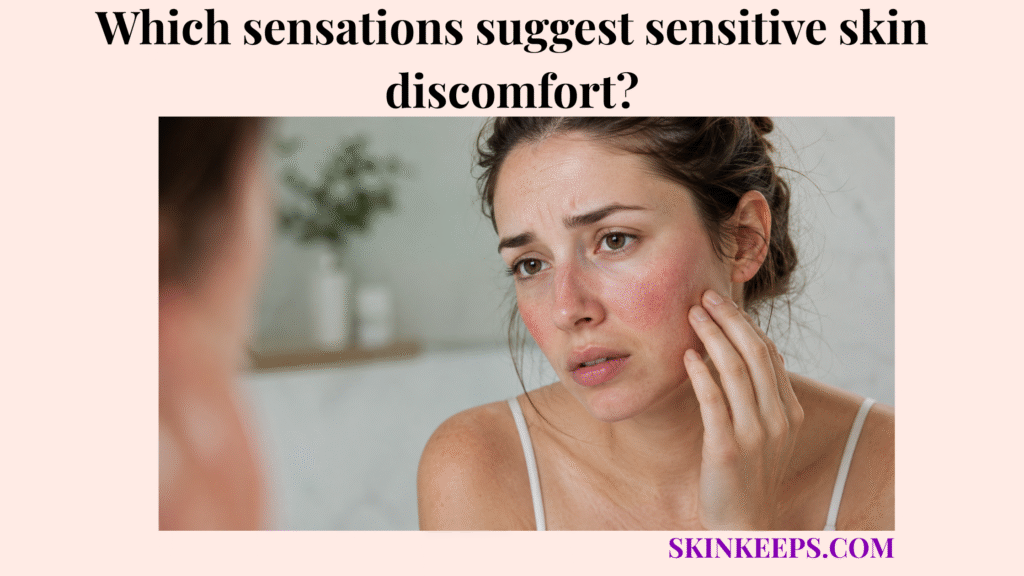
Sensitive skin discomfort is commonly suggested by stinging, burning, itching, tightness, prickling, heat, tenderness, soreness, tingling, or a raw feeling after skincare products, cleansing, weather exposure, shaving, sweat, friction, or temperature changes.
Sensitive skin does not always show obvious redness, bumps, or rash; sometimes the strongest clue is how quickly the skin feels uncomfortable after a trigger. This article explains invisible discomfort, stinging and burning, itching and tightness, prickling, heat, tenderness, trigger patterns, sensitive-vs-dry discomfort, condition confusion, calming direction, mistakes, tracking, warning signs, and final takeaways.
Why Can Sensitive Skin Feel Uncomfortable Even When It Looks Normal?
Sensitive skin can feel uncomfortable even when it looks normal because sensory reactivity can appear before visible irritation becomes obvious. Sensory discomfort should be understood inside the broader pattern of sensitive skin, where the skin may react quickly after products, weather, shaving, sweat, or friction.
Visible signs can be mild, delayed, subtle, or absent. The key clue is not whether the face looks dramatic; it is whether the same sensation keeps returning after the same kind of trigger.
How Sensitive Skin Can React Before Visible Irritation Appears
Sensitive skin can react before visible irritation appears because the outer layer may feel stinging, burning, itching, tightness, or heat before redness, bumps, swelling, or peeling is easy to see. Stinging and burning often begin with barrier behavior, especially when sensitive skin has a compromised barrier that tolerates contact stress poorly.
Product exposure, cleansing, weather, sweat, shaving, and friction can all create sensation-first reactions. The sensation should be treated as information, not ignored because the skin looks calm.
Why Sensation Can Be a Stronger Clue Than Appearance
Sensation can be a stronger clue than appearance when discomfort repeats after the same trigger even though the skin looks only mildly changed. Some visible reactions are delayed, subtle, or harder to see clearly.
Discomfort can exist even before visible change, but it may later overlap with visible sensitive-skin reactions such as redness, bumps, swelling, peeling, or rash-like texture. Sensation is still only a clue, not a diagnosis.
| Sensation | What It May Suggest |
|---|---|
| Stinging | Barrier sensitivity or product irritation. |
| Burning | Stronger irritation or inflammatory response. |
| Itching | Dryness, irritation, allergy tendency, or barrier stress. |
| Tightness | Moisture-barrier discomfort or over-cleansing. |
| Prickling | Nerve-like sensitivity after a trigger. |
| Heat | Flushing tendency or irritation response. |
| Tenderness | Raw, over-treated, or inflamed skin. |
| Raw feeling | Compromised barrier or overuse of actives. |
Which Stinging or Burning Sensations Suggest Sensitive Skin?
Stinging or burning sensations suggest sensitive skin when they appear quickly after products, cleansing, active ingredients, weather exposure, sweat, shaving, or friction. Mild brief stinging is different from repeated stinging or strong burning.
Burning is the more serious signal because it can suggest stronger irritation, barrier compromise, or inflammation. It should not be pushed through when it repeats, worsens, or appears with swelling, rash, oozing, crusting, blisters, or severe pain.
Why Stinging After Products Can Suggest Skin Reactivity
Stinging after products can suggest skin reactivity when the sensation repeats with cleansers, moisturizers, sunscreen, makeup, fragrance, acids, or retinoids. Repeated stinging from basic products is a stronger clue than one brief sting from one active product.
The product may not suit the barrier at that time. This does not diagnose allergy or dermatitis, but it does mean the repeated trigger should not be ignored.
Why Burning Is More Concerning Than Mild Tightness
Burning is more concerning than mild tightness because it can signal stronger irritation, barrier compromise, or inflammation rather than simple dryness. Heat and burning sensations need careful context because sensitive skin frequently shows redness or flushing after certain triggers.
Burning with swelling, rash, oozing, crusting, blisters, or severe pain is outside ordinary temporary discomfort. That pattern deserves evaluation rather than stronger products.
| Sensation Pattern | Possible Meaning |
|---|---|
| Brief mild sting from one product | Product may be too active or poorly tolerated. |
| Repeated stinging from basic products | Barrier may be highly reactive. |
| Burning after cleanser | Cleanser may be too harsh or skin may be irritated. |
| Burning after moisturizer | Barrier may be compromised or formula may not suit skin. |
| Burning with swelling or rash | More than ordinary sensitivity. |
Can Itching and Tightness Suggest Sensitive Skin Discomfort?
Itching and tightness can suggest sensitive skin discomfort when they appear quickly after triggers such as cleansing, fragrance, hot water, weather, sweat, shaving, or friction. The key clue is the trigger pattern, not the sensation alone.
Tightness after washing can reflect over-cleansing or barrier discomfort. Itching can overlap with dryness, irritation, product reaction, or allergy tendency, so repeated itch should be read with trigger timing and visible signs.
Itching and Tightness Clues
What Do Prickling, Heat, or Tenderness Mean in Sensitive Skin?
Prickling, heat, or tenderness can suggest sensitive skin when they repeatedly appear after actives, temperature shifts, sweat, friction, shaving, sun, wind, or over-treatment. These sensations are clues, not diagnoses.
Soreness and tingling also matter when they follow a repeatable trigger. The question is not whether one sensation proves sensitive skin; the question is whether the same exposure keeps producing the same discomfort pattern.
| Sensation | What to Watch For |
|---|---|
| Prickling | Often appears after actives, temperature shifts, or irritation. |
| Heat | May appear with flushing, sun, exercise, or reactive inflammation. |
| Tenderness | Can suggest raw or over-treated skin. |
| Soreness | May follow friction, shaving, scrubbing, or barrier damage. |
| Tingling | Can be mild, but repeated tingling may signal poor tolerance. |
Which Triggers Commonly Cause Sensitive Skin Discomfort?
Triggers that commonly cause sensitive skin discomfort include harsh cleansers, fragrance, strong acids, retinoids, hot water, cold wind, sweat, shaving, friction, sunscreen, makeup, and poorly tolerated formulas. Trigger repetition matters because external triggers can worsen sensitive skin reactions in recognizable sensation patterns.
Repeated trigger-sensation pairing matters more than one isolated uncomfortable day. A cleanser that repeatedly burns, a moisturizer that repeatedly stings, or hot water that repeatedly creates tightness should be treated as a pattern.
| Trigger | Common Sensation |
|---|---|
| Harsh cleanser | Tightness, stinging, burning. |
| Fragrance | Itching, stinging, rash-like discomfort. |
| Strong acids | Tingling, burning, peeling discomfort. |
| Retinoids | Dryness, burning, tenderness. |
| Hot water | Tightness, heat, burning. |
| Cold wind | Stinging, tightness, raw feeling. |
| Sweat | Itching, prickling, burning. |
| Shaving | Stinging, soreness, tenderness. |
| Friction | Rawness, heat, irritation. |
| Sunscreen or makeup | Stinging, itching, tightness if poorly tolerated. |
How Is Sensitive Skin Discomfort Different From Dry Skin Discomfort?
Sensitive skin discomfort differs from dry skin discomfort because sensitive discomfort is usually more trigger-linked, stingy, burning, prickling, or reactive, while dry skin discomfort is often more moisture-loss focused. Dry skin and sensitive skin can overlap, but the dominant clue differs.
Dry discomfort often centers on roughness, flaking, cracking, or moisture loss. Sensitive discomfort often centers on contact timing, product tolerance, stinging, burning, heat, or prickling after exposures.
| Feature | Sensitive Skin Discomfort | Dry Skin Discomfort |
|---|---|---|
| Main clue | Reacts quickly to triggers. | Feels tight, rough, or flaky from moisture loss. |
| Common sensations | Stinging, burning, prickling, heat, itching. | Tightness, roughness, itching, cracking discomfort. |
| Trigger pattern | Products, fragrance, heat, cold, friction, actives. | Weather, hot water, soaps, low humidity. |
| Visible signs | May be absent or mild. | Often rough, flaky, cracked, or dull. |
| Main first step | Identify and remove trigger. | Moisturize and reduce moisture loss. |
How Is Sensitive Skin Discomfort Different From Rosacea, Allergy, or Dermatitis?
Sensitive skin discomfort differs from rosacea, allergy, or dermatitis when the discomfort is mild, trigger-linked, and improves after removing the trigger, but persistent flushing, rash, swelling, oozing, crusting, or blisters suggest more than ordinary sensitivity. Every condition reference here is a boundary check, not a diagnosis.
Burning with repeated central-face flushing, itching with rash after a product, stinging from many basic products, swelling, oozing, crusting, blisters, and repeated same-area discomfort should be taken seriously. These patterns deserve evaluation when they persist or worsen.
| Pattern | Possible Concern |
|---|---|
| Burning with repeated central-face flushing | Rosacea-like pattern. |
| Itching with rash after a product | Contact dermatitis or allergy concern. |
| Stinging from many basic products | Strong barrier reactivity. |
| Burning with swelling | Stronger inflammatory reaction. |
| Discomfort with oozing, crusting, or blisters | Not ordinary sensitivity. |
| Repeated same-area discomfort | Needs closer evaluation. |
Can Sensitive Skin Discomfort Happen Without Redness?
Sensitive skin discomfort can happen without redness because stinging, burning, itching, heat, or tightness may appear before visible irritation or without obvious surface change. Lack of visible redness does not automatically mean the skin is fine.
Trigger-linked sensory discomfort is still useful information. Temperature-linked sensations matter when sensitive skin reacts visibly to temperature changes such as heat, hot water, cold wind, or sweat.
How Should Sensitive Skin Discomfort Be Calmed?
Sensitive skin discomfort should be calmed by stopping the likely trigger, simplifying care, avoiding heat and friction, and supporting the barrier with gentle fragrance-free basics. This is a first-step direction, not a full routine or product-buying guide.
A discomfort pattern should become calmer when the trigger load is reduced. If the skin keeps burning, swelling, or reacting to basic products, the issue has moved beyond simple routine adjustment.
Calming Direction
What Mistakes Make Sensitive Skin Discomfort Worse?
Mistakes make sensitive skin discomfort worse when they force the barrier through burning, add stronger actives, increase friction, or hide the real trigger behind too many product changes. The correction is not more intensity; it is better pattern control.
Pushing through burning is the worst assumption in this topic. Treating every reaction as purging can also miss irritation, allergy-like patterns, or dermatitis-like patterns.
| Mistake | Why It Backfires |
|---|---|
| Pushing through burning | Can worsen barrier irritation. |
| Adding more actives | Makes sensitivity harder to calm. |
| Scrubbing uncomfortable skin | Adds friction and inflammation. |
| Switching many products at once | Makes the trigger impossible to identify. |
| Ignoring fragrance reactions | Allows repeated irritation. |
| Treating all discomfort as “purging” | May miss irritation or dermatitis. |
| Using hot water for relief | Often increases burning and tightness. |
How Should Someone Track Sensitive Skin Discomfort?
Someone should track sensitive skin discomfort by recording the sensation type, trigger, timing, location, visible signs, duration, repeat pattern, and products that calmed or worsened the reaction. Tracking is pattern recognition, not diagnosis.
Photos help only if visible signs appear. For sensation-first reactions, written notes may be more useful because stinging, burning, tightness, or heat may fade before the skin visibly changes.
Discomfort Tracking Checklist
When Does Sensitive Skin Discomfort Need Professional Evaluation?
Sensitive skin discomfort needs professional evaluation when burning or pain is severe, symptoms persist after stopping triggers, or discomfort appears with swelling, blisters, oozing, crusting, bleeding, spreading rash, eye irritation, or sleep-disrupting itching. These signs deserve evaluation instead of repeated product switching.
Professional review becomes important when sensitive skin needs a dermatologist instead of repeated product guessing. The purpose is not to self-diagnose; it is to avoid ignoring symptoms that behave beyond ordinary temporary sensitivity.
Professional Evaluation Warning Signs
What Should You Remember About Sensitive Skin Discomfort?
Sensitive skin discomfort is usually most meaningful when stinging, burning, itching, tightness, heat, tenderness, prickling, or rawness repeats after clear triggers. The trigger pattern matters more than one isolated uncomfortable moment.
Final Takeaways
- Sensitive skin discomfort is usually felt as stinging, burning, itching, tightness, heat, tenderness, prickling, or rawness.
- Sensitive skin can feel uncomfortable even when it looks normal.
- Trigger pattern is the most important clue.
- Burning is more concerning than mild tightness.
- Discomfort after many basic products suggests strong barrier reactivity.
- Severe, persistent, swollen, blistering, oozing, or painful reactions need professional evaluation.
Frequently Asked Questions
Can Sensitive Skin Sting Without Looking Red?
Sensitive skin can sting without looking red because sensory discomfort may appear before visible irritation or without obvious surface change. Trigger-linked stinging still matters, especially after products, cleansing, weather, sweat, shaving, or friction, but it does not diagnose a condition by itself.
Is Burning Normal for Sensitive Skin?
Burning is not something to push through because it can suggest stronger irritation, barrier compromise, or inflammation. Brief mild tingling from one product differs from repeated or severe burning. Stop the trigger and seek evaluation if burning is severe or persistent.
Why Does Moisturizer Sting Sensitive Skin?
Moisturizer may sting sensitive skin when the barrier is compromised, the formula does not suit the skin, or the product contains ingredients the skin poorly tolerates. Repeated stinging from basic products suggests the barrier needs calmer support rather than more product guessing.
Can Sensitive Skin Feel Tight but Not Dry?
Sensitive skin can feel tight without being classically dry when cleansing, hot water, actives, weather, or friction leaves the barrier uncomfortable. Tightness is a barrier-comfort signal, not proof of dry skin type, especially when it follows repeat triggers.
When Should Sensitive Skin Discomfort Be Checked?
Sensitive skin discomfort should be checked when burning or pain is severe, symptoms persist, or discomfort appears with swelling, blisters, oozing, crusting, bleeding, eye irritation, spreading rash, or sleep-disrupting itch. Evaluation helps separate sensitivity from other possible conditions.
Conclusion
Sensitive skin discomfort is suggested by repeated stinging, burning, itching, tightness, prickling, heat, tenderness, soreness, tingling, or rawness after clear triggers. Products, cleansing, fragrance, hot water, cold wind, sweat, shaving, friction, sunscreen, makeup, and temperature changes can all create sensory discomfort even when visible signs are subtle.
Sensations are clues, not diagnoses. If discomfort is severe, persistent, swollen, blistering, oozing, crusted, bleeding, eye-associated, spreading, sleep-disrupting, or repeatedly triggered by many basic products, professional evaluation is safer than repeated product guessing.