
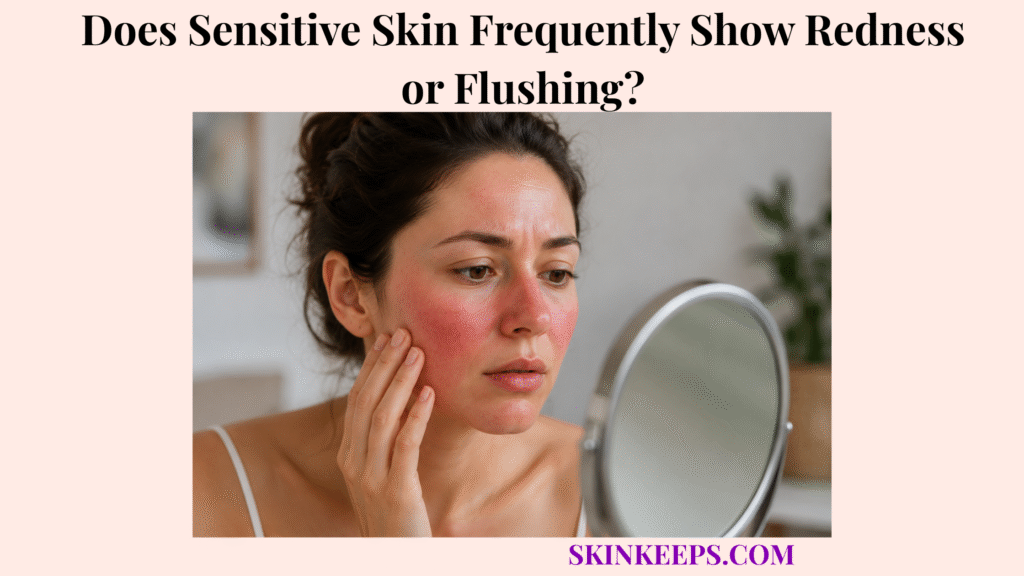
Yes, sensitive skin can frequently show redness or flushing, especially after exposure to skincare products, fragrance, heat, sun, wind, shaving, exercise, spicy foods, stress, temperature changes, or friction.
This happens because sensitive skin may react more easily to triggers with visible color change, warmth, irritation, stinging, burning, or patchy redness. This article explains why redness and flushing happen, how they differ, which triggers and locations matter, how they can look across skin tones, how to separate them from rosacea, dermatitis, or allergy patterns, how to calm the skin, when to get evaluation, and how to track repeated reactions.
Why Does Sensitive Skin Frequently Show Redness or Flushing?
Sensitive skin frequently shows redness or flushing because a reactive skin barrier can respond quickly to products, heat, wind, sun, shaving, fragrance, strong actives, or friction. Redness and flushing should be understood inside the broader pattern of sensitive skin, where contact, temperature, weather, and rubbing can trigger faster visible reactivity.
Redness usually describes visible irritation or color change, while flushing often describes sudden warmth and color change after a trigger. DermNet notes that sensitive skin may show redness or irritation after cosmetics or skincare products, including products previously tolerated. DermNet
How a Reactive Skin Barrier Makes Redness Easier to Trigger
A reactive skin barrier makes redness easier to trigger because the outer skin layer has lower tolerance for irritants, temperature shifts, friction, or active ingredients. Redness often begins with barrier behavior, especially when sensitive skin has a compromised barrier that reacts quickly to contact or environmental stress.
Products, fragrance, strong actives, harsh cleansers, shaving, and wind can irritate a reactive surface more easily than a calmer barrier. That does not mean barrier weakness is the only possible cause of redness, and it does not prove allergy, dermatitis, or rosacea by itself.
Why Flushing Can Appear Quickly After Heat, Products, or Friction
Flushing can appear quickly after heat, products, or friction because sensitive skin may react with sudden warmth and visible color change. Heat, sun, exercise, spicy foods, stress, and temperature shifts can create a rapid flushing pattern that feels hot before the color is fully visible.
Flushing patterns are easier to interpret when sensitive skin reacts visibly to temperature changes such as heat, sun, exercise, or cold wind. Frequent or persistent flushing, especially on the central face, should be treated as an overlap clue rather than dismissed as ordinary sensitivity.
| Visible Reaction | What It May Suggest |
|---|---|
| Temporary redness | Short-lived irritation or trigger response. |
| Flushing | Blood-flow response to heat, stress, products, or environment. |
| Patchy redness | Uneven irritation pattern. |
| Redness with stinging | Barrier sensitivity or product irritation. |
| Redness with swelling | Stronger irritation or allergic-type response. |
| Recurrent flushing | Possible sensitive skin, rosacea pattern, or trigger sensitivity. |
How Are Redness and Flushing Different in Sensitive Skin?
Redness and flushing are different because redness often describes an irritated patch or area, while flushing usually describes sudden warmth and color change after a trigger. Both can happen in sensitive skin, but they do not carry the same meaning.
Redness may last after product irritation, dryness, rubbing, shaving, or wind exposure. Flushing often appears more quickly after heat, sun, exercise, spicy foods, stress, or temperature shifts and may feel warm or hot while it is happening.
| Feature | Redness | Flushing |
|---|---|---|
| Main appearance | Pink, red, darker, or irritated patch. | Sudden warmth and color change. |
| Timing | Can last after irritation. | Often appears quickly after a trigger. |
| Common trigger | Products, friction, dryness, irritation. | Heat, sun, exercise, spicy foods, stress. |
| Sensation | May sting, itch, burn, or feel sore. | May feel warm or hot. |
| Concern level | Higher if persistent or rash-like. | Higher if frequent or central-face recurring. |
Which Triggers Commonly Cause Redness or Flushing in Sensitive Skin?
Triggers that commonly cause redness or flushing in sensitive skin include fragrance, strong skincare actives, harsh cleansers, heat, sun exposure, wind, cold, shaving, friction, exercise, spicy foods, and stress. Trigger repetition matters because external triggers can worsen sensitive skin reactions in recognizable patterns.
One isolated red episode may only show temporary irritation, but repeated redness after the same product, weather exposure, or rubbing pattern is more useful. Redness after a product should not be ignored if it becomes stronger each time or starts appearing with swelling, itching, burning, bumps, or peeling.
| Trigger | Common Reaction Pattern |
|---|---|
| Fragrance | Redness, stinging, or rash-like irritation. |
| Strong skincare actives | Redness, peeling, burning, or flushing. |
| Harsh cleansers | Tight redness or dry irritation. |
| Heat | Quick flushing or warmth. |
| Sun exposure | Redness, irritation, or flare-like response. |
| Wind or cold | Redness, stinging, or rough patches. |
| Shaving | Local redness, bumps, or irritation. |
| Friction | Red patches where skin is rubbed. |
Where Does Sensitive-Skin Redness or Flushing Usually Appear?
Sensitive-skin redness or flushing usually appears on areas that are exposed, product-covered, thin-skinned, frequently rubbed, shaved, or affected by heat and wind. Cheeks, nose, chin, around the mouth, forehead, neck, eyelids, product-applied areas, and weather-exposed areas can all show visible reactivity.
Location helps interpretation, but it cannot diagnose the cause alone. Central-face recurrence matters because repeated flushing on the cheeks, nose, chin, or forehead can overlap with rosacea patterns, especially when the redness persists or returns often.
Common Areas List
How Can Redness or Flushing Look Different Across Skin Tones?
Redness or flushing can look different across skin tones because inflammation is not always bright red on every complexion. In skin of colour, inflammatory changes may appear brown, brown-red, grey, purple, blue, black, or through texture and contour changes rather than obvious redness. PMC
On lighter skin, sensitive redness may look pink, red, flushed, or visibly inflamed. On medium or deeper skin tones, warmth, swelling, bumps, peeling, roughness, stinging, darker patches, grayish irritation, purple-brown change, or an ashy surface may be clearer clues than bright red color.
| Skin Tone Context | Redness or Flushing May Look Like |
|---|---|
| Lighter skin | Pink, red, flushed, or visibly inflamed. |
| Medium skin | Red-brown, warm-toned, dusky, or uneven. |
| Deeper skin | Purple-brown, grayish, darker, or ashy irritation. |
| Any skin tone | Warmth, swelling, bumps, peeling, roughness, or stinging may be clearer than color alone. |
How Is Sensitive-Skin Redness Different From Rosacea?
Sensitive-skin redness differs from rosacea when it is mainly trigger-linked to products, friction, dryness, fragrance, or weather and fades after trigger removal, while rosacea-like flushing often recurs or persists on the central face. Mayo Clinic describes typical rosacea changes on white skin as red cheeks, nose, and central face, with possible bumps, while rosacea on brown or Black skin can show brown discoloration. Mayo Clinic
Rosacea diagnosis should not be made from flushing alone. The American Academy of Dermatology explains that dermatologists diagnose rosacea by examining the skin and eyes and asking questions because signs can come and go. AAD
| Feature | Sensitive-Skin Redness | Possible Rosacea Pattern |
|---|---|---|
| Trigger | Product, weather, friction, dryness, fragrance. | Heat, sun, alcohol, spicy foods, stress, temperature shifts. |
| Duration | May fade after trigger removal. | Often recurs or persists. |
| Location | Can happen anywhere products or friction affect skin. | Often central face: cheeks, nose, chin, forehead. |
| Associated signs | Stinging, burning, rash-like irritation. | Flushing, persistent redness, bumps, visible vessels. |
| Next step | Remove trigger and calm barrier. | Dermatology evaluation if frequent or persistent. |
How Is Sensitive-Skin Redness Different From Dermatitis or Allergy?
Sensitive-skin redness differs from dermatitis or allergy when it is mild, trigger-linked, and improves after stopping the irritant, while stronger itch, swelling, oozing, crusting, blistering, or spreading suggests more than ordinary sensitivity. Mayo Clinic lists contact dermatitis signs such as itchy rash, darker leathery patches on brown or Black skin, bumps, blisters, oozing, crusting, swelling, burning, or tenderness. Mayo Clinic
Irritant responses can happen when a product directly bothers the skin, while allergic-type patterns may involve stronger itch, swelling, rash-like spread, or worsening with repeated exposure. Texture clues matter when redness appears with peeling, bumps, or swelling because sensitive skin texture can become rough, bumpy, peeling, or swollen-looking after irritation.
| Pattern | Possible Meaning |
|---|---|
| Redness after one irritating product | Sensitive reaction or irritant response. |
| Redness with strong itch | Dermatitis or allergic-type reaction possible. |
| Redness with swelling | Stronger reaction needing caution. |
| Redness with oozing or crusting | Not ordinary sensitivity. |
| Redness that spreads quickly | Needs professional evaluation. |
| Redness that repeats with the same product | Trigger should be stopped and assessed. |
How Should Redness or Flushing in Sensitive Skin Be Calmed?
Redness or flushing in sensitive skin should be calmed by stopping the likely trigger, simplifying care, avoiding heat and friction, and supporting the barrier with gentle, fragrance-free basics. The goal is not to build a full routine here; the goal is to stop the repeated irritation loop.
During active redness, strong scrubs, strong acids, and retinoids can increase irritation risk for reactive skin. A simple cleanser, a basic moisturizer, protection from sun, wind, heat, and friction, and slow product reintroduction are safer starting points than adding more active products.
Calming Direction
When Does Redness or Flushing Need Professional Evaluation?
Redness or flushing needs professional evaluation when it is frequent without a clear trigger, persistent, central-face recurring, spreading, painful, swollen, blistered, oozing, crusted, eye-associated, or triggered by many basic products. Professional review becomes important when sensitive skin needs a dermatologist instead of repeated product guessing.
Evaluation is useful when redness does not behave like a simple temporary trigger response. Dermatitis can involve swelling and irritation, and may cause itchy, dry, blistered, oozing, crusted, or flaky skin, so worsening rash-like redness should not be treated as simple sensitivity. Mayo Clinic
Redness Referral Checklist
How Should Someone Track Sensitive-Skin Redness or Flushing?
Someone should track sensitive-skin redness or flushing by recording the trigger, product used, timing, location, sensation, duration, visible changes, photos, and whether the same trigger caused redness before. Tracking helps identify repeatable patterns before the redness fades.
Photos can help when redness is short-lived, subtle, or harder to see on deeper skin tones. Tracking is useful evidence for pattern recognition, but it is not a diagnosis and should not replace evaluation when warning signs appear.
Redness Tracking Checklist
What Should You Remember About Sensitive Skin Redness and Flushing?
Sensitive skin can frequently show redness or flushing, but the pattern, trigger, location, duration, skin tone, and associated symptoms decide how concerning it is. Frequent or persistent flushing should not automatically be dismissed as normal sensitivity.
Final Takeaways
- Sensitive skin can frequently show redness or flushing.
- Redness often follows product exposure, weather, friction, shaving, or irritation.
- Flushing often appears quickly after heat, sun, exercise, stress, spicy foods, or temperature change.
- On deeper skin tones, redness may look darker, grayish, purple-brown, or ashy rather than bright red.
- Frequent or persistent flushing should not automatically be dismissed as normal sensitivity.
- Swelling, blistering, oozing, severe pain, spreading rash, or repeated central-face flushing needs professional evaluation.
Frequently Asked Questions
Does Sensitive Skin Always Turn Red?
Sensitive skin does not always turn red because some reactions are felt as burning, stinging, itching, warmth, or tightness without obvious visible redness. On deeper skin tones, irritation may appear darker, grayish, ashy, swollen, bumpy, peeling, or textured rather than bright red.
Is Flushing the Same as Sensitive Skin?
Flushing is not the same as sensitive skin, but sensitive skin can flush after triggers such as heat, sun, exercise, spicy foods, stress, or temperature shifts. Frequent, persistent, or central-face recurring flushing should be evaluated because rosacea and other conditions can overlap.
Why Does My Face Get Red After Skincare Products?
A face can get red after skincare products when the barrier reacts to fragrance, strong actives, harsh cleansers, exfoliants, retinoids, or ingredients the skin does not tolerate. If the same product repeatedly makes redness worse, stopping and assessing that trigger is safer than continuing.
How Can I Tell Sensitive Redness From Rosacea?
Sensitive redness is often linked to a product, friction, dryness, or weather trigger, while rosacea-like flushing often recurs on the central face and may persist or come with bumps, visible vessels, or eye irritation. The distinction is clinical, so frequent central-face flushing should be evaluated.
When Should Redness or Flushing Be Checked?
Redness or flushing should be checked when it persists, spreads, keeps recurring on the central face, reacts to many basic products, or appears with swelling, blistering, oozing, crusting, severe pain, severe itching, or eye irritation.
Conclusion
Sensitive skin can frequently show redness or flushing when common triggers make the skin react with visible color change, warmth, irritation, stinging, burning, or patchy redness. Products, fragrance, heat, sun, wind, shaving, exercise, spicy foods, stress, temperature shifts, and friction can all create recognizable redness or flushing patterns.
Redness and flushing are clues, not diagnoses. If flushing is persistent, central-face recurring, swollen, blistered, oozing, crusted, eye-associated, spreading, painful, or triggered by many basic products, professional evaluation is safer than repeated product guessing.