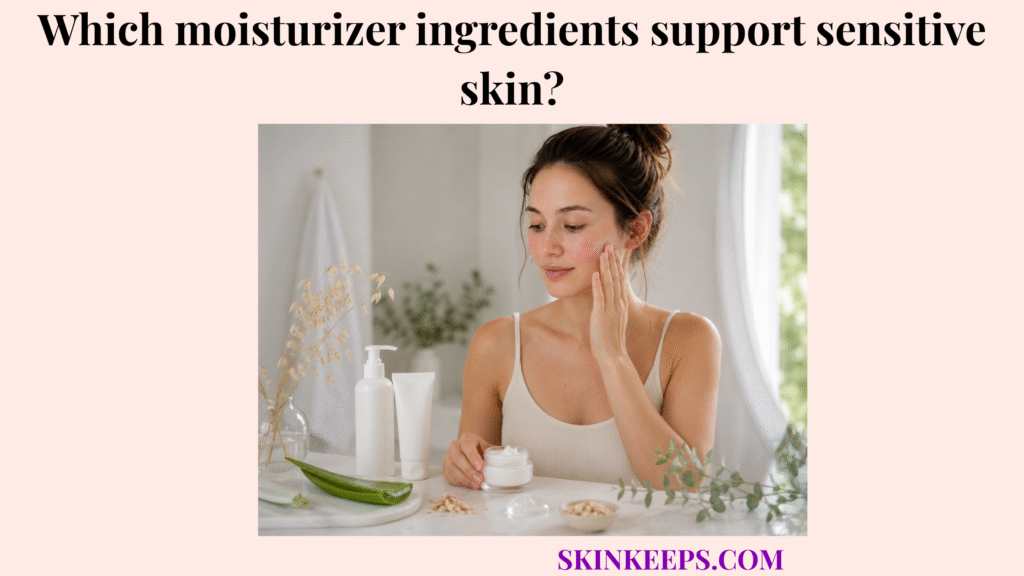
Moisturizer ingredients that support sensitive skin include humectants such as glycerin and hyaluronic acid, emollients such as squalane and fatty alcohols, occlusives such as petrolatum and dimethicone, barrier-supporting lipids such as ceramides, cholesterol, and fatty acids, and soothing ingredients such as panthenol, allantoin, colloidal oatmeal, and madecassoside. These categories support hydration, softening, water-loss reduction, barrier comfort, and comfort support, but one ingredient alone does not define the best moisturizer.
This article explains moisturizer ingredient categories, humectants, emollients, occlusives, barrier lipids, soothing ingredients, niacinamide nuance, fatty alcohol confusion, formula cautions, testing, tracking, and when professional evaluation is needed.
What Should Moisturizer Ingredients Do for Sensitive Skin?
Moisturizer ingredients for sensitive skin should hydrate, soften, reduce water loss, support barrier comfort, and lower unnecessary irritation risk. Moisturizer selection belongs within the broader care tips that help calm and protect sensitive skin because barrier comfort depends on both formula choice and gentle daily behavior.
Why Does Sensitive Skin Need Hydration and Barrier Comfort?
Sensitive skin needs hydration and barrier comfort because dryness and barrier stress can make cleansing, weather, friction, and products feel more irritating.
Why Does One Ingredient Rarely Solve Sensitivity Alone?
One ingredient rarely solves sensitivity alone because moisturizer tolerance depends on the full formula, texture, concentration, and repeated skin response.
| Ingredient role | What it helps with |
|---|---|
| Humectants | Attract and hold water in the outer skin layers. |
| Emollients | Smooth roughness and soften dry-feeling texture. |
| Occlusives | Reduce water loss and protect the surface. |
| Barrier lipids | Support skin barrier comfort. |
| Soothing ingredients | Help reduce the feeling of discomfort. |
| Fragrance-free formula design | Reduces unnecessary irritation risk. |
| Simple formula structure | Makes tolerance easier to assess. |
Moisturizer Ingredient Roles for Sensitive Skin
This visual separates the main moisturizer roles and shows why full formula tolerance matters more than a single ingredient name.
Figure 1. Moisturizers support sensitive skin through ingredient roles, not through one miracle ingredient.
Which Humectants Help Sensitive Skin Stay Hydrated?
Humectants help sensitive skin stay hydrated by attracting water into the outer skin layers and reducing the feeling of dryness or tightness.
| Humectant | Why it may support sensitive skin |
|---|---|
| Glycerin | Provides reliable hydration support and is common in sensitive-skin moisturizers. |
| Hyaluronic acid | Helps hold water and improve a plumper skin feel. |
| Sodium PCA | Supports natural moisture balance in the outer skin layers. |
| Betaine | Provides hydration support and is often well tolerated. |
| Urea at low levels | Can support hydration, though higher levels may sting some sensitive skin. |
| Aloe components | May feel soothing for some people, but tolerance depends on the full formula. |
Important Note
Humectants often work best when paired with emollients or occlusives, especially in dry or harsh environments.
Which Emollients Support Sensitive-Skin Comfort?
Emollients support sensitive-skin comfort by smoothing rough areas, softening dry-feeling texture, and reducing surface discomfort.
| Emollient | Sensitive-skin benefit |
|---|---|
| Squalane | Gives lightweight softening support. |
| Caprylic/capric triglyceride | Supports a smooth and comfortable texture. |
| Shea butter | Provides richer softening support, though it may feel heavy for some skin. |
| Fatty alcohols | Help texture and comfort; they are not the same as drying alcohols. |
| Jojoba oil | Provides softening support, but tolerance varies. |
| Sunflower seed oil | May support dry-feeling skin when tolerated. |
Are Occlusives Useful for Sensitive Skin?
Yes, occlusives can be useful for sensitive skin because they reduce water loss and protect the skin surface when the barrier feels dry, tight, raw, or irritated.
| Category | Main job | Sensitive-skin example |
|---|---|---|
| Humectant | Pulls water into the outer skin. | Glycerin, hyaluronic acid |
| Emollient | Softens and smooths texture. | Squalane, fatty alcohols |
| Occlusive | Reduces water loss from the surface. | Petrolatum, dimethicone |
Common Occlusive Notes
- Petrolatum can reduce water loss from the skin surface.
- Dimethicone can support a smoother protective feel.
- Mineral oil may support dryness when tolerated.
- Lanolin can be useful for some people but may bother others.
- Waxes and richer balms may help dry areas but can feel heavy for some skin.
Which Barrier Lipids Support Sensitive Skin?
Barrier lipids can support sensitive skin by helping reinforce surface comfort when the skin feels dry, tight, flaky, or easily irritated. Barrier lipids matter because the sensitive skin barrier can feel less comfortable when dryness, cleansing, weather, or irritation disrupts surface support.
| Barrier-support ingredient | Why it matters |
|---|---|
| Ceramides | Help support barrier structure. |
| Cholesterol | Works with other skin lipids in barrier support. |
| Fatty acids | Help support surface comfort. |
| Linoleic-acid-rich oils | May support dry or barrier-stressed skin when tolerated. |
| Phospholipids | Can support formula comfort and barrier feel. |
| Niacinamide | May support barrier function, but can sting some sensitive skin depending on formula and strength. |
Key Rule
Barrier-support ingredients are helpful only when the full formula is tolerated.
Which Soothing Ingredients May Help Sensitive Skin Feel Calmer?
Soothing ingredients may help sensitive skin feel calmer when the skin is tight, itchy, reactive, or mildly uncomfortable.
| Soothing ingredient | Possible support role |
|---|---|
| Panthenol | Supports comfort and barrier-support feel. |
| Allantoin | Helps reduce rough or uncomfortable feel. |
| Colloidal oatmeal | Often used for itchy or dry-feeling sensitive skin. |
| Madecassoside | Provides calming-support in some formulas. |
| Bisabolol | May feel soothing for some skin, but tolerance varies. |
| Licorice root components | May support visible calmness in some formulas. |
Is Niacinamide Good for Sensitive Skin?
Niacinamide can support some sensitive skin, but it is not automatically comfortable for everyone. It may support barrier comfort and visible calmness, but some reactive skin may sting or flush, especially with higher-strength formulas or when the barrier is already irritated.
Niacinamide Tolerance Notes
- Low-strength formulas may be more comfortable.
- Skin may sting when the barrier is already irritated.
- Flushing may appear after application.
- The ingredient may be tolerated in one formula but not another.
- Irritation may increase when combined with several actives.
- Reducing frequency may improve comfort.
Are Fatty Alcohols Bad for Sensitive Skin?
No, fatty alcohols are not the same as drying alcohols and are often used to improve moisturizer texture, softness, and stability.
| Ingredient type | Common examples | Sensitive-skin meaning |
|---|---|---|
| Drying alcohols | Alcohol denat., ethanol, SD alcohol | May sting or dry some sensitive skin in higher amounts. |
| Fatty alcohols | Cetyl alcohol, cetearyl alcohol, stearyl alcohol | Often used as emollients or texture-supporting ingredients. |
Which Ingredients Should Sensitive Skin Treat Cautiously in Moisturizers?
Sensitive skin should treat some moisturizer formula features cautiously, especially when reactions are frequent or repeatable patterns are already clear. Formula caution should focus on repeated reactions to irritating skincare ingredients, not fear of every unfamiliar ingredient name.
| Formula feature | Why caution may help |
|---|---|
| Added fragrance | It is a common optional irritation trigger. |
| Essential oils | Natural scent compounds can still irritate. |
| Many botanical extracts | They can make trigger identification harder. |
| Strong exfoliating acids | They may sting or peel reactive skin. |
| High drying alcohol content | It may increase tightness or burning in some formulas. |
| Retinoids in moisturizer | They may irritate if the barrier is not ready. |
| Heavy occlusive texture | It may feel uncomfortable or cause bumps for some people. |
| Cooling ingredients | Menthol-like sensations may irritate reactive skin. |
Which Moisturizer Ingredients Match Different Sensitive-Skin Symptoms?
Moisturizer ingredients should match the main sensitive-skin symptom, such as tightness, flaking, roughness, wind-chapping, or product intolerance. If stinging starts after washing, the reader may need to review both moisturizer support and cleanser type for sensitive skin.
| Sensitive-skin concern | Ingredient category that may help |
|---|---|
| Tightness | Humectants plus emollients |
| Flaking | Emollients, occlusives, barrier lipids |
| Stinging after cleansing | Barrier-supporting formula with simple ingredients |
| Rough texture | Emollients and humectants |
| Wind-chapped skin | Occlusives and richer emollients |
| Itchy dry-feeling skin | Humectants, colloidal oatmeal, panthenol |
| Product intolerance | Simple, fragrance-free formula with fewer variables |
| Oily but tight skin | Lightweight humectants and non-heavy emollients |
How Should Moisturizer Ingredients Differ for Dry-Sensitive, Oily-Sensitive, or Acne-Prone Sensitive Skin?
Moisturizer ingredients should differ by skin pattern because sensitive skin can also be dry, oily, combination, acne-prone, flaky, redness-prone, or mature.
| Skin pattern | Moisturizer ingredient direction |
|---|---|
| Dry-sensitive skin | Humectants, emollients, occlusives, and barrier lipids |
| Oily-sensitive skin | Lightweight humectants, gel-cream textures, and non-heavy emollients |
| Combination-sensitive skin | Balanced hydration without overly heavy layering |
| Acne-prone sensitive skin | Lightweight barrier support without unnecessary fragrance or heavy buildup |
| Flaky sensitive skin | Moisture support first, not harsh exfoliation |
| Redness-prone sensitive skin | Simple, soothing, fragrance-free formulas |
| Mature sensitive skin | Barrier lipids, emollients, and moisture-supporting ingredients |
Does a Moisturizer Need Many Active Ingredients to Support Sensitive Skin?
No, a moisturizer does not need many active ingredients to support sensitive skin. The main job of a moisturizer is hydration, softening, water-loss reduction, and barrier comfort.
| Less helpful thinking | Better thinking |
|---|---|
| More actives means better moisturizer. | Better tolerance means better support. |
| A moisturizer should fix every concern. | It should first support comfort. |
| Sensitive skin label guarantees safety. | Actual skin response matters. |
| Natural extracts are always calming. | Some botanicals can irritate. |
| Thick texture is always better. | Texture should match skin pattern. |
How Can Someone Choose a Moisturizer Ingredient Profile Without Overcomplicating It?
Someone can choose a moisturizer ingredient profile without overcomplicating it by looking for hydration, softening, water-loss reduction, and barrier support that matches the skin’s current needs.
Moisturizer Ingredient Profile Checklist
- Look for hydration support.
- Look for softening support.
- Consider occlusive support if skin is dry or chapped.
- Consider ceramides or barrier lipids for barrier stress.
- Prefer fragrance-free if fragrance triggers symptoms.
- Avoid strong actives during active irritation.
- Choose texture based on skin pattern.
- Keep the formula simple when the skin is reactive.
- Judge by comfort after repeated use, not one label claim.
- Stop if swelling, rash, burning, or persistent itching appears.
How Should Sensitive Skin Test a New Moisturizer?
Sensitive skin should test a new moisturizer slowly, while the skin is relatively calm and the rest of the routine stays stable. Readers may patch test new products where appropriate before applying a new moisturizer broadly, especially if past formulas caused strong reactions.
New Moisturizer Testing Guide
- Test when the skin is relatively calm.
- Introduce one moisturizer at a time.
- Keep cleanser and other routine steps stable.
- Apply to a limited area first if reactions are common.
- Watch for stinging, burning, itching, bumps, rash, or swelling.
- Check whether comfort improves or worsens after several uses.
- Avoid testing several barrier-repair products together.
- Stop if the reaction is strong, persistent, or spreading.
Moisturizer Tolerance Decision Loop
This visual shows how sensitive skin can assess a moisturizer by role, texture, fragrance status, application response, and repeated tolerance.
Figure 2. A moisturizer supports sensitive skin only when the complete formula remains comfortable over repeated use.
What Signs Show a Moisturizer Ingredient Mix Is Not Suitable?
A moisturizer ingredient mix is not suitable when it repeatedly causes burning, itching, rash-like changes, bumps, swelling, or worsening discomfort.
Moisturizer Mismatch Signs
- Moisturizer burns repeatedly.
- Itching appears after each use.
- Skin swells, develops rash, or becomes hot.
- Tiny bumps appear where the moisturizer is applied.
- Skin feels heavy, greasy, or trapped.
- Stinging worsens instead of calming.
- Tightness does not improve.
- Eye-area irritation appears.
- Symptoms stop when the moisturizer is removed.
- Similar formulas cause similar reactions.
What Mistakes Make Moisturizer Ingredient Choices Less Helpful?
Moisturizer ingredient choices become less helpful when people choose by trend, add too many formulas at once, or ignore repeated burning.
| Mistake | Why it backfires |
|---|---|
| Buying many barrier-repair products at once | Creates trigger confusion. |
| Choosing by trend ingredient only | Ignores full formula tolerance. |
| Assuming natural means safer | Some plant extracts irritate sensitive skin. |
| Avoiding fatty alcohols automatically | Confuses them with drying alcohols. |
| Using active moisturizers during a flare | May worsen stinging or peeling. |
| Choosing very heavy textures for oily-sensitive skin | May cause discomfort or bumps. |
| Ignoring repeated burning | Allows irritation to continue. |
| Removing moisturizer despite tightness | May leave the barrier unsupported. |
How Should Moisturizer Ingredient Tolerance Be Tracked?
Moisturizer ingredient tolerance should be tracked by recording the formula type, ingredient categories, application area, use frequency, and skin response over time.
Moisturizer Ingredient Tracking Worksheet
- Moisturizer name and texture.
- Main ingredient categories: humectant, emollient, occlusive, barrier lipid, soothing ingredient.
- Fragrance-free, scented, active, or botanical-heavy status.
- Application area.
- Frequency of use.
- Other products used before or after it.
- Immediate sensation after application.
- Skin feel after several hours.
- Symptoms: stinging, burning, itching, tightness, bumps, rash, swelling, peeling.
- Whether comfort improved with repeated use.
- Whether symptoms returned with similar formulas.
- Photos of visible reactions if needed.
When Should Moisturizer-Related Sensitivity Be Professionally Evaluated?
Moisturizer-related sensitivity should be professionally evaluated when reactions are severe, persistent, spreading, swollen, blistering, painful, recurring, or continue after stopping the suspected product. Severe, spreading, swollen, blistering, painful, or recurring moisturizer reactions are reasons to see a dermatologist.
Professional Evaluation Warning Signs
- Moisturizers repeatedly burn or sting strongly.
- Water or basic products cause discomfort.
- Rash spreads or repeatedly returns.
- Skin swells, blisters, oozes, crusts, or bleeds.
- Eye or eyelid reactions occur.
- Itching disrupts sleep.
- Skin becomes cracked, raw, or infected-looking.
- Several simple moisturizers cause similar reactions.
- Symptoms continue after stopping the suspected moisturizer.
- Eczema, dermatitis, allergy, rosacea, infection, or another condition may be involved.
Urgent Safety Note
Breathing difficulty, throat tightness, faintness, or rapid facial, lip, or tongue swelling requires emergency medical care.
What Should You Remember About Moisturizer Ingredients for Sensitive Skin?
Sensitive skin is often supported by moisturizer ingredients that hydrate, soften, reduce water loss, and support barrier comfort.
What Should You Remember?
- Helpful moisturizer categories include humectants, emollients, occlusives, barrier lipids, and soothing ingredients.
- Glycerin and hyaluronic acid support hydration.
- Squalane, fatty alcohols, and similar emollients support softness and comfort.
- Petrolatum and dimethicone help reduce water loss from the surface.
- Ceramides, cholesterol, and fatty acids support barrier comfort.
- Panthenol, allantoin, and colloidal oatmeal may support comfort in some formulas.
- Niacinamide can help some sensitive skin but can sting some reactive skin.
- Fatty alcohols are not the same as drying alcohols.
- The full formula matters more than one ingredient name.
- Fragrance, essential oils, strong actives, and overly complex formulas may irritate some sensitive skin.
- Severe or recurring moisturizer reactions need professional evaluation.
Frequently Asked Questions
What Moisturizer Ingredients Are Best for Sensitive Skin?
Moisturizer ingredients that often support sensitive skin include humectants such as glycerin and hyaluronic acid, emollients such as squalane and fatty alcohols, occlusives such as petrolatum and dimethicone, barrier lipids such as ceramides, and soothing ingredients such as panthenol, allantoin, and colloidal oatmeal.
Is Hyaluronic Acid Good for Sensitive Skin?
Hyaluronic acid can be good for sensitive skin when the full formula is tolerated. It helps hold water in the outer skin layers, but it may work best when paired with softening or sealing ingredients in dry environments.
Are Ceramides Helpful for Sensitive Skin?
Ceramides can be helpful for sensitive skin because they support the outer skin barrier. They are especially relevant when skin feels dry, tight, flaky, or easily irritated.
Is Petrolatum Safe for Sensitive Skin?
Petrolatum is a common occlusive ingredient that helps reduce water loss from the skin surface. Many sensitive-skin users tolerate it, but the texture may feel heavy for some people.
Can Niacinamide Irritate Sensitive Skin?
Yes, niacinamide can irritate some sensitive skin, especially in stronger formulas, during barrier irritation, or when combined with several active products. It should be judged by actual skin response.
Should Sensitive Skin Avoid Fragrance in Moisturizer?
Sensitive skin should be cautious with added fragrance, especially if scented products repeatedly cause stinging, itching, burning, or rash-like reactions. Fragrance-free formulas are often better starting points for reactive skin.
Conclusion
Sensitive skin is best supported by moisturizer ingredients that hydrate, soften, reduce water loss, and strengthen barrier comfort without adding unnecessary irritation risk. Humectants support hydration, emollients support softness, occlusives reduce water loss, barrier lipids support barrier comfort, and soothing ingredients may support comfort.
The full formula matters more than one ingredient name. Sensitive skin should avoid repeated triggers, new moisturizers should be tested carefully, and severe or recurring reactions need professional evaluation. The strongest moisturizer choice for sensitive skin is a formula that supports comfort, matches the skin pattern, avoids repeated triggers, and makes the skin feel calmer rather than more reactive.
Sources & Evidence
DermNet — Emollients and Moisturisers
Supports moisturizer types, emollient roles, and dry-skin comfort support.
[DermNet]DermNet — Barrier Cream
Supports occlusive and humectant ingredient roles including petrolatum, dimethicone, glycerin, urea, and hyaluronic acid.
[DermNet]American Academy of Dermatology — Sensitive Skin Care Guidance
Supports fragrance-free product selection and gentle moisturizer use for dry or sensitive skin.
[AAD]FDA — Skin Protectant Drug Products
Supports OTC skin protectant categories such as colloidal oatmeal, dimethicone, mineral oil, petrolatum, and related ingredients.
[FDA]Purnamawati et al., 2017 — The Role of Moisturizers in Addressing Various Kinds of Dermatitis
Supports humectant, emollient, and occlusive moisturizer roles in dry and dermatitis-prone skin.
[PMC]Lodén, 2016 — Role of Topical Emollients and Moisturizers in Skin Barrier Function
Supports moisturizer composition and the role of barrier-supportive ingredients in skin comfort.
[PubMed]DermNet — Fragrance Allergy
Supports caution around fragrance in products when repeated reaction patterns occur.
[DermNet]DermNet — Irritant Contact Dermatitis
Supports professional boundaries for repeated burning, stinging, and irritant reactions.
[DermNet]Disclaimer: This article provides general educational information and does not diagnose or treat irritant contact dermatitis, allergic contact dermatitis, eczema, rosacea, acne, infection, or another skin condition. Stop using clearly irritating moisturizers and seek professional advice for severe, persistent, recurrent, spreading, blistering, swollen, oozing, bleeding, painful, or eye-area reactions. Breathing difficulty, throat tightness, faintness, or rapid facial, lip, or tongue swelling requires urgent medical care.