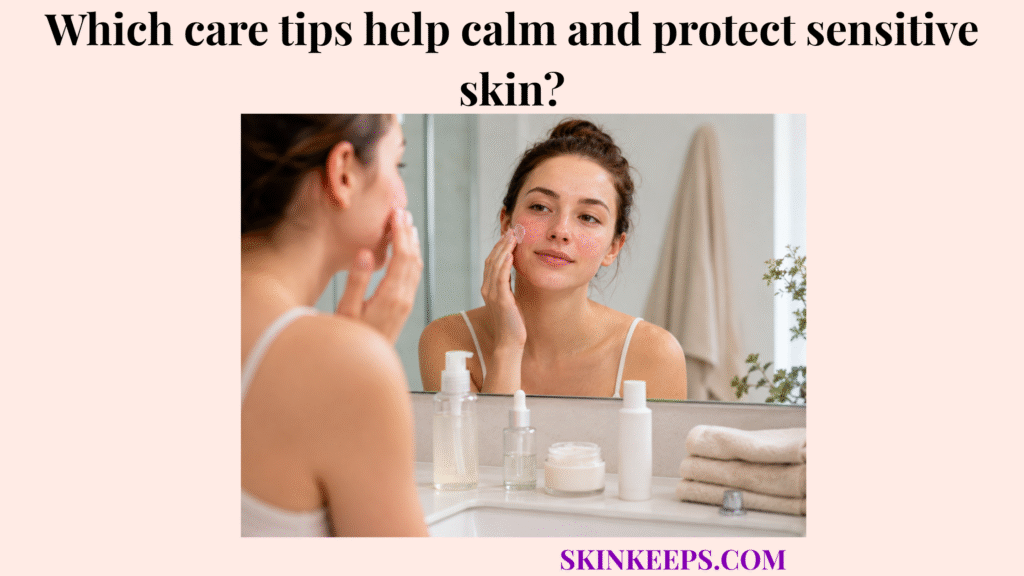
Care tips that help calm and protect sensitive skin include simplifying the routine during irritation, cleansing gently, avoiding hot water and scrubbing, using a tolerated moisturizer, protecting against sun and weather, and introducing new products slowly. The goal is to reduce irritation and protect the skin rather than add many calming products at once.
This article explains what sensitive-skin care is trying to do, how to calm skin during irritation, which cleansing and moisturizing habits help, how to reduce sun, weather, sweat, and friction triggers, how to test products carefully, how to track improvement, and when professional care is needed.
What Is the Main Goal of Sensitive-Skin Care?
The main goal of sensitive-skin care is to reduce irritation, support comfort, and prevent repeated triggers without overwhelming the skin with unnecessary products.
Why Does Calming Irritation Come Before Adding More Products?
Calming irritation comes before adding more products because extra formulas can create more variables when the skin is already reactive.
Why Does Protection Help Prevent Repeat Reactions?
Protection helps prevent repeat reactions by reducing exposure to known triggers such as sun, wind, heat, sweat, friction, and harsh products.
| Care goal | Practical tip |
|---|---|
| Calm discomfort | Pause irritating steps and keep care simple. |
| Reduce barrier stress | Avoid hot water, scrubs, and harsh cleansing. |
| Support comfort | Use a tolerated moisturizer. |
| Prevent repeat reactions | Track and avoid known triggers. |
| Protect exposed skin | Use sun, wind, heat, and friction protection. |
| Reduce product confusion | Introduce one product at a time. |
| Avoid worsening flares | Do not push through burning, swelling, or rash. |
Calm-and-Protect Care Logic
This visual shows that sensitive-skin care works best when irritation is reduced, comfort is supported, and repeat triggers are prevented without adding too many new variables.
Figure 1. Sensitive-skin care is most useful when it reduces avoidable irritation while preserving needed support.
How Should Sensitive Skin Be Calmed During Irritation?
Sensitive skin should be calmed during irritation by stopping the most likely trigger, pausing optional irritating steps, and keeping care simple. During a sensitive skin flare-up, the safest first step is often to reduce new variables rather than add several soothing products at once.
Calming During Irritation Checklist
- Stop the newest suspected trigger.
- Pause exfoliants, retinoids, strong actives, and scrubs.
- Avoid hot water.
- Cleanse only if needed.
- Use a gentle, fragrance-free cleanser if cleansing is necessary.
- Do not rub, pick, scratch, or scrub.
- Apply a simple tolerated moisturizer if the skin feels tight or dry.
- Avoid adding several soothing products at once.
- Protect irritated skin from sun, wind, sweat, and friction.
- Watch for swelling, oozing, blistering, or worsening pain.
Why Does Simplifying the Routine Help Calm Sensitive Skin?
Simplifying the routine helps calm sensitive skin because fewer products reduce ingredient exposure, rubbing, active overlap, and trigger confusion. This may be temporary or strategic; it does not mean the shortest routine is always best.
When Simplification May Help
- Skin burns after the full routine.
- Moisturizer suddenly stings.
- Products that usually work feel uncomfortable.
- Peeling or rawness appears.
- Several new products were recently added.
- Skin improves when optional steps are paused.
Which Cleansing Tips Help Protect Sensitive Skin?
Cleansing tips that protect sensitive skin include using lukewarm water, avoiding scrubbing, keeping cleanser contact brief, and cleansing only when needed. Reducing harsh cleansing habits can help protect sensitive skin from extra tightness, stinging, and friction-related discomfort.
Gentle Cleansing Tips
- Use lukewarm water.
- Avoid washing until the skin feels squeaky.
- Keep cleanser contact brief.
- Use fingertips instead of brushes or rough cloths.
- Avoid scrubbing flakes or rough patches.
- Pat dry with a soft towel.
- Cleanse only as needed for sweat, sunscreen, makeup, or residue.
- Stop cleansers that repeatedly sting, burn, itch, or tighten the skin.
How Can Moisturizer Help Calm and Protect Sensitive Skin?
A tolerated moisturizer can help calm and protect sensitive skin by reducing tightness, dryness, roughness, and barrier discomfort. Choosing moisturizer ingredients that support sensitive skin can help when dryness, tightness, or roughness makes the skin feel more reactive.
| Skin feeling | Why moisturizer may help |
|---|---|
| Tightness | Supports surface comfort. |
| Roughness | Helps soften dry-feeling texture. |
| Stinging after cleansing | May indicate barrier stress. |
| Flaking | Helps reduce dryness-related discomfort. |
| Raw feeling | Supports comfort when tolerated. |
| Weather-related dryness | Helps protect against moisture loss. |
Important Rule
If a moisturizer repeatedly burns, stings strongly, causes swelling, or triggers rash-like irritation, it should not be treated as automatically safe just because it is marketed for sensitive skin.
Which Product Habits Help Protect Sensitive Skin?
Product habits that protect sensitive skin include introducing one product at a time, avoiding new products during flares, and judging formulas by actual tolerance.
Protective Product Habits
- Introduce one new product at a time.
- Avoid testing new products during a flare.
- Start strong actives slowly if they are needed.
- Avoid layering several active products together.
- Choose fragrance-free options when fragrance triggers reactions.
- Keep ingredient lists from products that caused reactions.
- Stop products that repeatedly cause burning, itching, swelling, or rash.
- Judge products by actual tolerance, not marketing claims.
How Can Sensitive Skin Be Protected From Sun Exposure?
Sensitive skin can be protected from sun exposure by reducing unnecessary direct sun, using shade and protective clothing, and choosing sunscreen the skin can tolerate. Some readers may prefer mineral sunscreen for sensitive skin, but the best option is the sunscreen the skin can tolerate and use consistently.
Sun Protection Tips
- Limit unnecessary direct sun exposure.
- Use shade when possible.
- Wear protective clothing, hats, and sunglasses.
- Use sunscreen that the skin tolerates.
- Avoid harsh exfoliation before heavy sun exposure.
- Cleanse sunscreen gently at the end of the day.
- Watch for products that sting more after sun exposure.
How Can Sensitive Skin Be Protected From Wind, Cold, Heat, and Sweat?
Sensitive skin can be protected from wind, cold, heat, and sweat by reducing repeated exposure and responding gently instead of scrubbing or over-cleansing.
| Trigger | Protection tip |
|---|---|
| Wind | Protect exposed areas and avoid harsh cleansing afterward. |
| Cold air | Moisturize before dryness becomes severe. |
| Heat | Reduce overheating and watch for flushing or burning. |
| Sweat | Rinse gently instead of scrubbing. |
| Low humidity | Support barrier comfort and avoid over-cleansing. |
| Sudden temperature shifts | Keep routine stable and reduce strong actives during flares. |
| Pollution | Cleanse gently without abrasive scrubbing. |
How Can Friction Be Reduced for Sensitive Skin?
Friction can be reduced for sensitive skin by avoiding repeated rubbing from towels, fabrics, masks, shaving, makeup removal, and product application.
Friction-Reduction Tips
- Use soft fabrics when possible.
- Avoid rough towels and harsh wiping.
- Remove irritating tags or seams.
- Avoid tight clothing over irritated areas.
- Change out of sweat-soaked clothing promptly.
- Apply products gently without aggressive rubbing.
- Avoid picking flakes or squeezing irritation bumps.
- Use gentle makeup removal instead of scrubbing.
Which Ingredients or Formula Features Should Sensitive Skin Treat Cautiously?
Sensitive skin should treat certain formula features cautiously when reactions are frequent, but caution should not become a fear-based ingredient blacklist.
| Formula feature | Why caution may help |
|---|---|
| Added fragrance | It can be an optional irritation trigger. |
| Essential oils | Natural scent compounds can still irritate. |
| Strong exfoliating acids | They may cause burning, peeling, or tightness. |
| Retinoids | They can be useful but may irritate if introduced too quickly. |
| Harsh cleansers | They can strip barrier comfort. |
| Alcohol-heavy formulas | They may increase dryness or stinging in some formulas. |
| Many actives in one product | They can raise irritation load. |
| Many botanical extracts | They can make trigger identification harder. |
What Should Sensitive Skin Avoid During an Active Flare?
During an active flare, sensitive skin should avoid scrubs, strong actives, hot water, new product testing, and avoidable friction.
Active-Flare Avoid List
- Scrubs and cleansing brushes.
- Strong exfoliating acids.
- Retinoids if they are worsening irritation.
- Fragranced leave-on products.
- Hot water.
- Harsh cleansers.
- New product testing.
- Picking, scratching, or rubbing.
- Heavy layering of multiple calming products.
- Sun, wind, sweat, and friction exposure when avoidable.
How Can Sensitive Skin Test New Products More Safely?
Sensitive skin can test new products more safely by introducing one product at a time only when the skin is calm. Readers may patch test new products where appropriate before applying a new formula broadly.
Product-Testing Safety Guide
- Test only when the skin is calm.
- Introduce one product at a time.
- Keep the rest of the routine unchanged.
- Start slowly with strong or active products.
- Watch for immediate and delayed reactions.
- Do not test new products on raw, burning, or peeling skin.
- Stop if burning, swelling, rash, or persistent itching appears.
- Do not deliberately retest a product that caused a severe reaction.
Sensitive-Skin Product Change Safety Loop
This visual shows the safer sequence: calm skin first, test one product, keep the routine stable, and stop if warning symptoms return.
Figure 2. Product testing is safer and clearer when the skin is calm and only one new formula changes.
How Can Someone Know Whether Care Tips Are Actually Helping?
Care tips may be helping when stinging, burning, tightness, itching, rawness, and unpredictable reactions gradually become less frequent.
Care Improvement Signs
- Less stinging after cleansing.
- Less burning after products.
- Tightness becomes less frequent.
- Moisturizer feels comfortable again.
- Itching decreases.
- Skin feels less raw or reactive.
- Flares become easier to explain.
- Products are easier to tolerate.
- Redness, darker irritation, bumps, or flaking calm gradually.
- Reactions become less frequent after trigger reduction.
What Mistakes Prevent Sensitive Skin From Calming?
Common mistakes that prevent sensitive skin from calming include adding too many products, pushing through burning, scrubbing flakes, and changing the whole routine repeatedly.
| Mistake | Why it backfires |
|---|---|
| Adding many calming products at once | Creates more variables and possible triggers. |
| Pushing through burning | Can worsen irritation. |
| Scrubbing flakes | Adds friction to a stressed barrier. |
| Using hot water for comfort | Often increases tightness and burning. |
| Changing the whole routine repeatedly | Makes triggers hard to identify. |
| Treating every bump as acne | May over-irritate reaction bumps. |
| Ignoring fragrance reactions | Allows repeated exposure. |
| Avoiding professional help when symptoms are severe | May delay diagnosis or treatment. |
How Should Sensitive-Skin Care Be Tracked?
Sensitive-skin care should be tracked by recording symptoms, products, cleansing habits, environmental exposure, and changes after calming steps.
Sensitive-Skin Care Tracking Worksheet
- Current routine steps.
- Products stopped during irritation.
- Products kept during irritation.
- Main symptoms before simplifying care.
- Symptoms after calming steps.
- Cleansing method and water temperature.
- Moisturizer tolerance.
- Sun, wind, heat, sweat, fabric, or friction exposure.
- New products introduced and start dates.
- Whether symptoms returned after reintroduction.
- What clearly helped or worsened the reaction.
- Photos of visible changes if needed.
When Should Sensitive Skin Need Professional Evaluation?
Sensitive skin needs professional evaluation when reactions are severe, persistent, spreading, swollen, blistering, painful, recurring, or continue despite gentle care. Severe, spreading, swollen, blistering, painful, or recurring reactions are reasons to see a dermatologist.
Professional Evaluation Warning Signs
- Skin reacts to water or a very minimal routine.
- Burning, pain, or itching is severe or persistent.
- Rash spreads or repeatedly returns.
- Skin swells, blisters, oozes, crusts, or bleeds.
- Eye or eyelid reactions occur.
- Skin becomes cracked, raw, or infected-looking.
- Symptoms disrupt sleep or daily comfort.
- Reactions continue despite gentle care.
- Several gentle products cause strong reactions.
- Eczema, dermatitis, allergy, rosacea, infection, or another condition may be involved.
Urgent Safety Note
Breathing difficulty, throat tightness, faintness, or rapid facial, lip, or tongue swelling requires emergency medical care.
What Should You Remember About Calming and Protecting Sensitive Skin?
Sensitive skin is usually calmed by reducing irritation, supporting comfort, and preventing repeat triggers.
What Should You Remember?
- Sensitive skin usually needs fewer irritating variables, not many new products.
- Gentle cleansing can reduce friction and tightness.
- Hot water, scrubbing, and harsh cleansers can worsen discomfort.
- A tolerated moisturizer can support comfort when skin feels dry, tight, or rough.
- Sun, wind, heat, sweat, and friction protection can prevent repeat irritation.
- Known triggers should be reduced when patterns are clear.
- New products should be introduced slowly and only when skin is calm.
- Product reactions should be tracked instead of guessed.
- Severe or recurring reactions need professional evaluation.
Frequently Asked Questions
What Is the Fastest Way to Calm Sensitive Skin?
The safest first step is often to stop the newest suspected trigger, pause optional irritating products, avoid scrubbing and hot water, and keep care simple while watching symptoms.
Should Sensitive Skin Use More Calming Products During Irritation?
Not usually. Adding several calming products at once can create more variables and new triggers. It is usually better to simplify first and keep only tolerated support steps.
Is Moisturizer Always Good for Sensitive Skin?
A tolerated moisturizer can help dryness, tightness, and roughness. However, a moisturizer that repeatedly burns, stings strongly, causes swelling, or causes rash-like irritation should not be treated as automatically safe.
Should Sensitive Skin Avoid All Active Ingredients?
No. Sensitive skin does not need to avoid every active ingredient. Strong actives should be introduced carefully, avoided during active irritation when they worsen symptoms, and stopped if persistent burning or peeling appears.
How Can Sensitive Skin Be Protected Outside?
Sensitive skin can be protected outside by using shade, protective clothing, tolerated sunscreen, wind protection, gentle sweat removal, and reduced friction from clothing or masks.
When Should Sensitive Skin Symptoms Be Checked by a Dermatologist?
Symptoms should be checked when they are severe, persistent, spreading, swollen, blistering, painful, recurring, affect the eyes, or continue despite gentle care.
Conclusion
Sensitive skin is best calmed and protected by reducing irritation, keeping care gentle, supporting comfort, and preventing repeat exposure to known triggers. Simplification helps during irritation, gentle cleansing reduces friction, moisturizer support can improve comfort when tolerated, and sun, weather, sweat, and friction protection can prevent repeat reactions.
More products are not always better. Product testing should be slow, tracking should guide decisions, and severe or recurring symptoms need professional evaluation. The strongest sensitive-skin care strategy is calm, simple, protective, and guided by the skin’s real tolerance patterns.
Sources & Evidence
DermNet — Sensitive Skin
Supports sensitive-skin symptoms, product intolerance, and trigger recognition.
[DermNet]DermNet — Irritant Contact Dermatitis
Supports friction, water, soaps, cosmetics, heat, and repeated exposure as irritant factors.
[DermNet]DermNet — Allergic Contact Dermatitis
Supports professional evaluation for delayed, recurrent, swollen, blistering, or unclear contact reactions.
[DermNet]American Academy of Dermatology — Sensitive Skin Care Guidance
Supports gentle care, avoiding irritating products, and seeking care for persistent reactions.
[AAD]American Academy of Dermatology — Face Washing Guidance
Supports lukewarm water, gentle cleansing, avoiding scrubbing, and gentle drying.
[AAD]American Academy of Dermatology — Sun Protection
Supports shade, protective clothing, and consistent sun protection behavior.
[AAD]American Academy of Dermatology — How to Test Skin-Care Products
Supports cautious testing and stopping products that cause significant reactions.
[AAD]Draelos, 2018 — The Science Behind Skin Care: Moisturizers
Supports moisturizer use for skin comfort and barrier-supportive care decisions.
[PubMed]Draelos, 2018 — The Science Behind Skin Care: Cleansers
Supports cleanser formulation differences and gentle cleansing decisions.
[PubMed]Disclaimer: This article provides general educational information and does not diagnose or treat irritant contact dermatitis, allergic contact dermatitis, eczema, rosacea, acne, infection, or another skin condition. Stop using clearly irritating products and seek professional advice for severe, persistent, recurrent, spreading, blistering, swollen, oozing, bleeding, painful, or eye-area reactions. Breathing difficulty, throat tightness, faintness, or rapid facial, lip, or tongue swelling requires urgent medical care.